Sell My Car Hub

How to fill out a Hawaii title

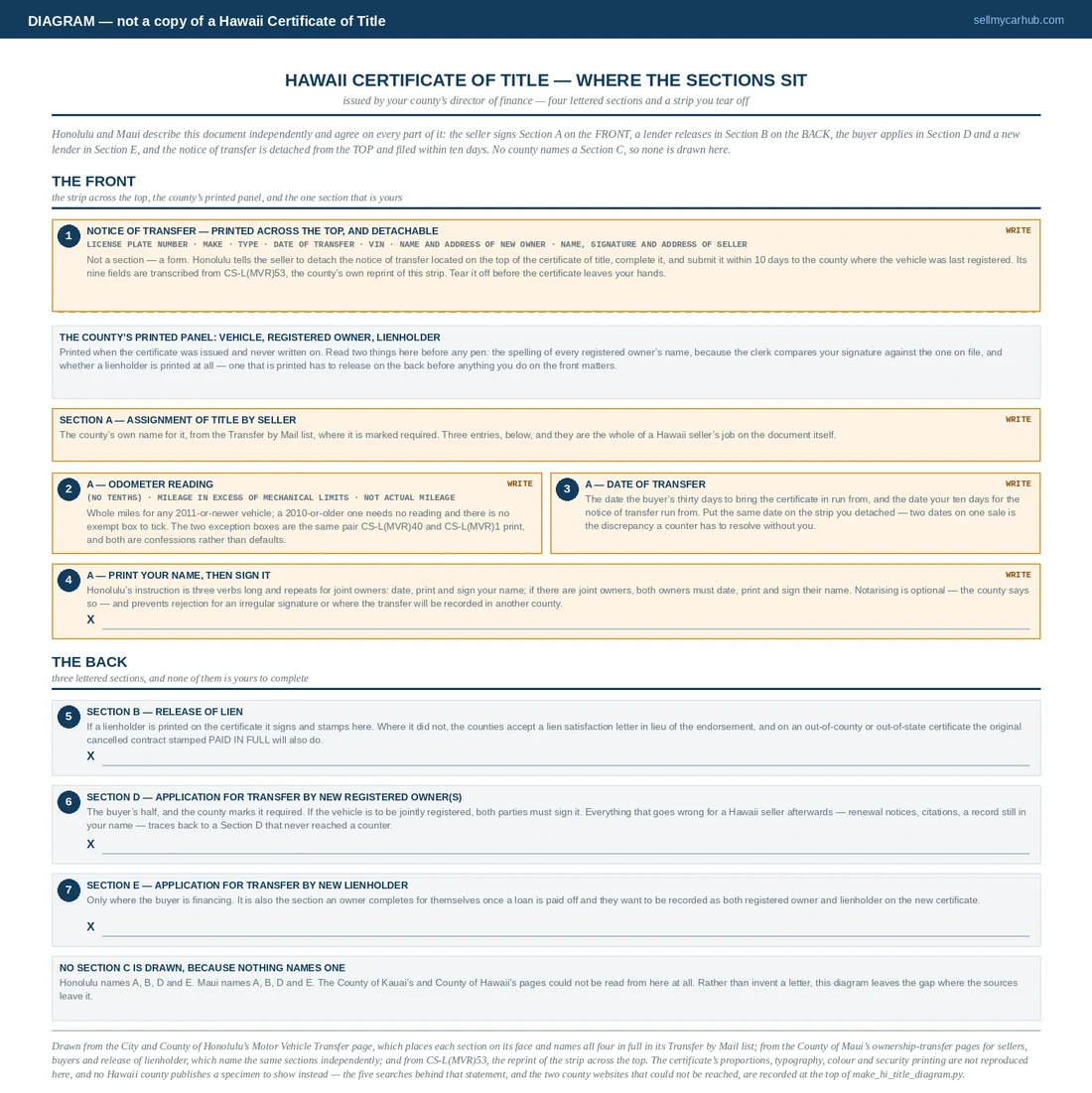
A Hawaii certificate of title is laid out in lettered sections and split across two faces, and the counties tell you which is which. Section A is on the front and it is yours. Sections B, D and E are on the back and belong to the lender and the buyer. Across the top sits a detachable notice of transfer that is not a section at all - it is the form you file. Here is the whole layout, block by block, in the order a sale meets it.

There is no blank Hawaii certificate to download, and no county publishes a picture of one. What you can download is the notice of transfer that is printed on it, which is why that form is shown filled in further down. Beside this paragraph is our printable checklist: the seven steps that are actually yours, from the safety check you should look at before agreeing a date to the strip you post ten days later.

A certificate that is defaced or mutilated is finished: the legal owners on record must apply for a duplicate before anyone can sign anything.

Honolulu and Maui describe the same document independently and agree on every section: the registered owners sign off in Section A on the front, a lienholder releases in Section B on the reverse, the new registered owners apply in Section D and a new lienholder in Section E, and the notice of transfer is detached from the top and mailed within ten days.

The layout, mapped

What each lettered section of a Hawaii certificate is for, and which face it is on

No Hawaii county publishes a specimen, sample or exhibit of its certificate of title anywhere that could be read for this page - not in a form, not in a manual, not on a page. So this is a diagram, drawn from the counties' own written instructions, and it says so across its top. Every block name below is transcribed from the Honolulu Motor Vehicle Transfer page, the Maui ownership-transfer pages, or the reprinted notice of transfer form, and each one carries the sentence it came from.

A labelled diagram of a Hawaii certificate of title, drawn rather than photographed and marked DIAGRAM across the top. The front carries a detachable notice of transfer strip along the top edge, an agency-printed vehicle and owner panel, and Section A, the assignment of title by seller, outlined in amber with an odometer reading, date, printed name and signature. The back is greyed and carries Section B, release of lien, Section D, application for transfer by new registered owners, and Section E, application for transfer by new lienholder.
A diagram, not a reproduction. The section letters and their names are the counties' own; the sheet they are drawn on is ours.
A real one, filled in

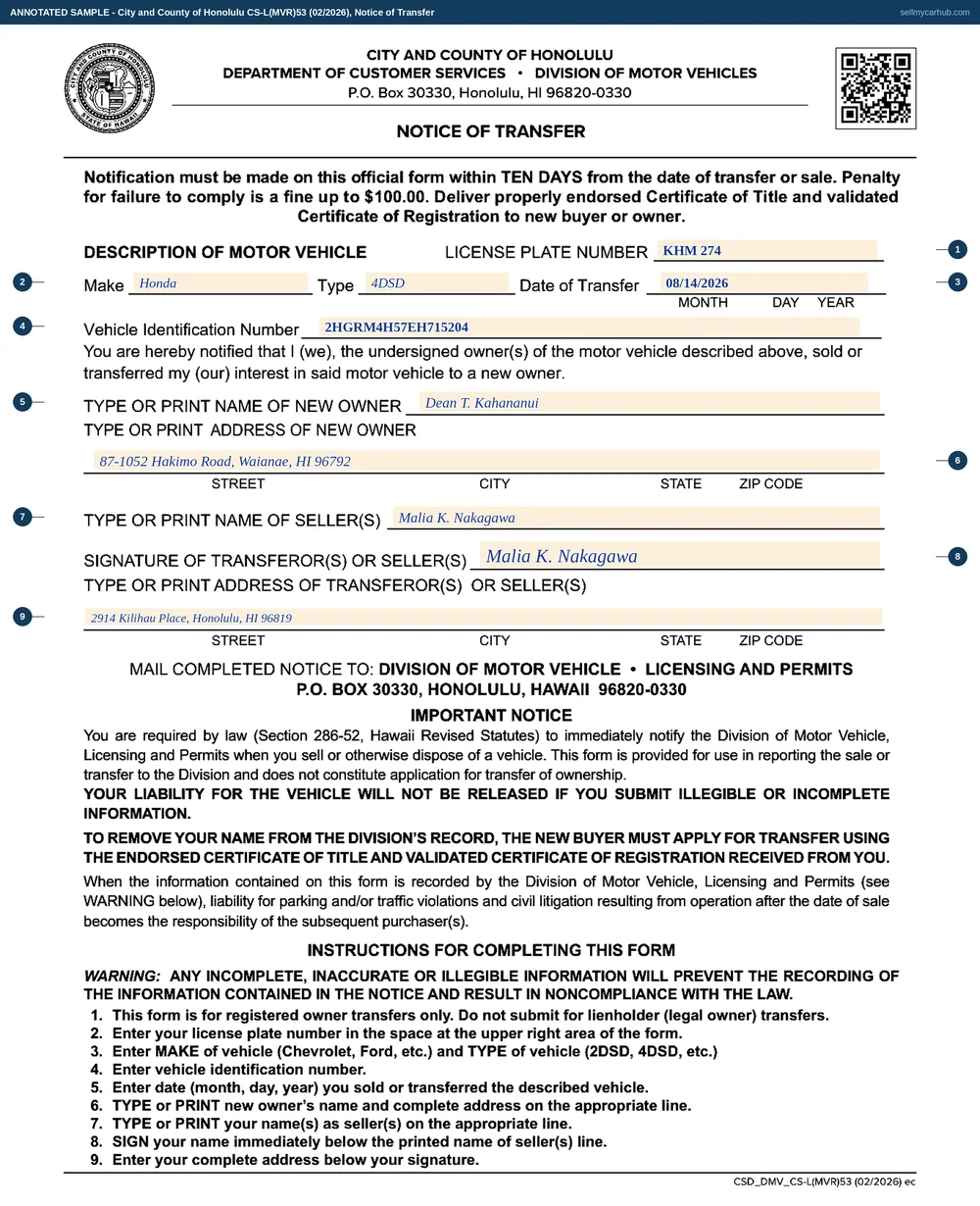
The notice of transfer, which is the top of the title reprinted as a form

The one part of a Hawaii certificate the county does publish is the strip across its head: when the original has already been torn off, Honolulu reissues it as CS-L(MVR)53, field for field. So this is the closest thing to a real Hawaii title block anyone can show you - the county's own reprint of it, completed.

The Honolulu Notice of Transfer form CS-L(MVR)53, filled in with a fictional seller's details: plate number, make, type, date of transfer, vehicle identification number, the new owner's name and address, and the seller's printed name, signature and address.
CS-L(MVR)53, rev 02/2026, filled in. The same nine boxes appear on the strip printed across the top of the certificate itself.

Seventy-six seconds from the department that runs Oahu's DMV, on what the seller does with the certificate. Its companion video for buyers is on the same county page. Nothing loads from YouTube until you press play.

Step by step

Every box, in the order you meet it

  1. 0
    You fill this in

    Before any pen: check the safety check and the registration

    This is the step that decides whether the rest of the page matters. The county will only complete a title transfer once the vehicle is current on both motor vehicle registration and safety inspection, so look at the emblem on the back of the car and the expiry on the registration certificate before you agree a date with anyone.

    Watch out: The safety check needs a valid Hawaii insurance identification card at the station, so cancelling your policy early can lock you out of the inspection you need to sell. Sort the inspection out first, then advertise.

  2. 1
    You fill this in

    Detach the notice of transfer from the top of the certificate

    The strip across the head of the sheet is a form, not decoration. Tear it off, and fill in the plate number, make, type, date of transfer, vehicle identification number, the new owner's name and address, and your own printed name, signature and address.

    Watch out: Do this before the buyer is standing in front of you. Hand over the certificate whole and your notice of transfer is now in their glovebox - which is recoverable, because each county publishes a replacement, but only if you notice.

  3. 2
    You fill this in

    Section A, front: the odometer reading

    Write the mileage in whole miles - every Hawaii form prints NO TENTHS beside the blank - for any vehicle of the 2011 model year or newer. A 2010-or-older vehicle needs no reading and there is no exempt box to tick.

    Watch out: Two tick boxes sit under the reading and both are confessions: one for mileage in excess of the odometer's mechanical limits, one for a reading that is not the actual mileage. Ticking neither is a positive statement that the number is true.

  4. 3
    You fill this in

    Section A, front: date it

    The date of transfer you write here is the date both clocks run from - your ten days for the notice, and the buyer's thirty days to bring the certificate to a satellite city hall.

    Watch out: Put the same date on the strip you detached. If the two disagree, the counter has to decide which one starts the buyer's penalty clock, and that conversation happens without you in the room.

  5. 4
    You fill this in

    Section A, front: print your name, then sign it

    Both, in that order, and both from every registered owner on the face of the certificate. The clerk compares the signature against the one already on file for the record.

    Watch out: If your signature has changed since the car was registered, or the transfer will be recorded in a different county from the one that issued the certificate, a notary is optional and cheap insurance - the county names those two situations itself.

  6. 5
    The lienholder fills this in

    Section B, back: the lender releases

    If a lienholder is printed on the certificate, it signs and stamps Section B. Nothing you do in Section A moves the car while an unreleased lien sits on the back of it.

    Watch out: A lender that has already sent the certificate to you may not want to re-endorse it. The counties accept a lien satisfaction letter in place of the Section B endorsement, so ask for one in writing rather than posting the title back and forth.

  7. 6
    The buyer fills this in

    Section D, back: the buyer applies

    The application for transfer by the new registered owner. If the vehicle is to be jointly registered, both of the new owners sign here.

    Watch out: Watch the buyer complete it. Everything that goes wrong for a Hawaii seller after this point - renewal notices, citations, a record still in your name - traces back to a buyer who never took Section D to a counter.

  8. 7
    The lienholder fills this in

    Section E, back: only if the buyer is financing

    The application for transfer by a new lienholder. It is also the box an owner fills in for themselves when a loan has been paid off and they want to appear as both registered owner and lienholder on the new certificate.

    Watch out: It is not your section and not your problem, but leaving it blank on a financed sale means the buyer's lender is not recorded - and the buyer will be back asking you to sign something. Let them complete their own half at the counter.

  9. 8
    You fill this in

    Hand over three documents, not one

    The endorsed certificate of title, the last-issued certificate of registration, and the current State of Hawaii safety inspection certificate. A company-owned vehicle adds a letter of authorization.

    Watch out: The registration certificate is the one people forget, because it normally lives in the car. Without it the buyer cannot complete the transfer, and you will be posting it to a stranger.

  10. 9
    You fill this in

    File the strip within ten days

    Send the notice of transfer to the county where the vehicle was LAST REGISTERED. On Oahu that is the Division of Motor Vehicle, Licensing and Permits at P.O. Box 30330, Honolulu; on Hawaii Island it is the Department of Finance VRL Division in Hilo.

    Watch out: The fine for not filing runs up to $100, but the real cost is slower: until the county records the notice, every citation the buyer collects lands on your record and your renewal notice keeps arriving.

Before the pen

Six rules for the pen, on a document that carries its own notice of sale

Six habits, and the first one has to happen before you write anything at all.

Tear the strip off first, before anything elseThe notice of transfer sits at the top of the certificate and it is yours. Detach it, fill it in and set it aside before you start on Section A, because the alternative is remembering to ask a stranger for the top of a document you have just given away.
Everything in ink, and typed if you canEvery Honolulu form in this set opens with the same line - type or print in ink, an improperly filled application will not be accepted - and the certificate is held to the same standard. A pencilled odometer reading is not a reading.
Both owners date, print AND signThe county spells out three actions and repeats them for joint owners: date, print and sign. A signature on its own, with no printed name beside it, is the commonest reason a Hawaii clerk hands a certificate back for signature comparison.
Do not correct the mileage in placeThere is a form for a wrong reading and it is one page long. Scratching out a figure or ticking a box you meant to leave alone turns a valid certificate into a defaced one, and a defaced certificate has to be replaced by the legal owners before the sale can move.
Write the date of transfer once and use it everywhereThe date you put in Section A is the date the buyer's thirty days run from and the date your ten days run from. Put the same date on the notice of transfer strip. Two different dates on two halves of the same sheet is a discrepancy the counter will ask about.
Keep a copy of the strip before you post itThe notice is a small piece of paper carrying the buyer's name, the date and the plate number, and once it goes to the county you have no record of what you told them. Photograph it. If a renewal notice or a citation turns up months later, that photograph and the county's email address are the whole of your defence.

The ink rule is the county DMV's own: “TYPE OR PRINT IN INK - IMPROPERLY FILLED APPLICATION WILL NOT BE ACCEPTED.” — Honolulu Department of Customer Services, Motor Vehicle Transfer.

Check your source

Four things Hawaii sellers get told that are not true

Four things Hawaii sellers pass to each other, three of which come from having sold a car on the mainland. The counties' own pages settle all four.

"Take your plates off before the buyer drives away."

That is the rule in Nevada and New Mexico and it is not the rule here. Honolulu's list of what a seller provides to the new owner is three documents and a letter of authorization for company cars - the endorsed certificate of title, the last-issued certificate of registration and the State of Hawaii safety inspection certificate. Plates are not on it, are not mentioned anywhere else on the page, and are not mentioned on Maui's seller page either. Ordinary plates stay with the vehicle. The two that do not are the ones with words on them: a personalised plate has to be transferred, stored or retired before the sale, and a veteran plate must be swapped for regular plates or the county will not record the change of ownership at all.

Honolulu Division of Motor Vehicles, the seller’s own instructions

"You have to get your signature notarised or the title is no good."

Honolulu writes the answer down: notarization of the seller's signature is optional. It then explains why people still do it - a notarised signature prevents rejection for an irregular signature when the clerk compares yours with the one on file, or when the transfer is recorded in another county, which on a four-county island chain happens more often than you would think. Where a notary genuinely is required is at the edges: a second buyer recording a double transfer needs a notarized bill of sale or a seller power of attorney, an out-of-county or out-of-state certificate the recorded owner never released needs a notarized bill of sale, and both of Honolulu's powers of attorney print a notary certification block.

Honolulu Division of Motor Vehicles, notarisation of the seller’s signature

"Just download the notice of transfer when you get round to it."

You can, and it is the second-best answer. Hawaii prints the notice of transfer on the certificate of title itself, as a strip across the top that the seller detaches - so the first-best answer is to tear it off before the certificate leaves your hands, because once the buyer has the whole sheet your own notice has gone with it. The standalone replacement exists precisely for people who did not: Honolulu's CS-L(MVR)53, the County of Hawaii's VRL-MVR504, Maui's own version. All of them carry the same instruction, which the Honolulu form prints in its first line - notification must be made on this official form within TEN DAYS from the date of transfer or sale, and the penalty for failure to comply is a fine up to $100.00.

Honolulu CS-L(MVR)53, Notice of Transfer

"Filing the notice of transfer gets my name off the car."

It does not, and the form says so in two places. It states that it does not constitute application for transfer of ownership, and then, in capitals: to remove your name from the division's record, the new buyer must apply for transfer using the endorsed certificate of title and validated certificate of registration received from you. What the notice does buy you is narrower and still worth having - once the county records it, liability for parking and traffic violations and for civil litigation arising from operation after the date of sale becomes the responsibility of the subsequent purchaser. It also warns that illegible or incomplete information will prevent the recording, and that your liability will not be released if you submit any.

Honolulu CS-L(MVR)53, Notice of Transfer
Who has to sign

Six signature rules, and the third is the one that trips up anyone whose car is registered on a different island from their letterbox:

Every registered owner named on the certificateIn Section A, on the front. Honolulu's instruction is three verbs long and repeats for joint owners: date, print and sign your name; if there are joint owners, both owners must date, print and sign their name.
The lienholder, in Section B on the backIf a lender is printed on the certificate it releases there. Where the lienholder did not complete Section B, the counties accept a lien satisfaction letter instead, and on an out-of-county or out-of-state certificate the original cancelled contract stamped PAID IN FULL will also do.
The seller again, on the strip across the topThe notice of transfer needs the seller's printed name, signature and address as well as the new owner's name and address, and it goes to the county where the vehicle was LAST REGISTERED - which is not necessarily the county you live in now.
The buyer, in Section D on the backThe application for transfer by the new registered owner. Both parties must sign it if the vehicle is to be jointly registered, and the buyer signs nothing on the front.
A new lender, in Section EOnly if the buyer is financing. It is also the section an owner completes for themselves when a loan is paid off and they want to be recorded as both registered owner and lienholder.
An attorney-in-fact, with a notary behind themHonolulu's seller power of attorney appoints someone to sign any application for original registration, certificate of title, duplicates or other certificates issued by the Director of Customer Services - and it makes the owner state the odometer reading on the form itself, so the agent signs the mileage disclosure exactly as the owner disclosed it.
A company, through a letter of authorizationA business-owned vehicle needs an LOA on file naming the individuals authorised to act. The county limits them by what the letter says: an authorization only to sell lets those individuals only release ownership or apply for a duplicate title.

Once it is signed

Signing Section A is the middle of a Hawaii sale, not the end of it. The strip across the top of the certificate still has to reach your county within ten days, and the buyer still has thirty to bring the sheet in.

The two things that follow a signed title — what happens to the plates and telling the county DMV the car is gone — are set out in full on the Hawaii paperwork page rather than repeated here.

The forms that go with it: the Notice of Transfer, the ten-day filing that is printed on the title, the Bill of Sale, for the price, the lien wording and a second odometer certification and the duplicate-title application, for a certificate that is lost or defaced.

Every field description here is taken from the Honolulu Department of Customer Services, Motor Vehicle Transfer and the City and County of Honolulu Division of Motor Vehicle, Licensing and Permits title pages, current as of 2026-08-23. Plain-language help with a form, not legal advice, and where our wording and the agency's differ, theirs governs.

Back to all Hawaii paperwork, or what selling a car in Hawaii involves.

Or let someone else do the paperwork

Get My Instant Offer → Online · about 2 minutes · free

Or send the details — we'll come to you

A safety check that lapsed, a title still with the credit union, a car parked on Maui while you live on Oahu - tell us what you are working with and we will tell you what it is worth as it stands.

or call/text (877) 405-1808