Hawaii does not put the price on the certificate of title, so an ordinary sale can be completed without ever writing down what the car sold for. This one-page bill of sale is where that number lives, and it does two other jobs the certificate cannot. It carries a warranty of clear ownership in the seller's own words - the said seller hereby warrants that he is the lawful owner of said vehicle, that it is free from all liens and encumbrances - with a line to name a lien if there is one. And it carries a second, standalone odometer certification, which is what makes it the document the county names when a buyer needs a notarized bill of sale for a double transfer or for a certificate the recorded owner never released.
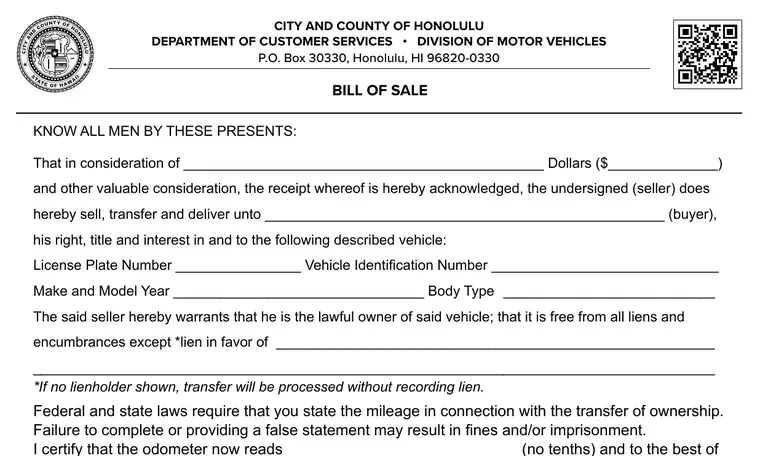
Written against CS-L(MVR)40 (04/2026), issued under City and County of Honolulu Department of Customer Services, Division of Motor Vehicles, issued for use with a certificate of title transfer. The lien line is the trap on this form, because it sits inside a sentence you are warranting. Read it as one sentence rather than as a box: you are swearing the vehicle is free from all liens and encumbrances except whatever you write on that rule. If a credit union still holds the certificate, this is not the form that fixes it - the release goes in Section B on the back of the title, or comes as a lien satisfaction letter.
Two documents, and they are not the same thing. Take the blank CS-L(MVR)40 from the www4.honolulu.gov copy so you get the revision that is current today, then print our CS-L(MVR)40 guide and keep it beside you while you fill theirs in.
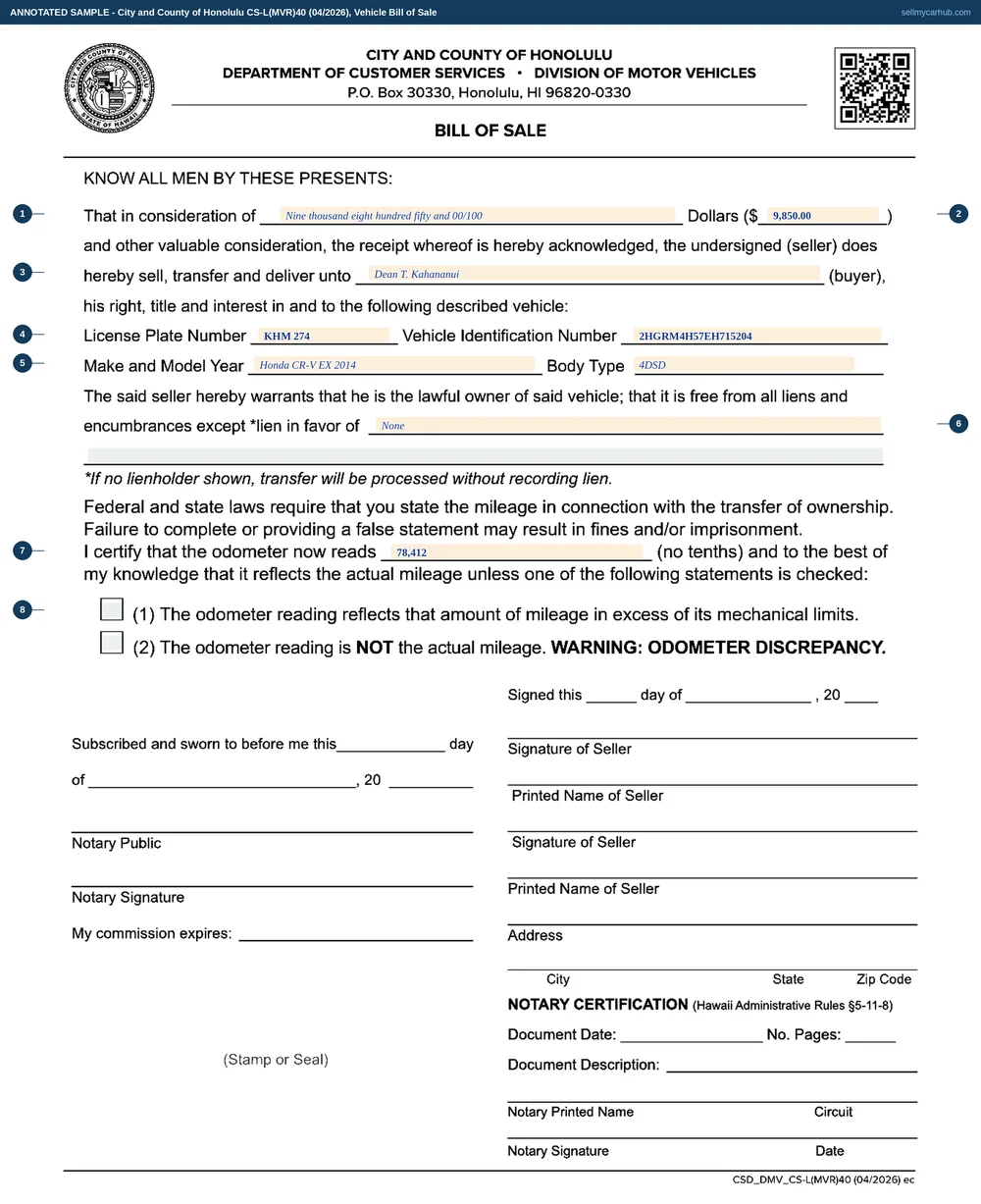
This is the actual CS-L(MVR)40, rendered from the PDF the City and County of Honolulu Division of Motor Vehicle, Licensing and Permits publishes and completed end to end: letterhead, every field, and the blocks at the foot.
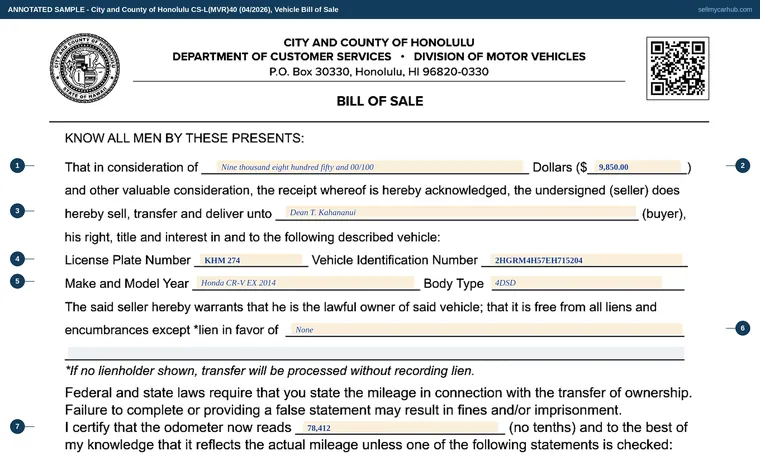
The long blank before the word Dollars. Write the amount the way a cheque is written - the whole number, then the cents.
Watch out: And other valuable consideration is already printed after it. You do not need to itemise a part-exchange or a set of tyres you threw in; the phrase covers them.
The bracketed box straight after. The two have to agree.
Watch out: Do not round one and not the other. A bill of sale whose words say eight hundred fifty and whose figures say eight hundred is a document that argues with itself, and the words are the half that governs.
The undersigned seller sells, transfers and delivers unto this person. Use the buyer's full legal name, matching the name that will go into Section D on the back of the certificate.
Watch out: If two people are buying jointly, write both names here. A bill of sale naming one of a joint pair does not evidence the other one's ownership.
The two boxes on the first description line. Both come off the certificate of registration.
Watch out: The VIN is the one that matters if the plate later changes. Check it against the plate on the dashboard as well as the paperwork.
The second description line. Make and model year share one box on this form; body type takes the county's own shorthand from the registration.
Watch out: Model year is the year the vehicle was built as, not the year you bought it. On a car sold new in January the two are often different.
Two ruled lines inside the warranty sentence. If nobody holds a lien, write None across them rather than leaving them empty.
Watch out: Empty lines invite a clerk to wonder. The county's own note - if no lienholder shown, transfer will be processed without recording lien - means blank works, but None is unambiguous.
Whole miles, no tenths, as at the moment of handover. The certification above it is a federal one and the warning about fines and imprisonment is printed on the form.
Watch out: Read the dashboard on the day you sign, not the day you advertised. A number two thousand miles stale is a false statement, however innocently it got there.
Box one is for a reading that reflects mileage in excess of the odometer's mechanical limits. Box two is for a reading that is not the actual mileage, and prints its own capitalised warning.
Watch out: Leave both empty on an honest odometer. Ticking one because you are unsure records a discrepancy against the vehicle that follows it through every future sale.
| On the form | What to put in it |
|---|---|
| Consideration, in words and in figures | The opening line: that in consideration of ____ Dollars ($____) and other valuable consideration, the receipt whereof is hereby acknowledged. The amount is written out longhand first and repeated in figures. |
| Name of buyer | The undersigned seller sells, transfers and delivers unto this person his right, title and interest in the vehicle. |
| License Plate Number | First of the four description boxes. |
| Vehicle Identification Number | Beside the plate, on the same rule. |
| Make and Model Year | One combined box - the form asks for both on a single line. |
| Body Type | Hawaii's shorthand for the shape of the car, matching the certificate of registration. |
| Lien in favour of | Two ruled lines for naming a lienholder, under a warranty that the vehicle is free from all liens and encumbrances except this one. The asterisk beneath is the county's own rule: if no lienholder shown, transfer will be processed without recording lien. |
| Odometer Reading | Under a printed warning that federal and state laws require you to state the mileage in connection with the transfer of ownership, and that failure to complete or providing a false statement may result in fines and imprisonment. The blank is followed by (no tenths). |
| Box 1, in excess of its mechanical limits | Tick only if the odometer reading reflects that amount of mileage in excess of its mechanical limits - a rolled-over five-digit odometer, not a broken one. |
| Box 2, not the actual mileage | Tick if the odometer reading is NOT the actual mileage. The form prints WARNING: ODOMETER DISCREPANCY beside it in capitals. |
Every line here was read off CS-L(MVR)40 (04/2026) itself — the PDF is here — and off the City and County of Honolulu Division of Motor Vehicle, Licensing and Permits pages. This is plain-language help with a form, not legal advice, and where our wording and the agency's differ, theirs governs.
Back to all Hawaii seller paperwork, or what selling a car in Hawaii involves.