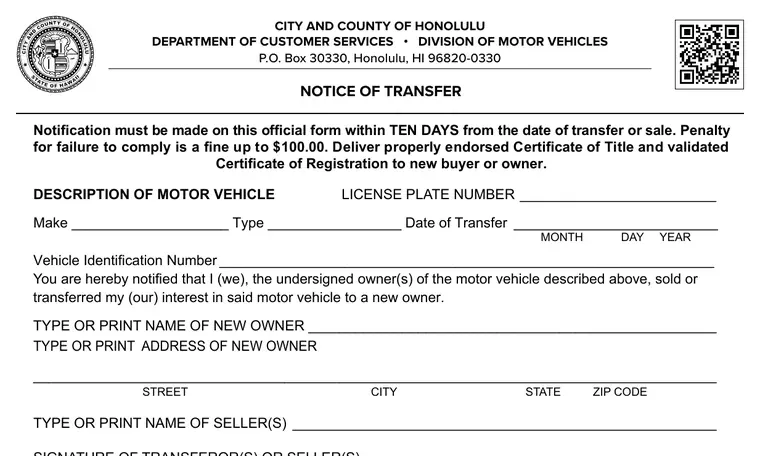
This is the one piece of paper a Hawaii seller is actually required to file, and most sellers never see it as a form at all - because it is printed across the top of the certificate of title, and the instruction is to tear it off. CS-L(MVR)53 is the reissue for everyone whose strip has already gone: same nine boxes, same job. Its opening line sets the clock in capitals - notification must be made on this official form within TEN DAYS from the date of transfer or sale, and the penalty for failure to comply is a fine up to $100.00. What it buys you is narrow and worth having: once the county records it, liability for parking and traffic violations and for civil litigation arising from operation after the date of sale becomes the responsibility of the subsequent purchaser.
Written against CS-L(MVR)53 (02/2026), issued under Section 286-52, Hawaii Revised Statutes, cited on the face of the form, and filed with the City and County of Honolulu Division of Motor Vehicle, Licensing and Permits. The single most expensive habit in a Hawaii sale is handing over the certificate of title intact. The notice of transfer is physically part of that sheet, so the moment it leaves your hand the only copy of your own filing is in someone else's car. Tear the strip off first, then endorse the rest.
Two documents, and they are not the same thing. Take the blank CS-L(MVR)53 from the www4.honolulu.gov copy so you get the revision that is current today, then print our CS-L(MVR)53 guide and keep it beside you while you fill theirs in.
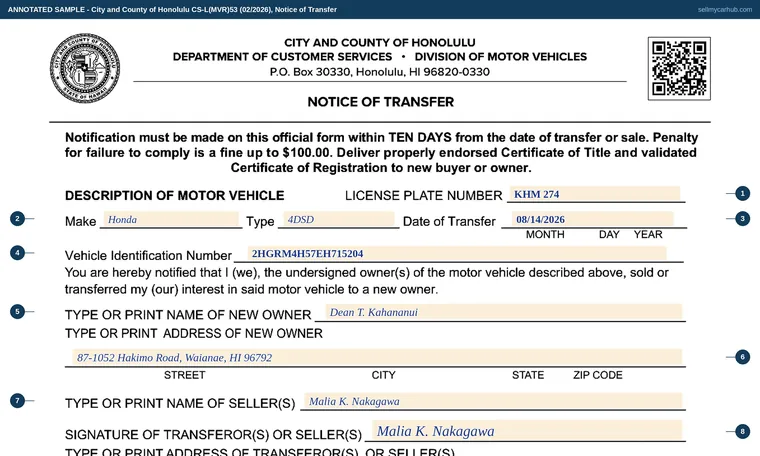
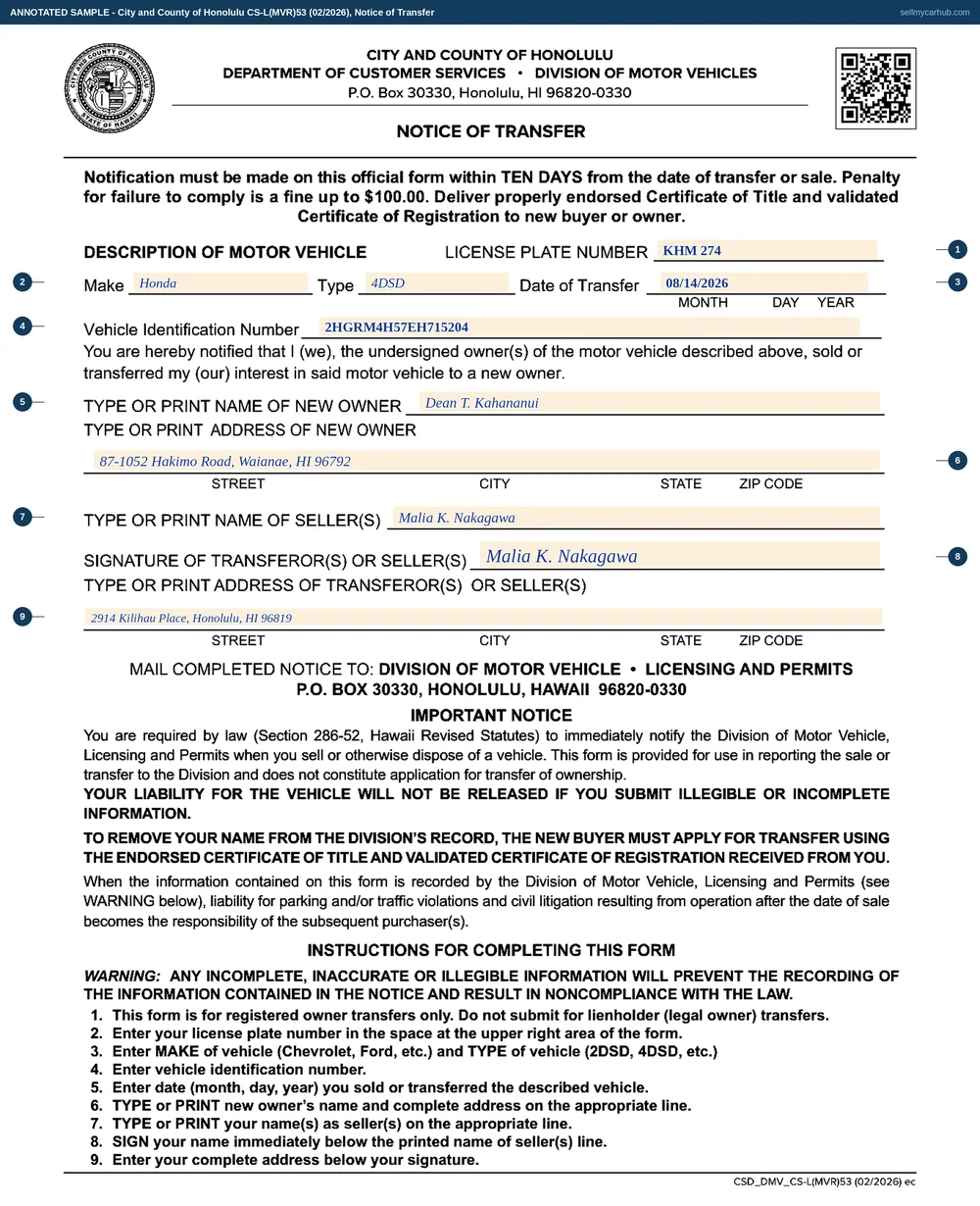
This is the actual CS-L(MVR)53, rendered from the PDF the City and County of Honolulu Division of Motor Vehicle, Licensing and Permits publishes and completed end to end: letterhead, every field, and the blocks at the foot.
Top right, above the description block. Copy it from the certificate of registration rather than from the car, because a plate that has been replaced since registration will not match the record.
Watch out: If the car carries a personalised plate, deal with the plate before you file this. Personalised plates must be transferred, stored or retired at the sale, and the notice describes a vehicle by a plate that is about to change.
Make is the manufacturer. Type is Hawaii's body-style code - the form's own examples are 2DSD and 4DSD, two-door and four-door sedan - and the certificate of registration prints the one the county has on record.
Watch out: Copy the type code from the registration exactly. Writing SUV or Wagon where the record says 4DSD is a discrepancy the clerk has to resolve before recording.
Month, day and year, in the three labelled slots. This is the date the ten-day clock started and the date the buyer's thirty days run from.
Watch out: It must match the date you wrote in Section A on the certificate. Two different dates on the two halves of one sale is the discrepancy that gets a notice queried.
The full VIN on the long rule under the description block. This is what ties the notice to a vehicle rather than to a registration that may already have changed.
Watch out: Seventeen characters, copied character by character. A transposed digit means the county records a sale for a car that does not exist and yours stays in your name.
Typed or printed, in full. If the buyer is a business, use its registered name rather than the name of the person standing in front of you.
Watch out: Take it from photo identification, not from a text message. This name is the whole of what the county knows about who has your car.
One ruled line with street, city, state and zip printed beneath it. A Hawaii address is normal but not required - a buyer shipping the car off-island still gets recorded here.
Watch out: An address the buyer has not moved into yet is worse than useless. If they are between homes, ask for the one their driver's licence carries.
Printed above the signature line. Every registered owner named on the certificate belongs here.
Watch out: Two owners on the title means two names and two signatures. A notice signed by one of a joint pair leaves the other one still on the record.
Sign immediately below the printed name of the seller line - the form's own instruction eight. Transferor is the form's word for you.
Watch out: No notary is needed on this form and none is offered. Do not let anyone tell you the notice needs witnessing; only the powers of attorney and a double-transfer bill of sale do.
Your complete address below the signature, with street, city, state and zip labelled underneath. This is where the county writes if the notice cannot be recorded.
Watch out: Use the address you can still be reached at in three months. If you are leaving the islands, that is not the one on your old registration.
| On the form | What to put in it |
|---|---|
| License Plate Number | Top right of the sheet. The county's record is keyed to the plate, so this is the first thing the clerk matches. |
| Make and Type | The instructions define both: enter MAKE of vehicle - Chevrolet, Ford, etc - and TYPE of vehicle, 2DSD, 4DSD, etc. Type is Hawaii's body-style shorthand, not a trim level. |
| Date of Transfer | Month, day and year you sold or transferred the vehicle, in three labelled boxes. Use the same date you wrote on the front of the certificate. |
| Vehicle Identification Number | One long rule across the sheet. It is the only field on the form that identifies the car rather than the registration. |
| Type or Print Name of New Owner | The buyer's name. The heading says type or print, and the warning at the foot explains why: illegible information prevents the recording. |
| Type or Print Address of New Owner | Street, city, state and zip code on one ruled line with the four labels printed underneath it. |
| Type or Print Name of Seller(s) | Your printed name, above the signature line rather than below it - the reverse of the order most forms use. |
| Signature of Transferor(s) or Seller(s) | The transferor is you. Every registered owner who appears on the certificate signs here. |
| Type or Print Address of Transferor(s) or Seller(s) | Your own street, city, state and zip, so the county can write back to you rather than to the address the record already has. |
Every line here was read off CS-L(MVR)53 (02/2026) itself — the PDF is here — and off the City and County of Honolulu Division of Motor Vehicle, Licensing and Permits pages. This is plain-language help with a form, not legal advice, and where our wording and the agency's differ, theirs governs.
Back to all Hawaii seller paperwork, or what selling a car in Hawaii involves.