Sell My Car Hub

How to fill out Hawaii CS-L(MVR)1

On an ordinary Oahu sale nobody fills this in: the buyer applies on the back of the certificate itself, in Section D, and the registration is reprinted from that. CS-L(MVR)1 is what a transfer needs when the certificate cannot carry the application - a vehicle last registered on another island, or one arriving with a title from another state. Honolulu names it in both of those sections and asks for it completed and signed, with both signatures where there are joint owners. It is also the clearest published picture of what a Hawaii registration actually charges for, because its office-use column itemises county tax, state tax, state registration, beautification, plate and emblem, county fee, alternative fuel fee, penalty and transfer fee.
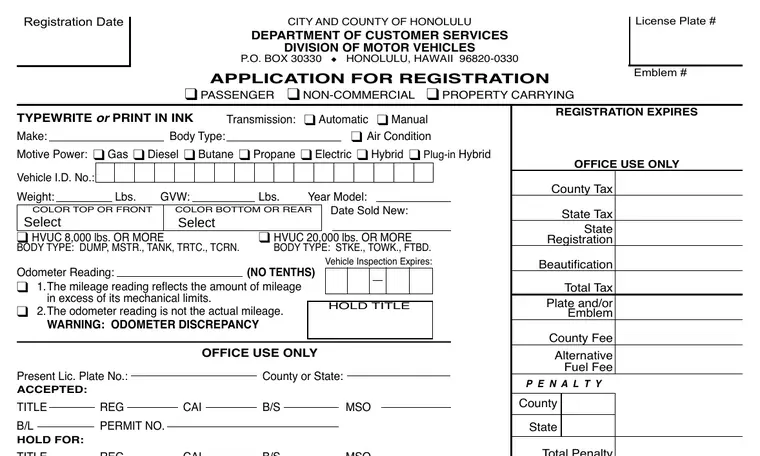
Written against CS-L(MVR)1 (SN 2024-08), issued under City and County of Honolulu Department of Customer Services, Division of Motor Vehicles, with the vehicle weight tax certification made under Section 249-13, Hawaii Revised Statutes. The odometer block on this form is a live disclosure, not a copy of one. It carries the same two exception boxes as the certificate and the bill of sale, so a reading transcribed carelessly from an older document becomes a fresh false statement rather than a repeat of an old one. Take the number off the dashboard on the day the form is signed.

Two documents, and they are not the same thing. Take the blank CS-L(MVR)1 from the www4.honolulu.gov copy so you get the revision that is current today, then print our CS-L(MVR)1 guide and keep it beside you while you fill theirs in.

Filled in

What a completed one looks like

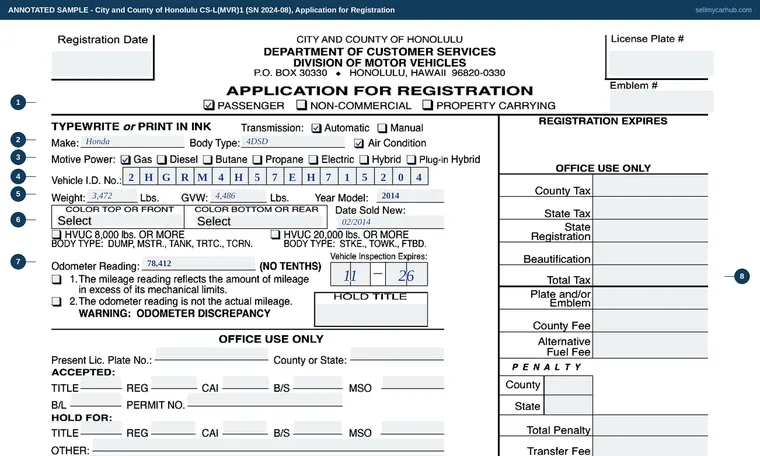
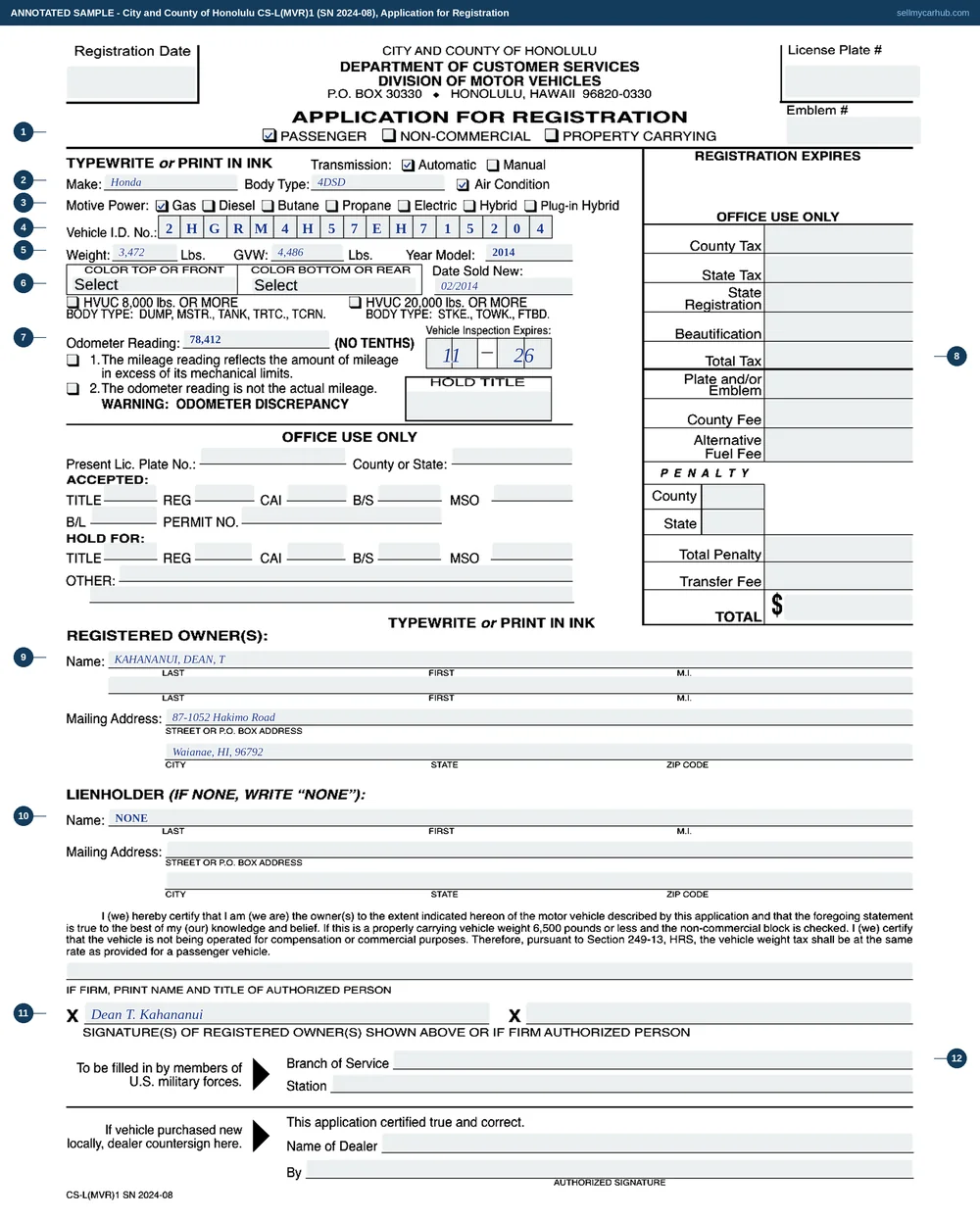
This is the actual CS-L(MVR)1, rendered from the PDF the City and County of Honolulu Division of Motor Vehicle, Licensing and Permits publishes and completed end to end: letterhead, every field, and the blocks at the foot.

A completed Honolulu Application for Registration, form CS-L(MVR)1. The passenger box is ticked, the make reads Honda and body type 4DSD, motive power gas, with vehicle identification number 2HGRM4H57EH715204 in the seventeen-cell comb. Weight is 3,472 pounds, gross vehicle weight 4,486 pounds and year model 2014. The two colour boxes are left as the form renders them, because they are dropdown lists that print the word Select rather than blanks. The odometer reading is 78,412 with no exception boxes ticked. The registered owner is Kahananui, Dean, T of 87-1052 Hakimo Road, Waianae, Hawaii 96792, and the lienholder line reads NONE. The office-use fee column and the dealer countersignature block are washed grey.
CS-L(MVR)1 completed for a car moving from another county onto the Oahu register: description, odometer, inspection expiry, both registered owners and a lienholder block reading None, with the office-use column and the dealer countersignature left grey.
Field by field

Every line, in the order you meet it

  1. 1
    The buyer fills this in

    Which of the three registration types

    Passenger, non-commercial or property carrying, across the top of the sheet. An ordinary car is passenger; a pickup or cargo van used privately is where the non-commercial box earns its keep.

    Watch out: Non-commercial is a certification further down the form, not just a tick. Read the paragraph above the signature line before choosing it.

  2. 2
    The buyer fills this in

    Make, body type and transmission

    The description line, with two transmission boxes and an air-conditioning tick beside it. Body type takes the county's shorthand from the previous certificate of registration.

    Watch out: Copy body type from the paperwork, not from the manufacturer's brochure. The county's list is short and its codes do not always match what the car is marketed as.

  3. 3
    The buyer fills this in

    Motive power

    Seven boxes from gas to plug-in hybrid. This is the box that decides whether the alternative fuel fee in the office column is charged.

    Watch out: Hybrid and plug-in hybrid are separate boxes and are not interchangeable. Choosing the wrong one changes what the counter charges.

  4. 4
    The buyer fills this in

    Vehicle I.D. No., one character per cell

    A seventeen-cell comb. Every character of the VIN gets its own box.

    Watch out: Start in the first cell. A VIN written centred, or run together over two cells, is the commonest reason a comb has to be redone in ink that will not erase.

  5. 5
    The buyer fills this in

    Weight, GVW and year model

    Weight in pounds and gross vehicle weight in pounds, then the model year. Hawaii taxes weight annually, so these are the numbers the bill is built from.

    Watch out: If the manufacturer's weight is not on record the county can send the vehicle to a state-certified scale. Bring whatever documentation of weight came with the car.

  6. 6
    The buyer fills this in

    Colours, from the dropdowns

    Colour top or front and colour bottom or rear are the only two selection lists on any Honolulu form - they open a fixed list rather than taking free text, and until one is chosen each box prints the word Select. That is why the sample above leaves them as the county draws them.

    Watch out: A two-tone car is why there are two boxes. On a single-colour car choose the same value in both rather than leaving the second showing Select.

  7. 7
    The buyer fills this in

    The odometer reading and its two boxes

    Whole miles, no tenths. The two exception boxes are the same declarations as everywhere else - mileage in excess of mechanical limits, or a reading that is not the actual mileage.

    Watch out: A 2010-or-older vehicle needs no reading at all, and this form has no exempt box to record that with. Leave it blank rather than writing the word exempt across a numeric field.

  8. 8
    The buyer fills this in

    Vehicle inspection expires

    The small month-and-year comb beside the odometer block. It records the current safety check.

    Watch out: This is the field that quietly proves the sale can proceed. If it is already in the past, the transfer does not go through until a new inspection is done.

  9. 9
    The buyer fills this in

    Registered owner names and mailing address

    Two name lines, each split into LAST, FIRST and M.I., then the mailing address as street, then city, state and zip.

    Watch out: The sub-labels sit under the rule, not above it. Write the surname first - a name entered in the order you say it out loud lands in the wrong three boxes.

  10. 10
    The buyer fills this in

    Lienholder, or the word NONE

    The lender financing the purchase goes here, name first and then mailing address. The heading itself tells you what to do when there is not one.

    Watch out: A cash sale with this block left blank invites a query. Writing NONE is the county's own instruction and takes two seconds.

  11. 11
    The buyer fills this in

    The certification and the signatures

    One paragraph above two signature rules. Joint owners both sign; a firm prints the name and title of its authorised person on the line above.

    Watch out: The certification includes the non-commercial statement. Signing it on a pickup that does paid work is a false statement about a tax rate, not a formality.

  12. 12
    Somebody else fills this in

    Military block and dealer countersignature

    Branch of service and station belong to an active-duty owner. The block at the foot is for a dealer certifying a locally purchased new vehicle.

    Watch out: Both stay empty in a private used-car sale. A dealer signature line filled in by a private seller is a misrepresentation of who sold the car.

At a glance

What goes where

On the formWhat to put in it
Registration typeThree tick boxes across the head of the form: passenger, non-commercial, property carrying.
Make, Body Type, Transmission, Air ConditionThe description block. Transmission is a choice of automatic or manual; air conditioning is a single tick.
Motive PowerSeven boxes - gas, diesel, butane, propane, electric, hybrid, plug-in hybrid - and the one that decides whether the alternative fuel fee in the office column applies.
Vehicle I.D. No.A seventeen-cell comb across the form. One character per cell.
Weight, GVW and Year ModelWeight in pounds, gross vehicle weight in pounds, and the model year. Weight is what Hawaii's annual tax is charged on.
Color top or front, Color bottom or rearTwo dropdowns rather than free text - the county keeps a fixed colour list.
Date Sold NewThe date the vehicle first left a dealer, not the date of your sale.
HVUC boxesTwo heavy-vehicle tick boxes at 8,000 lbs or more and 20,000 lbs or more, each with its own list of body types. A private car meets neither.
Odometer ReadingPrinted (NO TENTHS), with the same two exception boxes that appear on the certificate and the bill of sale.
Vehicle Inspection ExpiresA small month-and-year comb. It is on the form because the county will not complete a transfer on a vehicle whose safety check has lapsed.
Registered Owner(s)Two name lines split into LAST, FIRST and M.I., then a mailing address split into street, then city, state and zip.
Lienholder (if none, write NONE)The form's own instruction, in italics on the sheet. Name, then street, then city, state and zip.
The certificationOne paragraph above the signatures: I (we) hereby certify that I am (we are) the owner(s) to the extent indicated hereon, and, for a property-carrying vehicle of 6,500 pounds or less with the non-commercial block ticked, that the vehicle is not being operated for compensation or commercial purposes.
Signature(s) of registered owner(s)Two signature rules side by side, with a line above them for the printed name and title of an authorised person if the owner is a firm.
Branch of Service and StationA block to be filled in by members of U.S. military forces, sitting under its own arrow.
Dealer countersignatureIf the vehicle was purchased new locally, the dealer certifies the application true and correct and signs. A private sale leaves it empty.

What gets this one rejected

Rules that decide whether it is accepted

Every line here was read off CS-L(MVR)1 (SN 2024-08) itself — the PDF is here — and off the City and County of Honolulu Division of Motor Vehicle, Licensing and Permits pages. This is plain-language help with a form, not legal advice, and where our wording and the agency's differ, theirs governs.

Back to all Hawaii seller paperwork, or what selling a car in Hawaii involves.

Want the paperwork handled instead?

Get My Instant Offer → Online · about 2 minutes · free

Or send the details — we'll come to you

Shipping a car between islands to sell it, and finding the paperwork multiplies? Tell us where it is and we will quote on it where it stands.

or call/text (877) 405-1808