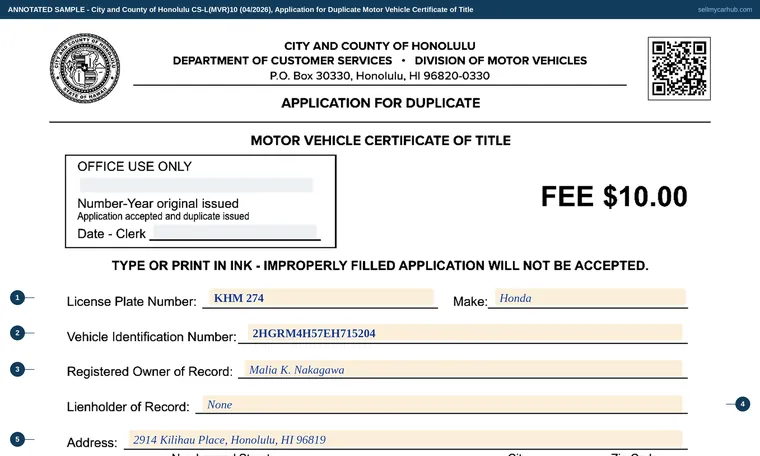
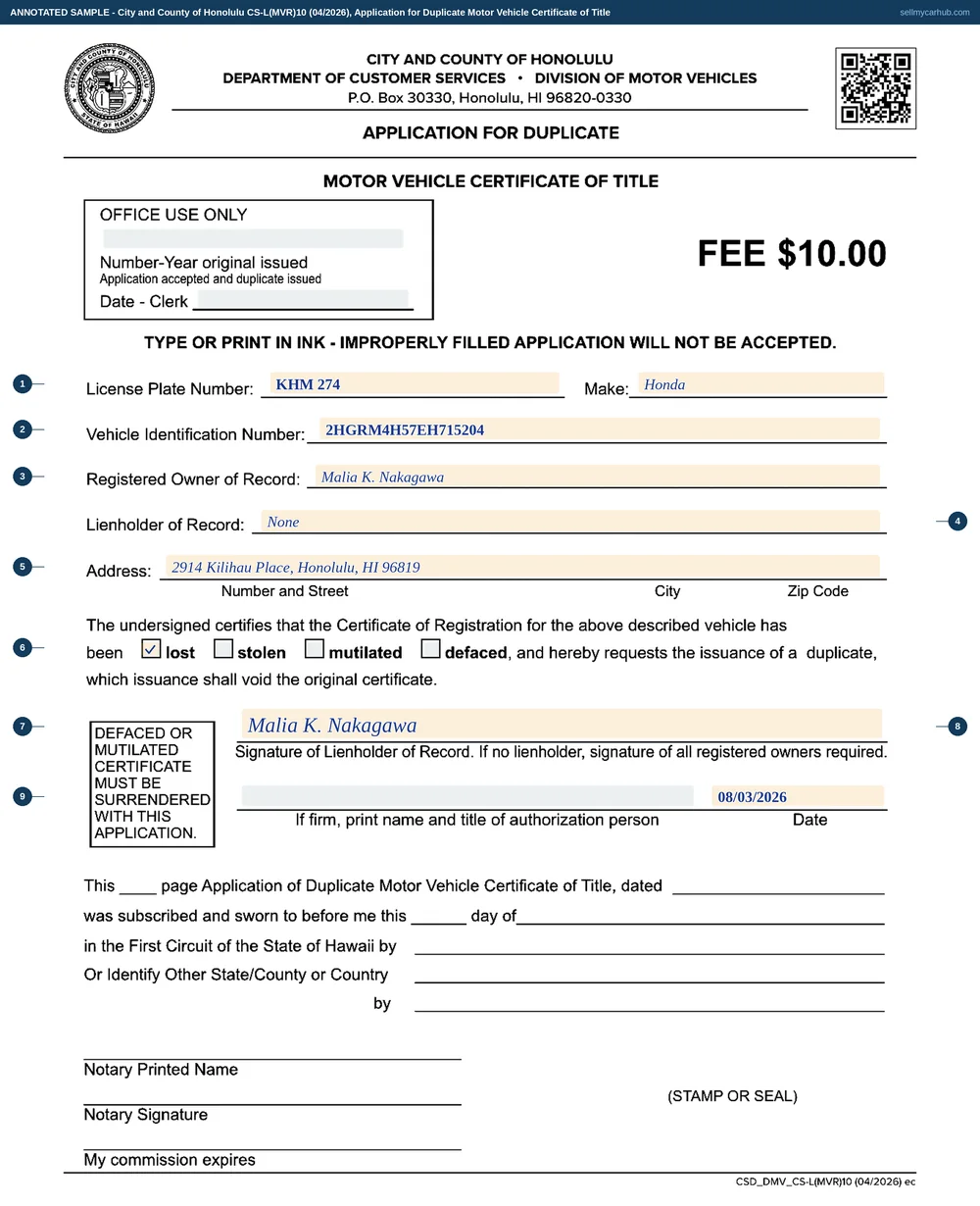
Honolulu names this form in the middle of its seller instructions, which tells you how routine the problem is: if the title is defaced or mutilated, the legal owners on record must apply for a duplicate. It covers the lost and the stolen certificate too, and the price is on the sheet - FEE $10.00, printed in the office-use box at the top. The one thing to understand before signing is who the applicant is. The signature line reads signature of lienholder of record, and only adds if no lienholder, signature of all registered owners required - so on a financed car the lender applies, not you.
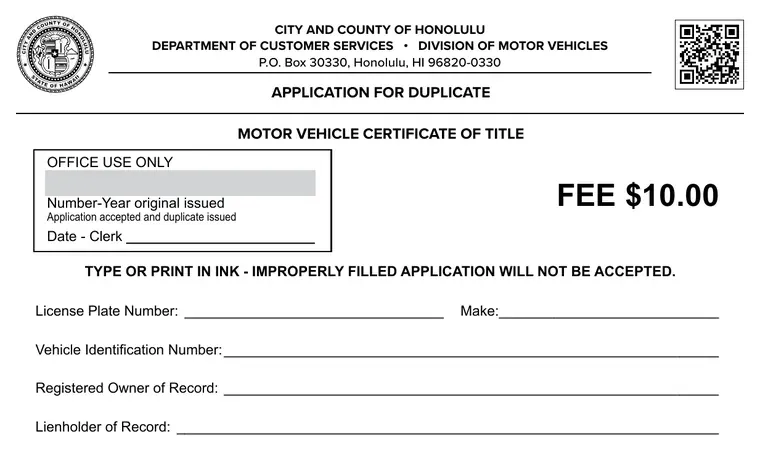
Written against CS-L(MVR)10 (04/2026), issued under City and County of Honolulu Department of Customer Services, Division of Motor Vehicles, with a fee of $10.00 printed in the form's own office-use block. The mail-order trap is worth naming. Honolulu also publishes an affidavit for a certificate that was issued and posted but never arrived, and the two applications are not interchangeable: a title the county says it mailed is a non-receipt problem, while a title you had and lost is a duplicate problem. Filing the wrong one costs a fee and a wait.
Two documents, and they are not the same thing. Take the blank CS-L(MVR)10 from the www4.honolulu.gov copy so you get the revision that is current today, then print our CS-L(MVR)10 guide and keep it beside you while you fill theirs in.
This is the actual CS-L(MVR)10, rendered from the PDF the City and County of Honolulu Division of Motor Vehicle, Licensing and Permits publishes and completed end to end: letterhead, every field, and the blocks at the foot.
The first description line. Both come off the certificate of registration, which is usually the document you still have when the title is the one that has gone.
Watch out: If the registration has gone too, that is a separate application and a separate sheet. Do not try to solve both on this one.
The full VIN. It is the field the county searches on when the plate has changed since the certificate was issued.
Watch out: Take it off the dashboard plate as well as the paperwork and check they agree before you write it down.
The name as the county holds it, which is the name that was on the certificate rather than a married or shortened version of it.
Watch out: If your name has changed since registration, the mismatch will surface here first. Bring the document that evidences the change to the counter.
The lender the county has on file. Filling this in truthfully decides who signs at the foot of the page.
Watch out: A loan you finished paying is still on record until the lender told the county. Check the record before assuming this line is empty.
Number and street on the rule, with city and zip code following the printed sub-labels beneath it.
Watch out: The duplicate is posted to the address on file. If yours has changed, file the change of address first or the new certificate goes to the old house.
Lost, stolen, mutilated or defaced - four boxes inside one sentence. Mutilated and defaced are the ones that come with an obligation attached.
Watch out: If you tick mutilated or defaced you must hand the certificate in with the application. The instruction is printed beside the signature block in capitals.
The primary signature line. On a financed vehicle the lender signs, because the lender is the party the certificate was issued to.
Watch out: This is the step that turns a two-day errand into a two-week one. Start with the lender, not with the counter.
The fallback, printed on the same caption: if no lienholder, signature of all registered owners required.
Watch out: All of them. A jointly owned car with one signature comes straight back, and the certificate is still lost while it does.
The last line: printed name and title of the authorised person where the owner is a company, and the date of the application.
Watch out: A company applying here also needs its letter of authorization on file, and a sell-only authorisation is enough - it covers releasing ownership and applying for a duplicate title.
| On the form | What to put in it |
|---|---|
| Number-Year original issued | Office use. The clerk records which certificate is being replaced. |
| Application accepted and duplicate issued, Date - Clerk | Office use, at the top left of the sheet. |
| License Plate Number and Make | The pair at the head of the description block. |
| Vehicle Identification Number | One long rule under the make and plate. |
| Registered Owner of Record | The name as the county holds it, not as you would write it today. |
| Lienholder of Record | The lender the county has on file. It decides who signs at the foot. |
| Address | Number and street, city and zip code, with the three labels printed beneath one rule. |
| Lost, stolen, mutilated, defaced | Four tick boxes inside the certification sentence. Exactly one is ticked. |
| Signature of Lienholder of Record | The signature line, with its own caption: if no lienholder, signature of all registered owners required. |
| If firm, print name and title of authorized person | For a company-owned vehicle, alongside the letter of authorization the county keeps on file. |
| Date | Beside the printed name, at the foot. |
Every line here was read off CS-L(MVR)10 (04/2026) itself — the PDF is here — and off the City and County of Honolulu Division of Motor Vehicle, Licensing and Permits pages. This is plain-language help with a form, not legal advice, and where our wording and the agency's differ, theirs governs.
Back to all Hawaii seller paperwork, or what selling a car in Hawaii involves.