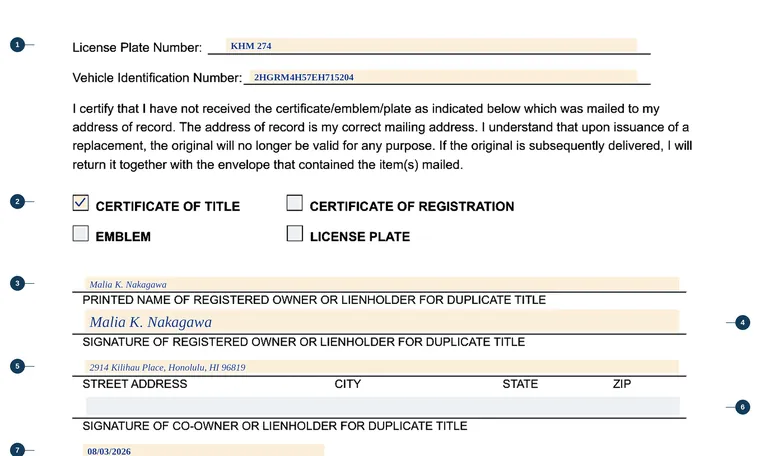
A Hawaii certificate of title is posted, not handed over - the county says so about a paid-off lien, where the title is updated and mailed to the address on file. When the envelope never arrives, this is the form. It covers four different items with one tick list: certificate of title, certificate of registration, emblem and license plate. The affidavit is narrower than a duplicate application and its certification says why: you are swearing not only that the item did not arrive but that the address of record is your correct mailing address, which is what tells the county the loss was in the post rather than in their file.
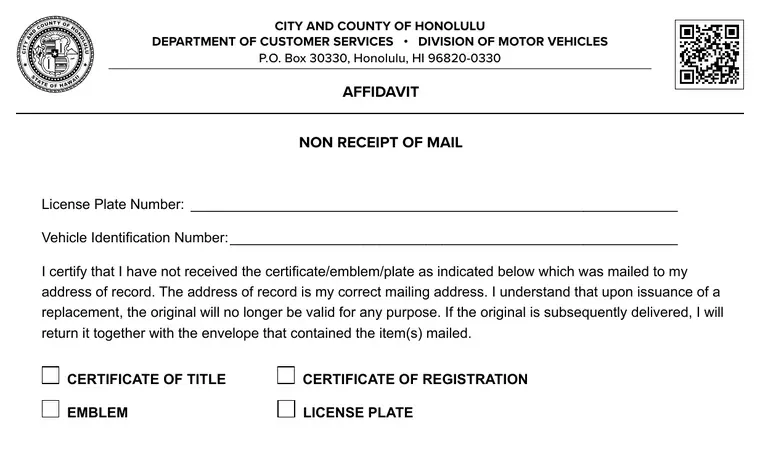
Written against CS-L(MVR)201 (01/2026), issued under City and County of Honolulu Department of Customer Services, Division of Motor Vehicles, sworn by the registered owner or by the lienholder the document was mailed to. The affidavit turns on one sentence: the address of record is my correct mailing address. If you have moved and not told the county, that sentence is untrue, and the honest sequence is to file the change of address first and then chase the missing document - not to swear to an address you no longer live at because it is quicker.
Two documents, and they are not the same thing. Take the blank CS-L(MVR)201 from the www4.honolulu.gov copy so you get the revision that is current today, then print our CS-L(MVR)201 guide and keep it beside you while you fill theirs in.
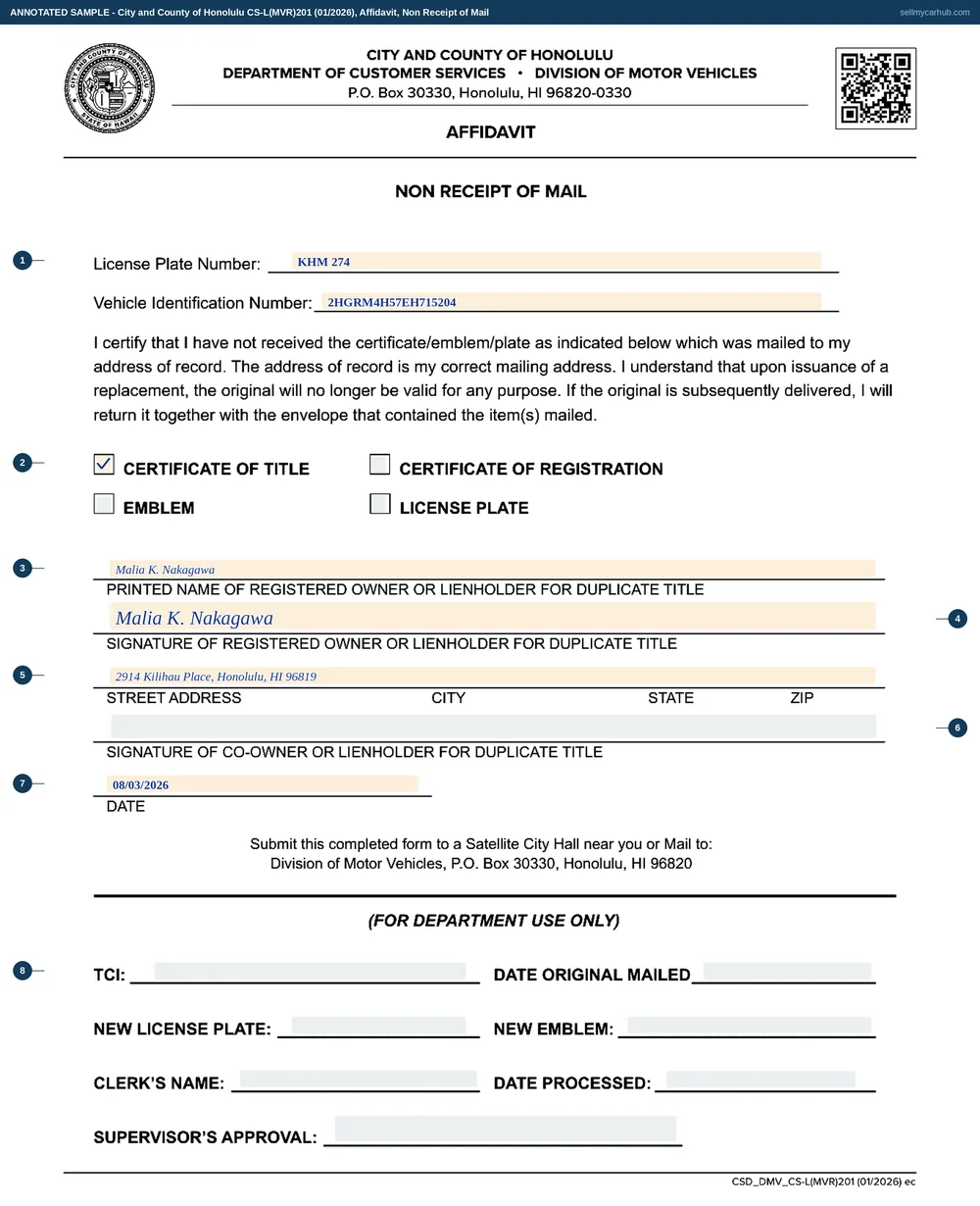
This is the actual CS-L(MVR)201, rendered from the PDF the City and County of Honolulu Division of Motor Vehicle, Licensing and Permits publishes and completed end to end: letterhead, every field, and the blocks at the foot.
The two identifiers at the top. They let the county find the mailing record for the item you say never arrived.
Watch out: Both, not one. The department-use block records the date originally mailed, and the clerk needs the record before they can look at that.
Four boxes: certificate of title, certificate of registration, emblem, license plate. Tick only what was actually posted to you.
Watch out: For a seller the title box is usually the one, and it usually follows a lien being paid off. Ticking registration as well because it is also old is a second claim you cannot support.
The line is captioned printed name of registered owner or lienholder for duplicate title, which is the form acknowledging that a lender may be the one making the claim.
Watch out: If a lender is on record and the title was mailed to them, the claim is theirs to make. Ask them before you file your own.
The affidavit's main signature, directly under the printed name.
Watch out: No notary block appears anywhere on this sheet, so nothing here needs witnessing - it is an affidavit in name and a signed certification in practice.
The address you are certifying is correct and current. This is the pivot of the whole document.
Watch out: If it differs by so much as an apartment number from the county's record, sort the address out first. A replacement posted to the same wrong place solves nothing.
A second rule for a jointly held record.
Watch out: Leave it blank on a solely owned vehicle rather than signing twice yourself, which is what people do when they read it as a witness line.
The date of the affidavit, at the foot of your half of the sheet.
Watch out: Give the post a reasonable interval first. Swearing non-receipt three days after the county mailed something is a claim you may have to withdraw.
Six fields the clerk completes: transaction control number, date originally mailed, new license plate, new emblem, clerk name, date processed and a supervisor's signature.
Watch out: Leave every one of them empty. The date originally mailed is the county's own record, and filling it in yourself is answering a question that was asked of them.
| On the form | What to put in it |
|---|---|
| License Plate Number | The identifier at the head of the sheet. |
| Vehicle Identification Number | Beneath it, on its own rule. |
| Certificate of Title | First of the four tick boxes - the one a seller waiting on a paid-off title needs. |
| Certificate of Registration | Second box, for a renewal certificate that never came. |
| Emblem | Third box, for the sticker. |
| License Plate | Fourth box, for a plate posted after an application. |
| Printed name of registered owner or lienholder for duplicate title | The heading on the name line itself, which is where the form quietly tells you the lienholder may be the affiant. |
| Signature of registered owner or lienholder | The main signature. |
| Address of registered owner | The address being certified as correct - the pivot of the whole affidavit. |
| Signature of co-owner | A second signature rule for a jointly held record. |
| Date | At the foot of the applicant's half. |
| Department use only | A block of six boxes the clerk completes: the transaction control number, the date originally mailed, the new license plate and new emblem issued, the clerk's name, the date processed and a supervisor's signature. |
Every line here was read off CS-L(MVR)201 (01/2026) itself — the PDF is here — and off the City and County of Honolulu Division of Motor Vehicle, Licensing and Permits pages. This is plain-language help with a form, not legal advice, and where our wording and the agency's differ, theirs governs.
Back to all Hawaii seller paperwork, or what selling a car in Hawaii involves.