How to fill out Hawaii CS-L(MVR)70
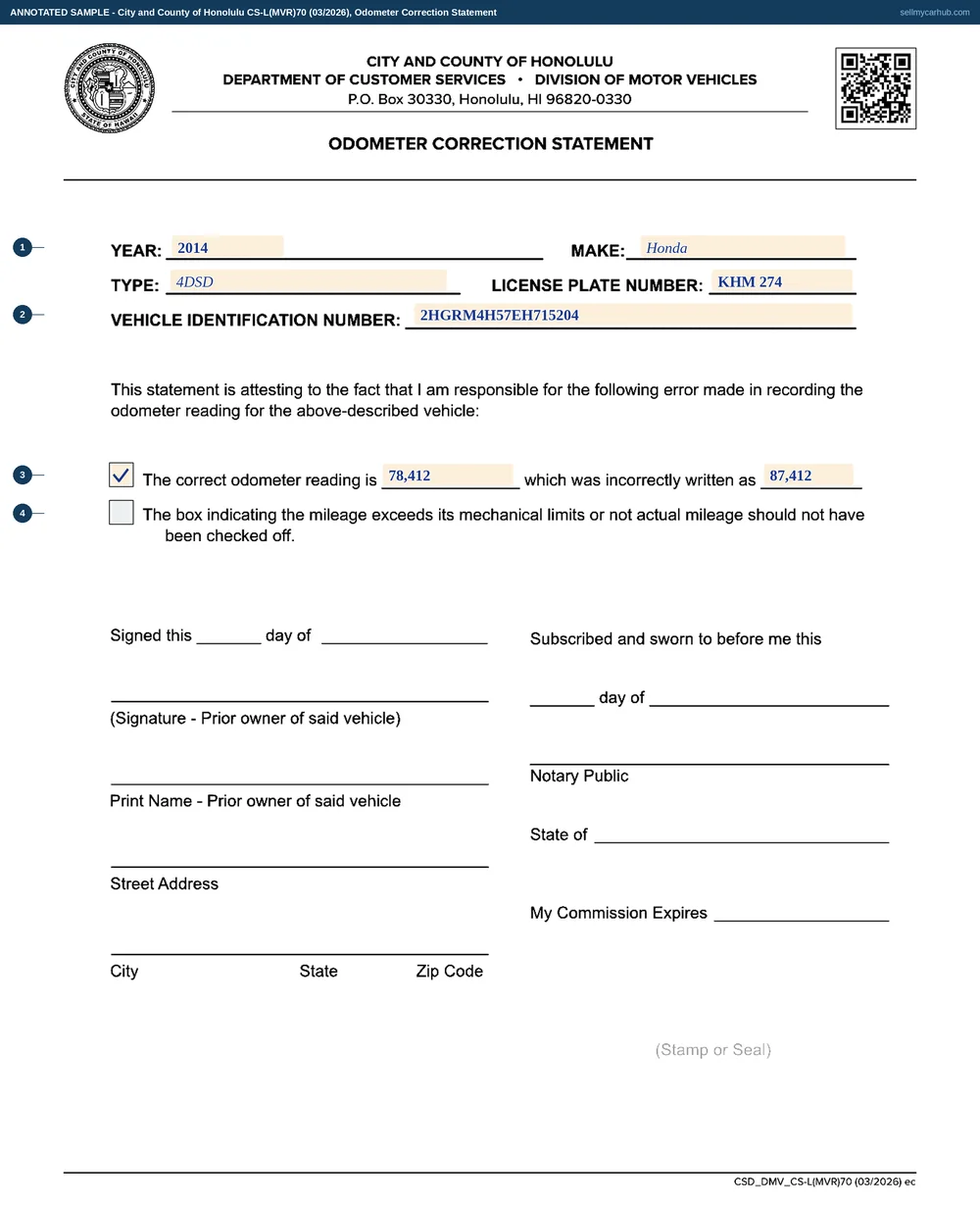
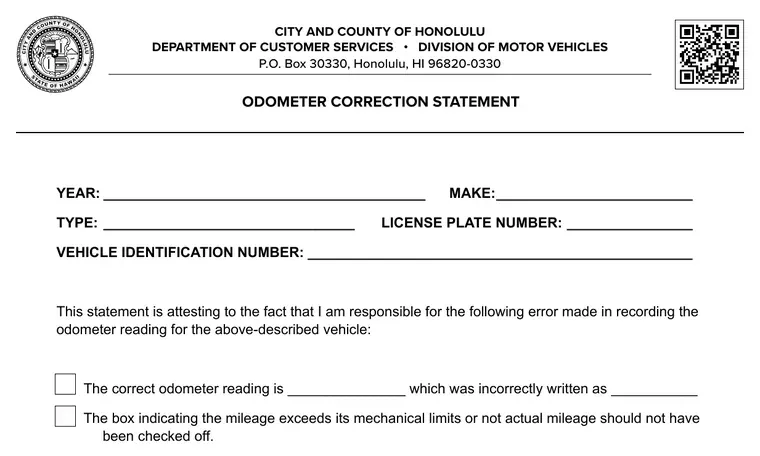
Section A of a Hawaii certificate has one numeric field and two tick boxes, and both of them are easy to get wrong under a buyer's gaze. This one-page statement is the county's cure, and it is written as a confession rather than a correction: this statement is attesting to the fact that I am responsible for the following error made in recording the odometer reading for the above-described vehicle. It offers exactly two remedies. Either the correct reading is one number and was incorrectly written as another, or the box indicating the mileage exceeds its mechanical limits or is not the actual mileage should not have been checked off. Anything outside those two is not a correction the form can make.
 Step 1 · the form itself
Blank CS-L(MVR)70 — Odometer Correction Statement
PDF at www4.honolulu.gov · new tab
View the blank CS-L(MVR)70
Step 1 · the form itself
Blank CS-L(MVR)70 — Odometer Correction Statement
PDF at www4.honolulu.gov · new tab
View the blank CS-L(MVR)70
 Step 2 · how to fill it in
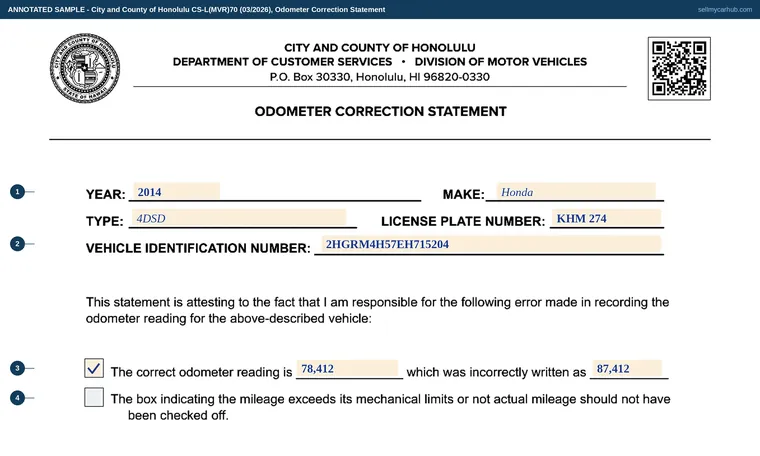
Our filled-in CS-L(MVR)70 guide
PDF · 2 pages · 410 KB · new tab
See our filled-in example
Step 2 · how to fill it in
Our filled-in CS-L(MVR)70 guide
PDF · 2 pages · 410 KB · new tab
See our filled-in example
Two documents, and they are not the same thing. Take the blank CS-L(MVR)70 from the www4.honolulu.gov copy so you get the revision that is current today, then print our CS-L(MVR)70 guide and keep it beside you while you fill theirs in.
Written against CS-L(MVR)70 (03/2026), issued under City and County of Honolulu Department of Customer Services, Division of Motor Vehicles, as the registered owner's own admission of an error in a recorded odometer reading. Correcting a mileage entry is a federal-disclosure matter, not housekeeping. The bill of sale and the registration application both print the warning that failure to complete or providing a false statement may result in fines and imprisonment, and this form's whole design - name the wrong figure, name the right one, admit responsibility - exists so the county can see the change was a correction rather than a revision.
Last updated .