What replaces a certificate of title when a vehicle has been damaged past the point where Virginia will keep calling it a car. It applies for a salvage certificate and it doubles as the way water damage gets reported. Two pages, a parts checklist that has to be completed, and a valuation triangle - actual cash value, estimated repairs cost and percent of damage - that decides what the vehicle becomes.
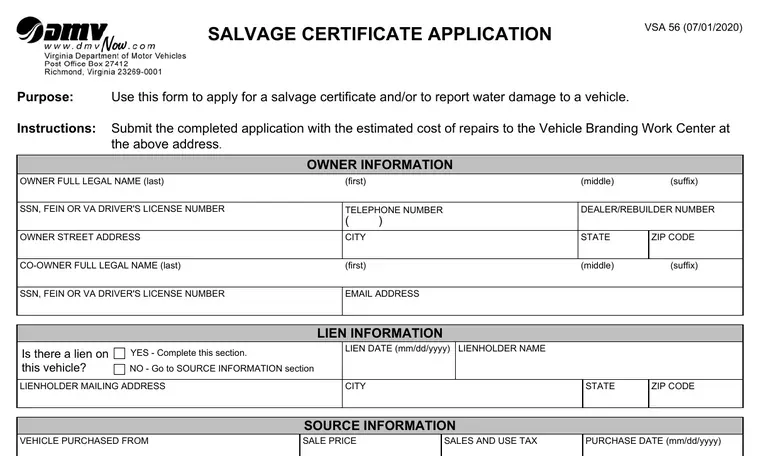
Written against VSA 56 (07/01/2020), issued under Va. Code 46.2-1603. This form is submitted to DMV's Vehicle Branding Work Center rather than to the titling counter, and that is not a formality. It goes to a different address from every other form in this file, and sending it to the Titling Work Center with the rest of the paperwork is a delay of weeks rather than a rejection.
Two documents, and they are not the same thing. Take the blank VSA 56 from the dmv.virginia.gov copy so you get the revision that is current today.
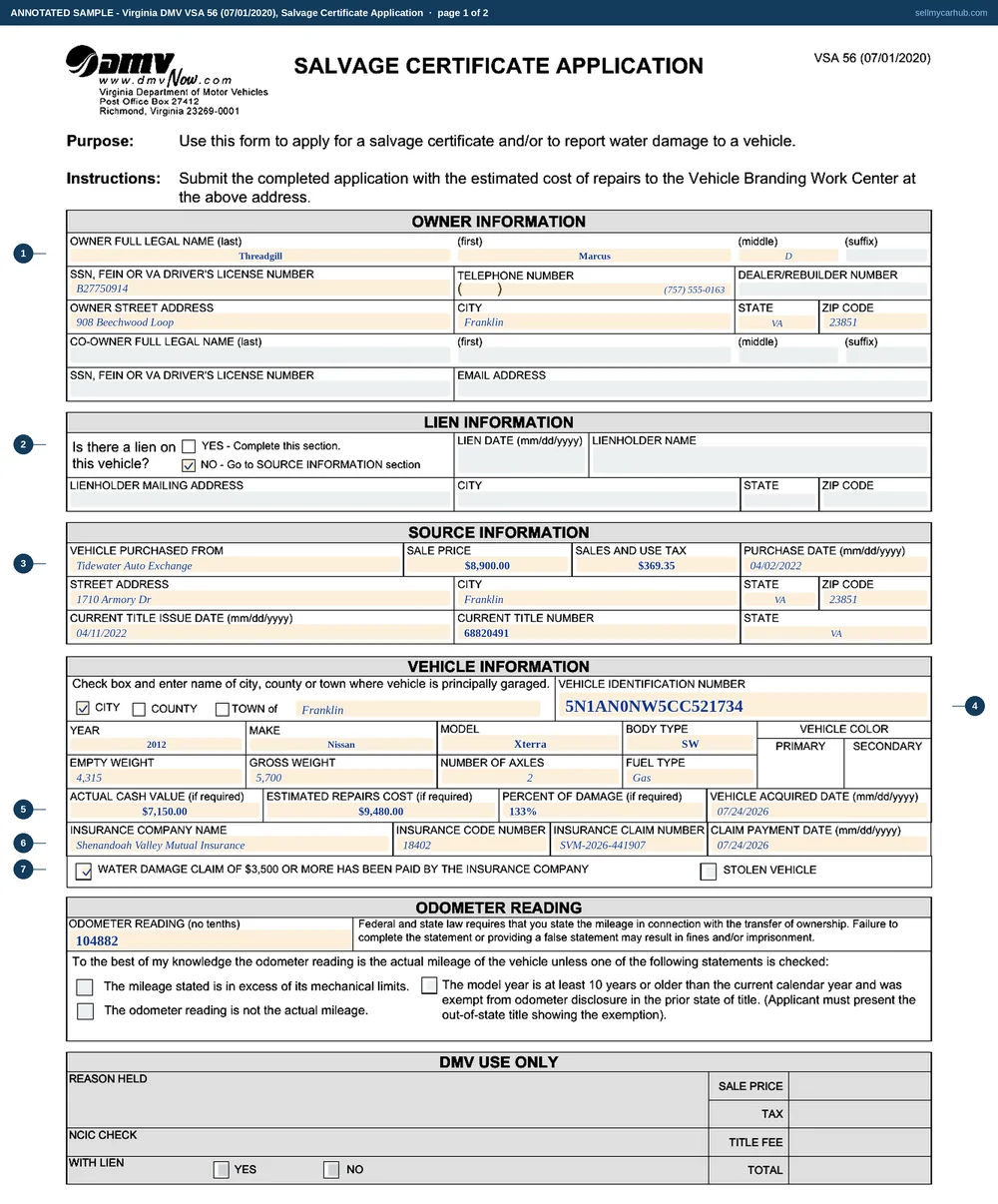
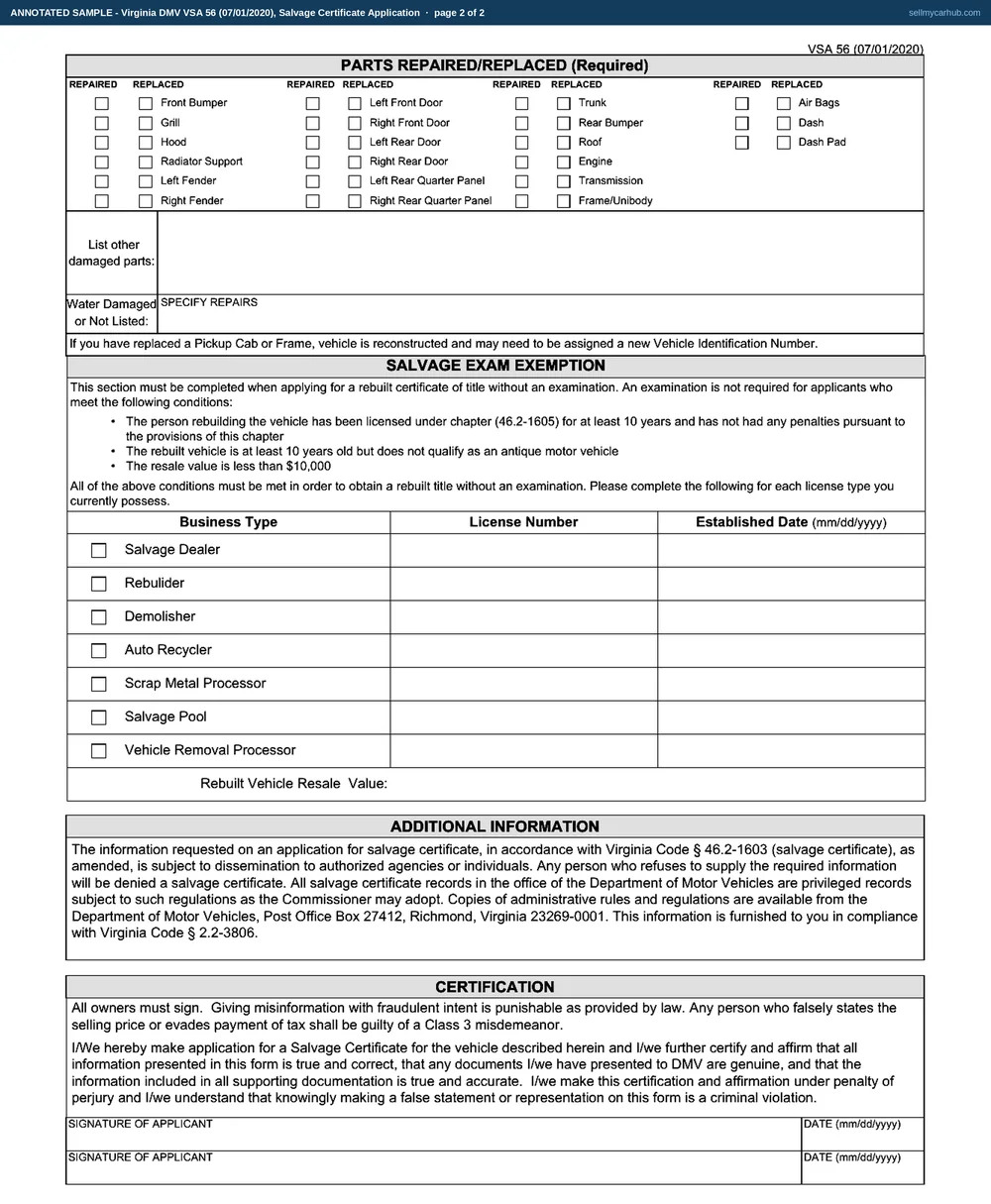
This is all 2 pages of the actual VSA 56, rendered from the PDF the Virginia Department of Motor Vehicles publishes and completed end to end: letterhead, every field, and the blocks at the foot.
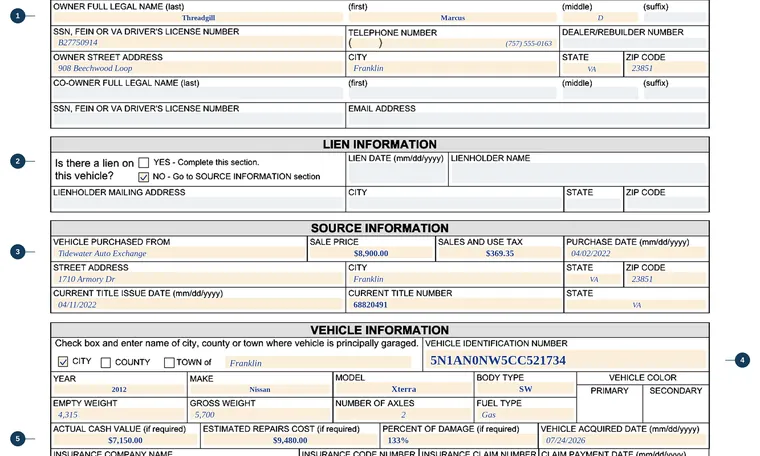
Name across four boxes, identification number, telephone and address, with the dealer or rebuilder number left blank by a private owner.
Watch out: Email is asked for on the co-owner line rather than the owner's. It is worth giving anyway - branding decisions come back in writing.
Yes or no, and the no branch says go to source information.
Watch out: A written-off car with a loan still on it is the lender's problem before it is yours. They will need to release the lien before a salvage certificate issues.
Who you bought it from, what you paid, the tax, the date, and the current title's issue date and number.
Watch out: This is history, not the loss. It is asking how you came to own the vehicle, not what the insurer has offered.
Garaging locality, VIN, year, make, model, body type, colours, weights, axles and fuel.
Watch out: Two colour boxes, primary and secondary. A single-colour car uses the first and leaves the second.
Actual cash value, estimated repairs cost and percent of damage, each marked if required.
Watch out: The estimate has to come with the form. Without it the row is unsupported and the application is incomplete.
Company, code number, claim number and claim payment date.
Watch out: The claim number is how DMV cross-checks the loss with the insurer. Get it off the settlement letter rather than from memory.
Marked where a water damage claim of $3,500 or more has been paid by the insurance company.
Watch out: It is a threshold and a fact, not an impression. A paid claim under that figure does not get this tick.
| On the form | What to put in it |
|---|---|
| Owner information | Owner full legal name across four boxes, SSN, FEIN or Virginia driver's licence number, telephone, a dealer or rebuilder number for the trade, street address, and a co-owner block with its own identification number and an email address. |
| Lien information | A yes-or-no, with the no branch sending you straight to source information, and a lien date, lienholder name and mailing address if yes. |
| Source information | Where the vehicle was purchased from, the sale price, the sales and use tax, the purchase date and the seller's address; then the current title issue date, the current title number and the state. |
| Vehicle information | The garaging locality with a city, county or town tick; the vehicle identification number, year, make, model, body type, primary and secondary colour, empty weight, gross weight, number of axles and fuel type. |
| The valuation row | Actual cash value, estimated repairs cost, percent of damage - each marked if required - and the vehicle acquired date. |
| Insurance details | Insurance company name, insurance code number, insurance claim number and claim payment date, then two ticks: water damage claim of $3,500 or more has been paid by the insurance company, and stolen vehicle. |
| Odometer reading | The reading with no tenths and three exceptions - in excess of mechanical limits, not the actual mileage, or the model year is at least 10 years or older than the current calendar year and was exempt from odometer disclosure in the prior state of title, with the out-of-state title required as proof. |
| Page two, parts repaired or replaced | A required grid of twenty-odd components - bumpers, grill, hood, radiator support, fenders, doors, quarter panels, trunk, roof, engine, transmission, frame or unibody, air bags, dash - each with a repaired and a replaced column, plus free text for other damaged parts. A note warns that replacing a pickup cab or frame makes the vehicle reconstructed and it may need a new vehicle identification number. |
| Salvage exam exemption | Completed only when applying for a rebuilt title without an examination, and only where all three conditions hold: the rebuilder licensed for at least 10 years with no penalties, the vehicle at least 10 years old but not an antique, and a resale value under $10,000. |
| Certification | All owners must sign, under a warning that any person who falsely states the selling price or evades payment of tax is guilty of a Class 3 misdemeanour. |
Every line here was read off VSA 56 (07/01/2020) itself — the PDF is here — and off the Virginia Department of Motor Vehicles pages. This is plain-language help with a form, not legal advice, and where our wording and the agency's differ, theirs governs.
Back to all Virginia seller paperwork, or what selling a car in Virginia involves.