Virginia keeps the private sale in one place. Section A, headed by a vertical rule reading assignment of title by owner and notify DMV when vehicle is sold, runs along the foot of the front face, and a seller fills in all of it bar the buyer's two lines. The pictures below are the department's own void specimen of the certificate, published on its titling-by-mail page, with our sample values written into the blocks it leaves empty.
Last updated .
Your 9 boxes
As a private seller you complete these and nothing else:
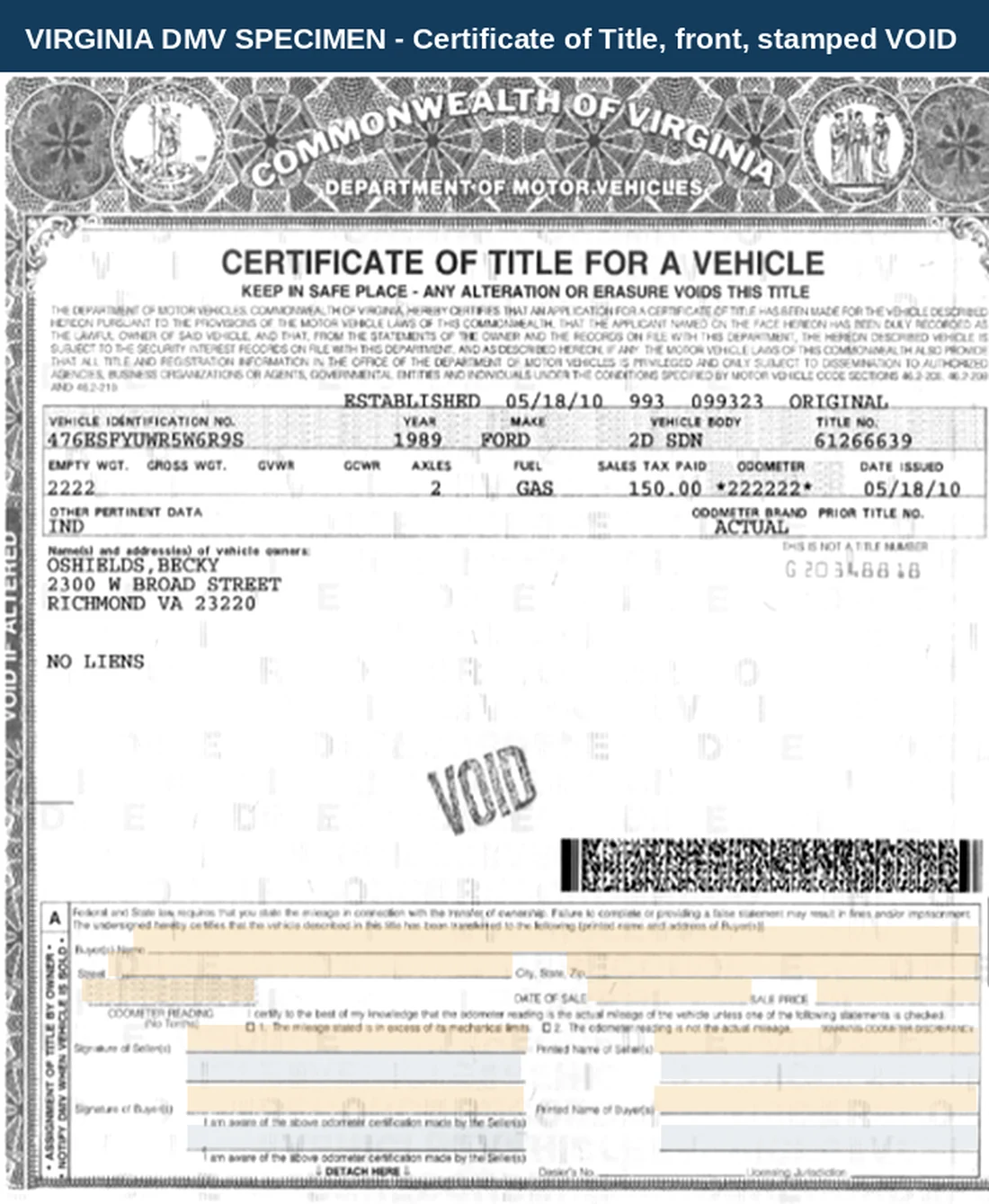
There is no blank Virginia certificate to download - it is secure stock, printed by DMV and posted to an owner or held electronically for a lender. What the department does publish is a picture of one, VOID and with its own address on it, and that picture is what this walkthrough annotates.
Any alteration or erasure voids this title - printed across the head of the certificate, and repeated as VOID IF ALTERED down both margins. There is no tidying up a Virginia assignment afterwards.
DMV's own order is the order the block is printed in: print and sign your name as seller, provide the name and address of the buyer on the top line of Section A, fill out the odometer reading using the odometer reading from the vehicle, enter the date of sale, and fill out the sale price section.
The real thing
A Virginia certificate of title, front, as the department prints it
Not a drawing. This is the Virginia DMV's own specimen, published as an image on its Submit Titling and Registration Applications by Mail page: stamped VOID through the middle, VOID IF ALTERED down both margins, the words THIS IS NOT A TITLE NUMBER printed in red above the control number, and a registered owner sitting at 2300 W Broad Street, Richmond - the department's own address, the one the same page gives for UPS and FedEx deliveries. Nobody's data is on it. Everything amber is Section A, at the foot of the sheet.
Amber — you write it, in pen
Grey — not yours to fill
Numbered — matches the steps below
Click or tap the picture to open it full size.
Read the top band before the bottom one. The odometer figure DMV already holds is printed there, between asterisks, alongside an odometer brand reading ACTUAL - and the mileage you write into Section A is the figure that will be compared against it. The department's placeholder digits on this specimen are a row of twos.
Closer in
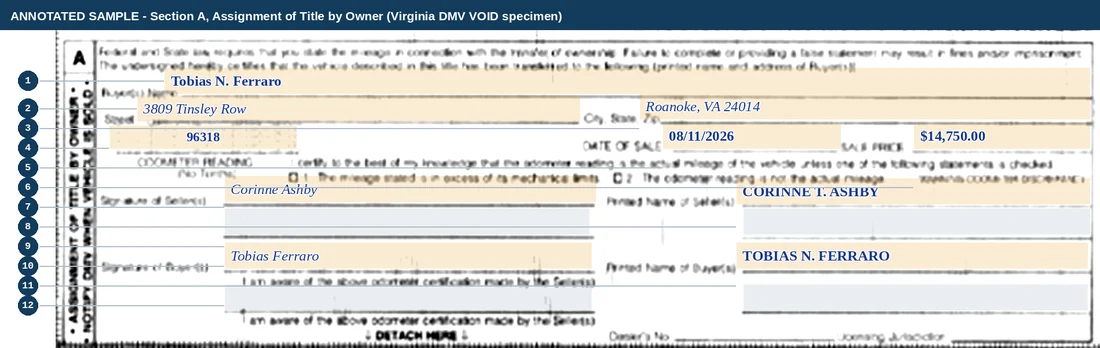
Section A, the entire private sale, filled in
Twelve blocks, and nine of them are yours. The two grey pairs are the second owner's and second buyer's lines - blank unless there really are two of each - and the last grey strip at the foot is the dealer's. Numbers in the margin match the steps further down this page.
Click or tap the picture to open it full size.
Neither exception box is ticked, and that is what an honest Virginia mileage disclosure looks like: the certification above them already says the reading is actual, so ticking nothing is the affirmative answer. Box 1 is mileage in excess of mechanical limits; box 2 is not the actual mileage, and it brands the title.
Click or tap the picture to open it full size.
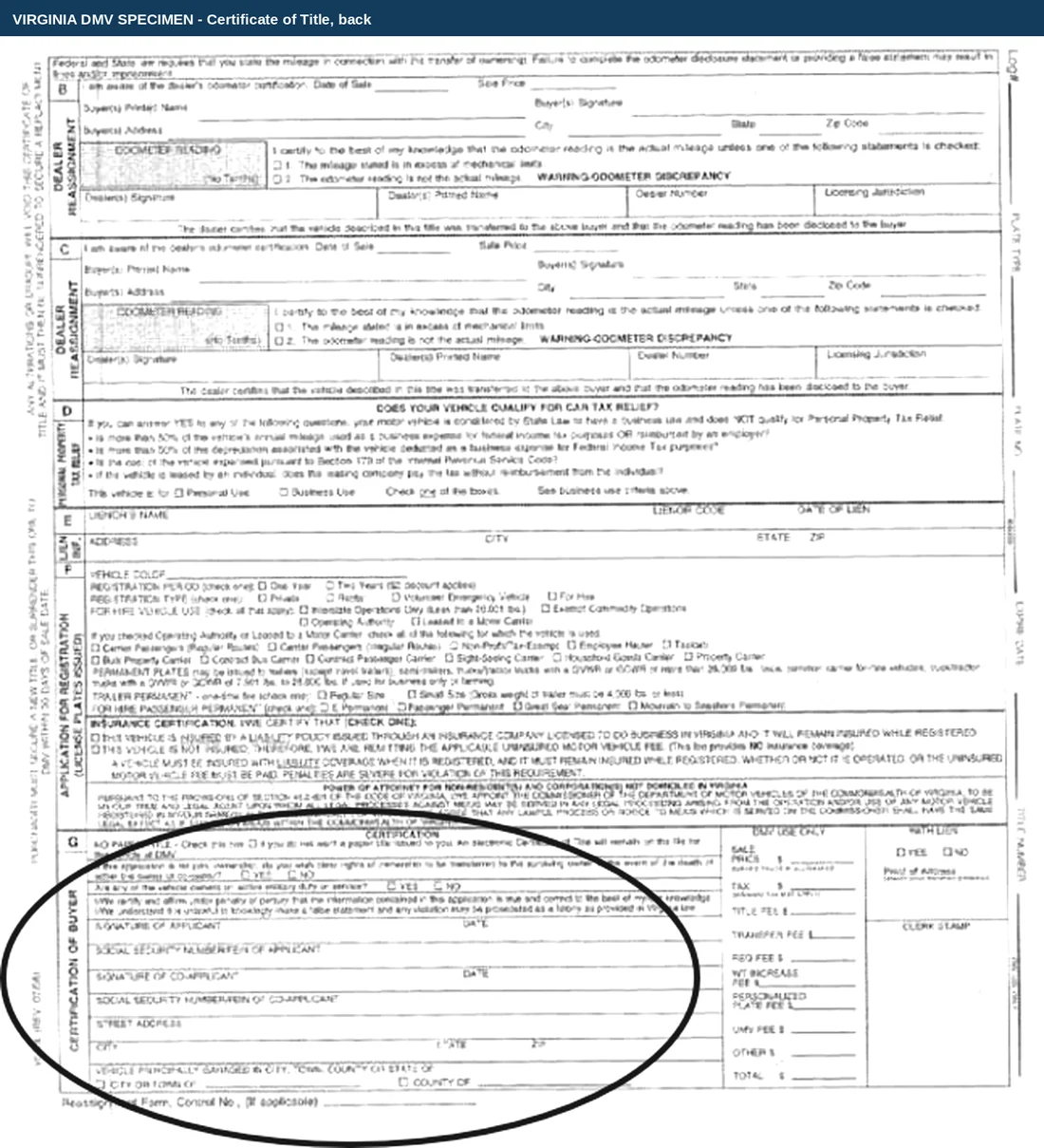
The ring is DMV's own mark, not ours - it published this picture to show where signatures go missing, and its list of common application errors names exactly that: missing signature(s) in the Certification section and on the back of the Title. One caution: this specimen is an earlier printing than the certificate DMV describes today. On it the blocks run D, E, F, G; the current Buying/Selling page names those same four blocks E, F, G and H. Go by the words printed on your own certificate, not by the letter.
Before you watch. This is DMV's advice to the person buying, not to you. Nothing in it covers assigning Section A, the plates or the notice of sale, and the vehicle-history services it names are commercial ones the department does not run.
Fifty-two seconds from the Virginia DMV, published 15 April 2025. It is addressed to buyers rather than sellers - it is the only thing on the department's channel about a private vehicle transaction at all - and it is worth a seller's minute anyway, because it describes exactly what a careful buyer will ask you to do: meet in a safe public place, produce documents, and pay by a method that leaves a trace. Nothing loads from YouTube until you press play.
Step by step
Every box, in the order you meet it
1
You fill this in
Section A, top line - the buyer's name
You write the buyer's printed name onto the first line of the block. It is your handwriting, not theirs.
Watch out: The sentence above the line spells out what it is for: the vehicle described in this title has been transferred to the following, printed name and address of buyer. Leaving it blank makes an open title and puts your signature on whatever happens next.
2
You fill this in
Section A - the buyer's street
Street address on the second line, taken off the buyer's licence rather than off a text message.
Watch out: This is the address DMV will use if anything about the sale has to be traced back. A misspelled street is the kind of error that comes back as a phone call rather than a rejection.
3
You fill this in
Section A - city, state and ZIP
The rest of the buyer's address, on the same printed rule to the right.
Watch out: Out-of-state buyers are fine here. Virginia's assignment does not care where the car is going; the buyer's own state decides what happens next with the certificate.
4
You fill this in
Section A - the odometer reading
Whole miles into the shaded box, no tenths. The printed label says so twice.
Watch out: DMV's own instruction is to use the odometer reading from the vehicle and not to guess or estimate - and its record already holds the last reading, printed on the face of this certificate. A figure lower than the one on file is what puts a title on hold.
5
You fill this in
Section A - the date of sale
The day the car actually changed hands, on the rule to the right of the mileage box.
Watch out: This is the date the buyer's thirty days under 46.2-630 start running from. Backdating it to be helpful shortens their clock rather than yours.
6
You fill this in
Section A - the sale price
The figure the buyer actually paid, in dollars, on the last rule of that row.
Watch out: Write it. DMV treats the sales price entered by the seller on the title certificate as a bill of sale, and a blank there is what forces a price certification or a valuation look-up onto the buyer.
7
You fill this in
Section A - your signature
Sign on the Signature of Seller(s) rule. If the certificate names two owners, both signatures go in - the block prints a second line for exactly that.
Watch out: Sign it in the same name the face of the certificate carries. A married name on the signature and a maiden name printed above it stops the transaction at the counter.
8
You fill this in
Section A - your printed name
Print it beside the signature, on the Printed Name of Seller(s) rule.
Watch out: Both are asked for. A signature nobody can read, with the printed line left empty, is an incomplete endorsement - and 46.2-628 makes willfully failing to endorse fully and correctly a Class 3 misdemeanour.
9
You fill this in
The second owner's pair of lines
A second signature and printed name, for a certificate issued in two names.
Watch out: Leave them alone if there is only one owner. Filling them in with the buyer's details - a genuinely common mistake, because they sit directly above the buyer's lines - crosses the two halves of the block.
10
The buyer fills this in
Section A - the buyer signs
The buyer signs on the Signature of Buyer(s) rule, under the sentence acknowledging the odometer certification the seller has just made.
Watch out: They are signing your mileage figure, not their own. That is why the reading goes in before the pen reaches this line.
11
The buyer fills this in
Section A - the buyer prints
Printed name beside the buyer's signature, closing the block.
Watch out: At this point the assignment is complete and the certificate belongs to the buyer. Everything else - tax relief, lien, registration, certification of buyer - happens on the reverse, in their hand.
12
The buyer fills this in
The second buyer's pair of lines
A second buyer signature and printed name, used only where the car is going into two names.
Watch out: Below them the sheet ends in a detach-here rule and a strip for a dealer's number and licensing jurisdiction. That strip is not yours - a private seller who writes in it has claimed to be a licensed Virginia dealer on a document signed under penalty of perjury.
Before the pen
Six habits for the block on the front
Six habits, and the first is about the one figure DMV can already check against its own record.
Read the mileage off the dashboard
DMV already holds the last figure and prints it on the face of the certificate. A reading below it puts the title on hold and can brand it NOT ACTUAL.
Nothing may be altered or erased
The sentence is printed across the head of the certificate. A crossed-out digit is a replacement title, not a correction.
Every owner on the face signs
One signature on a two-name certificate is not an assignment, however clearly the other owner agrees.
Write the price, even to a friend
The figure you enter is treated as the bill of sale. Leave it out and the buyer is sent to a price certification or a valuation guide.
Take the plates before they drive away
They belong to you and Virginia wants them back immediately if they are not going onto another car of yours.
Tell DMV afterwards
No penalty attaches, no deadline is set, and it is still the only thing that gets the vehicle off your record.
The ink rule is Virginia DMV's own: “Fill out the odometer reading using the odometer reading from the vehicle (do not guess or estimate)”
— Virginia DMV, Buying/Selling a Vehicle.
Check your source
Three Virginia rules that get repeated backwards
Three things said confidently about selling a car in Virginia. Each one has a source under it, and each one costs a seller either a wasted certificate or a suspension notice.
"Leave the plates on so the buyer can get home."
The exact opposite of Virginia's rule. DMV's instruction is that the seller should remove the license plates from the vehicle before allowing the buyer to take possession of the vehicle, and its plate page opens by saying that Virginia law requires you to immediately surrender your license plates and/or vehicle registration to DMV once the car is sold. Section 46.2-707 makes failing to surrender them, on a vehicle that is no longer insured, a Class 3 misdemeanour - and reinstatement costs a $600 noncompliance fee.
"The car is old enough that the mileage box does not apply."
Not in Virginia. Section 46.2-629(D) writes the ten-year and twenty-year ages with a second condition attached - the vehicle must also have been previously exempt from recording an odometer reading on the certificate of title in another state - so a car that has always been titled here never qualifies. Look at the paperwork and you can see it: the only exemption box on the VSA 17A reads 'Vehicle was exempt from disclosure in prior state of title', and Section A of the certificate offers no exemption box at all.
"Sell it for a dollar and there is no tax to pay."
There is a floor, not a rate. DMV states that the amount due is based on the vehicle's gross sales price, or $75, whichever is greater - so a dollar sale is taxed at seventy-five dollars, not at four cents. And on a car five years old or less, a price that is not within a $1,500 variance of the current trade-in value in the NADA Official Used Car Guide brings a notarised affidavit into the transaction rather than a saving.
Six signature rules, and four of the signatures are the seller's side of the block:
Every owner named on the face
DMV's instruction is all owners listed on the title must sign. Two names printed on the front means two signatures in Section A, whoever is doing the talking.
The seller, printed as well as signed
The block prints two lines side by side, Signature of Seller(s) and Printed Name of Seller(s), and wants both.
The buyer, in the same block
Sign and print your full name as the buyer in Section A of the title - the line underneath the seller's, above the sentence acknowledging the odometer certification.
Nobody in front of a notary
No part of Section A is sworn. Virginia's ordinary transfer has no witness, no stamp and no commission number anywhere on it.
A second buyer, if there is one
The block prints a second signature and printed-name pair for a co-buyer. Two people taking the car means both sign, and the title issues in both names.
A dealer, in a different block entirely
The two dealer reassignment blocks are on the reverse, lettered separately, and carry a dealer number and a licensing jurisdiction. A private seller never touches them.
Once it is signed
Signing is the middle of the job. What follows in Virginia is not a form you post: it is the plates coming off the car, and the order in which you surrender them and cancel the insurance.