A one-page rescue for the sale where nobody wrote the price down. Where a Virginia vehicle is more than five years old and the sales price on the certificate is missing or wrong, this is what stands in for a bill of sale - and it is the only form in the Virginia set that gives the seller a certification block of their own, worded separately from the purchaser's and signed separately.
Written against SUT 1 (06/10/2014), issued under Va. Code 58.1-2402. Age here is counted in model years against the current calendar year, and the two forms do not overlap: SUT 1 says the vehicle must be more than 5 years old, the SUT 1A says 5 years old or less. A car sitting exactly on the boundary belongs to the newer form, and that form wants a notary.
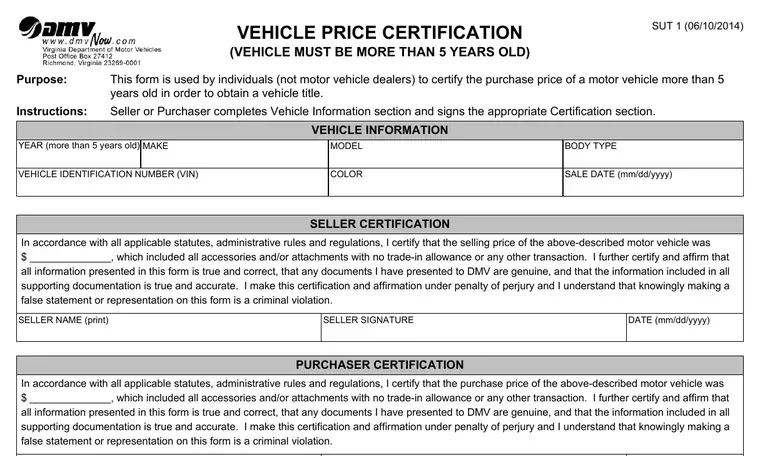
Two documents, and they are not the same thing. Take the blank SUT 1 from the dmv.virginia.gov copy so you get the revision that is current today.
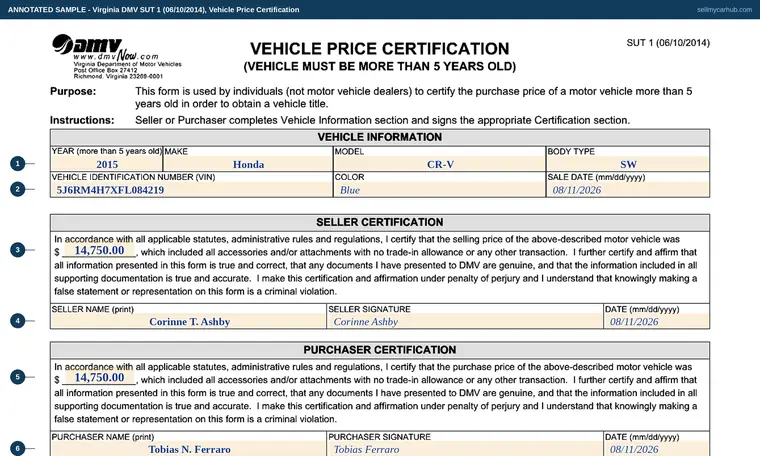
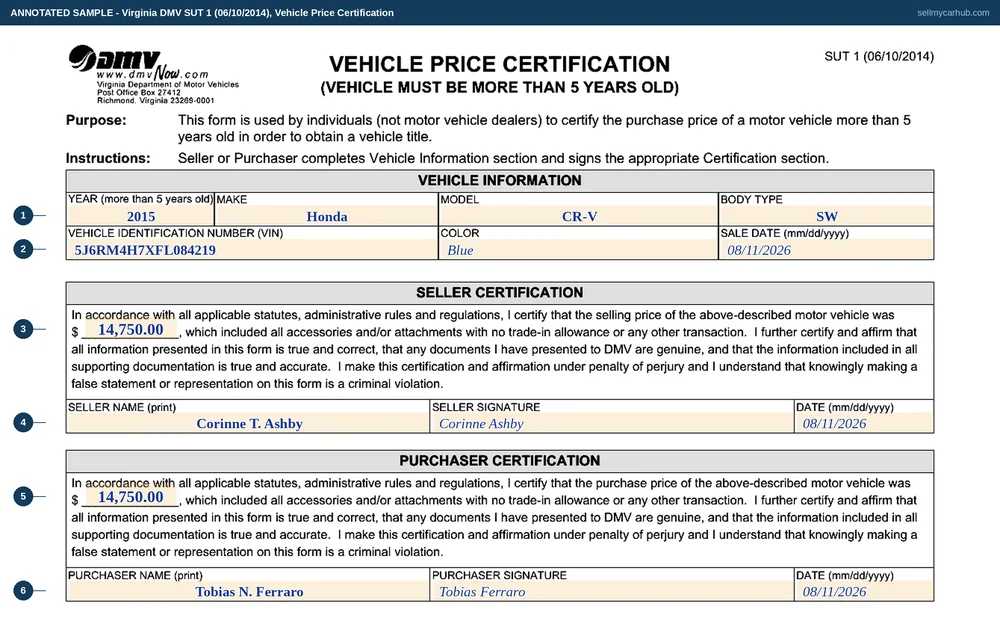
This is the actual SUT 1, rendered from the PDF the Virginia Department of Motor Vehicles publishes and completed end to end: letterhead, every field, and the blocks at the foot.
Year, make, model and body type, copied off the certificate.
Watch out: The year box carries its own condition in brackets. If it is not more than five years old this is the wrong form and the counter will say so.
The full vehicle identification number, the colour and the day the car changed hands.
Watch out: Colour is asked for here and nowhere else on the tax forms. Take it from the certificate rather than describing the paint.
The selling price, written into the blank in the middle of the printed sentence.
Watch out: Read what surrounds the blank before writing in it: all accessories and attachments are included and no trade-in allowance is deducted.
Print, sign and date. That is the end of the seller's part of this form.
Watch out: The name should match the one printed on the face of the certificate you assigned, not a shortened version of it.
The purchase price, in the buyer's own certification block below.
Watch out: It is the same number. Two different figures on one form is the fastest way to turn a formality into an investigation.
The buyer prints, signs and dates their half.
Watch out: This form travels with the title application. It is not something either party keeps - the copy that matters is DMV's.
| On the form | What to put in it |
|---|---|
| Vehicle information | Year - and the box is labelled more than 5 years old - make, model and body type across the top row; then the vehicle identification number, colour and the sale date underneath. |
| Seller certification | A printed sentence with a blank in the middle of it: the selling price of the above-described motor vehicle was, then the figure, then which included all accessories and/or attachments with no trade-in allowance or any other transaction. |
| Seller name, signature and date | Printed name on the left, signature in the middle, date on the right. This is the seller's whole involvement. |
| Purchaser certification | The same sentence again, worded as purchase price rather than selling price, with its own blank. |
| Purchaser name, signature and date | The buyer's matching row underneath. |
| The affirmation both of them sign | Identical in both blocks: that all information presented in this form is true and correct, that any documents presented to DMV are genuine, made under penalty of perjury, and that knowingly making a false statement or representation on this form is a criminal violation. |
Every line here was read off SUT 1 (06/10/2014) itself — the PDF is here — and off the Virginia Department of Motor Vehicles pages. This is plain-language help with a form, not legal advice, and where our wording and the agency's differ, theirs governs.
Back to all Virginia seller paperwork, or what selling a car in Virginia involves.