Sell My Car Hub

How to fill out Virginia VSA 17A

The sheet the buyer takes to the counter with your certificate. It applies for the new title, registers the car and works out the sales and use tax on one two-sided form - and there is no seller signature anywhere on it, because Virginia already got yours on the front of the title. What the seller does have to care about is the half of it copied straight off the certificate: the odometer figure, the price and the date, all three of which have to agree with what you wrote in Section A.

Written against VSA 17A (07/01/2024), issued under Va. Code 46.2-621 and 46.2-623. The odometer statement on this form and the one in Section A of the certificate are separate boxes that have to say the same thing. DMV's own list of common application errors on its titling-by-mail page names an incorrect or missing odometer reading first, ahead of missing signatures and a mismatched sales price - so it is the single most likely reason a Virginia application comes back in the post.

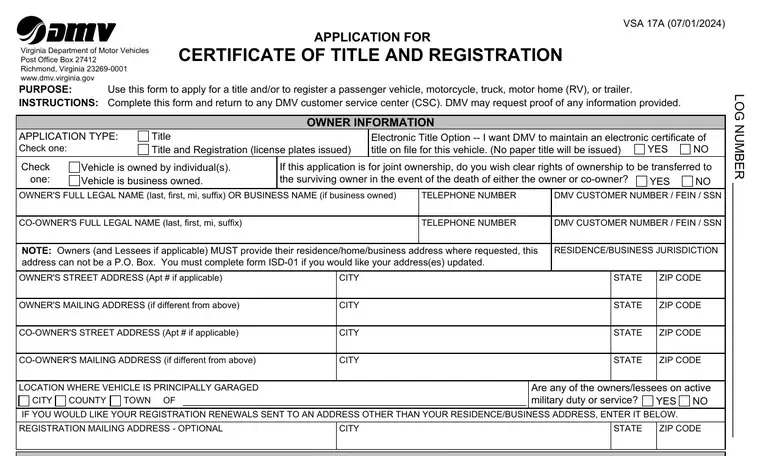
Two documents, and they are not the same thing. Take the blank VSA 17A from the dmv.virginia.gov copy so you get the revision that is current today.

Filled in

What a completed one looks like

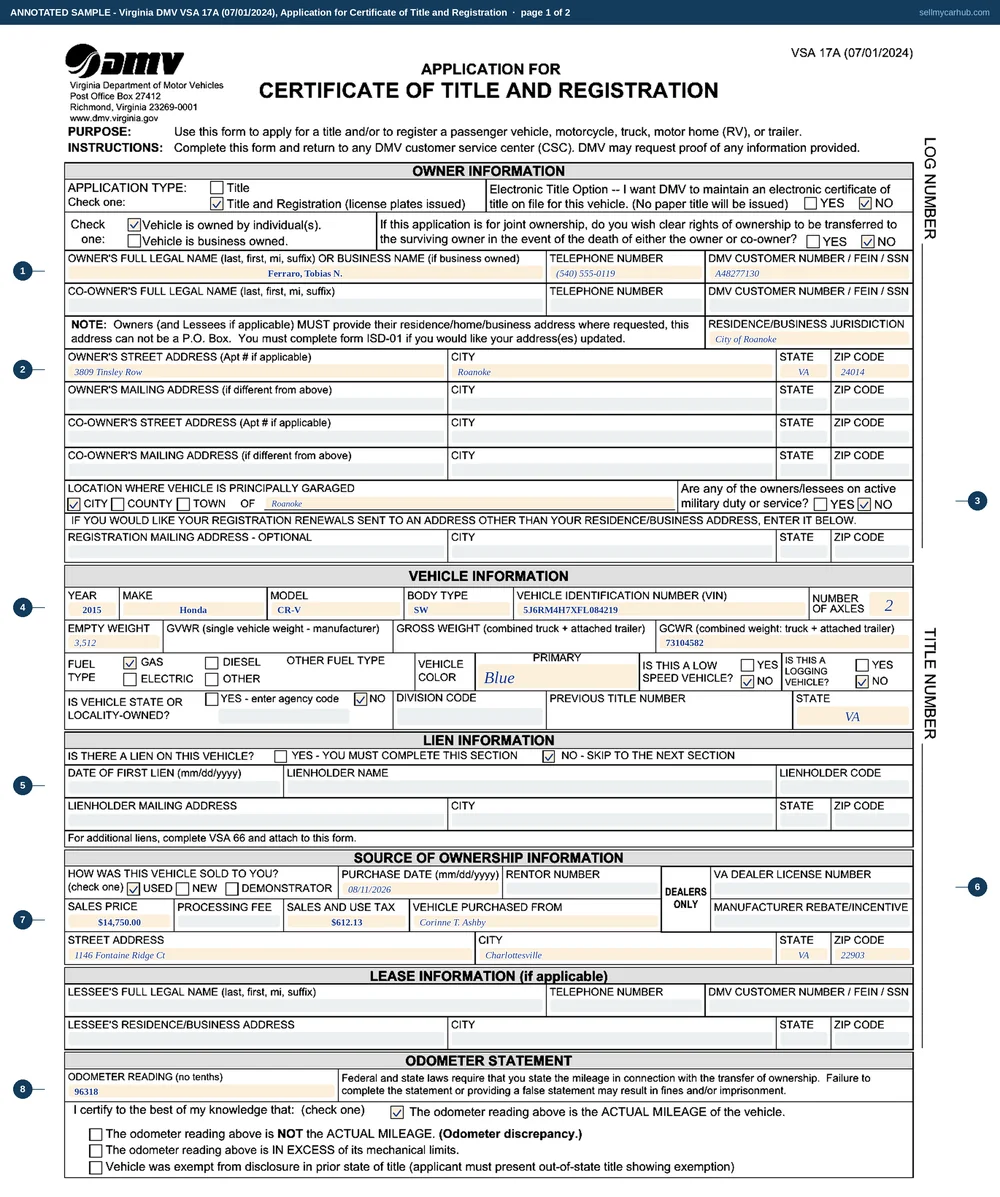
This is all 2 pages of the actual VSA 17A, rendered from the PDF the Virginia Department of Motor Vehicles publishes and completed end to end: letterhead, every field, and the blocks at the foot.

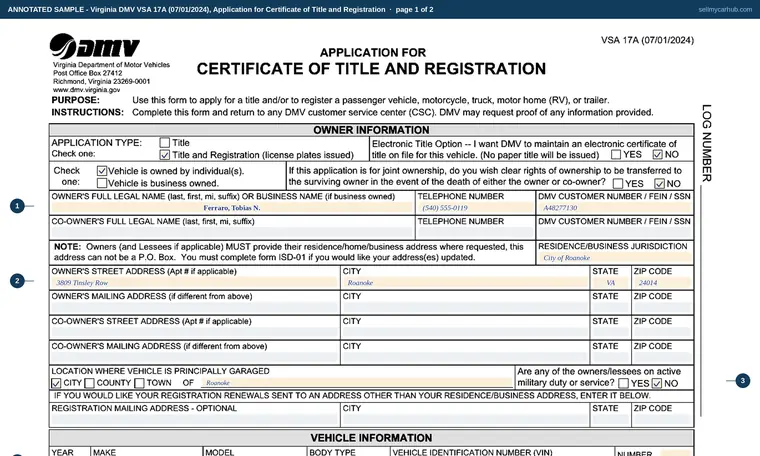
The Virginia DMV VSA 17A filled in for a buyer in Roanoke: owner information, a Charlottesville seller in the source-of-ownership block, a 2015 Honda CR-V with its vehicle identification number, no lien, a purchase date of 08/11/2026, a sales price of $14,750.00 and an odometer reading of 96318 certified as actual mileage.
Page 1 of 2. Owner, vehicle, lien, source of ownership and the odometer statement. Note what is absent - there is no seller block and no signature line on this face at all.
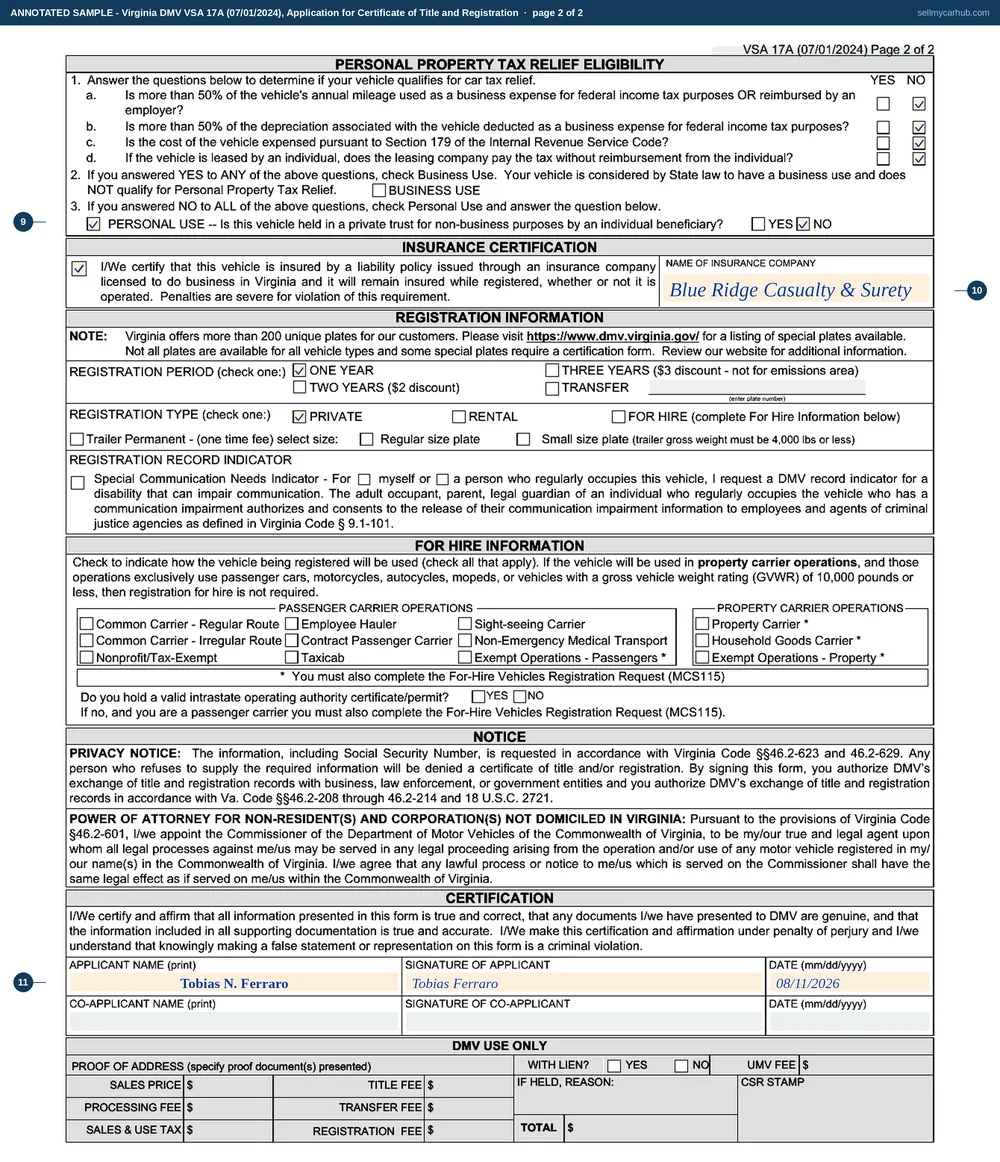
The Virginia DMV VSA 17A filled in for a buyer in Roanoke: owner information, a Charlottesville seller in the source-of-ownership block, a 2015 Honda CR-V with its vehicle identification number, no lien, a purchase date of 08/11/2026, a sales price of $14,750.00 and an odometer reading of 96318 certified as actual mileage.
Page 2 of 2. Car tax relief, insurance certification, registration and the certification the buyer signs. The DMV USE ONLY grid at the foot is where the title fee, transfer fee and sales and use tax are written by the clerk, not by you.
Field by field

Every line, in the order you meet it

  1. 1
    The buyer fills this in

    Owner information

    Full legal name in last, first, middle, suffix order, telephone, and the DMV customer number from the buyer's own licence.

    Watch out: The name has to match the licence, not the way it was written in the advert. A middle initial where the credential shows a full middle name is enough to stop it.

  2. 2
    The buyer fills this in

    The street address

    A residence address, in Virginia, with the mailing rows underneath left empty if they are the same.

    Watch out: The bold note is the only thing on the form set in that weight: the address can not be a P.O. Box.

  3. 3
    The buyer fills this in

    Where the vehicle is garaged

    A tick for city, county or town, and the name of the locality where the car will actually live.

    Watch out: This is what the local commissioner of the revenue bills against. Getting it wrong is a tax problem rather than a DMV one, which makes it the error nobody notices for a year.

  4. 4
    The buyer fills this in

    Vehicle information

    Year, make, model, body type, VIN and axles, taken off the certificate rather than off the car.

    Watch out: Compare them anyway. A VIN that reads differently on the dash plate and the title is the one discrepancy that has to be resolved before anything else happens.

  5. 5
    The buyer fills this in

    Lien information

    No lien means ticking the no box and moving on. A lien needs the date, the lienholder's name and their DMV lienholder code.

    Watch out: A second lender does not fit here. The line under the block says so: for additional liens, complete VSA 66 and attach to this form.

  6. 6
    The buyer fills this in

    Source of ownership

    Used, the purchase date, and the seller's name and address exactly as they appear in Section A of the certificate.

    Watch out: The purchase date here and the date of sale on the title are the same date. They are read together, and a difference is a question rather than a rejection.

  7. 7
    The buyer fills this in

    Sales price and sales and use tax

    The price paid, then the tax calculated on it at the rate DMV publishes, with the processing fee box left empty on a private sale.

    Watch out: Processing fee is a dealer's charge. A private seller has none, and a figure in that box on a private sale invites a query.

  8. 8
    The buyer fills this in

    The odometer statement

    The same whole-mile reading the seller wrote in Section A, with the actual mileage box ticked.

    Watch out: One tick only. The four statements are alternatives and the form is refused if two are marked.

  9. 9
    The buyer fills this in

    Personal property tax relief

    Four business-use questions, then personal use or business use, on the second page.

    Watch out: Answering all four no and then failing to tick personal use is the commonest incomplete on this page - the questions and the declaration are separate answers.

  10. 10
    The buyer fills this in

    Insurance certification

    One tick and the insurer's name, certifying the car is covered by a policy from a company licensed in Virginia and will stay covered while registered.

    Watch out: The wording is whether or not it is operated. A car sitting on a driveway with plates on it is still expected to be insured.

  11. 11
    The buyer fills this in

    Certification

    The buyer prints, signs and dates. A co-applicant signs underneath if the title is going into two names.

    Watch out: No notary, no witness. It is an affirmation under penalty of perjury and the form says a false statement on it is a criminal violation.

At a glance

What goes where

On the formWhat to put in it
Owner informationApplication type - title, or title and registration with plates issued. The electronic title option, a yes-or-no on whether DMV keeps the certificate on file instead of posting a paper one. Whether the vehicle is owned by individuals or business owned. And the survivorship question: for joint ownership, whether clear rights of ownership pass to the surviving owner on the death of either owner or co-owner.
Names, telephone and customer numberFull legal name in last, first, mi, suffix order, a telephone number, and the DMV customer number, FEIN or SSN. There is a co-owner row underneath it and a residence or business jurisdiction box to the right.
AddressesFour separate rows - owner's street address, owner's mailing address, co-owner's street, co-owner's mailing - and a bolded note that owners and lessees must give a residence, home or business address and that the address can not be a P.O. Box.
Location where vehicle is principally garagedA tick for city, county or town and the name of it. This is the line the local car tax follows, and it is about where the car sleeps rather than where the buyer collects post.
Vehicle informationYear, make, model, body type, the vehicle identification number and the number of axles; then empty weight, GVWR as a single vehicle weight from the manufacturer, gross weight and GCWR for a truck with a trailer. Fuel type, vehicle colour, and two yes-or-no ticks - is this a low speed vehicle, is this a logging vehicle. Then a previous title number and the state it came from.
Lien informationOne question with two answers, and the no branch says skip to the next section. A yes needs the date of first lien, lienholder name, lienholder code and address - and a note that for additional liens you complete a VSA 66 and attach it.
Source of ownership informationHow the vehicle was sold to you - used, new or demonstrator - the purchase date, then sales price, processing fee, sales and use tax, and who it was purchased from with their street address. The rentor number, dealer licence number and manufacturer rebate boxes beside them are marked dealers only.
Odometer statementThe reading, no tenths, and a certification with four mutually exclusive ticks: the reading above is the actual mileage; it is not the actual mileage, an odometer discrepancy; it is in excess of its mechanical limits; or the vehicle was exempt from disclosure in prior state of title, which requires the out-of-state title showing the exemption.
Personal property tax relief eligibilityFour questions on page two about business use - more than 50% of annual mileage claimed as a business expense or reimbursed by an employer, more than 50% of depreciation deducted, cost expensed under Section 179, or a leasing company paying the tax without reimbursement. Any yes means business use and no car tax relief.
Insurance certification and registrationA single tick certifying the vehicle is insured through a company licensed to do business in Virginia and will remain insured while registered, with the insurer's name beside it. Then the registration period - one year, two years with a $2 discount, three years with a $3 discount and not for an emissions area, or a transfer with a plate number - and the registration type.
CertificationApplicant name printed, signature and date, with a co-applicant row underneath. Everything above it is affirmed under penalty of perjury; nothing on the page is sworn in front of anybody.

What gets this one rejected

Rules that decide whether it is accepted

Every line here was read off VSA 17A (07/01/2024) itself — the PDF is here — and off the Virginia Department of Motor Vehicles pages. This is plain-language help with a form, not legal advice, and where our wording and the agency's differ, theirs governs.

Back to all Virginia seller paperwork, or what selling a car in Virginia involves.

Want the paperwork handled instead?

Get My Instant Offer → Online · about 2 minutes · free

Or send the details — we'll come to you

If you would rather not hand a stranger your title and hope the application behind it is filled in correctly, tell us about the car instead.

or call/text (877) 405-1808