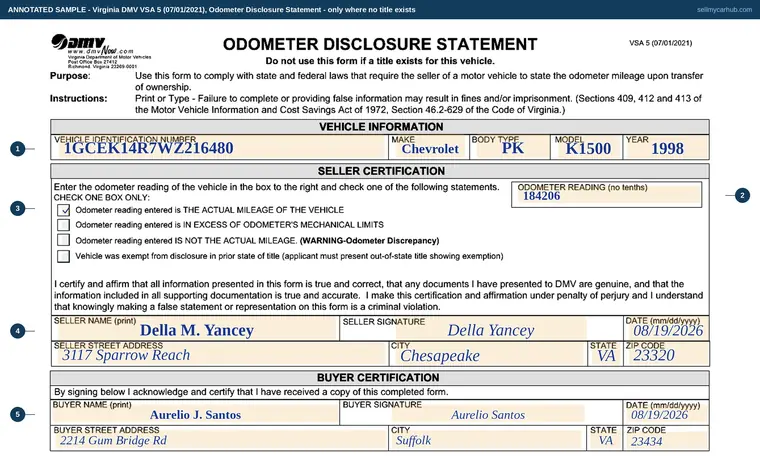
The form most Virginia sellers reach for and almost none of them need. Directly under its own title, in bold, it prints the condition: do not use this form if a title exists for this vehicle. A Virginia certificate already carries the mileage disclosure inside Section A, so this stands in only where there is no certificate to write on - a vehicle DMV has never titled, or one being titled here for the first time on other proof of ownership.
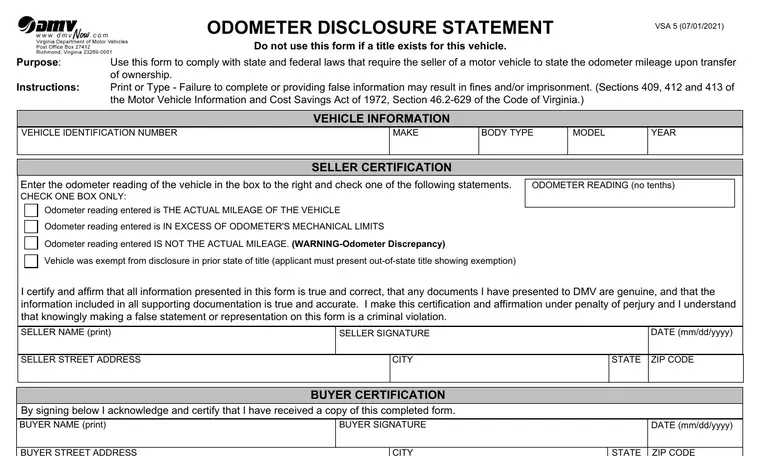
Written against VSA 5 (07/01/2021), issued under Va. Code 46.2-629 and 49 U.S.C. 32701. DMV's own forms index describes this as a form for recording odometer readings on new vehicles or for a lessee reporting to a leasing company - a description that sounds like it might cover a private sale. The form itself is narrower than the index entry, and the sentence printed on the form wins: do not use this form if a title exists for this vehicle.
Two documents, and they are not the same thing. Take the blank VSA 5 from the dmv.virginia.gov copy so you get the revision that is current today.
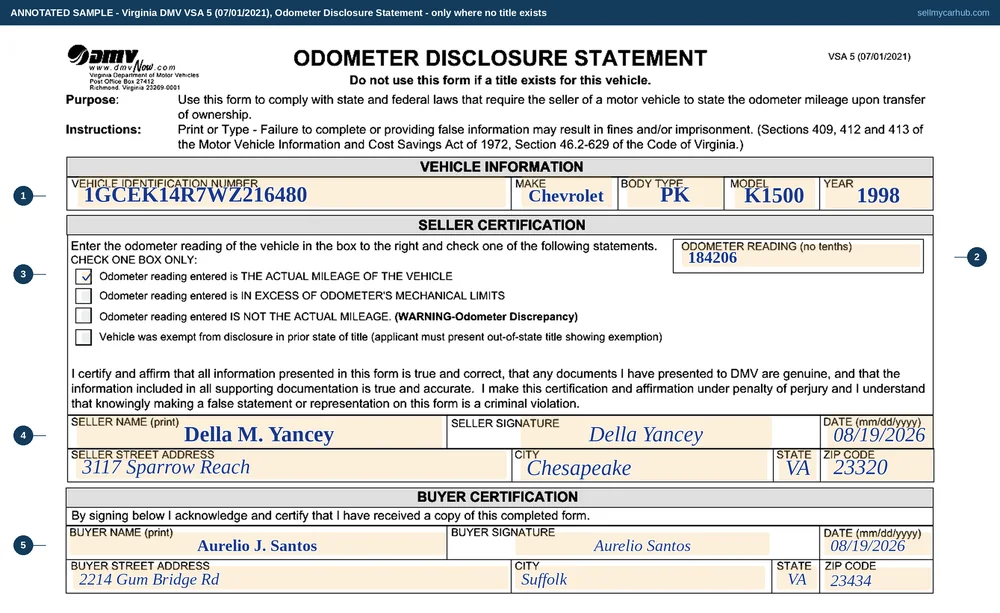
This is the actual VSA 5, rendered from the PDF the Virginia Department of Motor Vehicles publishes and completed end to end: letterhead, every field, and the blocks at the foot.
The full VIN, then make, body type, model and year.
Watch out: With no certificate to copy from, this comes off the vehicle itself. Photograph the VIN plate before you write it down.
Whole miles into the box at the top right of the seller's block.
Watch out: No tenths. Round nothing - write what the instrument shows, with the decimal digit left off.
Actual mileage, in excess of mechanical limits, not the actual mileage, or exempt in a prior state of title.
Watch out: Actual mileage is a positive claim, not a default. If the instrument is broken, the third box is the honest answer and it is better made now than argued about later.
Printed name, signature, date, then street address, city, state and ZIP.
Watch out: The address is asked for because this form may be the only record of who made the disclosure. A car with no title has no other paper trail.
The buyer prints, signs, dates and gives their own address, acknowledging that they received a copy.
Watch out: Give them the copy at the same time. The certification is about receipt, and signing for something you were not handed is how disputes start.
| On the form | What to put in it |
|---|---|
| Vehicle information | Vehicle identification number across most of the row, then make, body type, model and year in four narrow boxes to the right. |
| Odometer reading | One box, top right of the seller's block, labelled no tenths. |
| Check one box only | Four ticks and the instruction is explicit that only one is used: the reading is the actual mileage of the vehicle; it is in excess of the odometer's mechanical limits; it is not the actual mileage, with a bracketed warning of odometer discrepancy; or the vehicle was exempt from disclosure in prior state of title, which requires the out-of-state title showing the exemption. |
| Seller certification | Printed name, signature and date, then a second row for the seller's street address, city, state and ZIP code. |
| Buyer certification | A single printed sentence - by signing below I acknowledge and certify that I have received a copy of this completed form - then the buyer's printed name, signature, date and address. |
| The statutory footnote | The instruction line cites Sections 409, 412 and 413 of the Motor Vehicle Information and Cost Savings Act of 1972 and Section 46.2-629 of the Code of Virginia, and warns that failure to complete it or providing false information may result in fines and/or imprisonment. |
Every line here was read off VSA 5 (07/01/2021) itself — the PDF is here — and off the Virginia Department of Motor Vehicles pages. This is plain-language help with a form, not legal advice, and where our wording and the agency's differ, theirs governs.
Back to all Virginia seller paperwork, or what selling a car in Virginia involves.