The newer car's version of the same problem, and the one that costs an appointment. Where the vehicle is five years old or less, a bill of sale is not enough on its own - DMV wants the purchase price sworn, and the instruction line says so in seven words: complete the form, have it notarized and submit it with other titling paperwork. It is one of only two forms in the whole Virginia seller's set that a notary ever touches.
Written against SUT 1A (08/10/2017), issued under Va. Code 58.1-2402. Nothing on this form asks the seller for anything, which is exactly why sellers get caught by it. A buyer who discovers at the counter that the price needs swearing has to leave, find a notary and come back - and if the price was low because the two of you agreed it was low, the seller is the person they will telephone from the queue.
Two documents, and they are not the same thing. Take the blank SUT 1A from the dmv.virginia.gov copy so you get the revision that is current today.
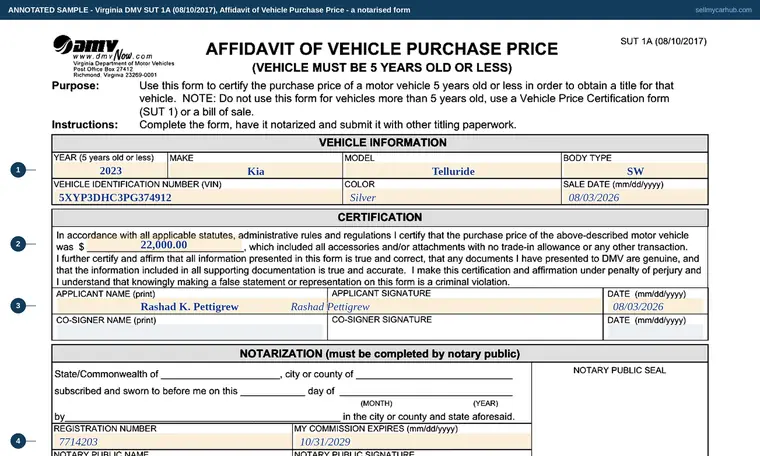
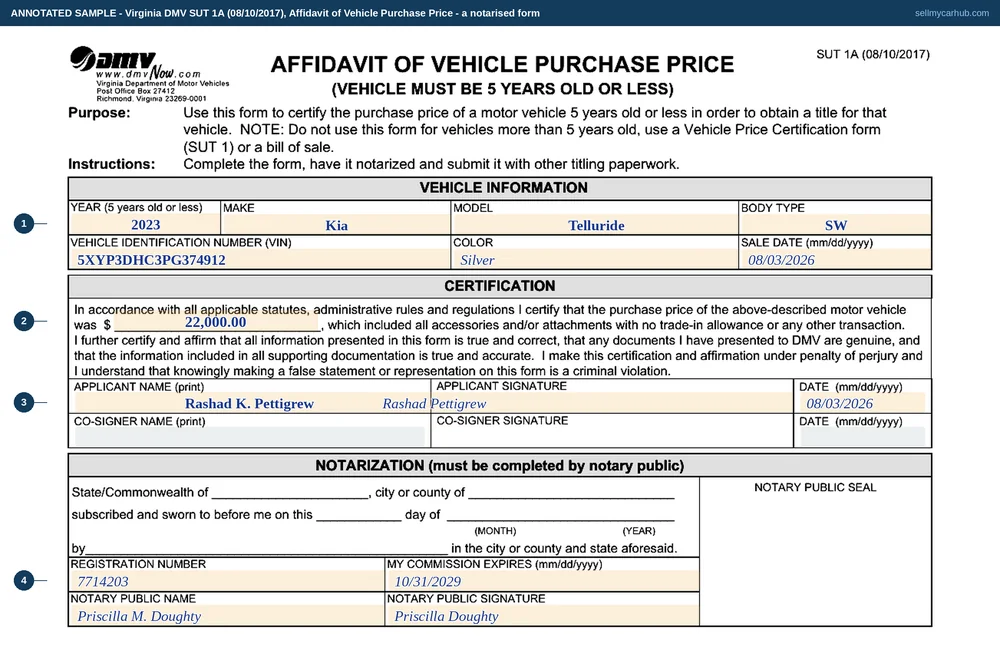
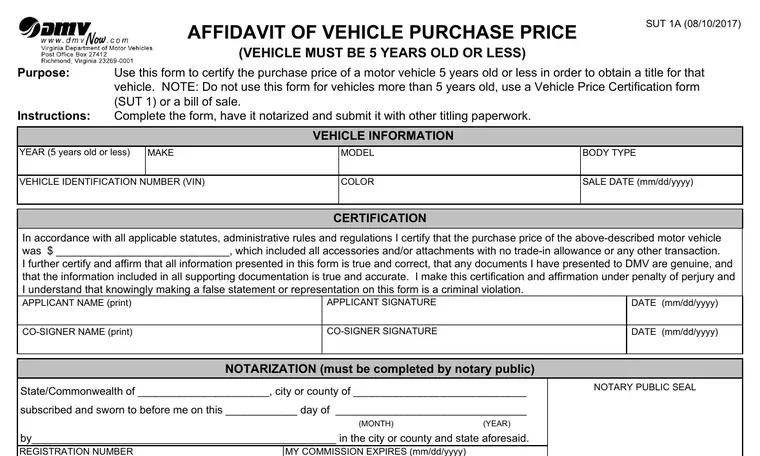
This is the actual SUT 1A, rendered from the PDF the Virginia Department of Motor Vehicles publishes and completed end to end: letterhead, every field, and the blocks at the foot.
Year, make, model and body type, with the year box carrying its own five-year limit.
Watch out: Model year, not the date it was bought. A 2021 car bought new in 2022 is still a 2021.
The figure paid, written into the blank in the certification sentence.
Watch out: Accessories and attachments are in; a trade-in allowance is not deducted. The sentence around the blank says both.
Printed name, signature and date - made in front of the notary, not at the kitchen table.
Watch out: A co-signer going onto the title signs the row underneath, and has to be standing there too.
The notary completes state, city or county, the day, month and year, the name of the person who appeared, their own registration number, commission expiry, name and signature.
Watch out: Check the commission expiry before you leave. A notarisation dated after the commission ran out is worth nothing, and nobody at the counter will notice until the file is opened.
| On the form | What to put in it |
|---|---|
| Vehicle information | Year - the box is labelled 5 years old or less - make, model and body type; then the vehicle identification number, colour and the sale date. |
| Certification | One sentence with a blank in it, certifying that the purchase price of the above-described motor vehicle was a stated figure, which included all accessories and/or attachments with no trade-in allowance or any other transaction. |
| Applicant name, signature and date | The buyer prints, signs and dates. This is an applicant's affidavit, not a joint one - the seller has no block on this form at all. |
| Co-signer name, signature and date | A second row for a co-purchaser going onto the title. |
| Notarization | A block headed must be completed by notary public: state or commonwealth, city or county, the day, month and year, and the name of the person who appeared. Then registration number, commission expiry date, notary public name and notary public signature, with a seal panel beside them. |
Every line here was read off SUT 1A (08/10/2017) itself — the PDF is here — and off the Virginia Department of Motor Vehicles pages. This is plain-language help with a form, not legal advice, and where our wording and the agency's differ, theirs governs.
Back to all Virginia seller paperwork, or what selling a car in Virginia involves.