Sell My Car Hub

How to fill out Virginia VSA 67

One form, two different remedies, and Virginia keeps them strictly apart. A replacement is for a certificate that has gone - lost, mutilated or illegible - and reissues the same information. A substitute is for a certificate whose information has changed, and it invalidates every earlier one. Section 4 does the first, section 5 does the second, and you sign in one of them, never both.
Written against VSA 67 (07/01/2020), issued under Va. Code 46.2-607. The word replacement is doing a lot of work here and it does not mean what it means in ordinary speech. If anything about the certificate is wrong rather than missing - a misspelled name, a married name, a new address you want printed - that is a substitute in section 5, and applying for a replacement instead reissues the same mistake at the same fee.

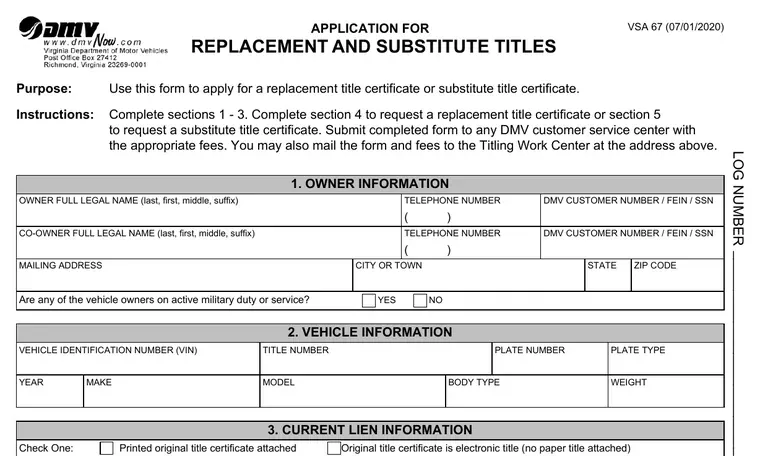
Two documents, and they are not the same thing. Take the blank VSA 67 from the dmv.virginia.gov copy so you get the revision that is current today.

Filled in

What a completed one looks like

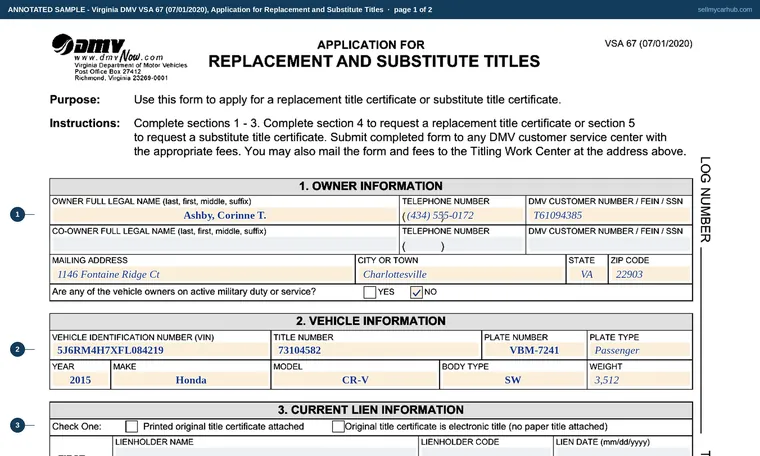
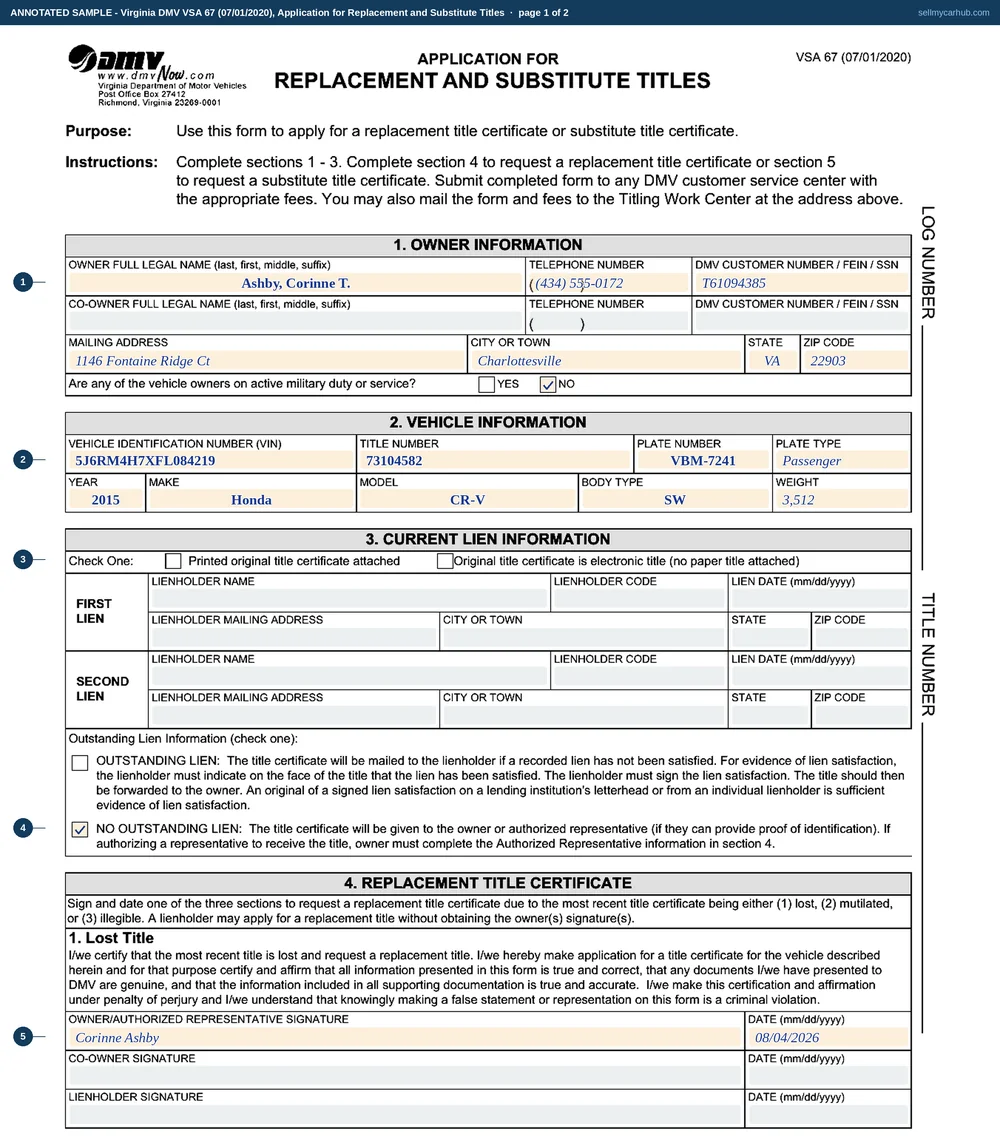
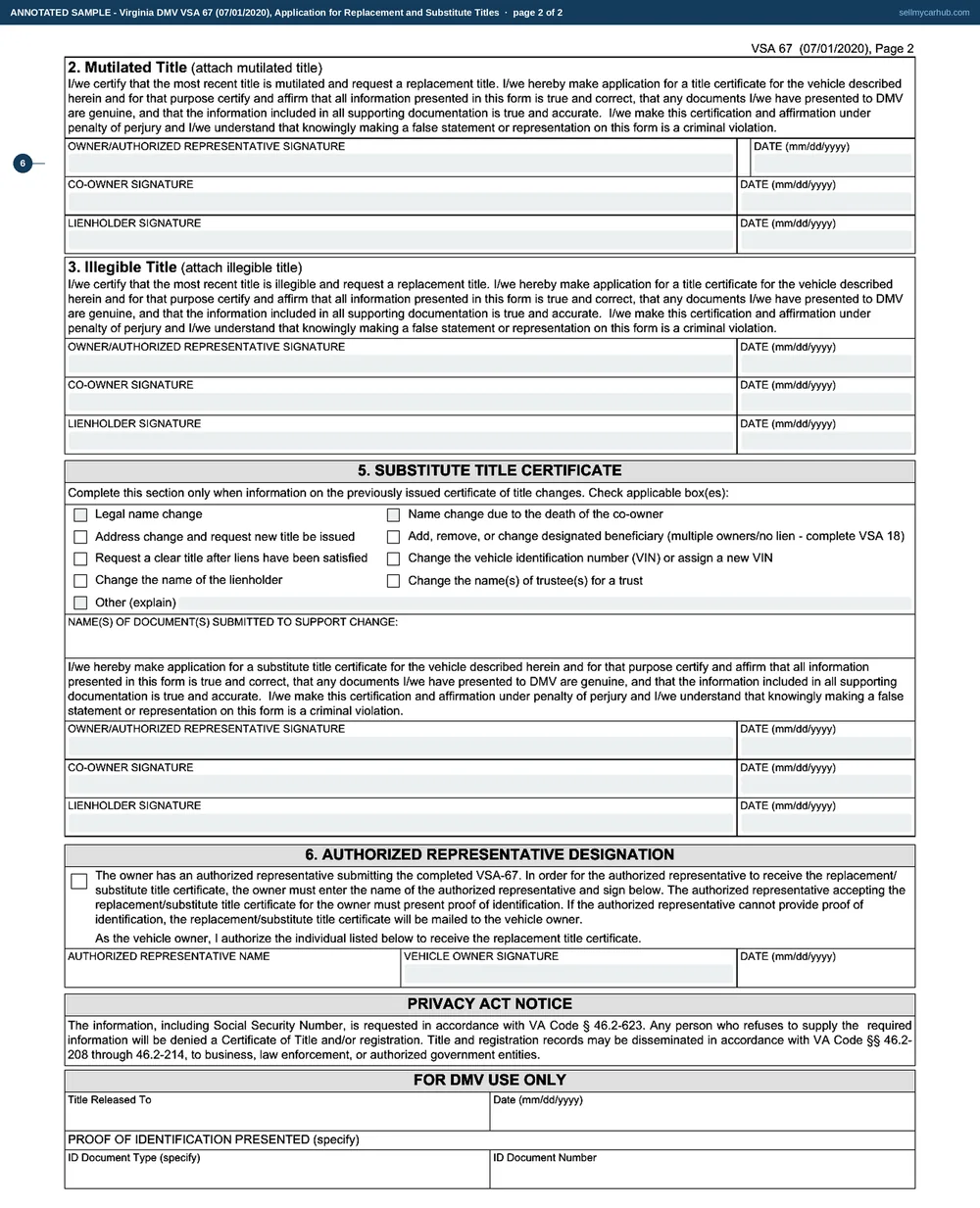
This is all 2 pages of the actual VSA 67, rendered from the PDF the Virginia Department of Motor Vehicles publishes and completed end to end: letterhead, every field, and the blocks at the foot.

The Virginia DMV VSA 67 filled in as a lost-title replacement: owner Corinne T. Ashby of Charlottesville, a 2015 Honda CR-V with its title and plate numbers, the no-outstanding-lien box ticked, and the owner's signature dated 08/04/2026 in the lost title block.
Page 1 of 2. Owner, vehicle, the lien position and the lost-title block signed. The two remaining replacement blocks and the whole of section 5 are greyed because only one of them is ever used.
The Virginia DMV VSA 67 filled in as a lost-title replacement: owner Corinne T. Ashby of Charlottesville, a 2015 Honda CR-V with its title and plate numbers, the no-outstanding-lien box ticked, and the owner's signature dated 08/04/2026 in the lost title block.
Page 2 of 2. The rest of section 4, section 5's substitute ticks, and the authorised representative designation.
Field by field

Every line, in the order you meet it

  1. 1
    You fill this in

    Section 1, owner information

    Names, telephone, customer number, mailing address, active duty question.

    Watch out: The address here is where the certificate will be posted. If you have moved since the title was issued, that is a substitute, not a replacement.

  2. 2
    You fill this in

    Section 2, the vehicle

    VIN, title number, plate number and type, year, make, model, body type, weight.

    Watch out: No title number to hand? The registration card carries it, and so does the DMV account the buyer will be using anyway.

  3. 3
    You fill this in

    Paper or electronic

    The pair of ticks in section 3, telling DMV whether a printed certificate exists in the world or the record is electronic with nothing on paper.

    Watch out: Neither statement fits a lost certificate cleanly, which is why the sample leaves the pair alone - but read them anyway. On a loan that has just been paid off the second one is usually the truth: the title was held electronically and never printed, so nothing has been lost and what you actually need is a printed copy.

  4. 4
    You fill this in

    The outstanding lien choice

    Outstanding, and the certificate goes to the lienholder; none, and it comes to you.

    Watch out: Ticking none while a lien is still recorded does not make it untrue. DMV posts to the lienholder either way and you have simply delayed yourself.

  5. 5
    You fill this in

    One of the three replacement blocks

    Lost, mutilated or illegible - signed and dated in that block only.

    Watch out: Mutilated and illegible both require the certificate itself in the envelope. Lost is the only one that does not.

  6. 6
    You fill this in

    Section 5, if it is a substitute instead

    The tick describing what has changed, and the documents that prove it.

    Watch out: A married name needs the marriage certificate; a beneficiary change needs a VSA 18 alongside. The documents line is where you list what you have enclosed.

At a glance

What goes where

On the formWhat to put in it
Section 1, owner informationOwner and co-owner full legal names, telephone numbers, DMV customer number, FEIN or SSN, a mailing address, and the active military duty question.
Section 2, vehicle informationVehicle identification number, title number, plate number and plate type; then year, make, model, body type and weight.
Section 3, current lien informationA tick for printed original title certificate attached or original title certificate is electronic, then first and second lien blocks. Underneath, an outstanding-lien choice: an outstanding lien means the certificate will be mailed to the lienholder unless the lien has been satisfied on the face of the title and signed by the lienholder; no outstanding lien means it is given to the owner or an authorised representative who can prove their identity.
Section 4, replacement title certificateThree separately signed blocks - lost title, mutilated title with the mutilated title attached, and illegible title with the illegible title attached. Each has its own owner, co-owner and lienholder signature lines and dates, and each carries the full certification wording.
Section 5, substitute title certificateA list of ticks: legal name change; address change with a new title issued; a clear title after liens have been satisfied; changing the lienholder's name; a name change due to the death of the co-owner; adding, removing or changing a designated beneficiary; changing or assigning a vehicle identification number; changing the names of trustees for a trust; and other, with a blank. Then a line for the names of documents submitted to support the change.
Section 6, authorised representative designationWhere somebody else is to collect the certificate: their name, the vehicle owner's signature and a date, with the representative required to show proof of identification or the title goes to the owner by post.

What gets this one rejected

Rules that decide whether it is accepted

Every line here was read off VSA 67 (07/01/2020) itself — the PDF is here — and off the Virginia Department of Motor Vehicles pages. This is plain-language help with a form, not legal advice, and where our wording and the agency's differ, theirs governs.

Back to all Virginia seller paperwork, or what selling a car in Virginia involves.

Want the paperwork handled instead?

Get My Instant Offer → Online · about 2 minutes · free

Or send the details — we'll come to you

Waiting on a replacement certificate before you can sell is dead time. Get an offer now and time the two together.

or call/text (877) 405-1808