Sell My Car Hub

How to fill out Virginia VSA 12

The route when the certificate cannot be produced at all - lost, unlawfully detained by somebody who holds it, or otherwise not available - and a replacement is not the answer because there is nothing on DMV's record to replace. It is a sworn affidavit, it is one of only two notarised forms in the Virginia set, and it never travels alone: DMV requires it to be submitted with whichever application is being made underneath it.
Written against VSA 12 (10/29/2025), issued under Va. Code 46.2-632. This is the slow road and it should be the second choice. If DMV's record shows a certificate was issued to you and it is simply lost, the replacement application is faster, cheaper and needs no notary. The affidavit is for the case where a replacement will not work - somebody else is holding the paper, or the ownership trail itself has a hole in it.

Two documents, and they are not the same thing. Take the blank VSA 12 from the dmv.virginia.gov copy so you get the revision that is current today.

Filled in

What a completed one looks like

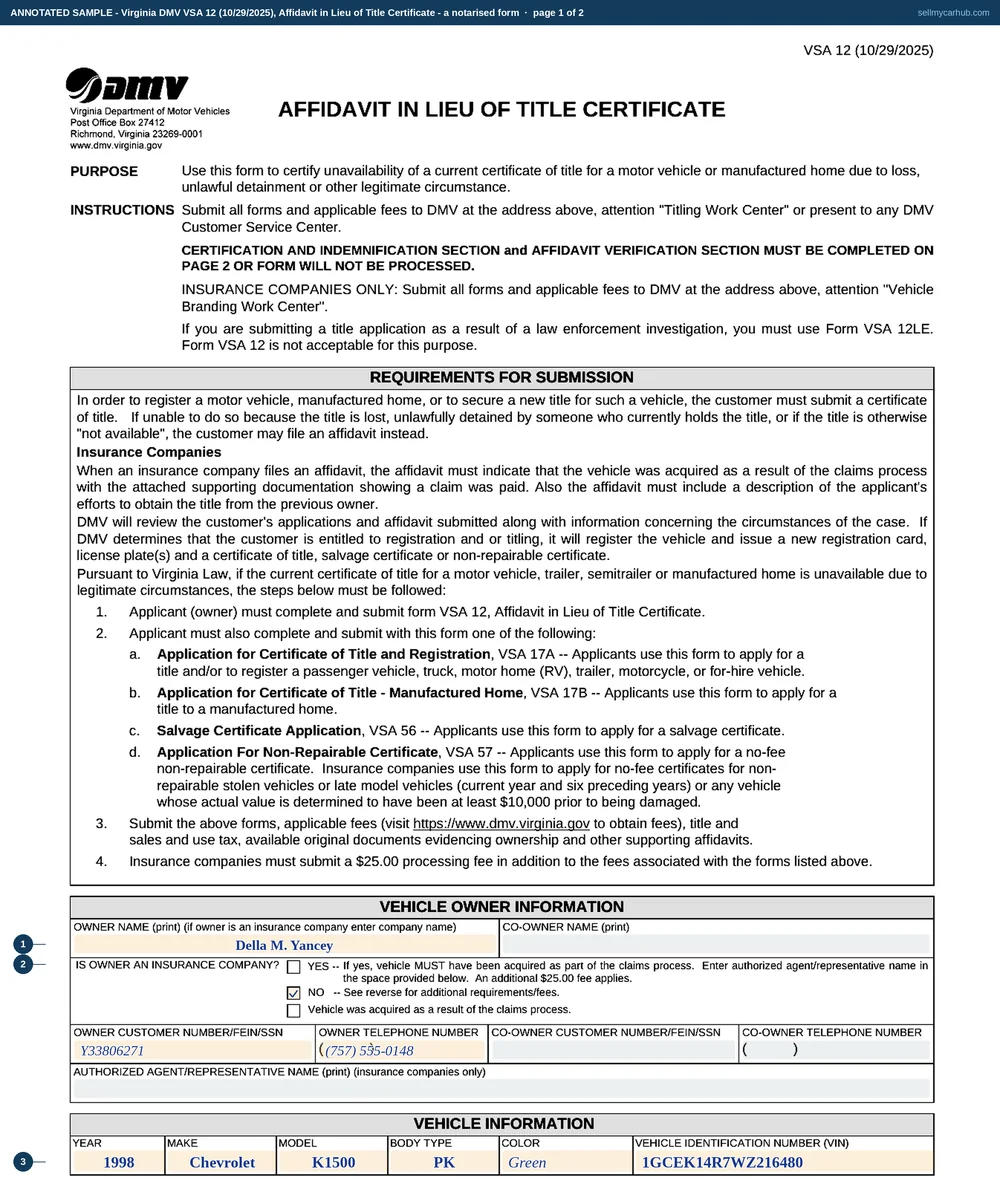
This is all 2 pages of the actual VSA 12, rendered from the PDF the Virginia Department of Motor Vehicles publishes and completed end to end: letterhead, every field, and the blocks at the foot.

The Virginia DMV VSA 12 filled in for a 1998 Chevrolet K1500 whose certificate cannot be found: owner Della M. Yancey of Chesapeake, the insurance-company question answered no, the vehicle described, a written account on page two of how the truck was acquired and every place the title was searched for, and a completed notarisation block.
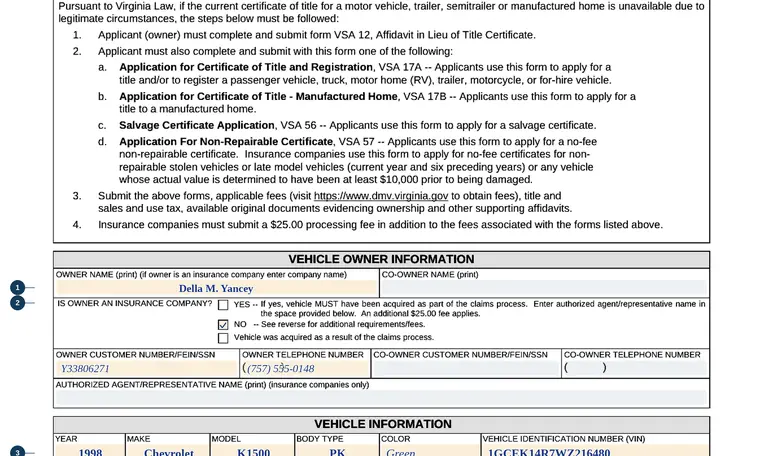
Page 1 of 2. The instructions that occupy most of the first page, then the owner block and the vehicle. The insurance-company branch is greyed - it is not the private owner's route.
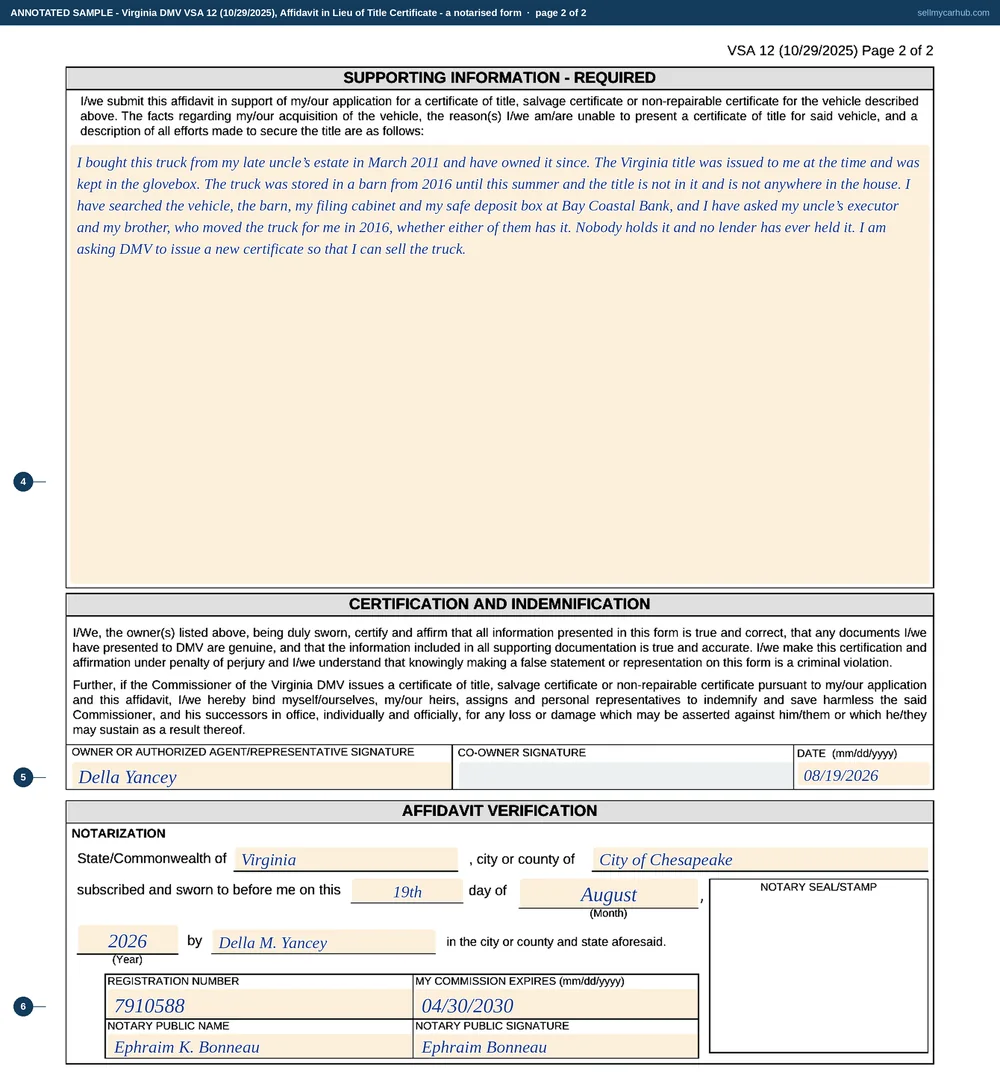
The Virginia DMV VSA 12 filled in for a 1998 Chevrolet K1500 whose certificate cannot be found: owner Della M. Yancey of Chesapeake, the insurance-company question answered no, the vehicle described, a written account on page two of how the truck was acquired and every place the title was searched for, and a completed notarisation block.
Page 2 of 2. The supporting information box, the indemnity you are signing, and the notarisation that makes it an affidavit.
Field by field

Every line, in the order you meet it

  1. 1
    You fill this in

    Vehicle owner information

    The owner's printed name, and the answer no to the insurance-company question.

    Watch out: The insurance branch adds a fee and its own evidence requirements. A private owner ticks no and moves on.

  2. 2
    You fill this in

    Customer number and telephone

    DMV customer number, FEIN or SSN and a telephone number.

    Watch out: Give a number you answer. This application is reviewed by a person and questions come back by phone.

  3. 3
    You fill this in

    Vehicle information

    Year, make, model, body type, colour and VIN.

    Watch out: Colour is asked for here. With no certificate to copy, it comes off the car - and it should match what DMV holds on its record.

  4. 4
    You fill this in

    The supporting information box

    Three things: how you acquired the vehicle, why you cannot present the certificate, and everything you did to find it.

    Watch out: Names and places, not adjectives. Who was asked, where it was searched, when it was last seen - that is what an examiner can weigh.

  5. 5
    You fill this in

    Certification and indemnification

    Sign and date, having read what the second paragraph binds you to.

    Watch out: The indemnity runs to your heirs and personal representatives. It is worth reading once rather than skimming.

  6. 6
    You fill this in

    The notary

    Sworn in front of a notary, who completes the verification block and applies a seal.

    Watch out: Take identification. A notary who cannot satisfy themselves who you are will not complete the block, and the form is refused without it.

At a glance

What goes where

On the formWhat to put in it
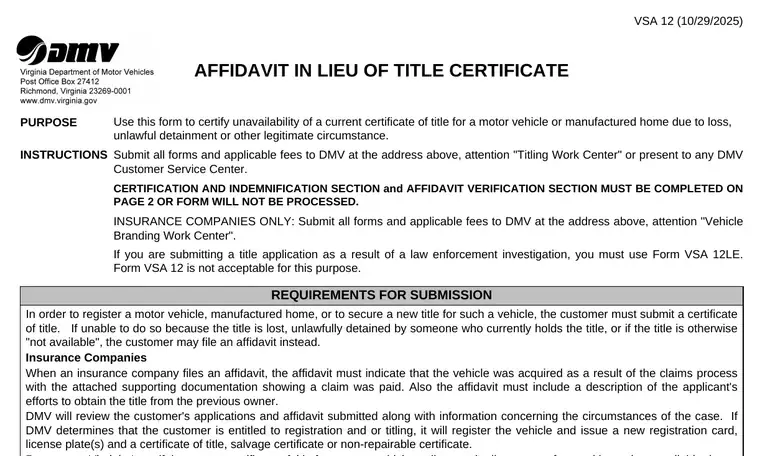
Requirements for submissionA full page of instructions before any box. It lists the four applications this affidavit can accompany - the VSA 17A for a passenger vehicle, truck, motor home, trailer or motorcycle; the VSA 17B for a manufactured home; the VSA 56 for a salvage certificate; and the VSA 57 for a no-fee non-repairable certificate - and sets out the insurance-company variant separately.
Vehicle owner informationOwner name printed, or the company name where the owner is an insurance company, with a co-owner box. A three-way tick asks whether the owner is an insurance company, with the yes branch requiring the vehicle to have been acquired as part of the claims process and adding a $25.00 fee, and a third tick confirming the vehicle was acquired as a result of the claims process.
Customer numbers and telephoneOwner customer number, FEIN or SSN and telephone; the same again for a co-owner; then an authorised agent or representative name marked insurance companies only.
Vehicle informationYear, make, model, body type, colour and the vehicle identification number.
Supporting information, requiredA very large free-text box on page two, headed with what it is for: the facts regarding acquisition of the vehicle, the reasons the certificate cannot be presented, and a description of all efforts made to secure the title.
Certification and indemnificationThe owner, being duly sworn, certifies the information is true and then binds themselves, their heirs, assigns and personal representatives to indemnify and save harmless the Commissioner and his successors in office for any loss or damage arising from the certificate being issued.
Affidavit verificationThe notarisation: state or commonwealth, city or county, the day, month and year, the name of the person who appeared, the notary's registration number, commission expiry, printed name and signature, and a seal panel.

What gets this one rejected

Rules that decide whether it is accepted

Every line here was read off VSA 12 (10/29/2025) itself — the PDF is here — and off the Virginia Department of Motor Vehicles pages. This is plain-language help with a form, not legal advice, and where our wording and the agency's differ, theirs governs.

Back to all Virginia seller paperwork, or what selling a car in Virginia involves.

Want the paperwork handled instead?

Get My Instant Offer → Online · about 2 minutes · free

Or send the details — we'll come to you

A car you own but cannot prove you own is the hardest thing to sell privately. Describe it to us and we will tell you what is possible.

or call/text (877) 405-1808