Where a badly damaged car stops being a car with a title and becomes a thing with a certificate. Two very different outcomes on one sheet: a salvage certificate, which can be rebuilt back onto the road through an inspection process, and a non-repairable certificate, which cannot - it is parts or scrap and the vehicle never comes back. The form is free to file and it is the ticks at the top that decide which of those you get.
Written against RV-F1311801 (Rev 1-21), issued under Tenn. Code Ann. 55-3-201. Seventy-five per cent of retail value is the statutory threshold, and it is the insurer's figure that usually crosses it. If you are still holding the vehicle after a settlement, the choice between the two boxes decides whether the car has a future.
Two documents, and they are not the same thing. Take the blank RV-F1311801 from the tn.gov copy so you get the revision that is current today.
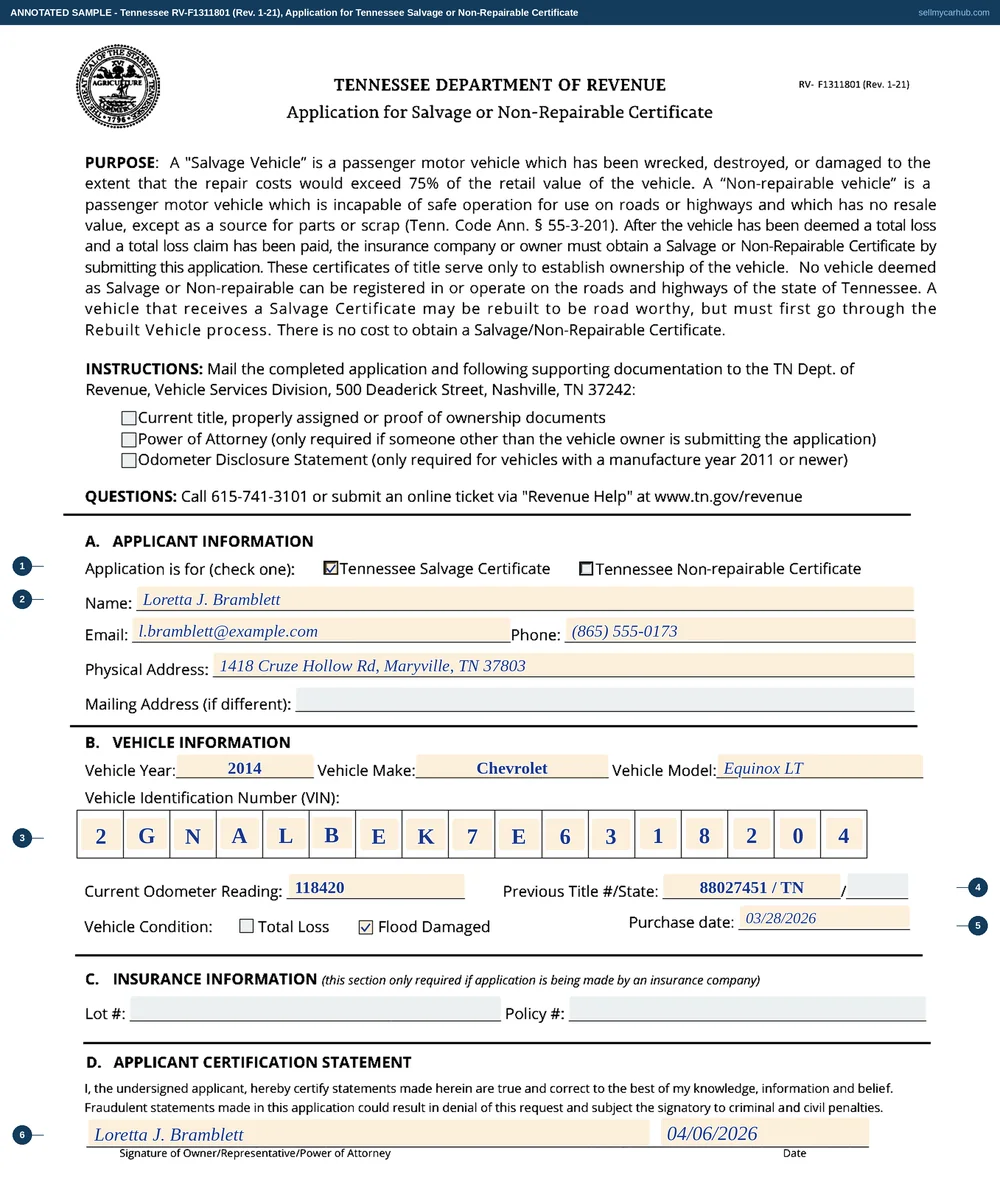
This is the actual RV-F1311801, rendered from the PDF the Tennessee Department of Revenue publishes and completed end to end: letterhead, every field, and the blocks at the foot.
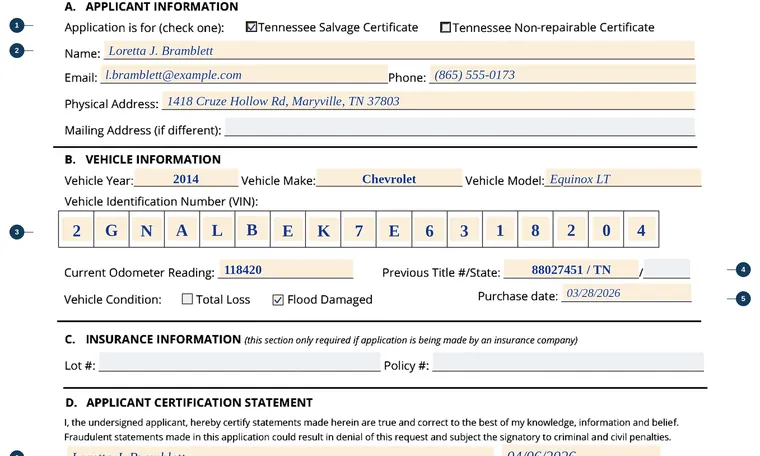
One tick at the top of block A, and it is the most consequential mark on the form.
Watch out: Salvage keeps a route back to the road through the rebuilt process. Non-repairable does not, and no later application undoes it.
Name, email, phone and physical address, with a mailing address if it differs.
Watch out: The certificate comes back by post, so the mailing address is the one that matters. This is a Nashville transaction, not a counter one.
Year, make and model, then the vehicle identification number one character per printed box.
Watch out: Write it from the title, then check it against the dash plate. A salvage record attaches to the number, and the wrong number brands a stranger's car.
The current reading, and the number and state of the title being surrendered.
Watch out: For a model year 2011 or newer vehicle an Odometer Disclosure Statement goes in the envelope as well - it is the third line of the instruction list.
Total loss or flood damaged, and the date you acquired the vehicle.
Watch out: Flood is a brand in its own right in Tennessee and it follows the vehicle. Ticking total loss on a flooded car understates what the next owner needs to know.
Block D, then the application with the assigned title and any power of attorney to the Vehicle Services Division.
Watch out: Section C stays empty unless an insurance company is applying. If the insurer has taken the car, it is their application and a different form governs the case where you never sent the title back.
| On the form | What to put in it |
|---|---|
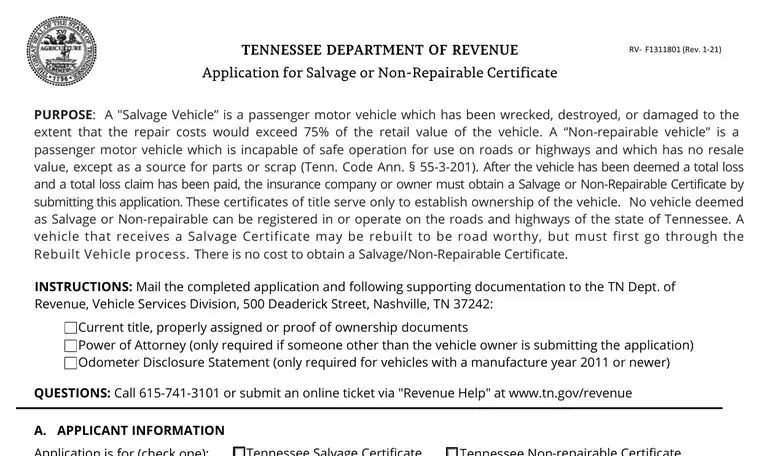
| The two definitions | Printed at the head. A salvage vehicle is a passenger motor vehicle wrecked, destroyed or damaged to the extent that repair costs would exceed 75 per cent of its retail value. A non-repairable vehicle is one incapable of safe operation with no resale value except as a source for parts or scrap. |
| Application is for | Two boxes: Tennessee Salvage Certificate, or Tennessee Non-repairable Certificate. |
| A. Applicant information | Name, email, phone, physical address and a mailing address if different. |
| B. Vehicle information | Vehicle year, make and model, then the vehicle identification number in seventeen printed cells, one character each. |
| Odometer and previous title | The current odometer reading, and the previous title number with its state. |
| Vehicle condition and purchase date | Two ticks - total loss, flood damaged - and the date the vehicle was acquired. |
| C. Insurance information | Lot number and policy number, required only where the application is being made by an insurance company. |
| D. Applicant certification | The true-and-correct statement, then the signature of the owner, representative or attorney-in-fact, and a date. |
| The instruction list | Three documents to post with it: the current title properly assigned or proof of ownership, a power of attorney where somebody other than the owner is applying, and an odometer disclosure statement for a vehicle of model year 2011 or newer. |
Every line here was read off RV-F1311801 (Rev 1-21) itself — the PDF is here — and off the Tennessee Department of Revenue pages. This is plain-language help with a form, not legal advice, and where our wording and the agency's differ, theirs governs.
Back to all Tennessee seller paperwork, or what selling a car in Tennessee involves.