Not yours, and worth understanding for exactly that reason. When an insurer pays a total loss and the owner never sends the title back, this is how the insurer gets a salvage certificate anyway - thirty days after settlement, with proof of two attempts to reach the owner. If you have settled a claim and put the paperwork in a drawer, this is the form that moves without you.
Written against RVF-16038 (8-20), issued under Tenn. Code Ann. 55-3-209. If your car has been totalled and settled, the endorsed title is the thing to post. Doing nothing does not stall the process; it simply takes you out of it after thirty days, and the address the letters go to is whatever the Department holds for you.
Two documents, and they are not the same thing. Take the blank RVF-16038 from the tn.gov copy so you get the revision that is current today.
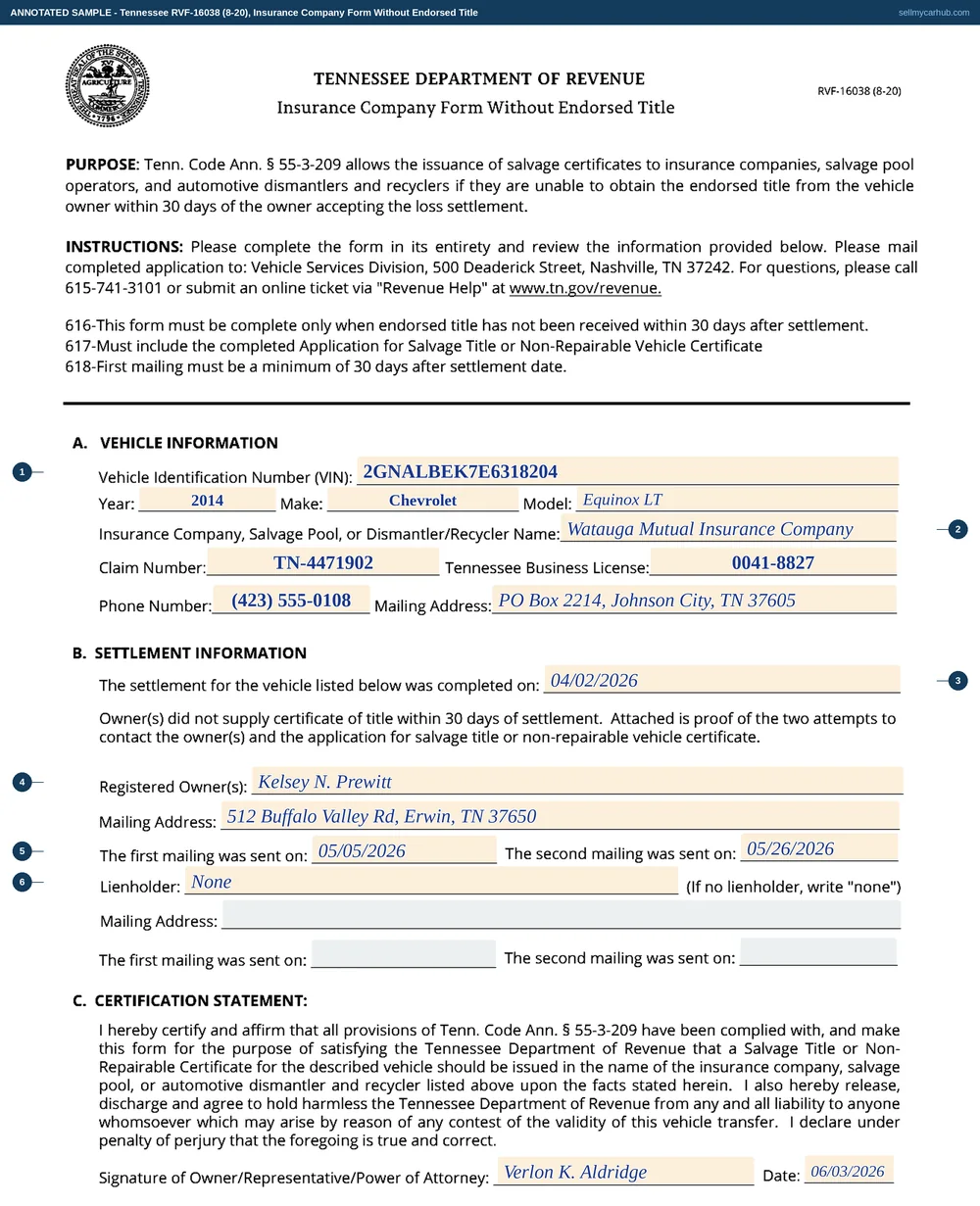
This is the actual RVF-16038, rendered from the PDF the Tennessee Department of Revenue publishes and completed end to end: letterhead, every field, and the blocks at the foot.
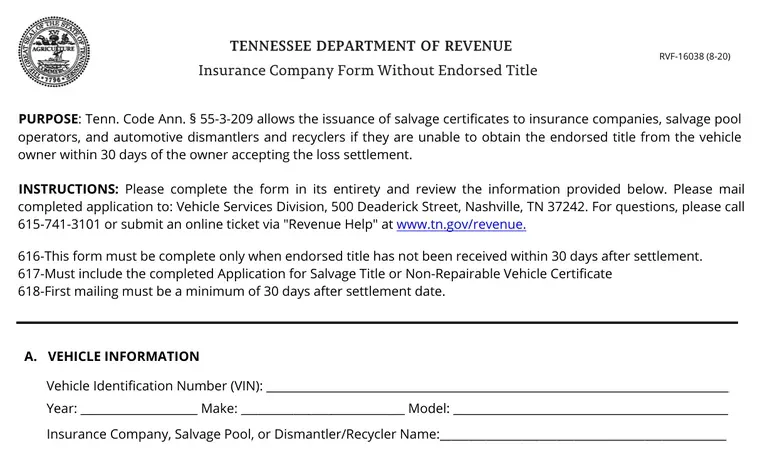
Thirty days since settlement with no endorsed title, the salvage application enclosed, and a first mailing no earlier than thirty days after settlement.
Watch out: For an owner, this is the timetable. Posting the endorsed title inside the window is what keeps you in the transaction.
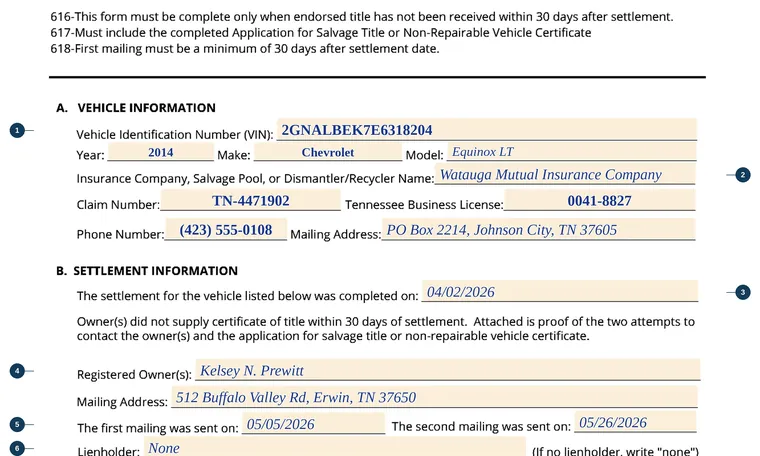
Vehicle identification number, year, make, model, the company name, claim number, Tennessee business licence, phone and mailing address.
Watch out: The claim number is the handle. If you are querying one of these, quote it rather than the vehicle identification number.
The settlement date, the registered owner's name and mailing address, and the dates of the two mailings.
Watch out: Check the address they used. It comes from the Department's record, which is why an address change filed years ago and never updated is the quiet cause of a lot of this.
Name, mailing address and two more mailing dates, or the word none.
Watch out: Where a lender is named, they get the same two letters. The Department's own FAQ says it will release the lien if the documentation is complete.
Compliance with the statute, a hold-harmless of the Department, and a declaration under penalty of perjury, then a signature and date.
Watch out: The hold-harmless clause is worth noticing: it anticipates a contest of the validity of the transfer, which tells you the Department knows these are sometimes disputed.
| On the form | What to put in it |
|---|---|
| The three conditions | Printed at the head of the form: it must be completed only when the endorsed title has not been received within thirty days after settlement; it must include the completed application for salvage title or non-repairable vehicle certificate; and the first mailing must be a minimum of thirty days after the settlement date. |
| A. Vehicle information | Vehicle identification number, year, make, model; then the insurance company, salvage pool or dismantler and recycler name, the claim number, a Tennessee business licence number, a phone number and a mailing address. |
| B. Settlement information | The date the settlement was completed, a printed statement that the owner did not supply the certificate of title within thirty days, and that proof of two attempts to contact them is attached. |
| The owner block | The registered owner's name and mailing address, and the dates the first and second mailings were sent. |
| The lienholder block | The same again for a lienholder, with the printed instruction to write none where there is not one. |
| C. Certification statement | A certification that all provisions of the statute have been complied with, a release and hold-harmless of the Department from liability arising by reason of any contest of the validity of the transfer, and a declaration under penalty of perjury, then a signature and a date. |
| The FAQ page | Four answered questions on the reverse - whether the vehicle has to be disposed of in Tennessee, whether out-of-state titles qualify, what happens to an unreleased lien, and what counts as proof of delivery. |
Every line here was read off RVF-16038 (8-20) itself — the PDF is here — and off the Tennessee Department of Revenue pages. This is plain-language help with a form, not legal advice, and where our wording and the agency's differ, theirs governs.
Back to all Tennessee seller paperwork, or what selling a car in Tennessee involves.