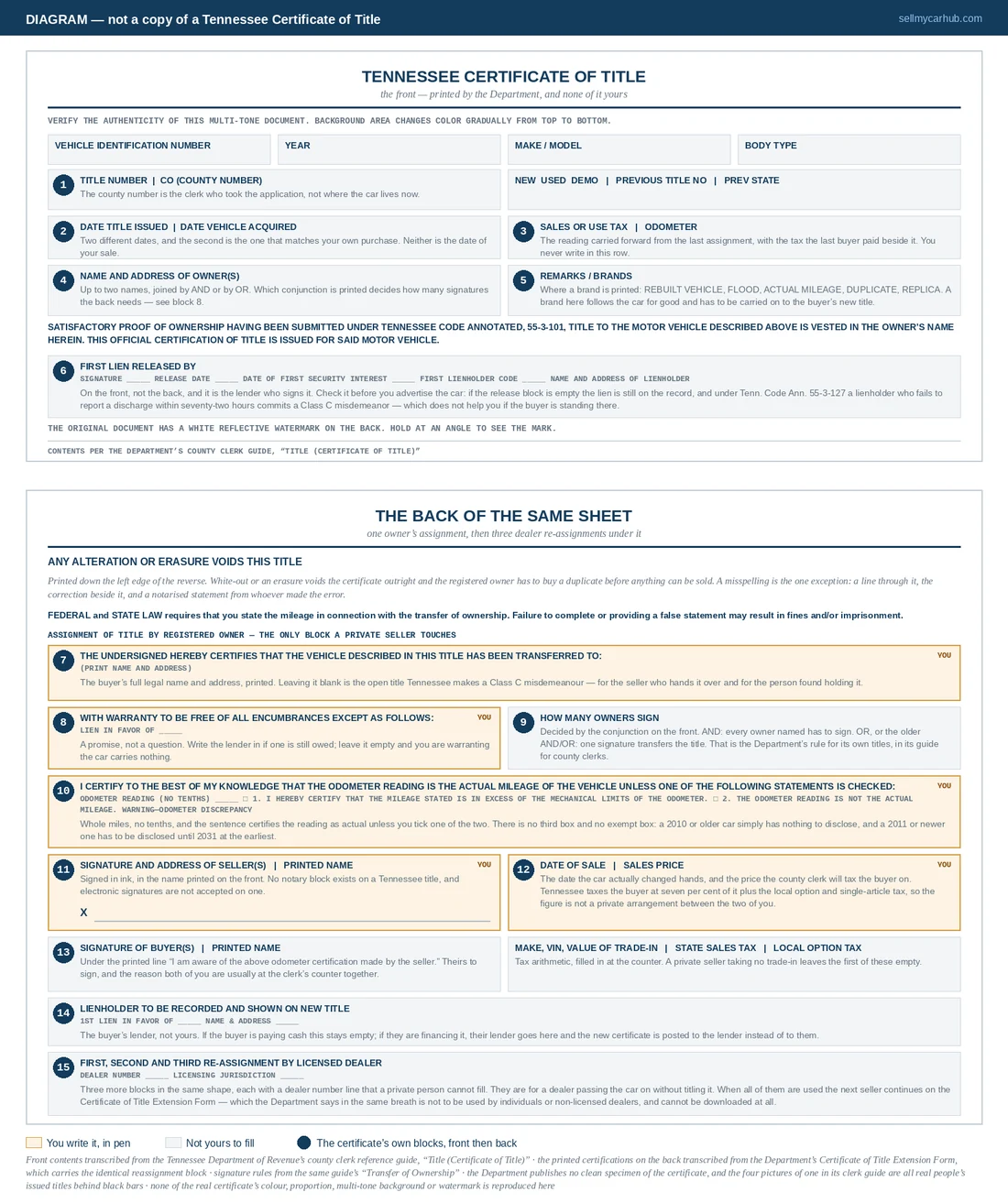
Everything a Tennessee seller does happens on one side of one piece of paper. The front is the Department's: vehicle, owner, brands, and the lien release the lender signs. The back carries four transfer blocks, and only the first of them - assignment of title by registered owner - belongs to a person rather than to a licensed dealer.
Last updated .
Your 7 boxes
As a private seller you complete these and nothing else:
You cannot download a blank Tennessee title and there is no sample to rehearse on. The certificate is multi-tone secure stock with a reflective watermark on the back, printed by the Department and posted to the owner, and the Department publishes no clean picture of one. What follows is a diagram of it, drawn from the Department's own description, with the seller's six blocks marked.
ANY ALTERATION OR ERASURE VOIDS THIS TITLE - printed down the left edge of the reverse, and meant literally.
The guide lists what the front of the certificate must carry and what the back is used for, item by item. Every block name below is transcribed from it or from the Department's own Certificate of Title Extension Form, which prints the identical reassignment block in legible type.
The certificate itself
What is on a Tennessee certificate, front and back
The markers below number the blocks in the order they appear on the document, front then back — a different set from the numbered steps further down this page, which follow the order you fill them in. Amber is the assignment: six blocks, and the whole of a private seller’s job.
Amber — you write it, in pen
Grey — not yours to fill
Numbered — in the order the certificate itself prints them
Click or tap the picture to open it full size.
Drawn, not photographed, and it says so across the top. The Department of Revenue publishes no clean specimen of the certificate: not on any page under Title and Registration, not in any of the fifty PDFs on its forms index, not in the 207 articles of its public help centre, and not in the 147 title and registration articles of its county clerk reference guide. Four pictures of a Tennessee title do exist in that guide and every one of them is a real issued certificate - a real vehicle identification number, a real lienholder, a real owner behind a black bar - with the redaction sitting exactly where the seller writes. Every block name and every quoted sentence here is transcribed instead from the guide's own description of the document and from the Department's Certificate of Title Extension Form, which prints the same reassignment block in legible type.
The one piece of it you can download
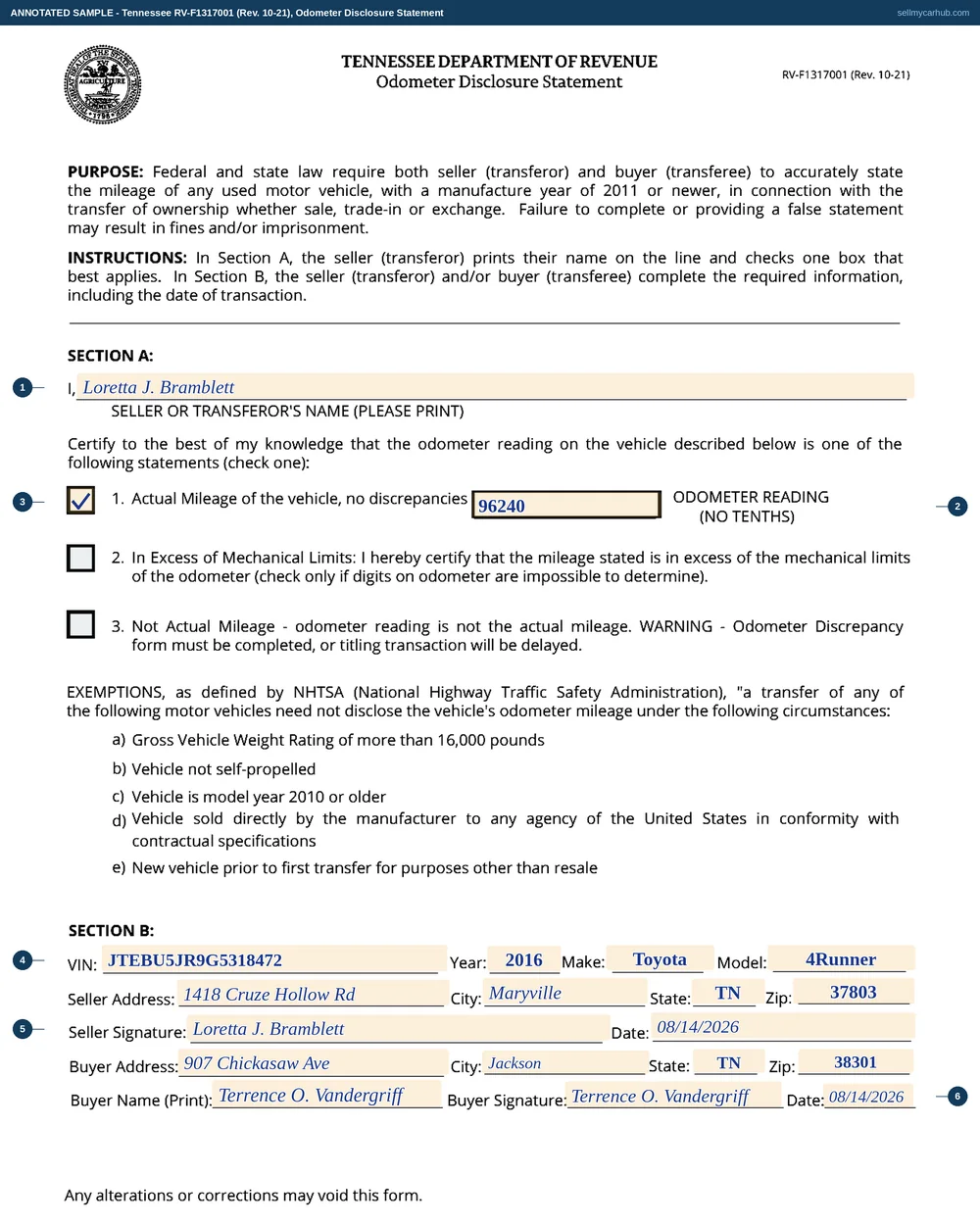
RV-F1317001, the odometer block on a sheet of its own
There is no downloadable stand-in for a Tennessee title - the certificate is printed on secure stock and the only copy in existence is the one in your drawer. What the Department does publish is the mileage certification, word for word as it appears on the back, on a one-page form a seller can practise on and a clerk will accept alongside the title. Amber is what gets written; grey is a statement that is not true of this car.
Click or tap the picture to open it full size.
Look at the two statements that are not ticked. The printed sentence above them certifies the reading as the actual mileage unless one of them is checked, so leaving both alone is a positive statement and not an omission. That is also why there is no exempt box: an exempt vehicle does not fill this in at all.
Before you watch. The Department publishes no video showing an assignment being filled in. Its channel carries 295 videos, examined one by one on 2026-08-23 at https://www.youtube.com/@TDOR2013; five touch title and registration at all - this one, Title Certificate Extension, How to request a duplicate title, Disposing of Your Old License Plate and Vehicle Services Frequently Asked Questions - and the rest are tax webinars, specialty plates and staff notices. Several third-party channels do show a Tennessee title being signed; none of them is the Department, which is why none is embedded here.
Published by the Department on its own channel in November 2021, and the only video it has about the certificate itself. Its stated audience is county clerks rather than the public - the description says the intent of this video is to assist Tennessee's county clerks with title certificates - which is exactly why it is worth three minutes: it is the document explained by the people who reject applications. Nothing loads from YouTube until you press play.
Step by step
Every box, in the order you meet it
1
You fill this in
Before the pen: get the spelling
The buyer's full legal name and complete address, read off their identification rather than off a text message.
Watch out: This is the block corrections happen in, and a correction here is not a correction. White-out or an erasure voids the certificate, and the fix is a duplicate title bought by you, with the ruined one enclosed.
2
You fill this in
The undersigned hereby certifies that the vehicle described in this title has been transferred to
The buyer's name and address, printed into the first block on the back - assignment of title by registered owner.
Watch out: Never leave it empty. An open title is one where only the seller has signed and the buyer's section is blank, and Tennessee makes it a Class C misdemeanour both for the transferor who delivers it and for anyone found in possession of it.
3
You fill this in
With warranty to be free of all encumbrances except as follows
A printed promise with a lien in favor of line under it. If nothing is owed, nothing goes on the line and you are warranting the car carries no lien.
Watch out: Look at the front before you sign under this. The first lien released by block is on the front of the certificate and the lender fills it in - if it is blank, the release never reached the Department whatever the payoff letter says.
4
You fill this in
The odometer certification
The reading in whole miles in the box marked no tenths, and then two checkboxes you leave alone unless one is true: in excess of the mechanical limits of the odometer, or not the actual mileage.
Watch out: Ticking the second box writes WARNING - ODOMETER DISCREPANCY onto the buyer's certificate and every certificate after it. It also obliges an Odometer Discrepancy Statement, without which the clerk holds the transaction.
5
You fill this in
Signature and address of seller(s), printed name
Signed in ink in the name printed on the front of the certificate, with your address and your name printed underneath it.
Watch out: Check the conjunction on the front first. AND between two owners means both of you sign; OR means one signature moves the car. And no photograph of a signature will do - electronic signatures on titles are not accepted.
6
You fill this in
Date of sale and sales price
The day the keys actually changed hands, and the money that changed hands with them.
Watch out: The price is what the county clerk taxes the buyer on. Writing a low number to help them is a false statement on a document you signed, and a price under three quarters of book needs an Affidavit of Non-dealer Transfers explaining itself.
7
The buyer fills this in
The buyer signs under your mileage
Signature of buyer(s) and printed name, under the printed line saying they are aware of the odometer certification the seller has made.
Watch out: It is a federal requirement rather than a Tennessee flourish, and it is the reason the two of you generally end up at the county clerk's window at the same time.
8
The buyer fills this in
Lienholder to be recorded and shown on new title
The buyer's own lender, if they are financing the car. Name and address, on the line marked 1st lien in favor of.
Watch out: Not your lender and not your business - but worth knowing, because it decides where the new certificate is posted. Where a lien is noted, the title goes to the lienholder rather than to the buyer.
9
The buyer fills this in
The tax lines get filled in at the counter
Make, VIN and value of trade-in, state sales tax and local option tax. Arithmetic the county clerk does when the application is presented.
Watch out: Seven per cent of the price to the state, up to 2.75 per cent locally on the first $1,600, and 2.75 per cent more on the next $1,600. Which is why the price you wrote in block 6 is not a private matter between the two of you.
10
Dealers only
The three blocks below yours are not yours
First, second and third re-assignment by licensed dealer, each with a dealer number and licensing jurisdiction line.
Watch out: A private person who fills one of these in has used the wrong block on the right document. When all of them are used up a dealer continues on the Certificate of Title Extension Form, which the Department says is not to be used by individuals or non-licensed dealers and does not publish for download.
11
The buyer fills this in
The buyer takes it to their own county clerk
Not yours, not where the car was, not where it was last registered - the clerk for the county the buyer lives in.
Watch out: There is no number of days. The rule is that they must title and register it before operating the vehicle upon a public road or highway, so a buyer who plans to drive it home has a thirty-day temporary operation permit to buy first, at $10.
12
You fill this in
And the plate comes off
Nothing to do with the certificate, and everything to do with your record. The plate is registered to you, the sale expires the registration, and the plate transfers to your next vehicle for a dollar.
Watch out: If it went with the car anyway, email a Vehicle License Plates Cancellation to the Department. Vehicle sold or traded in with license plate attached is the first reason printed on it, which tells you how often this happens.
Before the pen
Before you put a pen anywhere near it
Six habits, and the first one is the difference between a sale and a duplicate title application.
No white-out, no eraser, no second attempt
Using white out or making an erasure on a certificate of title when transferring ownership automatically voids the certificate, in the Department's own words. Not the line - the certificate.
A misspelling is the only thing you may strike through
One line through the wrong words, the right ones written beside them, and a notarised statement from the person who made the error goes in with the buyer's application.
Ink, and the same pen for the whole block
The assignment is a single certification about price, mileage and a named buyer. Half of it in one hand and half in another invites the question of when the other half was written.
Fill in the buyer before you hand it over
The name goes on at the kerb, not later, not by the buyer. A certificate delivered with the transferee blank is the open title, and it is a misdemeanour twice over.
Whole miles
The odometer box is labelled no tenths. Round down and write digits, not a phrase, and never write exempt in a box that has no exempt option.
Check the front before you sign the back
The first lien released by block and the REMARKS box are both on the front, and both of them can stop the sale after the money has changed hands.
Three things Tennessee sellers are told confidently that are not true. Each correction links the Department source it comes from.
“Take the title to the DMV and they will sort it out.”
There is no Tennessee DMV. Titles and registrations belong to the Department of Revenue's Vehicle Services Division, and the Department does not take applications over a counter - a county clerk does, and forwards the paperwork to Nashville. The Department's own instruction to the public is that title and registration transactions should be taken to your local county clerk, and its rejection notice to clerks says all applications for title and registration must be filed through the County Clerk's office.
The tag is not the car's, it is yours. Tennessee license plates follow the owner, not the vehicle, and they move to your next vehicle for a dollar - so a plate left on a sold car is your registration number driving around on somebody else's insurance. The buyer's legal way home is a $10 temporary operation permit from a county clerk, valid thirty days, and there is a form for it.
Nothing on a Tennessee certificate of title is notarised, and there is nowhere on the document to put a seal. The Department's rule for an ordinary sale asks only for a certificate properly assigned by the seller to the purchaser. Where Tennessee does insist on a notary it is on a bill of sale standing in for a missing title, or on the statement explaining a struck-through misspelling - never on the assignment itself. Even the secure power of attorney a dealer uses does not require notarization, and the Department says so.
Fewer signatures than most states want, and no witness to any of them:
Every owner the front requires
AND between two names means both signatures. OR, or the older AND/OR, means one is enough. The conjunction printed on the front is the whole of the test.
Nobody else, unless there is a power of attorney
RV-F1311401 lets an attorney-in-fact sign for an owner on a named vehicle. It is the general form; a dealership taking the car in trade needs the secure version instead, which the Department does not publish for download.
The buyer, once
Under the printed line acknowledging the odometer certification the seller has just made. That signature is federal, not Tennessee's, and it is why both parties are usually at the clerk's window together.
No notary, at any point
There is no acknowledgement block on the document. If somebody tells you a Tennessee title needs notarising they are describing a bill of sale, which does.
Not an executor, on a decedent's line
A dead owner's car moves on an Affidavit of Inheritance or on letters from the court, never on a signature in the decedent's name.
Not a dealer, in the first block
The three re-assignment blocks under yours carry a dealer number line. A private person filling one of them in has used the wrong block.
Once it is signed
The assignment is the whole of your job. Tennessee gives a private seller nothing to file afterwards, so the plate coming off and a photograph of the completed back of the title are the only record you will have.