Sell My Car Hub

How to fill out Tennessee RV-F1310801

The repair kit for a mileage figure that went onto the paperwork wrong. Four blocks, and it is built as a matched pair: the seller states what the reading actually was and why the documents say otherwise, and the buyer states the same thing from their side. A clerk who has spotted two different numbers will not move the transaction until both halves arrive.
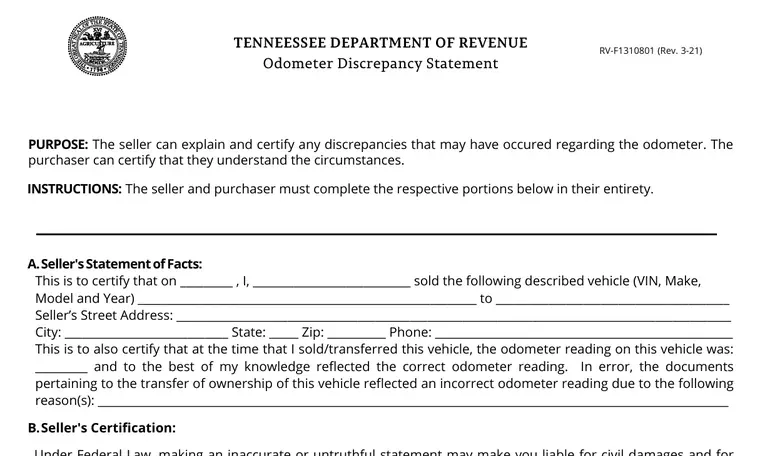
Written against RV-F1310801 (Rev 3-21), issued under Motor Vehicle Information and Cost Savings Act of 1972, Pub. L. 92-513. Getting this wrong is not a clerical matter. Both certification blocks quote the federal statute about civil damages and criminal penalties, and Tennessee has a misrepresentation-of-mileage offence of its own.

Two documents, and they are not the same thing. Take the blank RV-F1310801 from the tn.gov copy so you get the revision that is current today.

Filled in

What a completed one looks like

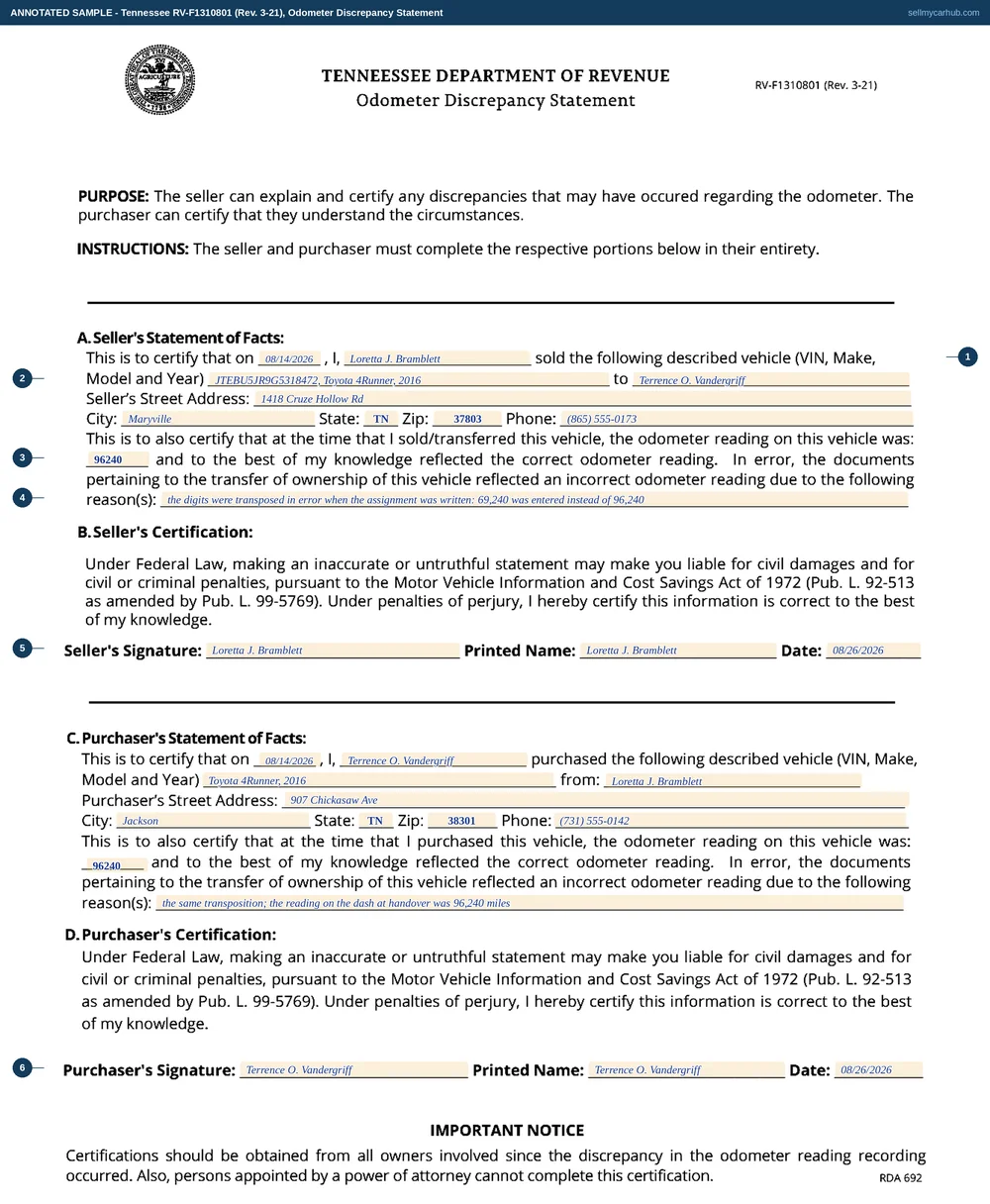
This is the actual RV-F1310801, rendered from the PDF the Tennessee Department of Revenue publishes and completed end to end: letterhead, every field, and the blocks at the foot.

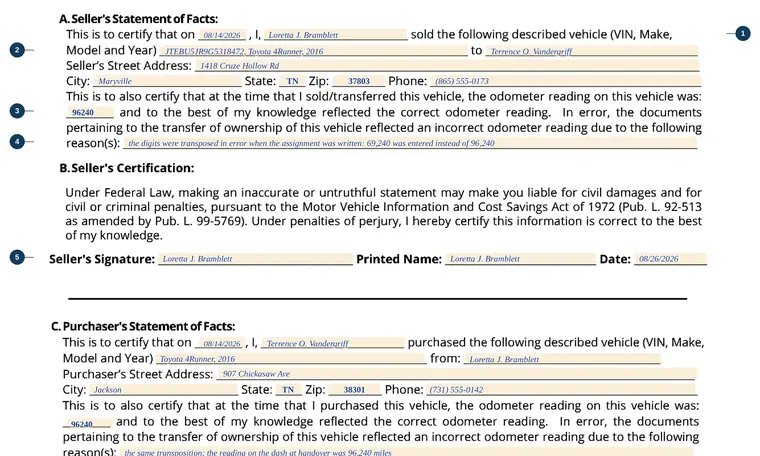
Tennessee form RV-F1310801 filled in by both sides: Loretta J. Bramblett states that on 14 August 2026 she sold a 2016 Toyota 4Runner, vehicle identification number JTEBU5JR9G5318472, to Terrence O. Vandergriff, that the reading was 96,240 miles, and that the digits were transposed as 69,240 when the assignment was written; Terrence O. Vandergriff states the same from the purchaser's side, and both have signed and dated 26 August 2026.
Both halves completed, because a clerk will not take one. Note the dates: the transaction date at the top of each block is the day of the sale, and the signature dates are the day the mistake was found and put right.
Field by field

Every line, in the order you meet it

  1. 1
    You fill this in

    This is to certify that on ______, I, ______

    The date of the sale and your name, opening the sentence that runs across the first block.

    Watch out: The date here is the date of the transfer, not today. The signature line further down carries today's date, and the two being different is normal on this form.

  2. 2
    You fill this in

    The vehicle, and who you sold it to

    Vehicle identification number, make, model and year on one rule, and the buyer's name on the next.

    Watch out: Copy the VIN from the title, not from this form's twin at the bottom of the page. The two blocks are filled in by different people and the clerk reads them against each other.

  3. 3
    You fill this in

    The reading, and the reason

    What the odometer actually showed at the handover, then a plain explanation of why the paperwork says something else.

    Watch out: Be specific and be dull. Digits transposed, a five read as a six, the reading copied from the previous year's inspection - a clerk is looking for a story that accounts for the exact difference between the two numbers.

  4. 4
    You fill this in

    Sign under the federal warning

    Signature, printed name and date, directly under the paragraph about civil damages and criminal penalties.

    Watch out: Read the paragraph. This is a sworn statement about mileage under a federal statute, which is a different order of thing from a clerical correction.

  5. 5
    The buyer fills this in

    The purchaser's mirror image

    Blocks C and D: what they bought, from whom, on what date, what the reading was, and the same explanation.

    Watch out: They fill this in themselves. A seller who completes both halves has produced two statements in one handwriting, which is the opposite of what the form is for.

  6. 6
    You fill this in

    The notice at the foot

    Two sentences: every owner since the discrepancy has to certify, and an attorney-in-fact cannot do it for anybody.

    Watch out: If the car has been sold on again since the error, this becomes a chain of statements rather than a pair, and it is worth ringing the clerk before you start collecting signatures.

At a glance

What goes where

On the formWhat to put in it
A. Seller's statement of factsA date, the seller's name, a description of the vehicle by vehicle identification number, make, model and year, and the name of the person it was sold to - all inside one running sentence.
Seller's address blockStreet, city, state, ZIP and telephone.
The reading, and why the papers disagreeOne box for the reading at the time of transfer, then a free line beginning: in error, the documents pertaining to the transfer of ownership of this vehicle reflected an incorrect odometer reading due to the following reason(s).
B. Seller's certificationThe federal warning about civil damages and civil or criminal penalties under the 1972 Act, then a signature, a printed name and a date.
C. Purchaser's statement of factsThe identical block from the buyer's side, saying what they bought, from whom, and what the reading was when they got it.
D. Purchaser's certificationThe same federal warning again, and the buyer's signature, printed name and date.
The important noticeA band across the foot: certifications should be obtained from all owners involved since the discrepancy occurred, and persons appointed by a power of attorney cannot complete this certification.

What gets this one rejected

Every line here was read off RV-F1310801 (Rev 3-21) itself — the PDF is here — and off the Tennessee Department of Revenue pages. This is plain-language help with a form, not legal advice, and where our wording and the agency's differ, theirs governs.

Back to all Tennessee seller paperwork, or what selling a car in Tennessee involves.

Want the paperwork handled instead?

Get My Instant Offer → Online · about 2 minutes · free

Or send the details — we'll come to you

If the mileage paperwork has become a two-party negotiation, an offer from us is one signature and no correspondence.

or call/text (877) 405-1808