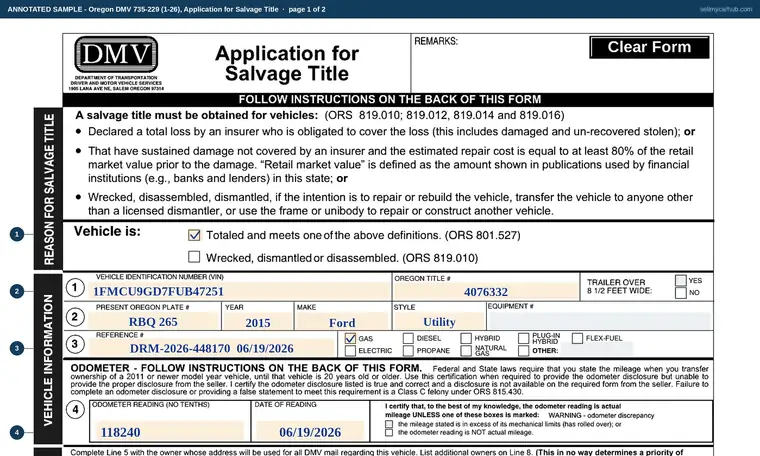
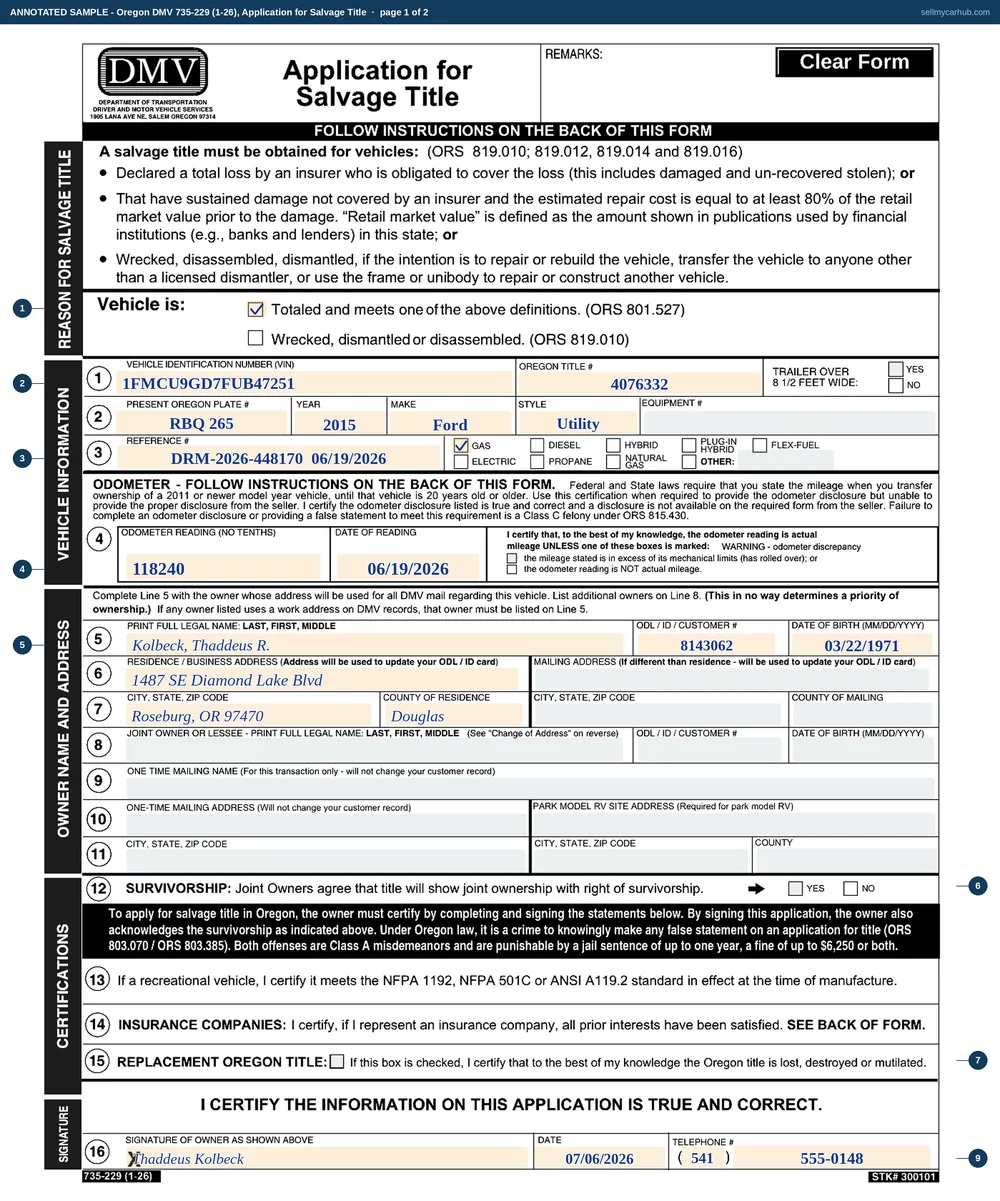
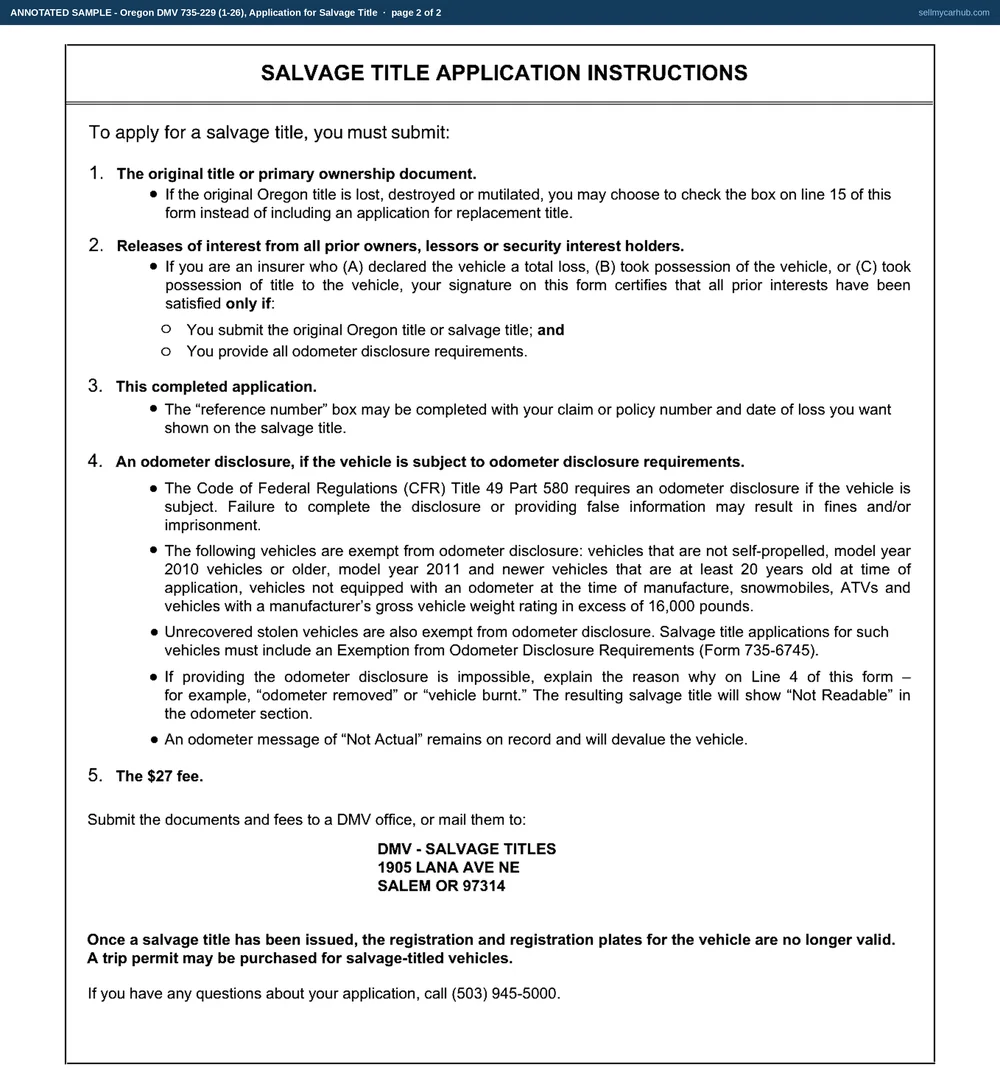
Sixteen numbered lines and a page of instructions, for a vehicle that Oregon will not let stay on an ordinary title. Three things trigger it: an insurer declared it a total loss, or the estimated repair cost reached at least 80% of the retail market value before the damage and no insurer was involved, or it has been wrecked, disassembled or dismantled and somebody intends to rebuild it, sell it to anyone other than a licensed dismantler, or use the frame to build something else. The fee is $27. Once the salvage title issues, the registration and the plates are dead.
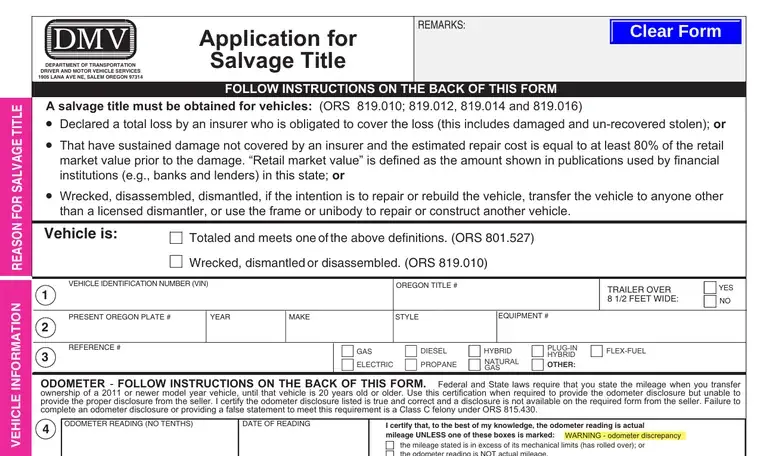
Written against 735-229 (1-26), issued under ORS 819.010, 819.012, 819.014 and 819.016. Revised January 2026. Read the instructions on the back before line 1 — they change what has to be in the envelope depending on whether the applicant is the owner or the insurer.
Two documents, and they are not the same thing. Take the blank 735-229 from the oregon.gov copy so you get the revision that is current today.
This is all 2 pages of the actual 735-229, rendered from the PDF the Oregon Department of Transportation, Driver and Motor Vehicle Services Division publishes and completed end to end: letterhead, every field, and the blocks at the foot.
Two ticks at the head of the form: totalled and meets one of the definitions, or wrecked, dismantled or disassembled.
Watch out: The definitions sit directly above the boxes. Totalled covers an insurer's declaration and the 80%-of-retail-value case; wrecked covers the intention to rebuild, to sell to anyone but a licensed dismantler, or to reuse the frame.
The vehicle identification number and the number of the title being surrendered.
Watch out: The original title has to go in the envelope with this. If it is lost, line 15's Replacement Oregon Title box does the job instead of a separate application.
A box that may be completed with a claim or policy number and date of loss to be shown on the salvage title.
Watch out: Optional, and worth filling in. A salvage title carrying the claim number it came from is a document a future buyer can trace.
Whole miles, no tenths, with the two exception statements beside them.
Watch out: Where the reading cannot be given, the instructions ask you to explain why here — odometer removed, vehicle burnt — and the salvage title then shows Not Readable in the odometer section.
Full legal name last, first, middle, with a customer number, date of birth, residence and mailing address, each with a county.
Watch out: Complete line 5 with the owner whose address will be used for all DMV mail about this vehicle — the same instruction as on the ordinary title application.
A yes-or-no pair for joint owners.
Watch out: It is asked on a salvage title exactly as on a regular one, and it is exactly as easy to skip. The answer ends up printed on the certificate.
A certification that if the applicant represents an insurance company, all prior interests have been satisfied.
Watch out: Only an insurer signs this, and the instructions attach conditions: it holds only if they submit the original Oregon title or salvage title and provide all odometer disclosure requirements.
A box certifying that to the best of your knowledge the Oregon title is lost, destroyed or mutilated.
Watch out: This is the shortcut. Rather than filing a separate replacement application, an owner whose title has gone missing ticks this on the salvage application itself.
One signature, dated, with a telephone number.
Watch out: The certification above it is the standard one: knowingly making a false statement on an application for title is a Class A misdemeanour under ORS 803.070 and 803.385, with up to a year in jail and a fine of up to $6,250.
| On the form | What to put in it |
|---|---|
| Reason for salvage title | Two ticks: totalled and meets one of the definitions in ORS 819.010, or wrecked, dismantled or disassembled under ORS 801.527. |
| Lines 1 to 3 | Vehicle identification number and Oregon title number; present plate number, year, make, style, equipment number; a reference number box for an insurer's claim or policy number and date of loss; and a nine-box motor power row. |
| Line 4, odometer | Reading in whole miles with no tenths, the date of reading, and the two exception statements — in excess of mechanical limits, and not actual mileage under WARNING - odometer discrepancy. |
| Lines 5 to 11, ownership | Owner name printed last, first, middle, customer number, date of birth, residence and mailing addresses with counties, a joint owner row, a one-time mailing name and address, and a park model RV site address. |
| Line 12, survivorship | A yes-or-no pair: joint owners agree that title will show joint ownership with right of survivorship. |
| Lines 13 to 15, certifications | Recreational vehicle standards; a certification for insurance companies that all prior interests have been satisfied; and a Replacement Oregon Title box for an owner whose title is lost, destroyed or mutilated. |
| Line 16, signature | Signature of owner as shown above, with a date and a telephone number. |
| The instructions on page two | What to submit: the original title or primary ownership document, releases of interest from all prior owners, lessors or security interest holders, the completed application, an odometer disclosure if the vehicle is subject to one, and the $27 fee. |
Every line here was read off 735-229 (1-26) itself — the PDF is here — and off the Oregon Department of Transportation, Driver and Motor Vehicle Services Division pages. This is plain-language help with a form, not legal advice, and where our wording and the agency's differ, theirs governs.
Back to all Oregon seller paperwork, or what selling a car in Oregon involves.