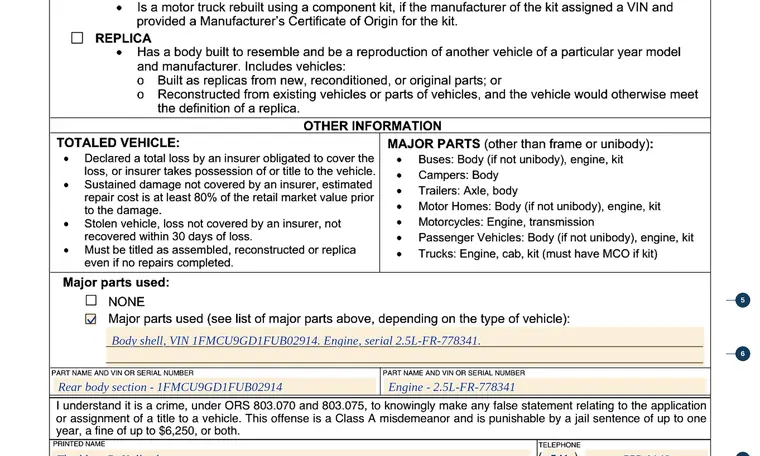
The form that decides which of three words gets printed on the next title. Assembled, reconstructed and replica are defined side by side on this sheet, and the definitions are narrower than the words suggest — the difference between assembled and reconstructed comes down to whether the body resembles a particular year model and make. Underneath sits the other half of it: the Oregon definition of a totalled vehicle, including the 80% repair-cost test and the thirty-day rule for a stolen vehicle nobody insured.
Written against 735-6511 (6-25), issued under ORS 801.135, ORS 803.070 and ORS 803.075. Revised June 2025. The three definitions look interchangeable and are not — read all three sets of bullet points before ticking, because the word that goes on the title is decided here and it is on the title for good.
Two documents, and they are not the same thing. Take the blank 735-6511 from the oregon.gov copy so you get the revision that is current today.
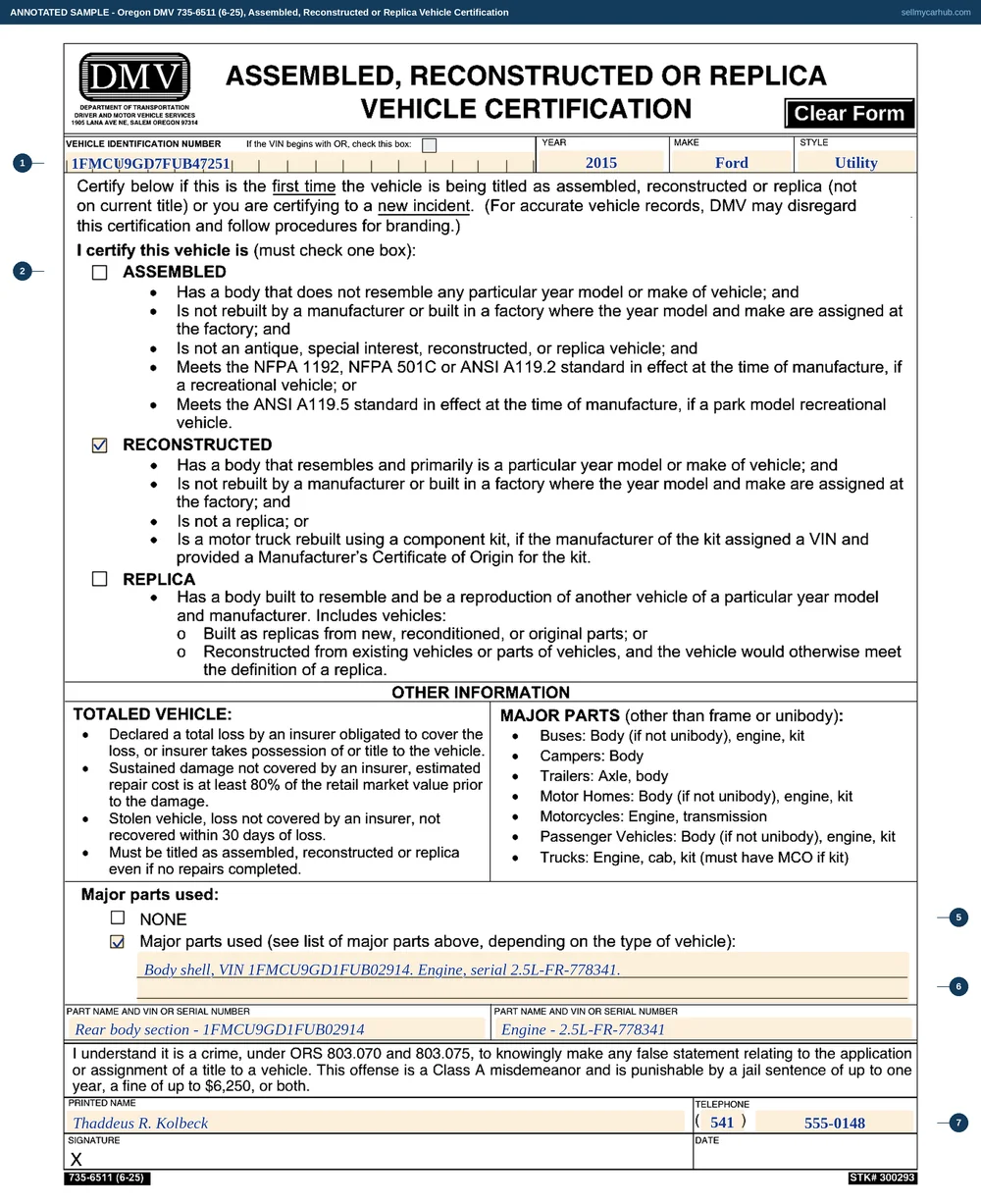
This is the actual 735-6511, rendered from the PDF the Oregon Department of Transportation, Driver and Motor Vehicle Services Division publishes and completed end to end: letterhead, every field, and the blocks at the foot.
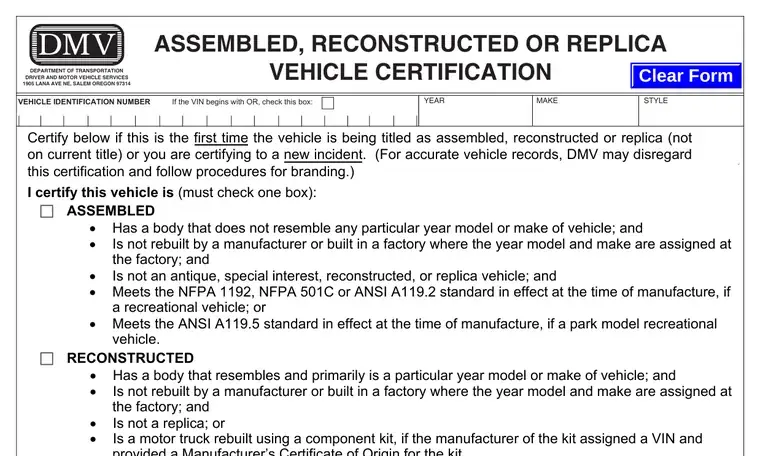
The description band, with the OR tick box for a DMV-assigned number.
Watch out: An assembled vehicle often has no factory VIN at all. That is what the OR box and the VIN inspection form are for, and the number DMV assigns starts with those two letters.
The first of the three boxes, for a body that does not resemble any particular year model or make.
Watch out: Every bullet under it has to be true, including the negatives: not factory built, and not an antique, special interest, reconstructed or replica vehicle.
The second box, for a body that resembles and primarily is a particular year model or make.
Watch out: This is where a rebuilt total loss usually lands. If the car still looks like the car it was, it is reconstructed rather than assembled.
The third box, for a body built to resemble and be a reproduction of another vehicle of a particular year model and manufacturer.
Watch out: It covers both a replica built from new parts and one reconstructed from existing vehicles, so long as the finished thing would otherwise meet the replica definition.
A definitions block rather than a field: an insurer's declaration, the 80% repair-cost test where no insurer is involved, and a stolen vehicle not recovered within 30 days.
Watch out: Read it even though there is nothing to fill in. It is the clearest statement Oregon publishes of when a car stops being an ordinary car.
Two columns of part name and VIN or serial number, with a NONE option, drawn from the MAJOR PARTS list beside it.
Watch out: What counts as a major part differs by vehicle type. On a passenger car it is the body if it is not unibody, the engine, and the kit; on a motorcycle it is the engine and transmission.
The certification block at the foot.
Watch out: Above it: knowingly making any false statement relating to the application or assignment of a title is a Class A misdemeanour, punishable by a jail sentence of up to one year, a fine of up to $6,250, or both.
| On the form | What to put in it |
|---|---|
| Vehicle identification number, year, make, style | The description band across the top, with the OR tick box for a DMV-assigned identification number. |
| ASSEMBLED | Five conditions, all of which must hold: a body that does not resemble any particular year model or make; not rebuilt by a manufacturer or built in a factory where the year model and make are assigned at the factory; not an antique, special interest, reconstructed or replica vehicle; and the NFPA or ANSI standards where it is a recreational or park model recreational vehicle. |
| RECONSTRUCTED | A body that resembles and primarily is a particular year model or make; not factory built with year model and make assigned there; and either not a replica, or a motor truck rebuilt using a component kit where the kit manufacturer assigned a VIN and provided a Manufacturer's Certificate of Origin for the kit. |
| REPLICA | A body built to resemble and be a reproduction of another vehicle of a particular year model and manufacturer, including vehicles built as replicas from new, reconditioned or original parts, and vehicles reconstructed from existing vehicles or parts of vehicles that would otherwise meet the replica definition. |
| TOTALED VEHICLE | The definitions block: declared a total loss by an insurer obligated to cover the loss, or an insurer taking possession of or title to the vehicle; damage not covered by an insurer where the estimated repair cost is at least 80% of the retail market value prior to the damage; or a stolen vehicle, loss not covered by an insurer, not recovered within 30 days of loss. |
| MAJOR PARTS | What counts, by vehicle type: passenger vehicles — body if not unibody, engine, kit; trucks — engine, cab, kit, which must have an MCO if it is a kit; motorcycles — engine, transmission; motor homes and buses — body if not unibody, engine, kit; campers — body; trailers — axle, body. |
| Major parts used | Two columns of part name and VIN or serial number, with a NONE option. |
| Printed name, telephone, signature and date | The certification block, under a warning that knowingly making a false statement relating to the application or assignment of a title is a Class A misdemeanour under ORS 803.070 and 803.075. |
Every line here was read off 735-6511 (6-25) itself — the PDF is here — and off the Oregon Department of Transportation, Driver and Motor Vehicle Services Division pages. This is plain-language help with a form, not legal advice, and where our wording and the agency's differ, theirs governs.
Back to all Oregon seller paperwork, or what selling a car in Oregon involves.