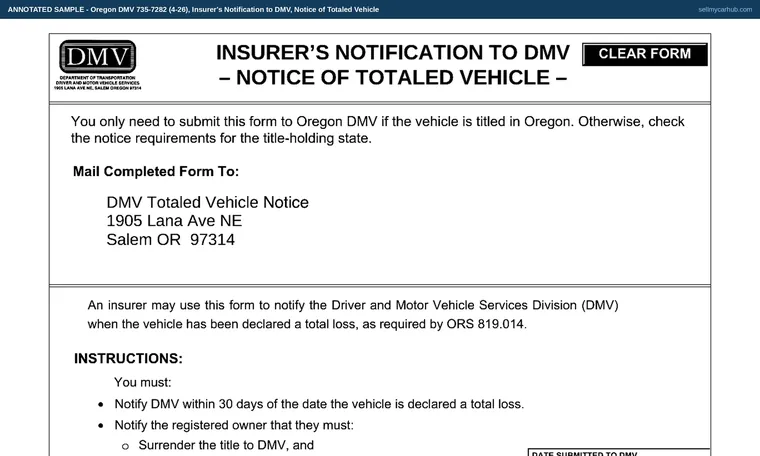
Not your form, and worth a page precisely because it looks like it might be. This is the notice an insurance company files when it declares a vehicle a total loss, and it carries the instructions the insurer has to give you. If your car has just been written off, this is the document your insurer owes DMV within thirty days — and the reason you will shortly be asked to surrender a certificate you may have been planning to sell.
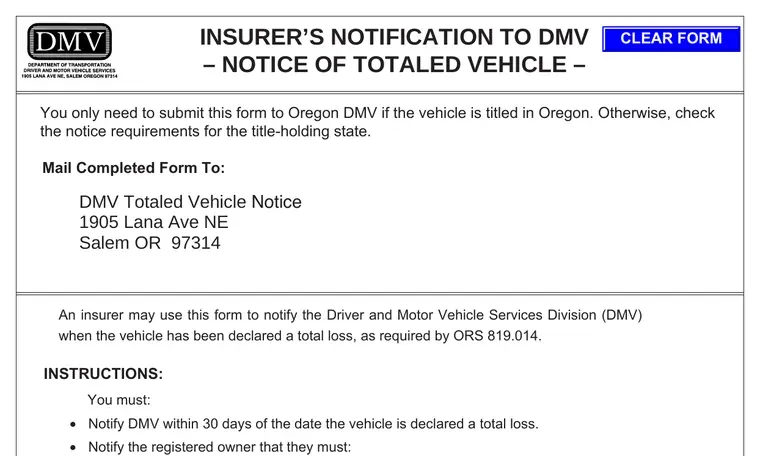
Written against 735-7282 (4-26), issued under ORS 819.014. Revised April 2026. If you are a private seller reading this page, the useful part is the three duties in the middle — those are the things your insurer is obliged to tell you, and the things a buyer will later hold you to.
Two documents, and they are not the same thing. Take the blank 735-7282 from the oregon.gov copy so you get the revision that is current today.
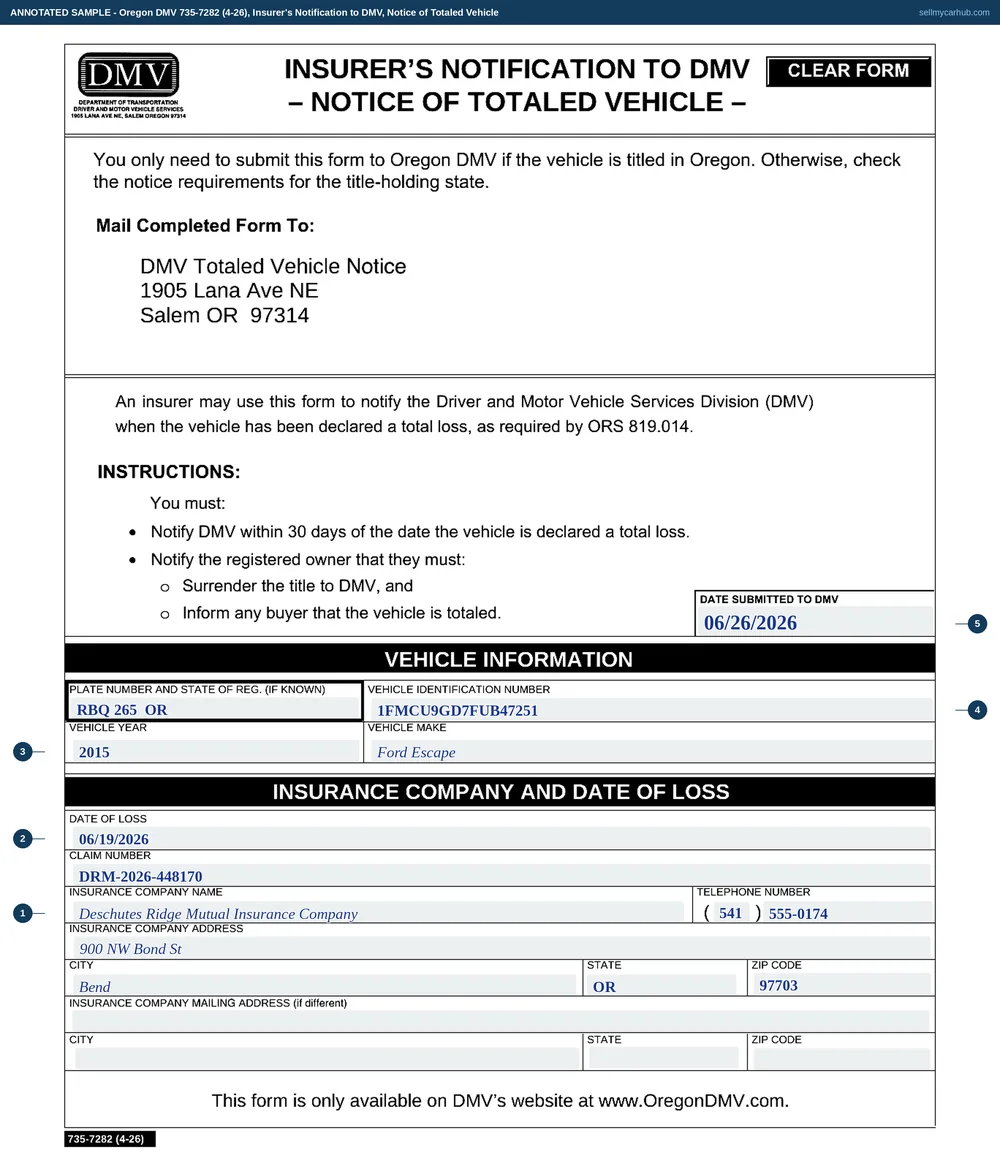
This is the actual 735-7282, rendered from the PDF the Oregon Department of Transportation, Driver and Motor Vehicle Services Division publishes and completed end to end: letterhead, every field, and the blocks at the foot.
The insurer's own identification at the head of the form, with a separate mailing address if it differs.
Watch out: If you are the owner and this box is being filled in on your behalf, it is not your form. Ask for a copy of it anyway — it dates the declaration.
Two boxes tying the notice to the claim.
Watch out: The date of loss and the date the vehicle was declared a total loss are not always the same day, and it is the declaration that starts the thirty days.
The vehicle block, with the plate marked if known.
Watch out: State of registration matters because the form is only for Oregon-titled vehicles. Anything else goes to the state that issued the title.
The identifier DMV attaches the totalled brand to.
Watch out: Once this notice lands, the brand follows the VIN. Nothing done to the car afterwards takes it off the record.
One box, and the one the thirty-day duty is measured against.
Watch out: You must notify DMV within 30 days of the date the vehicle is declared a total loss — the form prints the duty directly above the boxes.
Two printed obligations rather than fields: tell the owner to surrender the title to DMV, and tell them they must inform any buyer that the vehicle is totalled.
Watch out: That second obligation is the one that reaches a private sale months later. A totalled car sold without the disclosure is a problem that arrives with the buyer's own title application.
| On the form | What to put in it |
|---|---|
| Insurance company and date of loss | Insurance company name, address, telephone number, a mailing address if different, the date of loss and a claim number. |
| Vehicle information | Vehicle year, make, plate number and state of registration if known, and the vehicle identification number. |
| Date submitted to DMV | One dated box, which is the date the thirty days is measured against. |
| The instructions block | An insurer may use this form to notify DMV when the vehicle has been declared a total loss, as required by ORS 819.014 — followed by what the insurer must do. |
| The three duties | Notify DMV within 30 days of the date the vehicle is declared a total loss; notify the registered owner that they must surrender the title to DMV; and notify the registered owner that they must inform any buyer that the vehicle is totalled. |
| The out-of-state note | You only need to submit this form to Oregon DMV if the vehicle is titled in Oregon; otherwise check the notice requirements for the title-holding state. |
| The availability note | This form is only available on DMV's website at www.OregonDMV.com. |
Every line here was read off 735-7282 (4-26) itself — the PDF is here — and off the Oregon Department of Transportation, Driver and Motor Vehicle Services Division pages. This is plain-language help with a form, not legal advice, and where our wording and the agency's differ, theirs governs.
Back to all Oregon seller paperwork, or what selling a car in Oregon involves.