Sell My Car Hub

How to fill out West Virginia DMV-SV-1

The form that retires a wrecked car's ordinary title. Owner or insurer applies, describes the vehicle, and picks the certificate's flavour from the fee row: flood damage, fire damage or salvage at $22.50 each, or a non-repairable certificate - over 75% damaged and not to be reconstructed - for which no fee is due. Below that, a damage checklist of twenty-seven parts from front bumper to engine, ticked to record where the harm is. For a private owner this is the honest path when the insurer totals the car and you keep it, or when nobody was insured and the wreck is yours to dispose of.
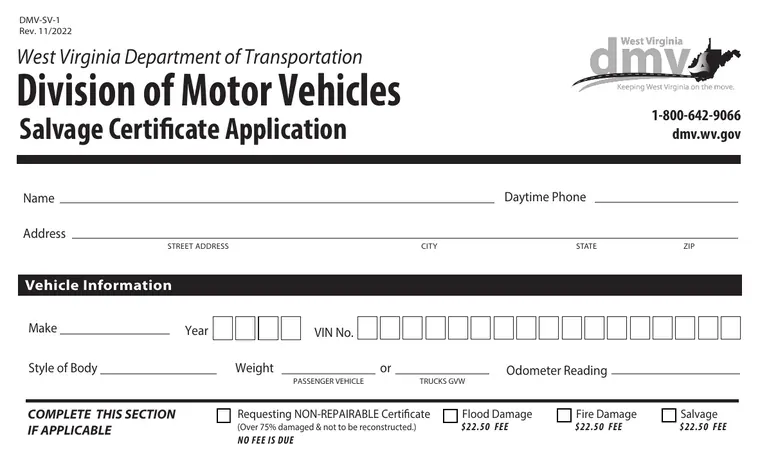
Written against DMV-SV-1 (Rev 11/2022), issued under W. Va. Code 17A-4-10. Read the reconstruction path before you choose salvage over non-repairable: the rebuilt car must pass the state's salvage inspection - the Division publishes the schedule of exam dates and locations - and airbags must be intact or replaced to manufacturer's specifications to qualify for a reconstructed certificate. If neither you nor any buyer will realistically rebuild it, the no-fee non-repairable certificate is the truthful box, and the parts are worth what they are worth.

Two documents, and they are not the same thing. Take the blank DMV-SV-1 from the webapps.transportation.wv.gov copy so you get the revision that is current today, then print our DMV-SV-1 guide and keep it beside you while you fill theirs in.

Filled in

What a completed one looks like

This is the actual DMV-SV-1, rendered from the PDF the West Virginia Division of Motor Vehicles publishes and completed end to end: letterhead, every field, and the blocks at the foot.

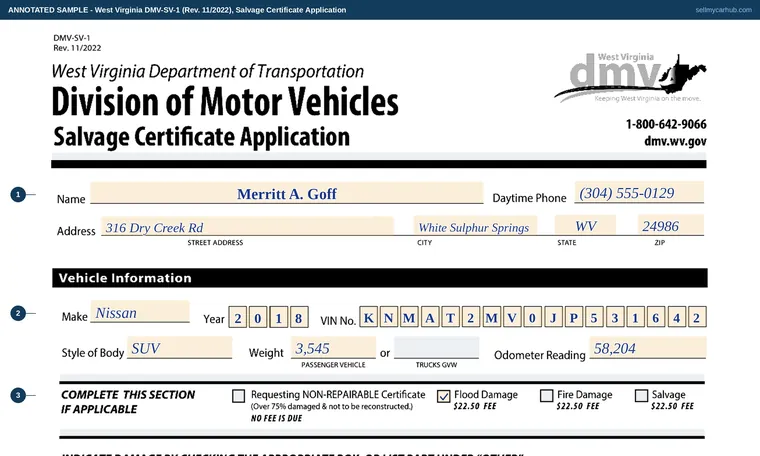
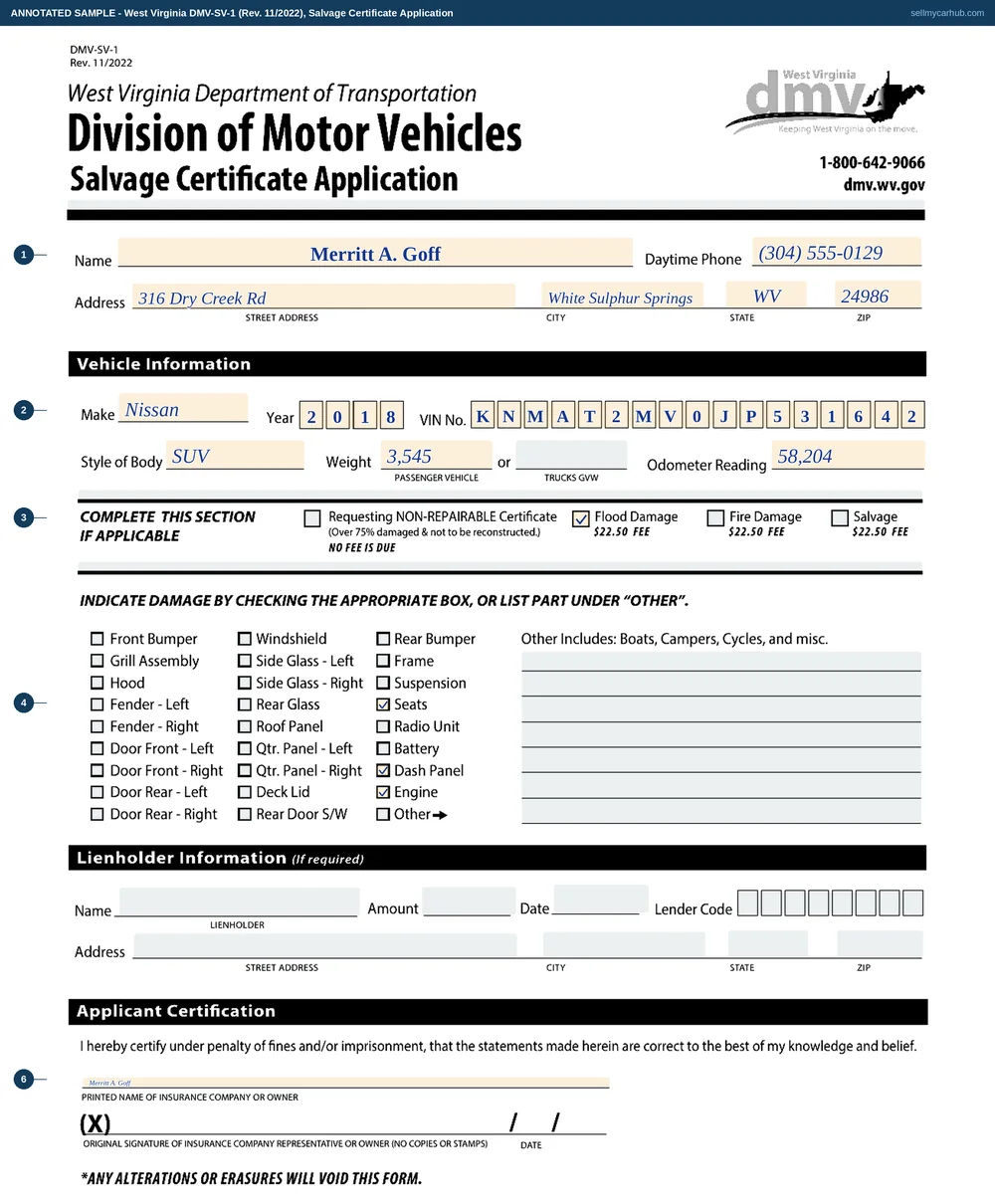
The West Virginia DMV-SV-1 salvage certificate application filled in: owner Merritt A. Goff of White Sulphur Springs applies for a flood damage certificate on a 2018 Nissan Rogue, VIN in the comb boxes, seats, dash panel and engine ticked on the damage checklist, no lienholder, and the printed name entered above the original-signature line.
A flood-totalled car the owner kept after the payout. The flood damage box sets the certificate's brand and its fee; the ticked parts record where the water reached.
Field by field

Every line, in the order you meet it

  1. 1
    You fill this in

    Applicant block

    Your name, phone and address - or the insurer's, when the company took the car with the payout.

    Watch out: Whoever will hold the salvage certificate applies. Keep the car after a total loss and that is you, not the adjuster.

  2. 2
    You fill this in

    Vehicle information

    Make, year and VIN into their combs, body style, weight and the odometer reading.

    Watch out: One character per box, and the reading still matters - mileage follows the vehicle onto whatever certificate comes next.

  3. 3
    You fill this in

    Choose the certificate

    Non-repairable with no fee, or flood, fire or salvage with the $22.50.

    Watch out: This tick writes the brand. Flood is not a synonym for salvage - it is a more specific warning, and the examiner will expect the checklist to agree with it.

  4. 4
    You fill this in

    The damage checklist

    Tick every part that took harm; overflow goes under other.

    Watch out: Honesty here is cheap - the inspection that precedes any rebuild will find what the boxes missed, with your certification underneath.

  5. 5
    The lienholder fills this in

    Lienholder, if any

    The lender's name, address, amount, date and code, where money is still owed on the wreck.

    Watch out: A payoff mid-claim does not erase the record - if the state still shows the lien, the release paperwork needs to travel with this application.

  6. 6
    You fill this in

    Certification

    Printed name, original signature, date.

    Watch out: No copies or stamps is printed on the line itself. Sign the sheet you post, not a scan of it.

At a glance

What goes where

On the formWhat to put in it
Applicant informationName, daytime phone, and a street address, city, state and zip row - the owner keeping the wreck, or the insurance company that paid it out.
Vehicle informationMake, a four-box year comb, a seventeen-box VIN comb, style of body, weight boxed as passenger vehicle or trucks GVW, and the odometer reading.
The certificate choiceComplete this section if applicable: requesting non-repairable certificate - over 75% damaged and not to be reconstructed, no fee is due - or flood damage, fire damage or salvage, each at a $22.50 fee.
The damage checklistIndicate damage by checking the appropriate box, or list part under other: twenty-seven named parts - bumpers, glass, panels, frame, suspension, seats, engine and the rest - with the note that other includes boats, campers, cycles and misc.
Lienholder information (if required)Name, street address row, amount, date and an eight-box lender code comb - because a lien survives the wreck and rides onto the salvage certificate.
Applicant certificationThe printed name of insurance company or owner, then the (X) line demanding an original signature of insurance company representative or owner - no copies or stamps - with the date, under a certification made under penalty of fines and/or imprisonment. The foot warns that any alterations or erasures will void this form.

What gets this one rejected

Rules that decide whether it is accepted

Every line here was read off DMV-SV-1 (Rev 11/2022) itself — the PDF is here — and off the West Virginia Division of Motor Vehicles pages. This is plain-language help with a form, not legal advice, and where our wording and the agency's differ, theirs governs.

Back to all West Virginia seller paperwork, or what selling a car in West Virginia involves.

Want the paperwork handled instead?

Get My Instant Offer → Online · about 2 minutes · free

Or send the details — we'll come to you

Totalled, flooded or just done? We buy salvage-bound cars as they sit - the checklist can be somebody else's job.

or call/text (877) 405-1808