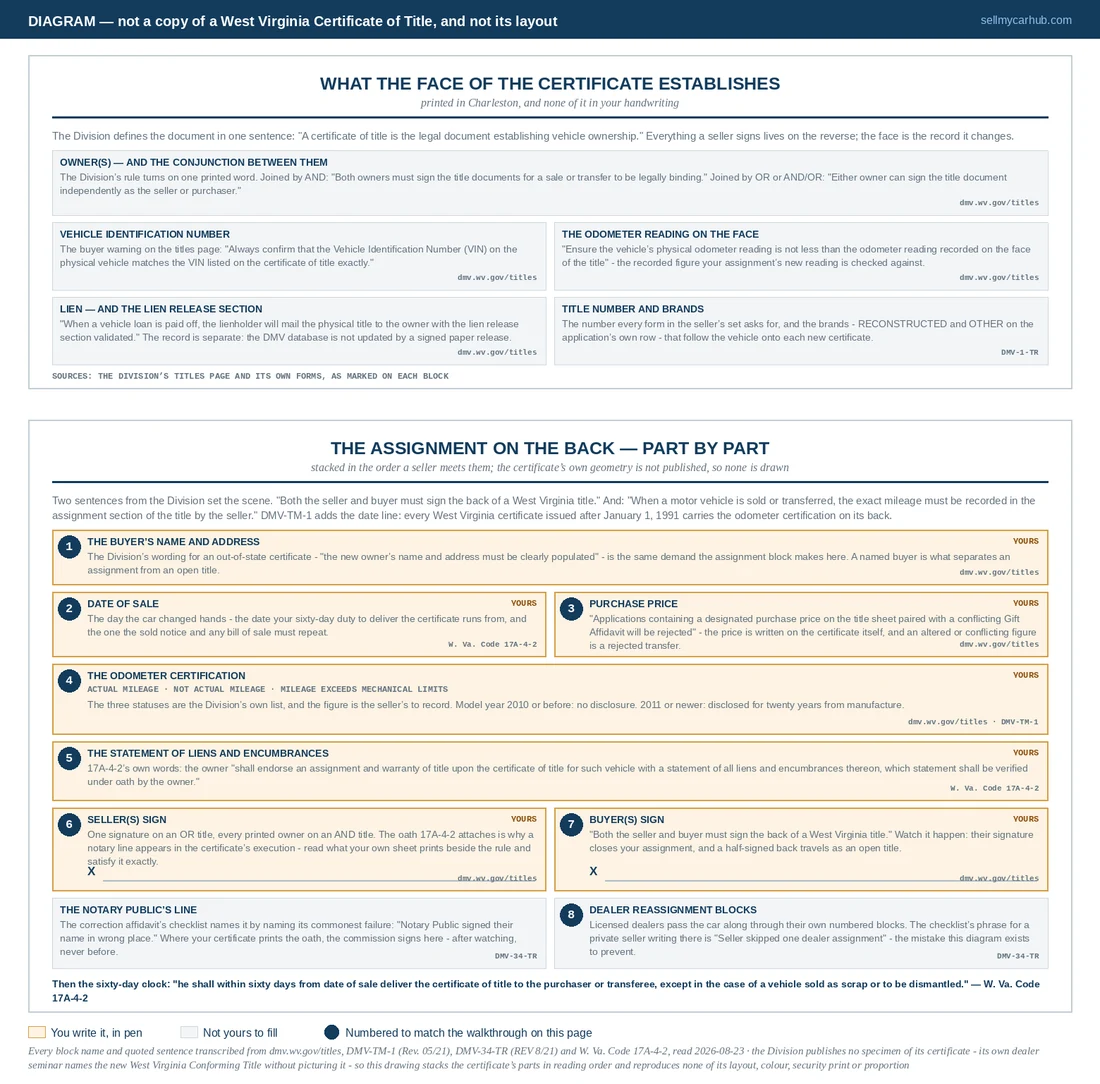
West Virginia prints the sale on the reverse of the certificate: an assignment with the buyer's name and address, the price, the date, the mileage certification, and the signatures the front's conjunction demands. The Division publishes no picture of it - what follows is a labelled diagram built from the Division's own descriptions, with every block name carrying its source.
Last updated .
Your 6 boxes
As a private seller you complete these and nothing else:
There is no blank West Virginia certificate to download and no published specimen of one - the seminar manual names the state's conforming title without ever picturing it. The diagram below is drawn from the Division's own written descriptions, and each block says where its name came from.
Do not mark out, white out or erase - the Division's own instruction, and its consequence in the same sentence: this will void the title, and a duplicate title will be required.
The Division's instructions run: both the seller and buyer must sign the back of a West Virginia title; the exact mileage must be recorded in the assignment section of the title by the seller; and if names on the face are joined by AND, both owners must sign, while OR lets either sign independently. Blue or black ink is the rule its forms print - the application says type or print in blue or black ink only.
A diagram, because no specimen exists
The back of a West Virginia certificate, block by block
The Division publishes no sample of its certificate anywhere we could find - not in the dealer seminar manual, not in the reconstructed-vehicle guide, not among its 306 published PDFs - and its 2025 seminar names a new West Virginia Conforming Title without picturing it. So this is a drawing, labelled as one. Every block name on it is transcribed from the Division's titles page, from DMV-TM-1's description of the certification on the back, from the mistakes listed on the correction affidavit, and from 17A-4-2 - and the drawing carries none of the certificate's colour, proportion or security print.
Amber — you write it, in pen
Grey — not yours to fill
Numbered circles - the walkthrough further down uses the same figures
Click or tap the picture to open it full size.
A diagram of the reverse of the certificate, not a reproduction of one. Amber blocks are the seller's writing; the dealer reassignments are on every state's stock and are never a private seller's to touch - the correction affidavit's phrase for that mistake is seller skipped one dealer assignment.
A real one, filled in
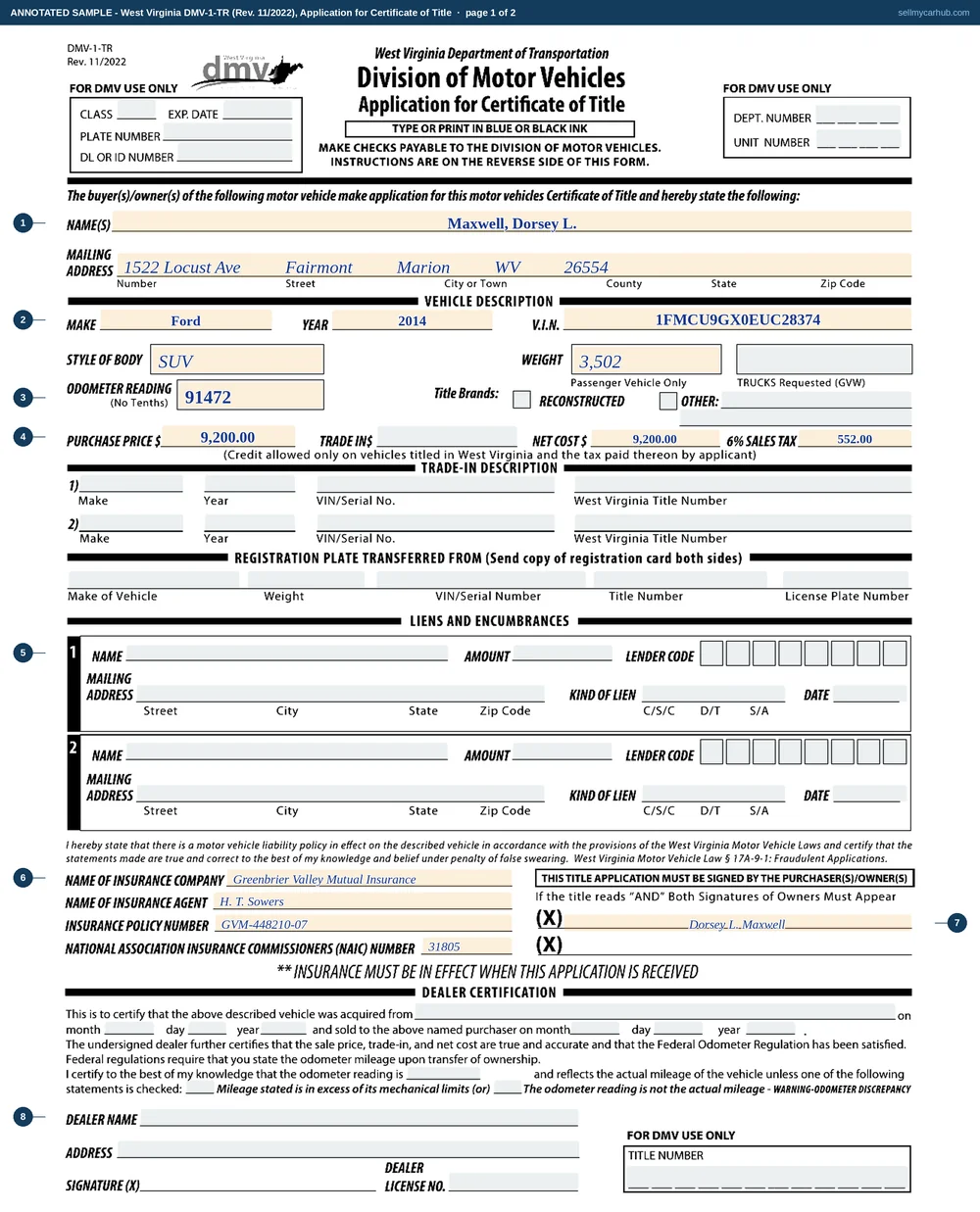
The DMV-1-TR that travels with your signed certificate
What we can show completed end to end is the Division's own application - the sheet your buyer files with the assigned certificate, carrying the same price, the same mileage and the same names, which is exactly how the counter cross-checks the two documents.
Click or tap the picture to open it full size.
The buyer's application for the sale this section follows. The price and mileage on it must agree with the certificate's assignment - the pairing is how a West Virginia transfer is audited.
Step by step
Every box, in the order you meet it
1
You fill this in
The buyer's name and address
You write the buyer in, on the assignment's own lines. For an out-of-state certificate the Division's wording is that the new owner's name and address must be clearly populated on the face of the document - on a West Virginia certificate the assignment block asks for the same thing on the back.
Watch out: An assignment naming nobody is an open title: your sworn signature under a blank the next holder can fill with anyone. The buyer warnings on the titles page exist because open titles circulate.
2
You fill this in
The date of sale
The day the car actually changed hands, matching the date you will write on the sold notice and, where one is used, on the bill of sale.
Watch out: This date starts your sixty-day duty to deliver the certificate and anchors the buyer's ten-day window on your registration. Three documents with three different dates is how a counter visit becomes a correction affidavit.
3
You fill this in
The purchase price
The true figure, in dollars. The state will set it against the NADA Clean Loan Book: under half of book, the price only stands with a notarised bill of sale; two model years old or newer, book value is taxed no matter what you write.
Watch out: Never round it, never improve it, never write gift beside a number. An altered or conflicting price is a rejected application and a duplicate title, and a false gift claim risks every license and registration in both names.
4
You fill this in
The odometer certification
Exact mileage, recorded in the assignment section by the seller - the Division's own sentence. Mark the status: Actual Mileage, Not Actual Mileage, or Mileage Exceeds Mechanical Limits.
Watch out: A 2010-or-older model year owes no disclosure at all; a 2011-or-newer one discloses for twenty years. Marking Not Actual Mileage is permanent - it follows the vehicle, not you.
5
You fill this in
The statement of liens
17A-4-2 requires the assignment to carry a statement of all liens and encumbrances, verified under oath. A paid-off loan belongs here as released - with the lender's paper release in the buyer's hand.
Watch out: The state's record is the trap: the DMV database is not electronically updated when a lender signs a physical release, so clear the record - or hand over the release of lien - before the buyer finds the encumbrance at the counter.
6
You fill this in
Seller's signature - counting the owners first
Read the conjunction on the face. AND means both owners must sign the title documents for the transfer to be legally binding; OR means either owner can sign independently.
Watch out: The oath rule is the part to read off your own certificate: the Code wants the lien statement verified under oath, and if your certificate prints a notary line beside the signature, sign in front of one - not at the kitchen table the night before.
7
The buyer fills this in
The buyer signs the back
The Division's sentence covers both of you: both the seller and buyer must sign the back of a West Virginia title.
Watch out: Watch it happen. A back signed by the seller alone travels as an open title, and what the buyer does with it afterwards happens over your sworn signature.
8
Dealers only
The dealer reassignments
Licensed dealers pass a car along through their own numbered reassignment blocks rather than through your assignment.
Watch out: The correction affidavit lists seller skipped one dealer assignment among the mistakes it repairs - which tells you these blocks are where private sellers most often write by accident. Leave them alone.
9
The buyer fills this in
The DMV-1-TR rides on top
The buyer completes the application - vehicle description, the same odometer reading, the same purchase price, tax, insurance certification - and signs it under penalty of false swearing.
Watch out: The application must agree with the assignment line for line. The mileage and the price are read side by side, and a mismatch stops the transfer harder than a blank would.
10
The buyer fills this in
Then the packet goes in, with the fees
Certificate, application, tax at 6% of the net price, the $15.00 title fee, and the registration or plate-transfer money, to a Regional Office or the Charleston post box.
Watch out: Cheap car, different arithmetic: net price under $500 pays the flat $30.00. And if the price was below half of book, the notarised bill of sale has to be in the same envelope or the tax comes back calculated on the book.
Before the pen
Five habits for the back of a West Virginia certificate
Five habits, and the first exists because this state compares your price against a valuation book.
Price the car against the book before you write
Below 50% of NADA Clean Loan Book, the figure needs a notarised bill of sale behind it or the buyer is taxed on book value - decide which before the pen touches the title.
Read the reading off the dash, then compare it to the face
The certificate already prints the last recorded mileage. A figure below it is the discrepancy the whole odometer regime exists to catch.
Count the owners and the conjunction
AND needs every printed owner's signature; OR needs one. The face tells you which certificate you are holding before anyone signs the back.
Nothing gets crossed out
Mark out, white out or erase and the Division's instruction is that the title is void and a duplicate is required. A fresh certificate costs $15.00 and weeks; a tidy-up costs the sale.
Do the record work the same day
Sold notice to the insurance box, plate transferred or accounted for, and only then the insurance call. The verification computer only knows what you told it.
The ink rule is WV DMV's own: “Ensure the vehicle's physical odometer reading is not less than the odometer reading recorded on the face of the title”
— WV DMV, Titles.
Check your source
Three West Virginia rules that get repeated backwards
Three confident claims about selling a car in West Virginia, each with the Division's or the Code's own words underneath it.
"Put a dollar on the title and there is no real tax."
West Virginia taxes the value, not your number, whenever your number fails its checks. A net price under $500 pays a flat $30.00 rather than a percentage. A price below half the NADA Clean Loan Book value is only accepted with a notarized bill of sale signed by both parties - otherwise tax will automatically be assessed on the full NADA Clean Loan Book value - and a vehicle two years old or newer is taxed directly on its current book value regardless of the private transaction price. The dollar sale accomplishes nothing except suspicion.
"Leave the plates on - the buyer needs them to get home."
The Code says the opposite, and makes it a duty rather than a preference: whenever the owner of a registered vehicle transfers or assigns his or her title, the registration expires, and it shall be the duty of the original owner to retain the registration plates. The buyer's lawful way home is ten days on your registration carrying the consent in writing of such previous owner. A plate left on the car keeps your name in the insurance sweep, and the Division warns that a dropped policy on an outstanding plate can lead to suspension of your driving privileges.
Only straight up and down, and only between spouses. The exemption the Division cites is strictly between parent and child, child and parent, or spouse and spouse - a car gifted to a sibling, a grandchild, a niece or a step-relative requires the Affidavit of Transfer of Ownership Without Consideration, sworn before a notary, or sales tax will automatically be assessed against the full book value of the vehicle. And a gifted car carrying a lien is not exempt at all: tax is calculated on the recorded lien amount.
Six signature rules, and the conjunction printed between the owners' names decides the first two:
Every owner joined by AND
The titles page states that both owners must sign the title documents for a sale or transfer to be legally binding. One pen, two signatures, however far apart the owners live.
Either owner joined by OR
Joined by OR or AND/OR, either owner can sign the title document independently as the seller or purchaser - the Division's words, and the reason the conjunction on the face matters more than the names.
The seller, on the assignment
Signature plus the buyer's name and address, the date, the price and the mileage - the parts of the back the titles page assigns to you by name.
The buyer, on the same back
Both the seller and buyer must sign the back of a West Virginia title. Their half continues onto the DMV-1-TR, which they sign under penalty of false swearing.
An attorney-in-fact, if you cannot be there
The DMV-9-TR grants authority to sign in the name of the undersigned any certificate of title covering the vehicle described - a per-vehicle appointment, not a general one.
A legal heir, for an owner who has died
Where no will was left and no administrator appointed, the DMV-185-TR is sworn, the death certificate attached, and the heir signs in the owner's place.
Once it is signed
The signed certificate has a sixty-day delivery clock on it, and everything after it in West Virginia is about the record: the plate that stays with you, the sold notice that goes to the insurance section, and the policy you cancel only once both are done.