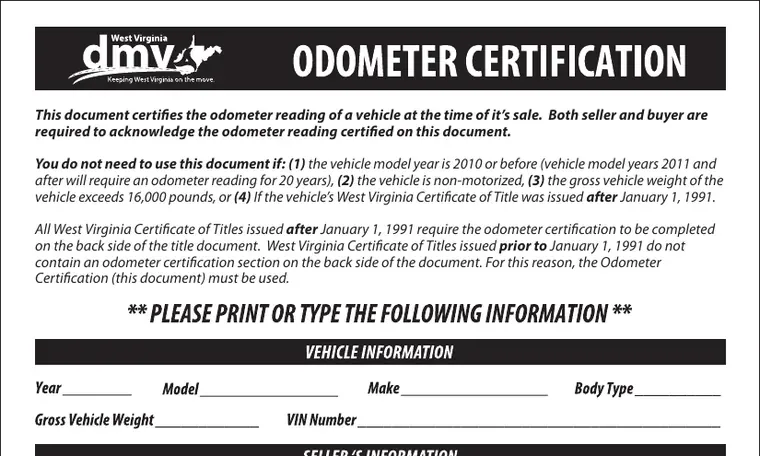
The standalone mileage certification, for the sale whose certificate has nowhere to write one. Its own second paragraph does the sorting: you do not need this document if the vehicle model year is 2010 or before, if it is non-motorized, if its gross vehicle weight exceeds 16,000 pounds - or if the West Virginia certificate was issued after January 1, 1991, because every certificate since then prints the certification on its own back. What is left is narrow, and the Division's titles page names it in one line: when a motor vehicle is sold or transferred, the exact mileage must be recorded in the assignment section of the title - if the title format lacks this section, use Form DMV-TM-1.
Written against DMV-TM-1 (Rev 05/21), issued under 49 U.S.C. 32705 and W. Va. Code 17A-3-12a. Read the four exclusions as alternatives and a strange truth appears: an ordinary car recent enough to need disclosure - model year 2011 or newer - cannot sit on a pre-1991 West Virginia certificate, so this form's honest audience is the odd-format title: the out-of-state certificate with no room in its assignment, the older document formats the titles page means by lacks this section. If your West Virginia certificate has the odometer lines on its back, write there and leave this sheet unprinted.
Two documents, and they are not the same thing. Take the blank DMV-TM-1 from the webapps.transportation.wv.gov copy so you get the revision that is current today, then print our DMV-TM-1 guide and keep it beside you while you fill theirs in.
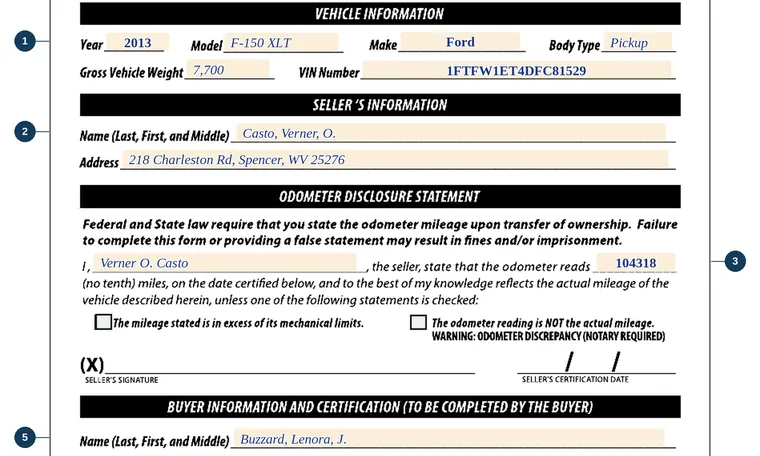
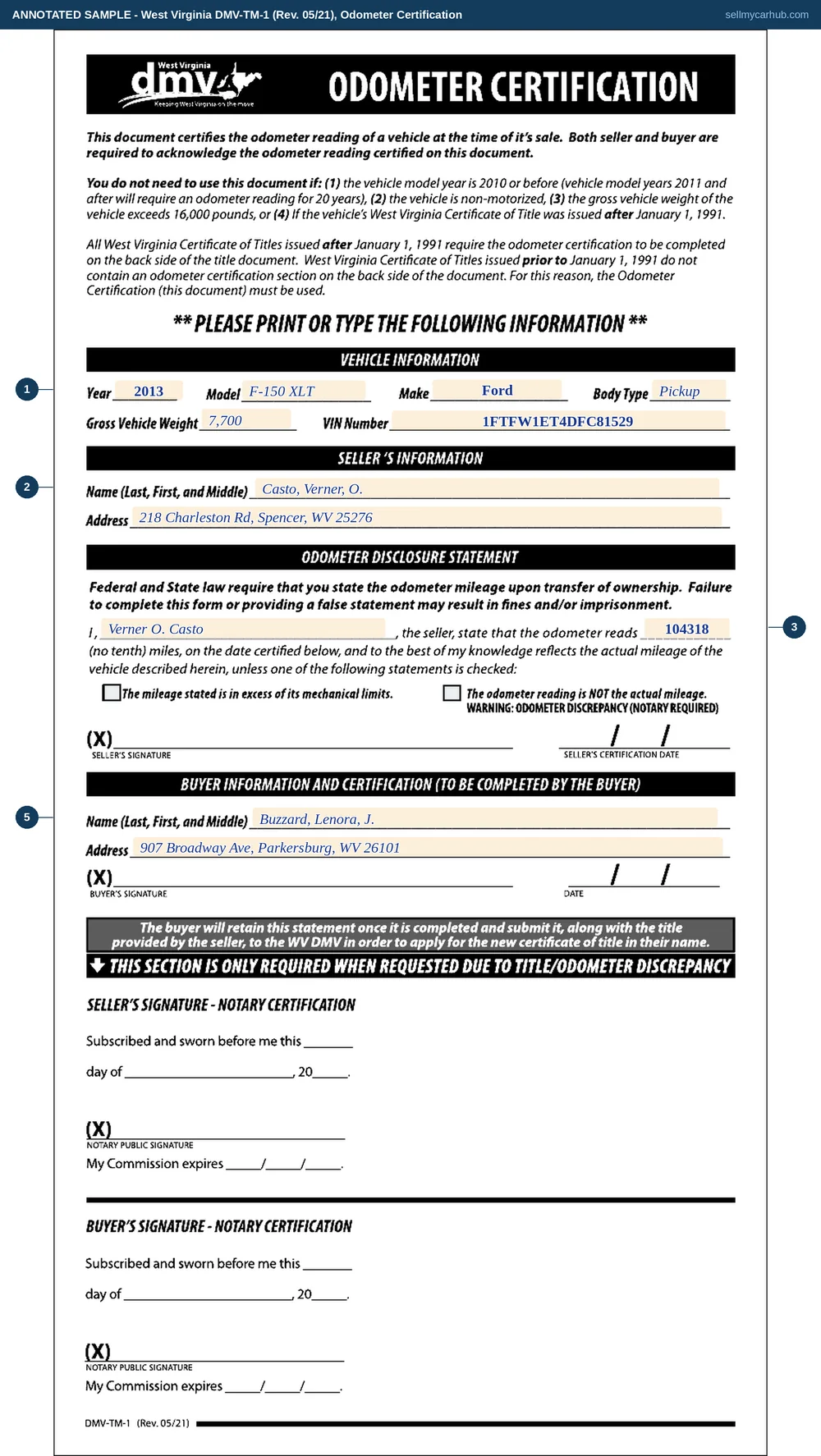
This is the actual DMV-TM-1, rendered from the PDF the West Virginia Division of Motor Vehicles publishes and completed end to end: letterhead, every field, and the blocks at the foot.
Year, model, make, body type, gross vehicle weight and the full VIN.
Watch out: The weight box is doing legal work - over 16,000 pounds gross and the form's own exclusions say you did not need to be here.
Last, first and middle, then the address, as the record should hold them.
Watch out: This sheet may be the only disclosure document the sale produces, so treat it with title-grade care: certificate names, not nicknames.
Whole miles into the printed sentence, and a tick only for a true exception.
Watch out: The second box's printed warning says notary required on a discrepancy - ticking it is what summons the oath blocks at the foot of the page.
The (X) line and the certification date beside it.
Watch out: The reading is certified as of this date. Fill the sheet at the handover so the date, the reading and the sale agree.
The buyer's name, address, signature and date - their acknowledgement of your figure.
Watch out: They are countersigning your number, which is why the figure goes in before their pen arrives. Then the sheet is theirs to keep and file with the title.
| On the form | What to put in it |
|---|---|
| The sorting paragraphs | Two printed paragraphs before any blank: who must acknowledge the reading - both seller and buyer - and the four situations where the document is not needed, including the note that vehicle model years 2011 and after will require an odometer reading for 20 years. |
| Vehicle information | Year, model, make, body type on the first row; gross vehicle weight and the VIN number on the second. |
| Seller's information | Name in last-first-middle order, then address, on two ruled lines. |
| Odometer disclosure statement | The certification sentence: I, the seller, state that the odometer reads a no-tenth figure on the date certified below, reflecting to the best of my knowledge the actual mileage unless one of two boxes is checked - the mileage stated is in excess of its mechanical limits, or the odometer reading is NOT the actual mileage with its warning that an odometer discrepancy requires notarisation. Then the seller's (X) signature and certification date. |
| Buyer information and certification | To be completed by the buyer: name, address, and the buyer's own (X) signature and date - the acknowledgement the first paragraph promises. |
| The retention instruction and the notary bands | A grey bar: the buyer will retain this statement once it is completed and submit it, along with the title provided by the seller, to the WV DMV in order to apply for the new certificate of title in their name. Below it, two full notary certification blocks - seller's and buyer's - under a heading that says this section is only required when requested due to title/odometer discrepancy. |
Every line here was read off DMV-TM-1 (Rev 05/21) itself — the PDF is here — and off the West Virginia Division of Motor Vehicles pages. This is plain-language help with a form, not legal advice, and where our wording and the agency's differ, theirs governs.
Back to all West Virginia seller paperwork, or what selling a car in West Virginia involves.