Sell My Car Hub

How to fill out West Virginia DMV-7-TR

West Virginia's sworn receipt, and the form whose own title announces the oath: NOTARY IS REQUIRED. Nothing obliges an ordinary sale to use it - the price on the certificate usually does the work - but the moment your price falls below half the NADA Clean Loan Book value, a notarised bill of sale is the only thing standing between your buyer and tax assessed on the full book figure. The grey banner across its head keeps everyone honest about what it is not: the ownership status of the vehicle, trailer, or boat named herein will not change until the buyer applies for and is issued a certificate of title.
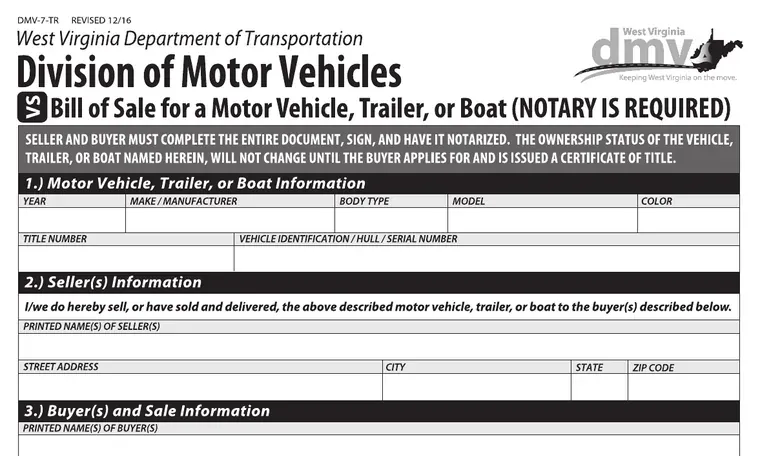
Written against DMV-7-TR (Rev 12/16), issued under W. Va. Code 11-15-3c and 17A-3-4. This is the one form in the ordinary-sale set the Division publishes with no live text layer - the PDF is artwork - so read it on paper before the notary visit rather than trusting a screen-reader's silence. And notice what the odometer sentence makes you certify: the reading on the date certified below, which is the notary's date. Sell on Saturday, swear on Wednesday, and the mileage you wrote is already four days stale - fill the sheet in at the handover and swear it the same day if you can.

Two documents, and they are not the same thing. Take the blank DMV-7-TR from the webapps.transportation.wv.gov copy so you get the revision that is current today, then print our DMV-7-TR guide and keep it beside you while you fill theirs in.

Filled in

What a completed one looks like

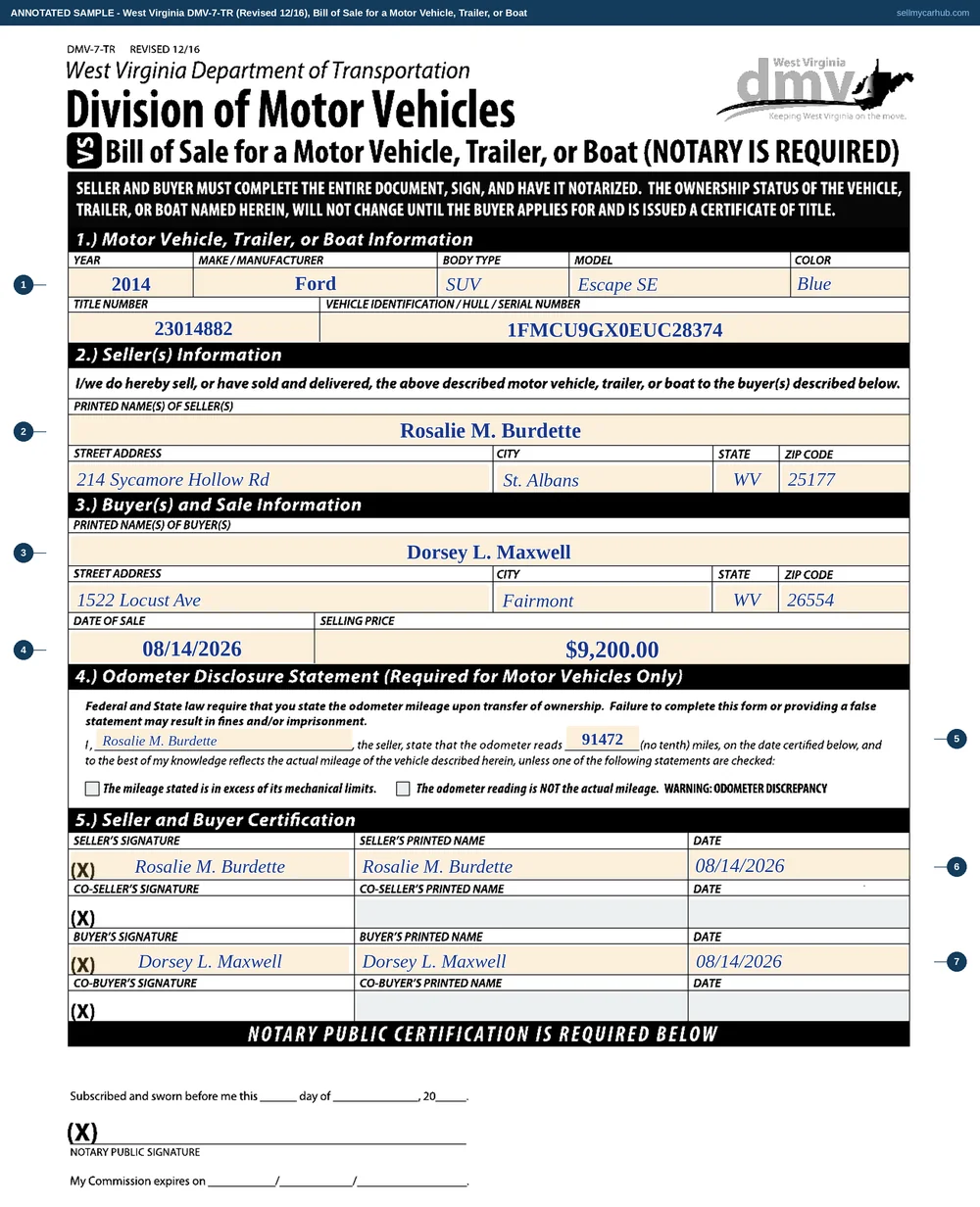
This is the actual DMV-7-TR, rendered from the PDF the West Virginia Division of Motor Vehicles publishes and completed end to end: letterhead, every field, and the blocks at the foot.

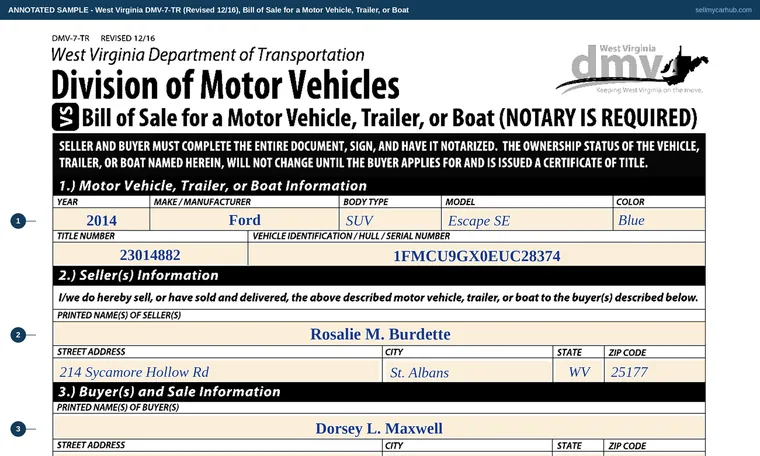
The West Virginia DMV-7-TR bill of sale filled in for the 2014 Ford Escape: seller Rosalie M. Burdette of St. Albans, buyer Dorsey L. Maxwell of Fairmont, a selling price of $9,200.00 on 08/14/2026, an odometer reading of 91472 with neither exception box checked, the seller and buyer signature rows completed, and the notary certification band at the foot left for the commission.
Sworn for the sale this section follows. Neither odometer exception is ticked - the printed sentence already certifies actual mileage, so an honest reading leaves both boxes alone - and the bottom band belongs to the notary, not to either party.
Field by field

Every line, in the order you meet it

  1. 1
    You fill this in

    The vehicle row

    Year, make, body type, model and color, then title number and the full VIN on the second line.

    Watch out: Copy the title number from the certificate itself. This sheet is read beside the title application, and a wrong title number is a mismatch you swore to.

  2. 2
    You fill this in

    Seller printed name and address

    Print every selling owner's name over the declaration, then your street address, city, state and zip.

    Watch out: Print, not sign - the signatures live in section five. Names here should read exactly as the face of the certificate prints them.

  3. 3
    You fill this in

    Buyer printed name and address

    The buyers' names and address, written at the handover with their license in your hand.

    Watch out: The Division wants a legible copy of both parties' driver's licenses attached, so take the photograph of theirs when you write this line - not after they drive off.

  4. 4
    You fill this in

    Date of sale and selling price

    The real day and the real figure - the two boxes this form exists to make sworn.

    Watch out: This price is the one measured against the Clean Loan Book. It should equal the certificate's price to the cent; the sworn copy of a different number is how a sale becomes an investigation.

  5. 5
    You fill this in

    The odometer sentence

    Your name into the printed I-the-seller sentence, the no-tenths reading, and a tick only if one of the two printed exceptions is true.

    Watch out: The second box's own label carries the warning about an odometer discrepancy. It brands the vehicle's record - tick it only because it is true, never because the dash display is dim.

  6. 6
    You fill this in

    Seller and co-seller sign

    Signature, printed name and date on the seller rows - in front of the notary.

    Watch out: Hold your pen until the commission is watching. The certification below says sworn before me, and a notary who did not see it happen is entitled to refuse the stamp.

  7. 7
    The buyer fills this in

    Buyer and co-buyer sign

    The buyers' rows, same discipline, same sitting where possible.

    Watch out: The buyer is the person this sheet ultimately defends - it is their tax bill that book value would inflate - so no buyer should resist the trip to the notary.

  8. 8
    Somebody else fills this in

    The notary block

    The commission completes the sworn-before-me date, signs, and enters the commission expiry.

    Watch out: Check the expiry line is actually filled. An incomplete notarisation reads as no notarisation, and the whole point of the sheet dissolves with it.

At a glance

What goes where

On the formWhat to put in it
1.) Motor vehicle, trailer, or boat informationYear, make/manufacturer, body type, model and color across the top row; then the title number and the vehicle identification / hull / serial number on their own ruled line beneath.
2.) Seller(s) informationA printed declaration - I/we do hereby sell, or have sold and delivered, the above described motor vehicle, trailer, or boat to the buyer(s) described below - then the printed name(s) of seller(s) and a street address, city, state and zip code row.
3.) Buyer(s) and sale informationThe buyers' printed names and address in the same shape, then the two boxes the tax examiner reads first: date of sale and selling price.
4.) Odometer disclosure statement (required for motor vehicles only)The federal-and-state warning that failure to complete this form or providing a false statement may result in fines and/or imprisonment, then the seller's sentence: I, the seller, state that the odometer reads a figure in no-tenth miles on the date certified below, reflecting actual mileage unless one of two boxes is checked - mileage in excess of its mechanical limits, or the reading is NOT the actual mileage with its printed WARNING: ODOMETER DISCREPANCY.
5.) Seller and buyer certificationFour signature rows - seller, co-seller, buyer, co-buyer - each an (X) line with a printed name and date beside it.
Notary public certificationThe block the headline banner points at: subscribed and sworn before me this day, the notary public signature, and my commission expires on. Signed last, in front of the commission, or the whole sheet is decorative.

What gets this one rejected

Rules that decide whether it is accepted

Every line here was read off DMV-7-TR (Rev 12/16) itself — the PDF is here — and off the West Virginia Division of Motor Vehicles pages. This is plain-language help with a form, not legal advice, and where our wording and the agency's differ, theirs governs.

Back to all West Virginia seller paperwork, or what selling a car in West Virginia involves.

Want the paperwork handled instead?

Get My Instant Offer → Online · about 2 minutes · free

Or send the details — we'll come to you

Selling cheap because the car needs work is exactly when the paperwork gets heaviest here. A firm offer skips the oath entirely.

or call/text (877) 405-1808