The dealership counter's odometer sheet - the Division's forms index files it with (Dealers) in its name, and its top line asks for a customer's name and a stock no., which is dealership inventory language. A private seller meets it in one situation only: trading a car in, where you are the transferor whose sentence and signature it collects. It appears here because it is the first result a search for a West Virginia odometer form tends to surface, and filing it on a driveway sale substitutes a stock-control document for the disclosure the title itself should carry.
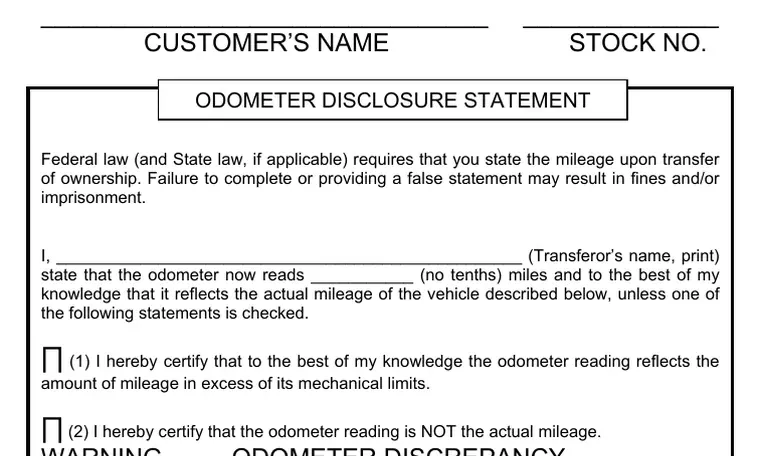
Written against DMV-43 (Rev 1/91), issued under 49 U.S.C. 32705. The revision printed at its foot is decades old and the sheet shows it: nothing on it mentions the model-year split or the twenty-year disclosure period the newer paperwork explains. The federal duty it recites is real, but the sorting - who must disclose and for how long - lives on DMV-TM-1 and the titles page, so read those to learn whether your vehicle discloses at all, and use this sheet only because a dealership handed it across its counter.
Two documents, and they are not the same thing. Take the blank DMV-43 from the webapps.transportation.wv.gov copy so you get the revision that is current today, then print our DMV-43 guide and keep it beside you while you fill theirs in.
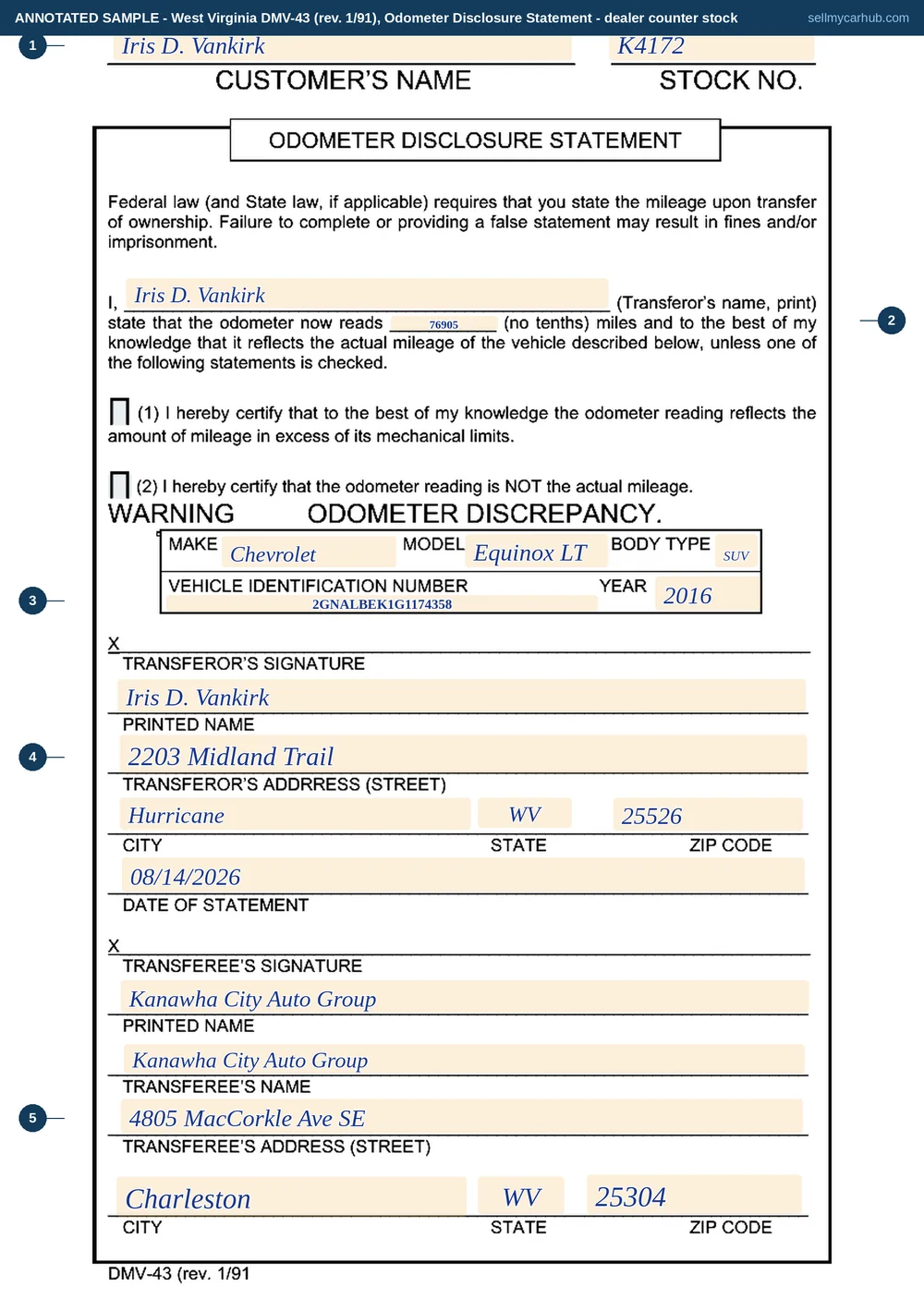
This is the actual DMV-43, rendered from the PDF the West Virginia Division of Motor Vehicles publishes and completed end to end: letterhead, every field, and the blocks at the foot.
The dealership's deal reference - your name as their customer, and the number they file the trade-in under.
Watch out: If you are completing this anywhere but a dealership counter, stop; the form has no role in a sale between individuals.
Your printed name into the sentence, the no-tenths reading, and a numbered box only for a true exception.
Watch out: The second box's printed warning is the permanent one. On a trade-in it also moves money - a discrepancy reading reprices the deal on the spot.
Make, model, body type, VIN and year for the car being traded.
Watch out: Read the VIN from the vehicle or the certificate, not the sales listing - the dealer's title work will be built on what this line says.
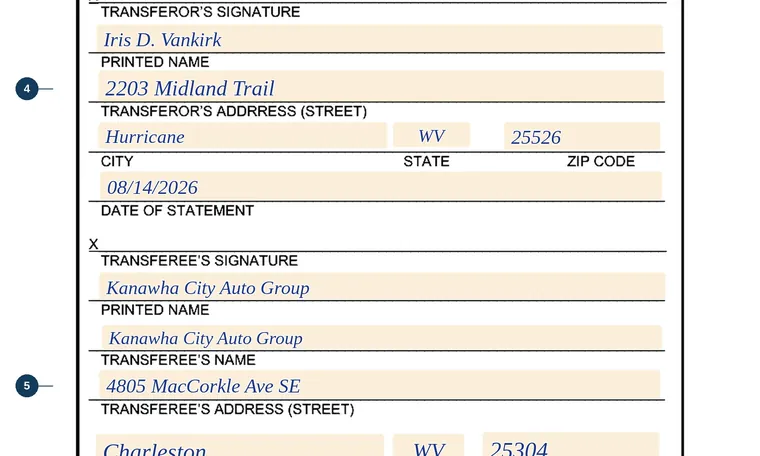
Sign, print, and give your address and the date of statement.
Watch out: The date should be the day the trade actually concludes. A statement dated before the deal exists certifies a reading nobody could yet rely on.
The dealership signs and identifies itself as the receiving party.
Watch out: Ask for a copy once both blocks are done. The original disappears into the deal jacket, and the copy is your record of exactly what was certified.
| On the form | What to put in it |
|---|---|
| Customer's name and stock no. | The two blanks above the title - the dealership's file reference for the deal and the inventory number it assigns your trade-in. |
| The federal sentence | Federal law (and state law, if applicable) requires that you state the mileage upon transfer of ownership - with the warning that failure to complete or providing a false statement may result in fines and/or imprisonment. |
| Transferor's statement | Your printed name and the reading in no-tenths miles, reflecting actual mileage unless one of two numbered certifications is checked: (1) the reading reflects the amount of mileage in excess of its mechanical limits, or (2) the odometer reading is NOT the actual mileage, printed beside WARNING ODOMETER DISCREPANCY. |
| Vehicle identification | Make, model, body type, the vehicle identification number and year, boxed mid-sheet. |
| Transferor block | Signature, printed name, street address, city, state and zip, and the date of statement. |
| Transferee block | The dealership's mirror: signature, printed name, name and street address, city, state and zip. |
Every line here was read off DMV-43 (Rev 1/91) itself — the PDF is here — and off the West Virginia Division of Motor Vehicles pages. This is plain-language help with a form, not legal advice, and where our wording and the agency's differ, theirs governs.
Back to all West Virginia seller paperwork, or what selling a car in West Virginia involves.