The sheet that turns your assigned certificate into the buyer's new title, and the one place the whole deal is added up: price, trade-in, net cost and the 6% sales tax on one row, the insurance certification underneath, and a fee table on the reverse that itemises what the cheque to the Division must cover. The buyer signs it under penalty of false swearing; there is no seller signature on the front of it at all, because West Virginia already collected yours on the back of the certificate. What a seller cannot ignore is that its figures are read against the assignment you wrote - the same price, the same mileage, the same names.
Written against DMV-1-TR (Rev 11/2022), issued under W. Va. Code 17A-3-4 and 17A-4-3. The odometer reading box sits on the front with no exception ticks beside it - those live in the dealer certification, which a private sale leaves blank. Your actual disclosure was made in the assignment section of the certificate, so the number copied onto this application has to match it exactly; the seminar the Division runs for dealers lists mismatched evidence as a leading reason title work is sent back.
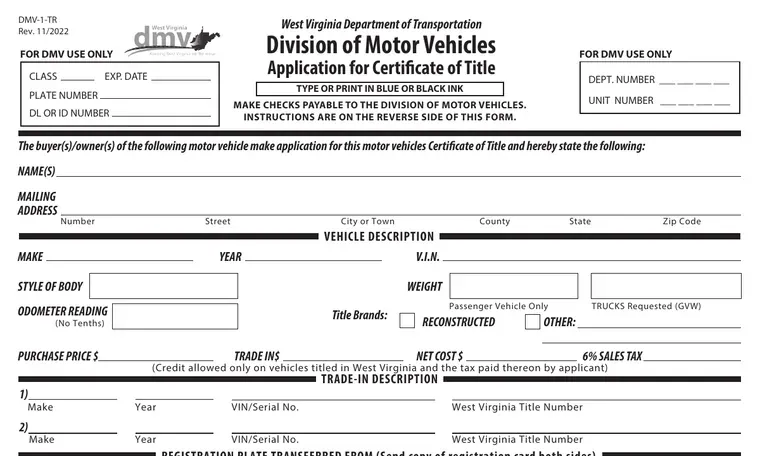
Two documents, and they are not the same thing. Take the blank DMV-1-TR from the webapps.transportation.wv.gov copy so you get the revision that is current today, then print our DMV-1-TR guide and keep it beside you while you fill theirs in.
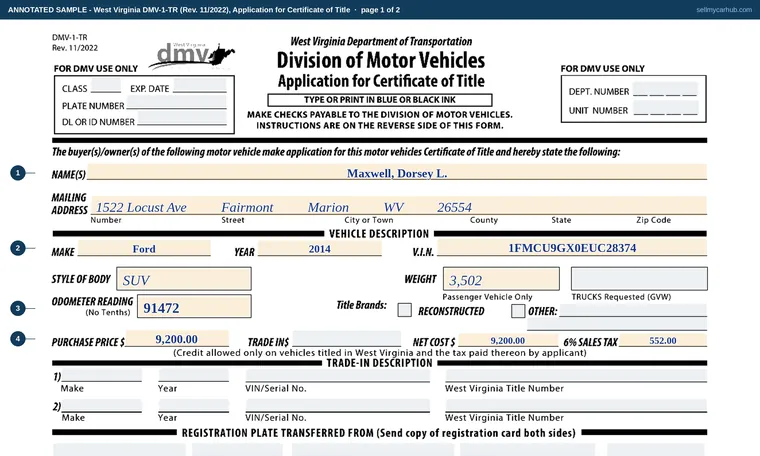
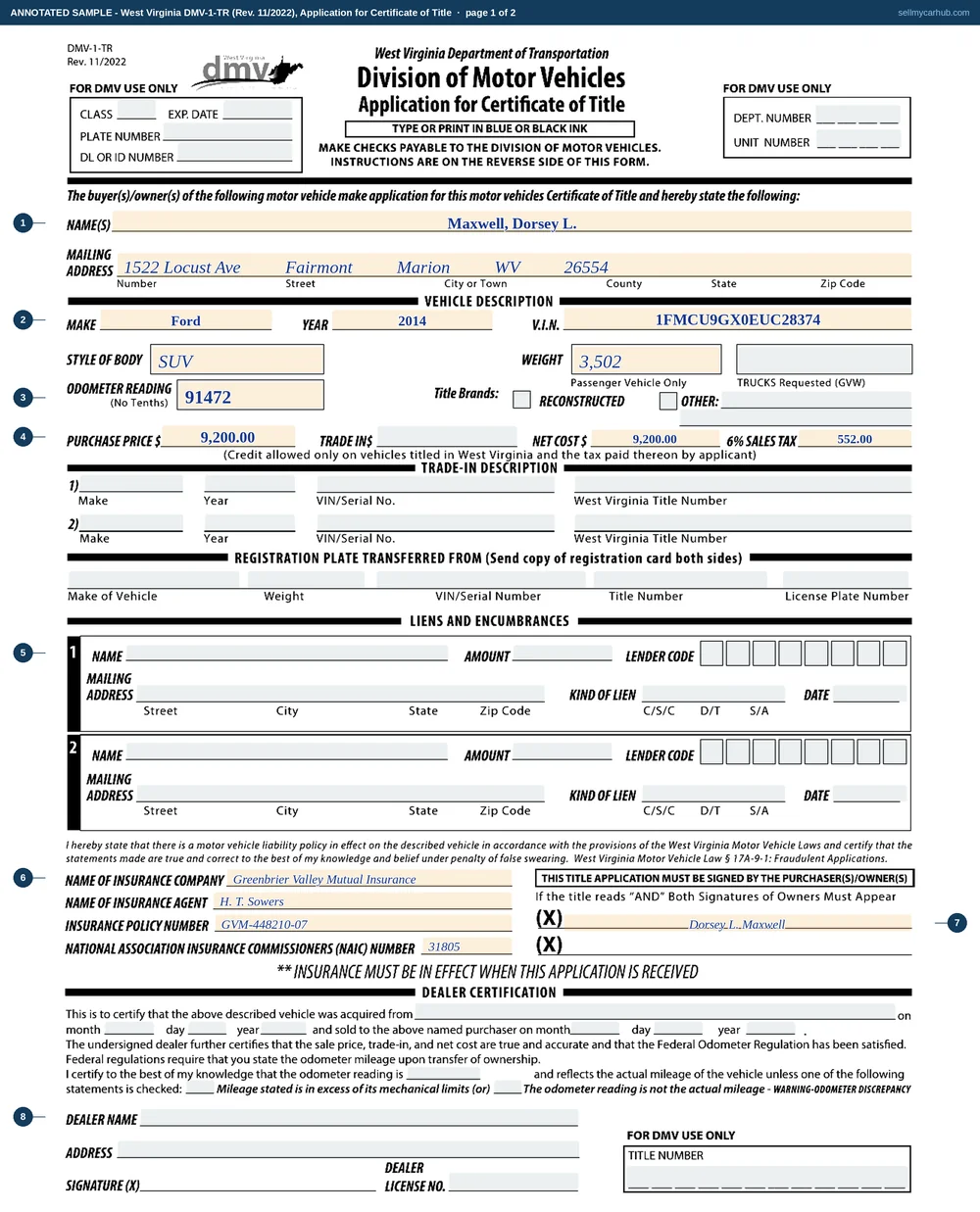
This is all 2 pages of the actual DMV-1-TR, rendered from the PDF the West Virginia Division of Motor Vehicles publishes and completed end to end: letterhead, every field, and the blocks at the foot.
Full name as it should read on the new certificate, then the one-row address with county included.
Watch out: The county box matters here in a way other states' forms don't warn about - it is where the personal property tax on the vehicle will be assessed each year.
Make, year, VIN, body style and weight, copied from the certificate rather than from memory.
Watch out: The Division's buyer warning is to confirm the VIN on the physical vehicle matches the certificate exactly - this box is where a transposed character gets immortalised.
The same whole-mile figure the seller certified on the back of the title, and a tick only if the certificate already carries a brand.
Watch out: No tenths. And no invented brand honesty either - the brand row copies the certificate, it does not editorialise about the car's condition.
Price paid, trade-in if a dealer deal, net cost, then 6% of the net.
Watch out: On a private sale the price and the net cost are the same figure. If that figure is under half of book value, the notarised bill of sale must be in the same envelope or the tax is recalculated on the book.
The buyer's lender, if the purchase is financed - name, amount, lender code, address, kind and date. Nothing here concerns the loan you already paid off.
Watch out: An individual lender rather than a bank needs the signed loan agreement attached - the Division will not record a private person as lienholder on paperwork alone.
Company, agent, policy and NAIC number, feeding the certification beside it.
Watch out: This is the certification the verification computer checks later. A policy bought the same morning is fine; a policy promised for next week is a rejected application.
One (X) line, or both where the new title reads AND, signed under penalty of false swearing.
Watch out: The citation printed beside the oath is 17A-9-1, Fraudulent Applications. It reaches every figure above the line, including the price.
Acquisition and sale dates, the price certification and the dealer's own odometer statement - completed only when a licensed dealer sold the car.
Watch out: A private seller who writes here has certified a dealer sale that never happened. Leave it to the trade.
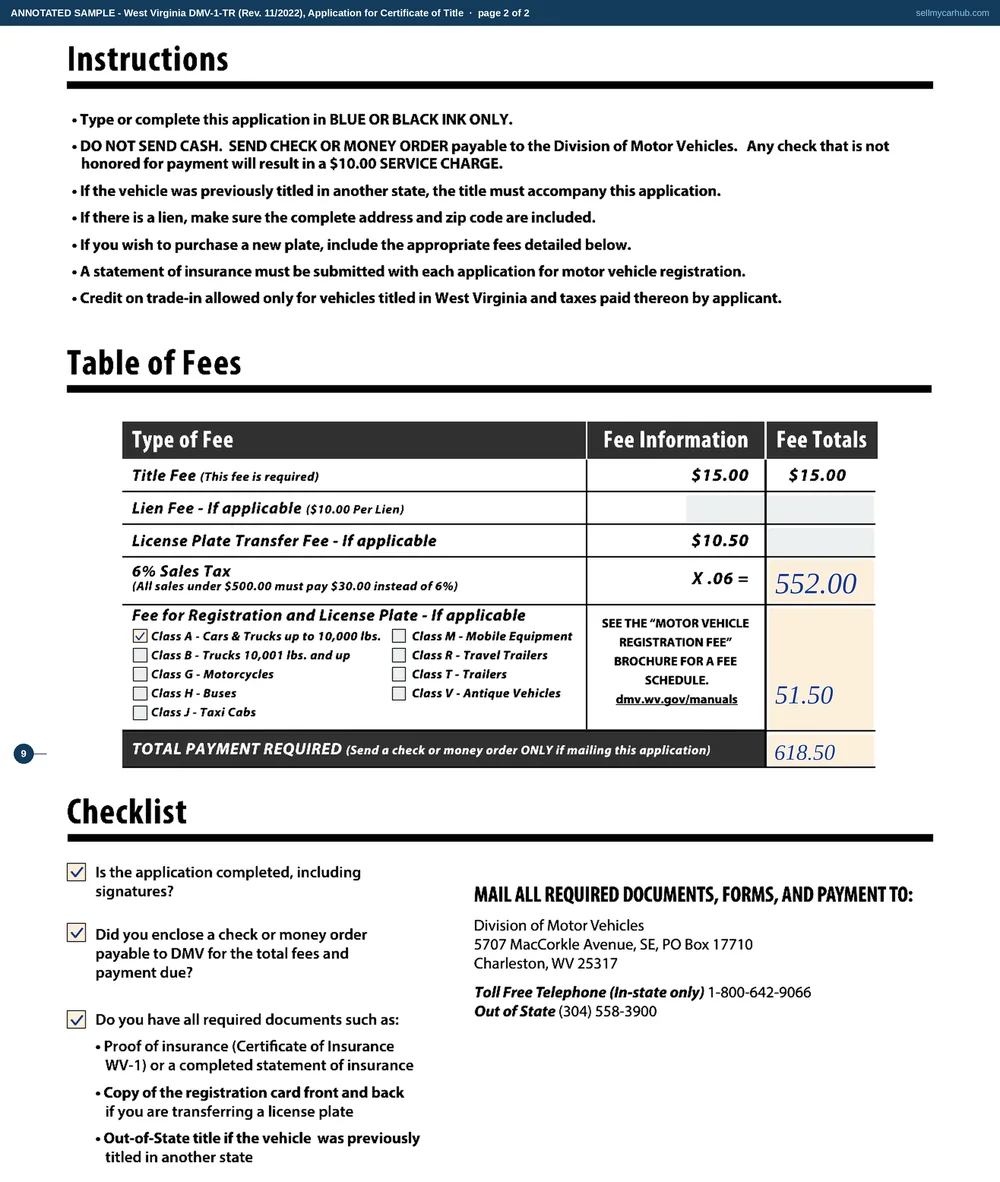
Total from the reverse's fee table - $15.00 title, tax, and whichever registration line applies - as one cheque to the Division of Motor Vehicles.
Watch out: The checklist on the back is worth actually running: signatures, payment, insurance proof, and the registration card copy if a plate is transferring.
| On the form | What to put in it |
|---|---|
| Name(s) and mailing address | The buyer(s)/owner(s) of the following motor vehicle make application - full name, then number, street, city or town, county, state and zip code across one ruled row. Two buyers both go here if the new title is to carry two names. |
| Vehicle description | Make, year, V.I.N., style of body and weight, with the weight boxed for passenger vehicle only against a TRUCKS requested (GVW) alternative. Then the odometer reading, no tenths, and the title brands row - RECONSTRUCTED or OTHER. |
| Purchase price, trade-in, net cost and 6% sales tax | Four boxes across the sheet's middle. The bracketed condition under them is the whole trade-in rule: credit allowed only on vehicles titled in West Virginia and the tax paid thereon by applicant. |
| Trade-in description | Two numbered rows - make, year, VIN/serial number and the West Virginia title number of whatever was traded. Private sales leave both empty; the arithmetic above then runs on the price alone. |
| Registration plate transferred from | The buyer's old vehicle: make, weight, VIN, title number and license plate number, with an instruction to send a copy of the registration card both sides. This is where the buyer's own plate follows them onto the newly bought car. |
| Liens and encumbrances | Two numbered lien blocks, each with name, amount, lender code, mailing address, kind of lien - C/S/C, D/T or S/A - and date. What is written here is what the new certificate will carry on its face. |
| Insurance and certification | Name of insurance company, agent, policy number and NAIC number, beside the statement that there is a motor vehicle liability policy in effect on the described vehicle and that the statements are true and correct under penalty of false swearing, citing 17A-9-1, Fraudulent Applications. Two (X) signature lines, with the rule printed above them: if the title reads AND, both signatures of owners must appear. |
| Dealer certification | A block a private sale leaves entirely blank: acquired-from and sold-to dates, a certification that the sale price, trade-in and net cost are true and that the Federal Odometer Regulation has been satisfied, the dealer's own odometer statement with its two exception ticks, and the dealer name, address, signature and license number. |
| The reverse - instructions, fee table and checklist | Blue or black ink only, no cash, the $10.00 service charge for a dishonoured cheque, and the fee table: title fee $15.00 (this fee is required), lien fee $10.00 per lien, license plate transfer fee $10.50, 6% sales tax with the note that all sales under $500.00 must pay $30.00 instead, and registration by class from the fee brochure. The checklist closes with the Charleston post box the packet goes to. |
Every line here was read off DMV-1-TR (Rev 11/2022) itself — the PDF is here — and off the West Virginia Division of Motor Vehicles pages. This is plain-language help with a form, not legal advice, and where our wording and the agency's differ, theirs governs.
Back to all West Virginia seller paperwork, or what selling a car in West Virginia involves.