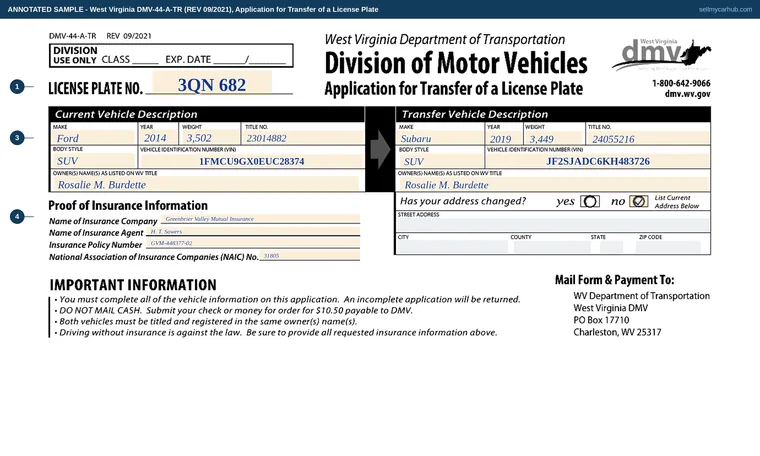
The form that moves your plate onto your next car - the natural sequel to a West Virginia sale, where keeping the plate is the statutory duty and wasting its remaining registration is optional. The sheet is a FROM and TO pair: the current vehicle description on the left, the transfer vehicle on the right, insurance proof beneath, and the two rules its important-information box insists on - both vehicles must be titled and registered in the same owner(s) name(s), and the fee is $10.50 by check or money order, never cash.
Written against DMV-44-A-TR (Rev 09/2021), issued under W. Va. Code 17A-4-1 and 17A-10-10. Do this promptly or the plate becomes a liability instead of an asset: an idle plate from a sold car sits in the insurance verification sweep wearing your name, and the Division's own instruction for a dropped policy is that the plate is supposed to be returned. Transfer it, surrender it, or account for it with the lost-plate statement - the one thing a West Virginia plate cannot safely do is nothing.
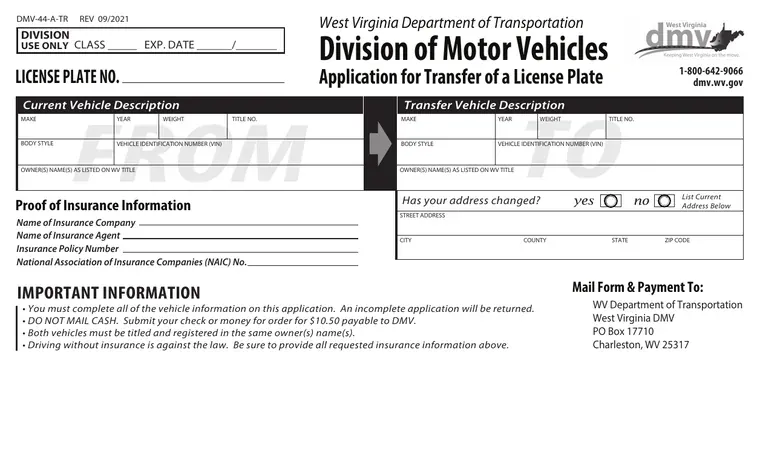
Two documents, and they are not the same thing. Take the blank DMV-44-A-TR from the webapps.transportation.wv.gov copy so you get the revision that is current today, then print our DMV-44-A-TR guide and keep it beside you while you fill theirs in.
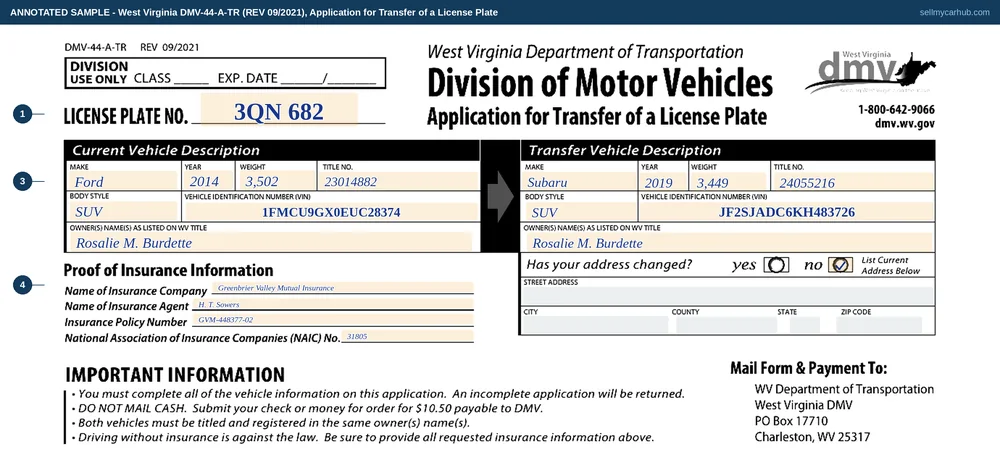
This is the actual DMV-44-A-TR, rendered from the PDF the West Virginia Division of Motor Vehicles publishes and completed end to end: letterhead, every field, and the blocks at the foot.
The plate coming off the sold car, exactly as stamped.
Watch out: Physically take it off before the buyer drives away - the transfer moves the number, but only you can move the tin.
Make, year, weight, title number, body style and VIN of the car you sold, with your name as its title lists it.
Watch out: Yes, the sold car's details - the Division matches this column against the record the plate hangs on today.
The same identifiers for your other car, titled in the same name.
Watch out: Same name means same name. A car titled jointly with your spouse is not in the same name as one titled alone, and this is the rejection the counter sees most.
Insurer, agent, policy and NAIC number for the receiving car; the address row only if yours changed.
Watch out: The NAIC number is on your insurance card. It is how the verification system finds your policy without a phone call.
The $10.50 check or money order, the registration card copy both sides, and the Charleston box.
Watch out: The registration card copy is on the DMV-1-TR's checklist for transfers too - the two forms enforce the same packet from opposite ends.
| On the form | What to put in it |
|---|---|
| License plate number | The plate being moved, top left under the Division-use class and expiry boxes. |
| Current vehicle description - FROM | Make, year, weight, title number, body style and the VIN of the car the plate is leaving: the one you sold. |
| Transfer vehicle description - TO | The same six identifiers for the car receiving the plate, plus the owner(s) name(s) as listed on WV title under each column. |
| Proof of insurance information | Name of insurance company, agent, policy number and the NAIC number - the transfer certifies cover on the receiving car. |
| Has your address changed? | A street address, city, county, state and zip row, with the instruction to list the current address - the Division updates the record from it. |
| Important information and the mail box | Complete all vehicle information or the application is returned; the $10.50 payable to DMV; both vehicles in the same name; driving without insurance is against the law; and the PO Box 17710 Charleston address the form and payment go to. |
Every line here was read off DMV-44-A-TR (Rev 09/2021) itself — the PDF is here — and off the West Virginia Division of Motor Vehicles pages. This is plain-language help with a form, not legal advice, and where our wording and the agency's differ, theirs governs.
Back to all West Virginia seller paperwork, or what selling a car in West Virginia involves.