Turns a wrecked car's ordinary title into a salvage title, or into a non-repairable certificate if it is going to be crushed or parted out. Most people meet this because an insurer totalled their car and they kept it — and until the paper matches the vehicle, nobody can legally buy it from you.
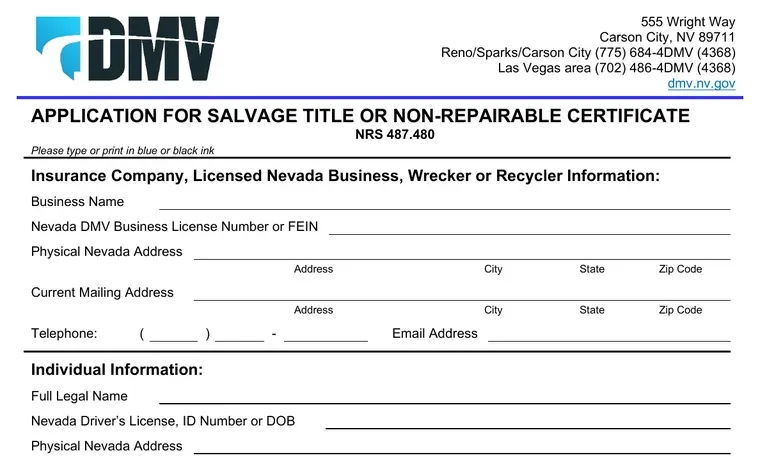
Written against VP 213 (05/2024), issued under NRS 487.480. May 2024 revision. There are two applicant blocks and you use one of them. The top half is for an insurance company, a licensed Nevada business, a wrecker or a recycler; a private owner keeping their own totalled car fills in the individual block underneath and leaves the business block empty.
Two documents, and they are not the same thing. Take the blank VP 213 from the dmv.nv.gov copy so you get the revision that is current today, then print our VP 213 guide and keep it beside you while you fill theirs in.
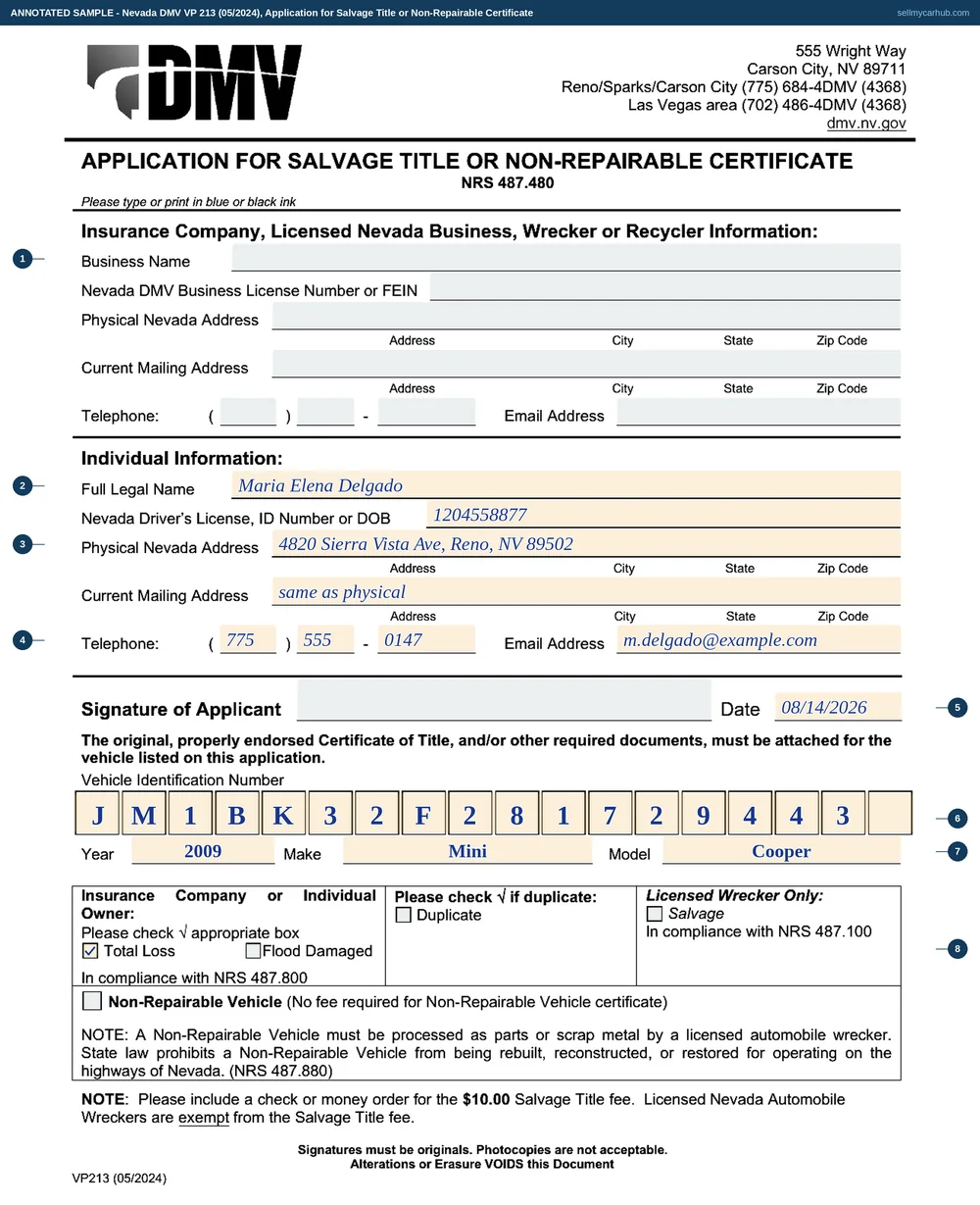
This is the actual VP 213, rendered from the PDF the Nevada Department of Motor Vehicles publishes and completed end to end: letterhead, every field, and the blocks at the foot.
Business name, Nevada DMV business licence number or FEIN, addresses and contact details.
Watch out: An insurance company, licensed Nevada business, wrecker or recycler fills this in. A private owner leaves every line of it empty.
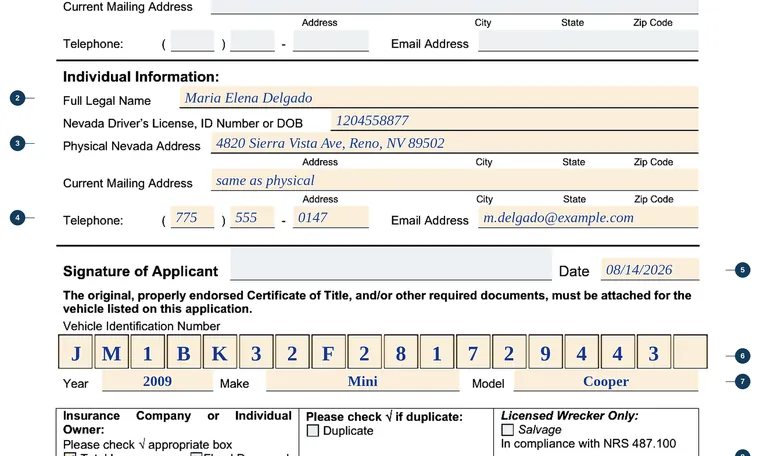
The individual block: your name as it appears on your identification.
Watch out: It has to match the name endorsed on the title you are attaching. If the title is in a maiden name, that mismatch gets cleared with VP 185 before this is filed.
Physical Nevada address, then mailing address if it differs.
Watch out: The form asks specifically for a physical Nevada address. A PO box belongs on the mailing line.
Split across three boxes for the number, then the email line.
Watch out: Salvage applications generate questions more often than ordinary transfers. A number the DMV can reach saves a fortnight.
The applicant signs and dates.
Watch out: Sign as the individual applicant, on the individual line. There is a separate date box beside the business signature that is not yours.
One character per box.
Watch out: Take it off the title you are surrendering, and check it against the car. A wrecked vehicle is exactly where a transposed VIN goes unnoticed until it is too late.
The vehicle description.
Watch out: Copy it from the title rather than from the insurer's total-loss letter. Insurers abbreviate; the DMV matches against its own record.
Total loss, flood damaged, non-repairable, or duplicate.
Watch out: Read the difference before you tick. Non-repairable means the vehicle will never be registered again, and that is a one-way door.
| On the form | What to put in it |
|---|---|
| Who is applying | Either a business block for insurers, wreckers and recyclers, or an individual block for an owner applying for themselves. |
| The vehicle | VIN, year, make and model. |
| What you are asking for | Total loss, flood damaged, non-repairable, or a duplicate. |
| The title | The original endorsed Certificate of Title has to be attached to the application. |
Every line here was read off VP 213 (05/2024) itself — the PDF is here — and off the Nevada Department of Motor Vehicles pages. This is plain-language help with a form, not legal advice, and where our wording and the agency's differ, theirs governs.
Back to all Nevada seller paperwork, or what selling a car in Nevada involves.