Sell your car in Las Vegas: running, sun-damaged or won't start
Even a car worn out by the Mojave heat can get a cash offer online, with pickup wherever it's parked in the valley. Inside the city limits, city code sets time limits for a car parked on a street or left dead in an apartment lot.
Prefer a callback? Leave your number ↓
Offers powered by our buying partner — ★ 4.7 Trustpilot (205,000+ reviews) · ★ 4.5 Google (8,900+)
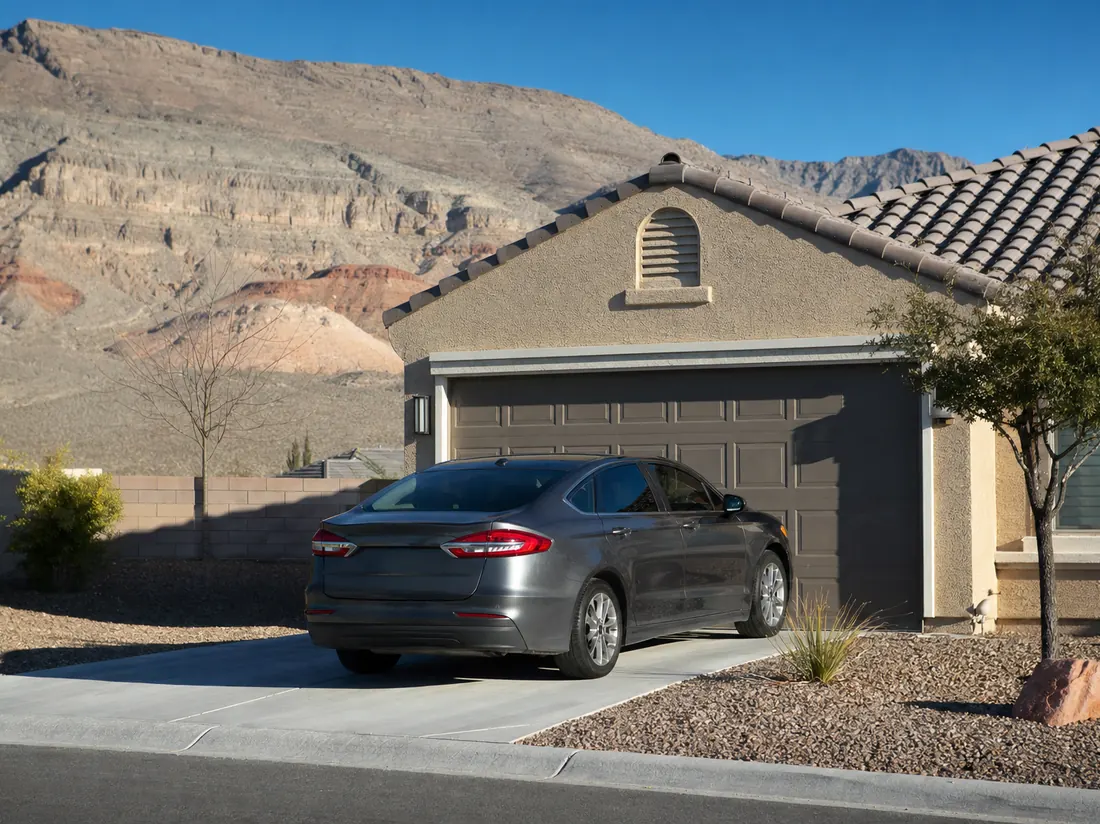
Where the city lets you park a car for sale
- At home, one at a time. On a single-family lot, a car with a for-sale sign must be owned by or registered to an owner or resident. It has to sit on an improved parking surface with its VIN visible from outside. The city allows one car for sale there at a time, and two in any 12 months (LVMC 19.12.020).
- Not on a store or empty lot without written consent. Showing a car for sale on a parking lot, vacant lot or empty property is illegal unless zoning allows it and the lot owner's signed consent is posted inside the windshield. Parking it there while you shop is fine. Otherwise the fine is $100, and after a 24-hour notice the car can be towed at your cost (LVMC 10.78).
- Not on a dirt shoulder. The same goes for any unpaved part of a public right-of-way, where the car can be towed after a 72-hour notice (LVMC 13.04.070).
Where we pick up around Las Vegas
Pickup covers the whole valley. A garage in Summerlin gets the same trip as a carport in Sunrise Manor. That goes for downtown, Centennial Hills, Spring Valley, Paradise, Enterprise, Winchester and Whitney too.
If a title problem needs a counter visit: the Nevada DMV's Las Vegas offices are on East Sahara Avenue, North Decatur Boulevard and West Flamingo Road. East Sahara also houses its emissions lab. All three require an appointment and open Saturdays from 8 a.m. to 4 p.m. A fourth, Silverado, at 9850 S. Valley View Blvd., is listed as coming this fall.
Cash for your car in Las Vegas
Officers may remove a car parked on a city street right away, without waiting out a warning notice, if it is too disabled to drive normally (LVMC 11.24.030). Push a dead one onto your driveway if you can. At an apartment complex, a car that plainly doesn't run and can be seen from the street may stay in its parking space seven days in a row, no more (LVMC 11.24.020).
When the car is only worth scrap, cash for junk cars in Las Vegas starts at our junk car page. One that's sun-worn or won't start still gets an offer as it sits, and pickup is arranged around a car that can't drive itself.
If the engine is why it won't start or drive, selling a car that overheats, knocks or has a seized engine compares the repair bill with selling it as it is. A slipping transmission or a failing CVT has its own guide: selling a car with a bad transmission.
Leaving Nellis: ship it, store it or sell it
Nellis sits about eight miles northeast of Las Vegas (MilitaryINSTALLATIONS). PCS orders can let you ship or store one car at government expense. On a move to or from an overseas base, only one car owned or leased for personal use ships that way (Military OneSource). For what your orders allow, the Nellis moving page points you to the base household goods and transportation office, and for shipping, to the PCSmyPOV site (MilitaryINSTALLATIONS).
If a car isn't making the trip, our guide to selling a car before a PCS move covers the timing, and pickup comes to wherever it's parked in the valley.
How long a car can sit in the city
- •On a street, beside the same property: no more than 72 hours in a row, or 72 hours in any 96-hour stretch. Moving it a few feet doesn't restart the count (source)
- •A car with no current registration or no valid plate can't be parked on a city street at all, and that includes one whose plates you've already taken off (source)
- •Once a warning notice goes on the car, it can be towed 72 hours later at the owner's expense, and the fine for a street violation is $75 (source, fine schedule)
Asked by Las Vegas sellers
Should I check my car's trade-in value at a Las Vegas dealer first?
Get the number, and do the tax math with it. Sales tax on a dealer purchase in Clark County is 8.375%, and Nevada law leaves the trade-in allowance out of the taxed amount (NRS 372.025). So a $10,000 trade allowance takes $837.50 off the tax on your next car. Count that before you compare the trade number with a cash offer. Our guide to trading in versus selling covers the rest.
What if the car already has a city parking notice on it?
Pay it or set up a payment plan with the city's Parking Services Division within 30 calendar days, or a late penalty is added. An appeal can be filed within 90 days (LVMC 11.10.090). The office is at 350 S. City Parkway, open weekdays 7:30 a.m. to 5:15 p.m., phone 702-229-4700, and it takes payments and appeals online. The city says Mondays and Fridays are its busiest days (Parking Services).
I live in Spring Valley, not the city. Do these rules apply to me?
No, these are city rules. The Census Bureau lists Spring Valley, Paradise, Enterprise and Summerlin South as census designated places. It defines those as unincorporated communities, so Las Vegas city code doesn't reach them. Clark County's FixIt page has a jurisdiction app that shows whether the city or the county covers an address. County Code Enforcement handles violations of the county code, and its office at 4701 W. Russell Road is open Monday through Thursday.
The DMV side of a Nevada sale, from the title to the online resale notice, is on our Nevada page.