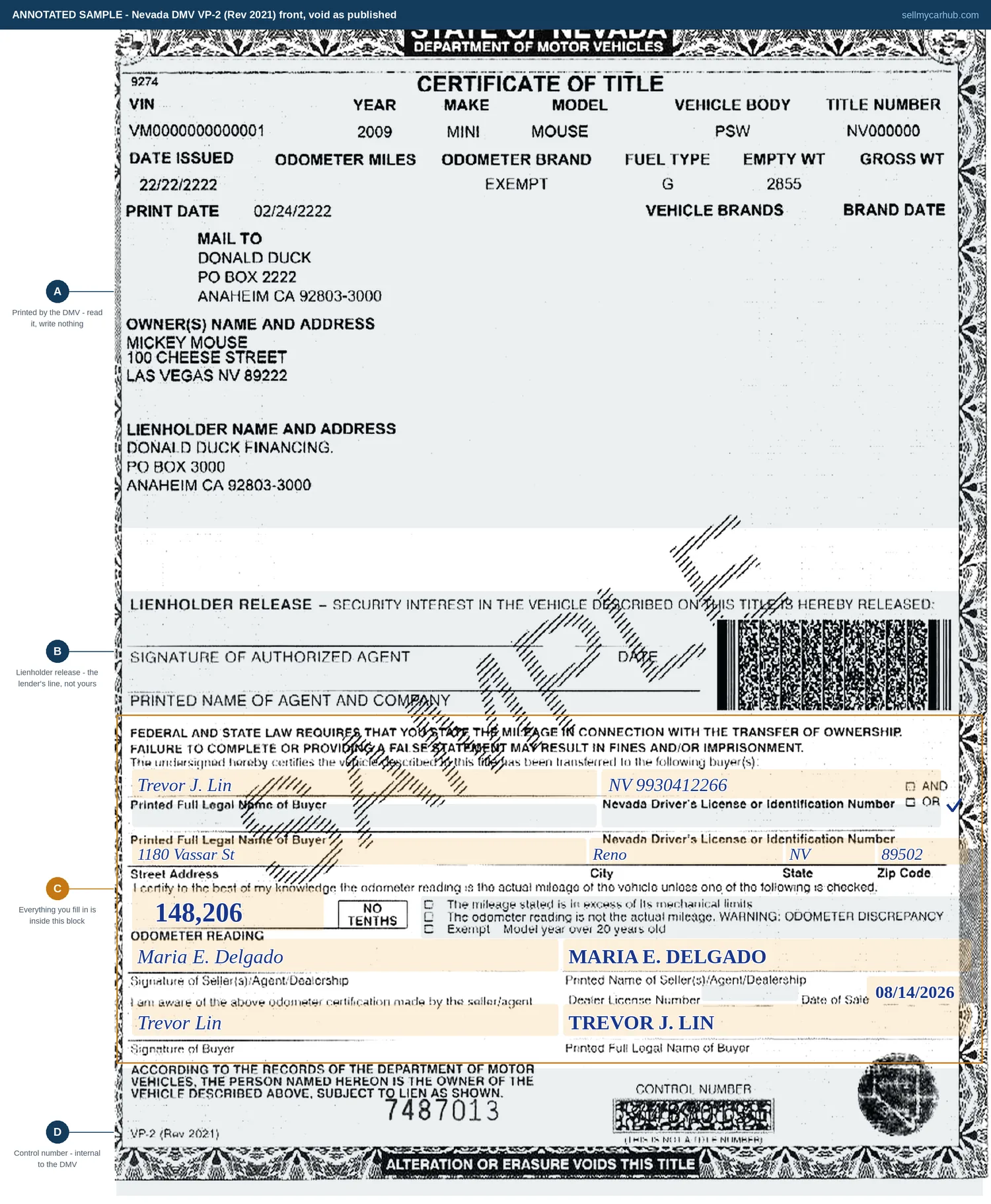
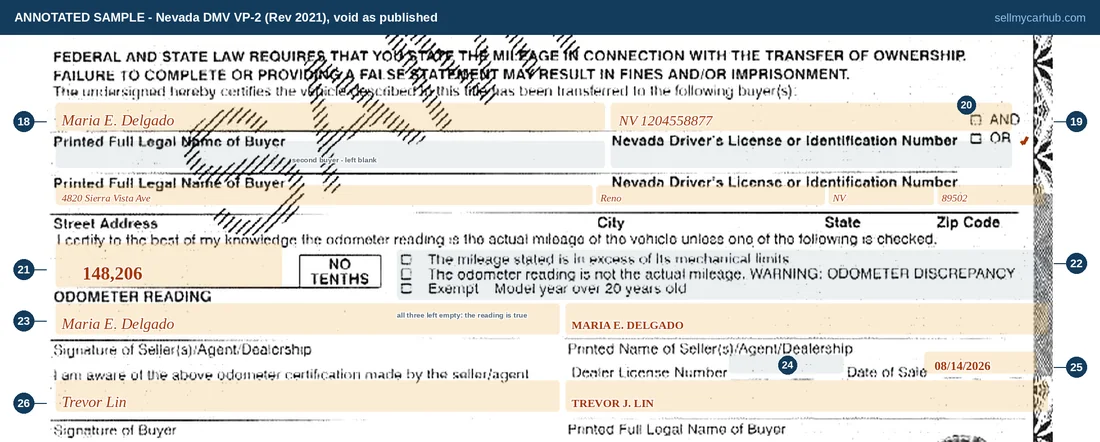
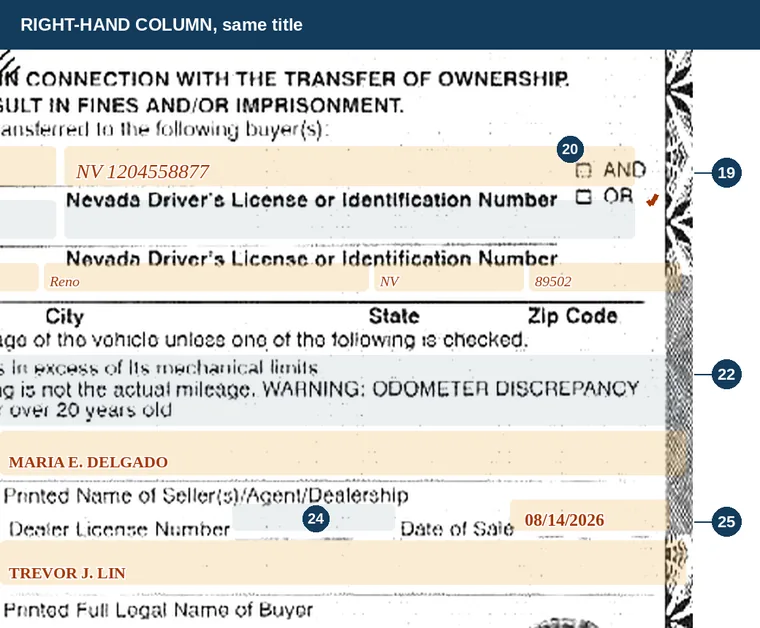
Ten boxes on the transfer section, and only 4 of them are yours. Here is the transfer section of a VP-2 (Rev 2021) Nevada title with sample values in it, numbered exactly the way the Nevada Department of Motor Vehicles numbers them in its own Nevada DMV Registration and Title Guide, revised April 2025.
As a private seller you complete these and nothing else:
Made to sit next to the title while you fill it in. Nothing to sign up for.
Any alteration or erasure voids a Nevada Certificate of Title. There is no correction fluid, no scribbling out, no writing over. Get it wrong and you are applying for a duplicate.
Three title styles are in circulation and all are valid: Revision 2021 (the blue one), 1/2016, and 8/2010. The boxes are in the same order on all three.
This is the actual VP-2 (Rev 2021) title, not a drawing of one. Orange is what gets written in, and every box a private seller touches is shaded. Tap any number to jump to what it means.
Before you watch. The title in this video is an older-style Nevada one, so its odometer line reads "Exempt – Model year over 9 years old". That wording was overtaken by the federal change to 20 years, which is why step 22 above says what it does. Everything else in it is the physical act of signing, which has not changed.
Made by DMV Made Easy in August 2024, not by us and not by the Nevada DMV — the written steps above are what we stand behind. Nothing loads from YouTube until you press play.
If a lienholder is printed on the title, this has to be released before anything transfers. The lienholder or their authorized agent signs and dates it. A business lienholder prints the business name alongside the representative's signature.
Watch out: This is not yours to fill in. If the box is filled and the car is paid off, you are clear to sell.
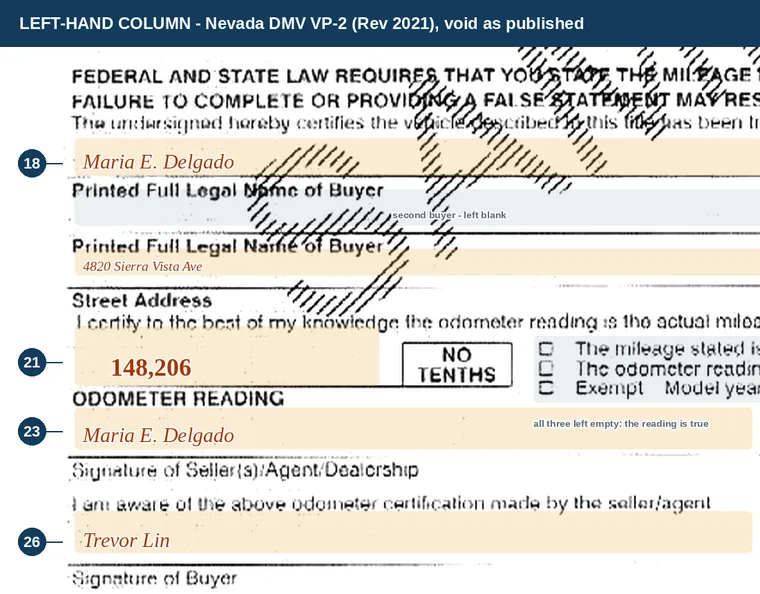
The buyer's full legal name exactly as it reads on their driver's license, ID card or business license, then street address, city, state and ZIP. This is the name that ends up on the new registration and title.
Watch out: Trading as a business? Put DBA in front of the business name. Leased? The words Lessee and Lessor go after the full legal name, and multiple lessees are separated with a semicolon.
Taken from whatever document the buyer actually presented at the sale. The DMV uses it to match the legal name onto the registration and title.
Watch out: No Nevada license or ID? Print "No Nevada DL or ID". A business with no FEIN? Print "No FEIN". Never write a Social Security number here.
Only relevant when the car is going into more than one name. Ticking AND means every one of those people will have to sign next time the car is sold. Ticking OR means any one of them can.
Watch out: One tick, and it decides how hard the buyer's own future sale is. Most people want OR and never think about it.
Exactly what the odometer shows, excluding tenths. There is a NO TENTHS box printed right next to it for a reason.
Watch out: Not the rounded number, not last month's number. Walk out and read it.
Leave all three boxes empty if the reading is the true mileage. Tick one only if it is not: over mechanical limits, not actual mileage, or exempt by age. Whichever you tick brands the new title accordingly.
Watch out: The exemption line is where people go wrong. A 2021-issue title says over 20 years old; a title printed under the old rule says over 9 years. The 20-year rule is the one in force.
Sign exactly as your name is printed on the face of the title, and print it beside the signature.
Watch out: Exactly as printed. Not your married name if the title has your maiden name, not initials if it spells you out.
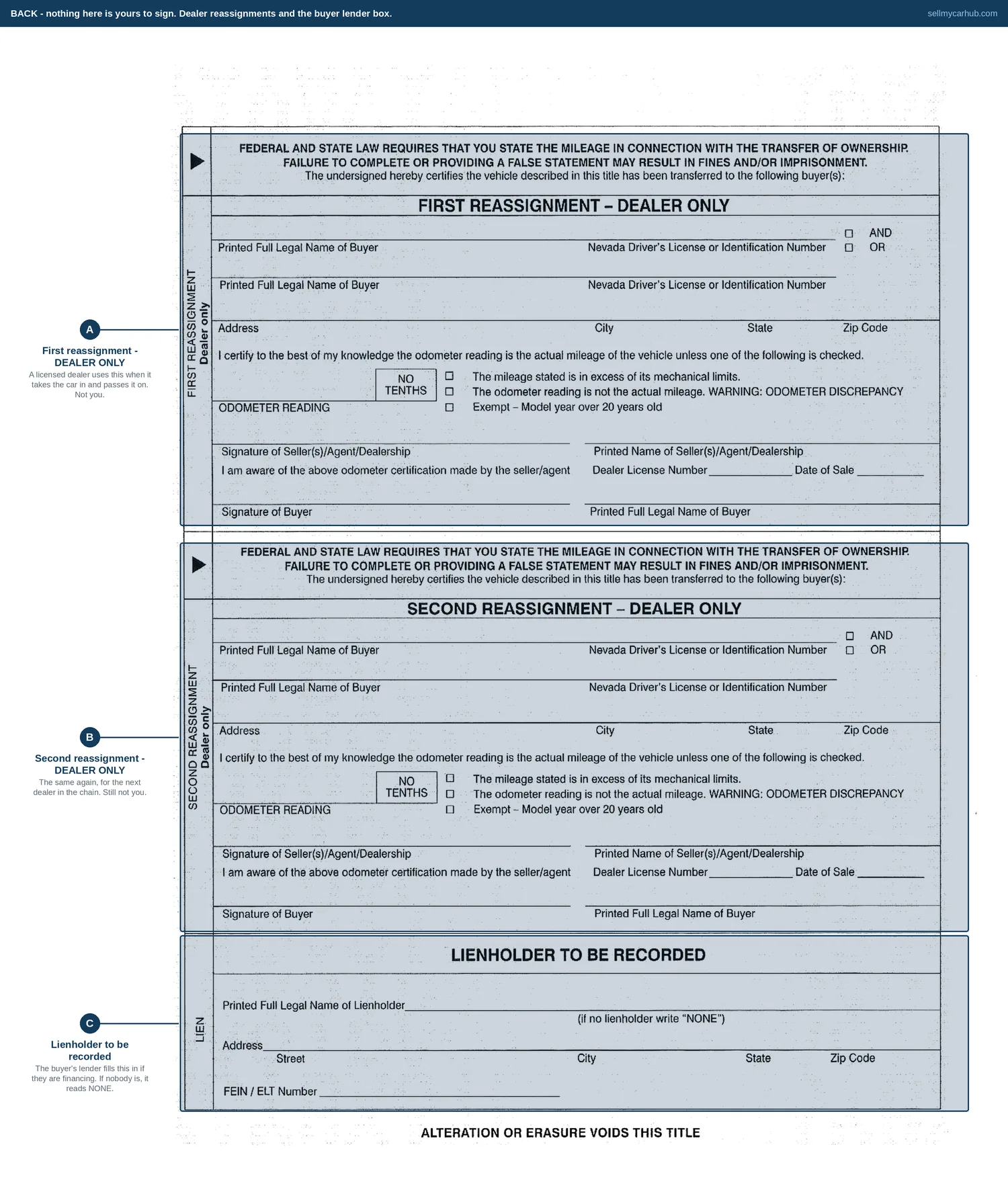
Only a licensed dealer fills this in. A private seller leaves it alone.
Watch out: Blank is correct for a private sale.
The actual date ownership changed hands - not the date you agreed a price, and not the date the buyer gets round to the DMV.
Watch out: This date starts the buyer's 30-day clock to register, and it is the date your resale notification should match.
The buyer signs and prints their full legal name, acknowledging the odometer certification you made above.
Watch out: Do not let them take the title away to sign it later. Unsigned here, the transfer is incomplete.
Five rules that decide whether the paper you hand over is still a valid title. None of them are obvious and all of them are cheap to get right.
| Black or dark blue ink | The DMV's own guideline is to type or print in black or dark blue. Any other colour is asking for the transaction to be handed back. |
|---|---|
| Your legal name, not a nickname | Name and address have to be recorded exactly as they read on the driver's license - on every document, not just this one. |
| Sign in the seller's box only | Box 23 is yours. Box 26 belongs to the buyer, and it is signed at the handover, not before. Signing the wrong line on a title is not something you can tidy up afterwards. |
| No white-out, no crossing out, no writing over | Alteration or erasure voids the title outright. The paper is printed on erasure-sensitive stock precisely so this shows. |
| Do not tear, fold hard, or trim it | It is a security document. Damage it and you are applying for a duplicate, which is $20 and a wait. |
The ink rule is the DMV's own: “Always type or print in black or dark blue ink.” — Nevada DMV Registration and Title Guide, revised April 2025.
These three turn up on page one of a search for this, and each one costs somebody either a wasted trip or money they did not owe. Every correction below links the Nevada page it comes from.
"AND/OR between the names means everyone still has to sign."
One signature is enough. The DMV's guide puts "and/or" in the same bucket as "or": only one of the owners or sellers has to sign. It is "and" on its own, or no word at all, that requires everyone.
Nevada DMV Registration and Title Guide, Certificate of Title, revised April 2025
"Budget around 8% Nevada sales tax on the purchase."
Not on a private-party sale. The Nevada DMV states plainly that sales taxes are not charged on private party vehicle sales, family sales or gifts. The buyer still owes registration fees and Governmental Services Tax, but not sales tax.
Nevada DMV, Registration - Private Party, Family Sales & Gifts
"A new car is exempt from smog for its first two registrations."
Three. The DMV exempts a new vehicle until its fourth registration - the first three are exempt. Hybrids get five model years and need a test in the sixth.
Sign exactly as your name appears on the face of the title. Which of you has to sign depends on one word printed between the names:
| Names joined by AND | Every registered owner has to sign. |
|---|---|
| Names joined by OR, or AND/OR | One signature is enough. |
| Names with nothing between them | Every owner signs. The DMV treats a missing indicator as AND. |
| A business on the title | The business name has to appear alongside the signature of an authorized representative. |
The number in the lower right corner is the control number, not the title number. The DMV uses it internally - do not quote it as your title number.
Keep your plates and either move them to another vehicle or surrender them — either move them to another vehicle or turn them in for cancellation within 60 days of the sale - 30 days for special plates.
Then file the MyDMV Registration Cancellation and Vehicle Resale Notification. The bill of sale, the registration cancellation and the resale notification together are your proof you sold it. Nevada passes the resale notification to wreckers and tow operators, so if the car is later abandoned the trail does not end at your name.
The forms that go with it: the bill of sale, a duplicate title if yours is gone, and the plate release if the plates are going with the car.
Every field description here is taken from the Nevada DMV Registration and Title Guide, revised April 2025 and the Nevada Department of Motor Vehicles title pages, current as of 2026-08-22. Plain-language help with a form, not legal advice, and where our wording and the agency's differ, theirs governs.
Back to all Nevada paperwork, or what selling a car in Nevada involves.