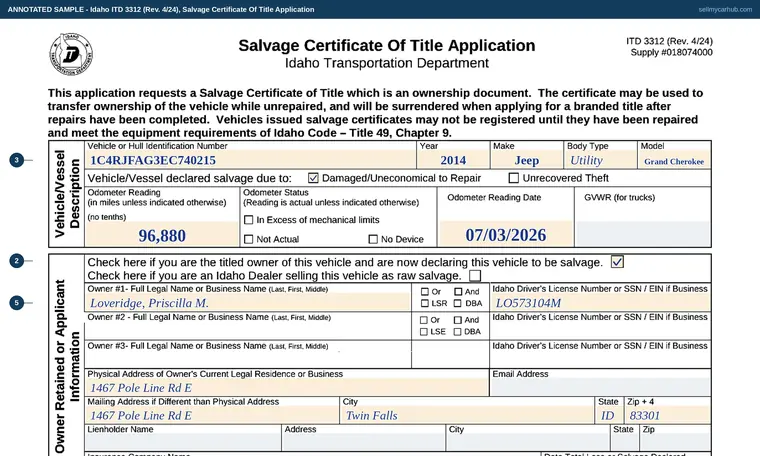
The form that turns a written-off car back into something you are allowed to sell. Idaho's rule for an owner who kept a total-loss vehicle after the insurance settlement is unforgiving: the owner may not sell or otherwise dispose of the vehicle until he has been issued a salvage certificate, and an owner who fails to surrender the title, or who sells without telling the buyer the vehicle was totalled, is guilty of a misdemeanour carrying up to six months in jail, a one thousand dollar fine, or both. The certificate this application produces is itself the ownership document - it takes the place of the previous title - and it is what a buyer of an unrepaired salvage vehicle receives instead of a title.
Written against 3312 (Rev 4/24), issued under Idaho Code 49-524. Whatever you do, tell the buyer. The misdemeanour in section 49-524(8) is not only about failing to surrender the title - it is also about selling the vehicle and not telling the buyer that it is totalled. On top of that, ITD's own tip sheet warns buyers to run a NMVTIS history report before purchase, so a concealed total loss is likely to surface in the middle of the sale rather than after it.
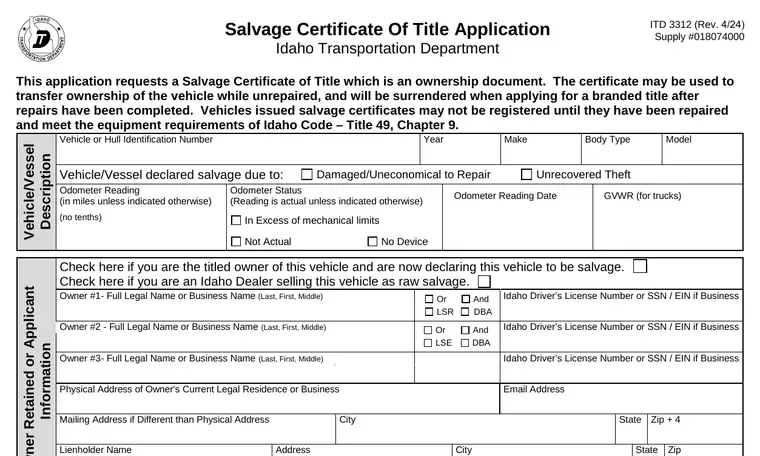
Two documents, and they are not the same thing. Take the blank 3312 from the itd.idaho.gov copy so you get the revision that is current today, then print our 3312 guide and keep it beside you while you fill theirs in.
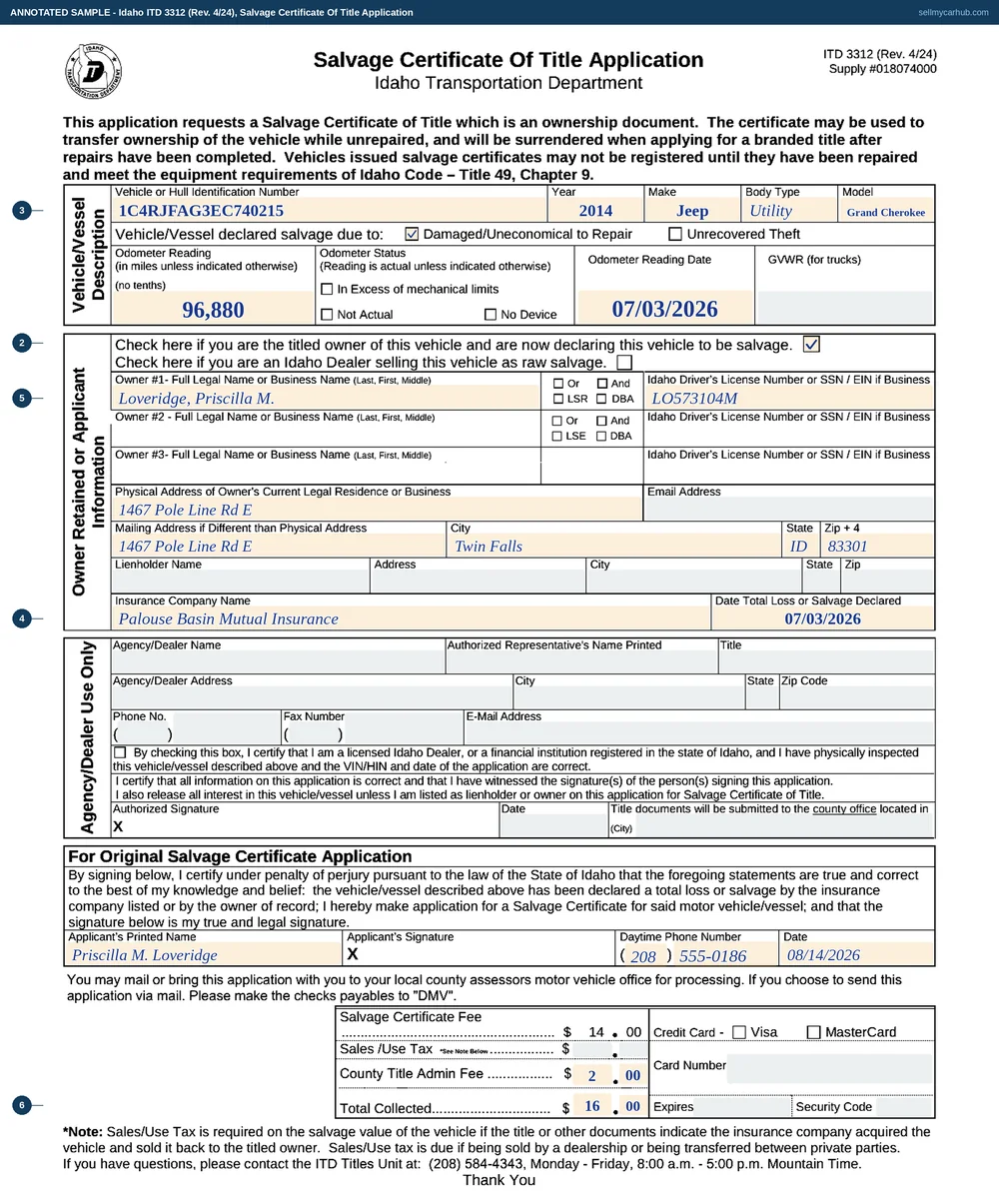
This is the actual 3312, rendered from the PDF the Idaho Transportation Department, Division of Motor Vehicles publishes and completed end to end: letterhead, every field, and the blocks at the foot.
An owner-retained salvage vehicle cannot lawfully be sold until the salvage certificate has been issued.
Watch out: The penalty is a misdemeanour with jail time attached, and it applies equally to selling without telling the buyer the car was totalled.
Titled owner declaring the vehicle salvage, or an Idaho dealer selling raw salvage.
Watch out: If you kept the car after a settlement, the first box is yours and the second is not - and the Agency/Dealer block at the foot stays empty.
VIN, year, make, body type, model, and whether it is damaged and uneconomical to repair or an unrecovered theft.
Watch out: The odometer reading date is a separate box from the reading. Use the date it was actually read, not today.
The insurance company and the date the total loss or salvage was declared.
Watch out: That date drives the timetable in section 49-524. Take it off the settlement letter rather than from memory.
Full legal names with identifiers, addresses, and any lender still recorded.
Watch out: A salvage certificate carries a lien forward. If the loan was cleared by the settlement, get the release before you file this.
The fourteen-dollar salvage certificate fee printed on the form, the county's title admin fee, and sales or use tax where the printed note says it is due.
Watch out: The tax note catches the common case: an insurer that paid out and then sold the wreck back to you.
The certificate is the ownership document. A buyer of the unrepaired vehicle receives it in place of a title.
Watch out: If you repair it instead, the route is a Salvage Vehicle Statement and an application for a branded title reading Rebuilt Salvage - which stays on the record permanently.
| On the form | What to put in it |
|---|---|
| Vehicle or Hull Identification Number, Year, Make, Body Type, Model | The vehicle the bond is being written against, on one rule. |
| Vehicle/Vessel declared salvage due to: Damaged/Uneconomical to Repair, or Unrecovered Theft | Two tick boxes, and they are the two ways a vehicle becomes salvage in Idaho. |
| Odometer Reading (no tenths), Odometer Status, Odometer Reading Date, GVWR (for trucks) | The mileage block, with In Excess of mechanical limits, Not Actual and No Device as the status options. |
| Check here if you are the titled owner of this vehicle and are now declaring this vehicle to be salvage | The owner-retained tick box, and the one that makes this a seller's form rather than an insurer's. |
| Check here if you are an Idaho Dealer selling this vehicle as raw salvage | The parallel box for a dealer. |
| Owner #1, #2 and #3: Full Legal Name or Business Name (Last, First, Middle), Or / And / LSR / DBA, Idaho Driver's License Number or SSN / EIN if Business | The owners, with the joining boxes. |
| Physical Address of Owner's Current Legal Residence or Business, Email Address, Mailing Address if Different, City, State, Zip + 4 | Where the owner is. |
| Lienholder Name, Address, City, State, Zip | Any lender still recorded. |
| Insurance Company Name and Date Total Loss or Salvage Declared | The insurer and the date, which is the date the clocks in section 49-524 run from. |
| Agency/Dealer Use Only: Agency/Dealer Name, Authorized Representative's Name Printed, Title, Address, Phone, Fax, E-Mail | The block for an insurer, salvage pool or dealer filing on somebody's behalf, with a certification that they have physically inspected the vehicle and witnessed the signatures. |
| Applicant's Printed Name, Signature, Daytime Phone Number, Date | Your signature, under a certification that the vehicle has been declared a total loss or salvage by the insurance company listed or by the owner of record. |
| Salvage Certificate Fee, Sales/Use Tax, County Title Admin Fee, Total Collected, and a credit card block | The money, and a printed note that sales or use tax is due where the insurer sold the vehicle back to the titled owner, or where it is being sold by a dealership or transferred between private parties. |
Every line here was read off 3312 (Rev 4/24) itself — the PDF is here — and off the Idaho Transportation Department, Division of Motor Vehicles pages. This is plain-language help with a form, not legal advice, and where our wording and the agency's differ, theirs governs.
Back to all Idaho seller paperwork, or what selling a car in Idaho involves.