Idaho's certificate does two jobs a seller cares about. The middle of it transfers the car; the bottom of it tears off and becomes the notice that takes your name off the record. Below is what sits where, why the price you write on it decides the buyer's tax bill, and the order ITD itself sets out for signing one.
Last updated .
Your 8 boxes
As a private seller you complete these and nothing else:
There is no blank Idaho certificate of title to download and no photograph of one either - the department publishes samples of driver licences and identity cards but nothing at all for a title. What you can download is the printable checklist beside this paragraph, which lists the sections in the order you meet them and marks the ones that are yours.
A correction on Idaho title paperwork is not fatal, but it is not invisible either - ITD 3395, the Statement of Correction or Erasure, exists so that somebody can explain in writing what was changed and why.
ITD never publishes a numbered how-to-sell list, so this order is assembled from the three documents that each cover part of it: the Surviving Spouse Guide for how the certificate is filled in, the Top 10 Tips for the plates and the release of liability, and section 49-526 for the deadline.
The certificate itself
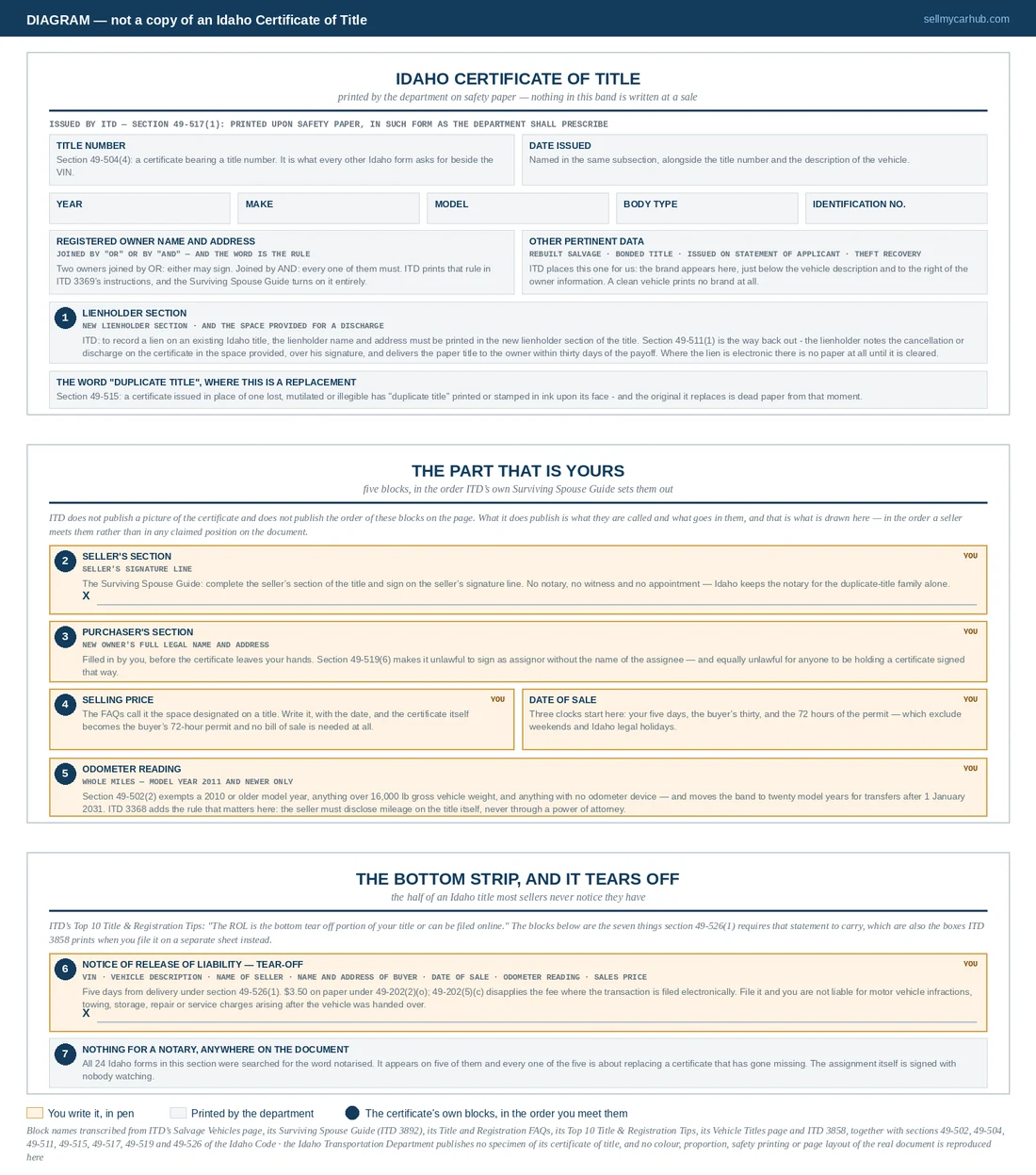
What sits where on an Idaho Certificate of Title
The seven markers below number the certificate's own sections in the order you fill them in. They are a different set from the numbered steps further down this page, which run through the whole sale rather than through the document. Every block name is transcribed from a source named in the caption; none of the certificate's colour, proportion, safety-paper printing or layout beyond the two placements ITD does publish is reproduced.
Amber — you write it, in pen
Grey — not yours to fill
Numbered — the certificate's own blocks, in the order a seller meets them
Click or tap the picture to open it full size.
Drawn, and labelled as a drawing across the top. The Idaho Transportation Department publishes no specimen of its certificate of title: its media library was queried through the site's own REST API - 3,716 items - for title, sample, specimen, certificate, assignment and titling, and the only specimen documents ITD publishes are driver licence and identity card samples. All 47 PDFs in its DMV Guidance library, its six dealer newsletters from October 2024 to July 2026, its two dealer form-instruction PDFs, its Form 0502 interactive training package and all 24 forms in this section were scanned for embedded images; not one contains a picture of the certificate, and the only rasters anywhere in the form set are a departmental QR code on ITD 3367 and a solid masked bar on ITD 3368. Block names here are transcribed from ITD's Salvage Vehicles page, its Surviving Spouse Guide, its Title and Registration FAQs, its Top 10 Tips and sections 49-504, 49-511, 49-515 and 49-517 of the Idaho Code.
The five-day form, filled in
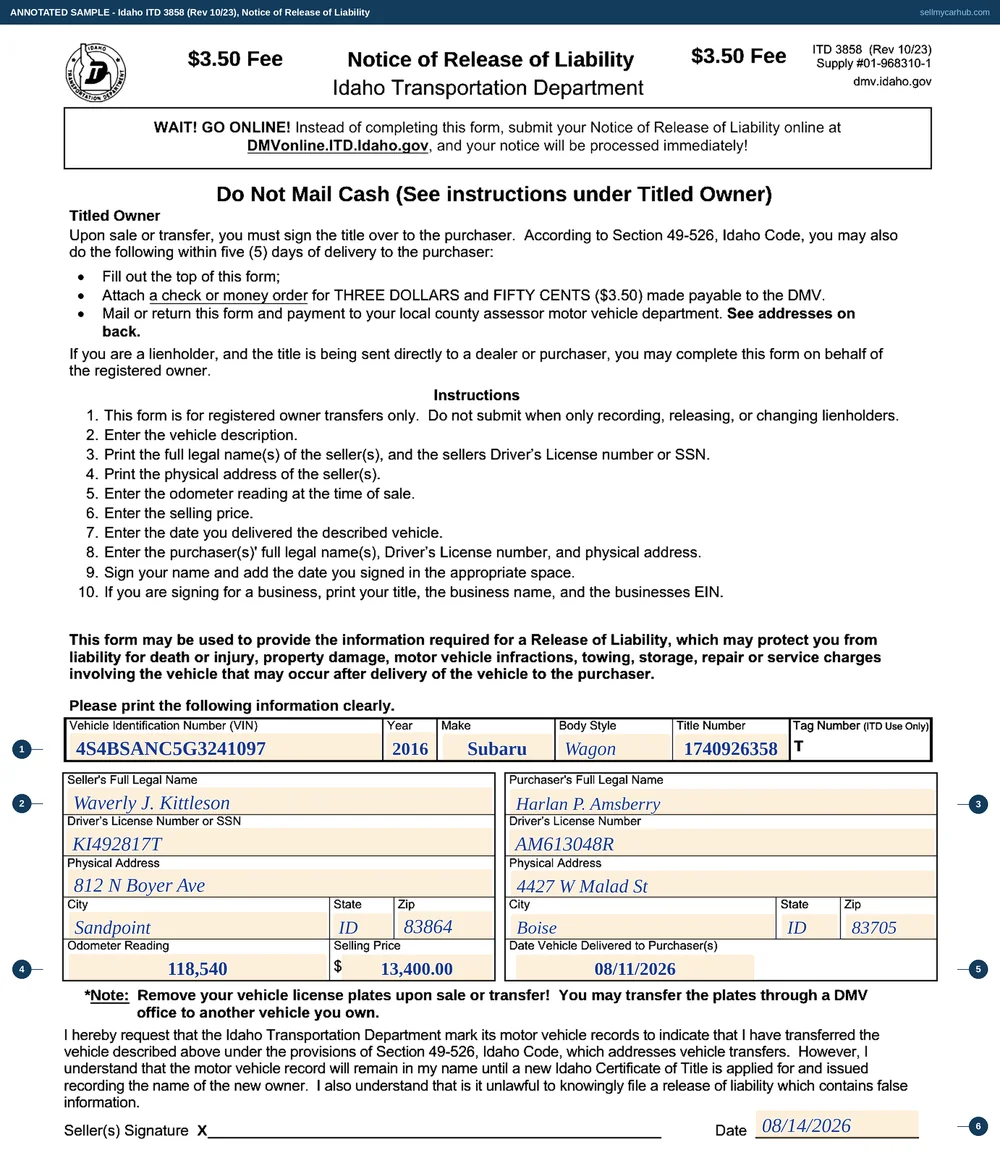
A completed Notice of Release of Liability, the only Idaho document that is yours alone
Every other piece of paper in an Idaho sale is shared with the buyer. This one is not: you fill it in, you file it, and until it lands you are the owner the department knows about. Here it is completed for the sale this section follows, with six of its blocks numbered on the image and picked up one by one underneath.
Click or tap the picture to open it full size.
Look at the date the vehicle was delivered. Everything on this form runs off that one box: five days from it under section 49-526, and the $3.50 fee printed twice across the top applies only to the paper copy - section 49-202(5)(c) disapplies it for a filing made electronically.
Step by step
Every box, in the order you meet it
0
You fill this in
Before any box: make sure it is titled in your name
Section 49-502(3) will not let a resident pass on a vehicle that is not titled to them, and ITD's fourth tip says it in one line - it is illegal to acquire and resell a vehicle without titling in your name unless you have a dealer's licence.
Watch out: If you bought it and never got round to titling it, that is the job to do first, and it is not free: the tip sheet adds that transferring without titling does not relieve you of the tax you owed on your own purchase.
1
You fill this in
The seller's section
Printed on the certificate itself. Sign on the seller's signature line, and have every owner joined to you by AND sign it too.
Watch out: This is the signature nobody has to watch. Idaho asks for no notary here, no witness and no appointment - the only Idaho vehicle forms that need one are the three duplicate-title applications.
2
You fill this in
The purchaser's section
The buyer's full legal name and address, written in by you before the certificate changes hands.
Watch out: Leaving it blank is not a shortcut, it is section 49-519(6): unlawful to sign as assignor without the assignee's name, and equally unlawful for the buyer to be carrying the thing afterwards.
3
You fill this in
The selling price and the date
The figure you actually took, and the day the car changed hands. Both go on the certificate.
Watch out: Write them and you have just saved a document: with the price, the date and your signature on the title, the FAQs say no bill of sale is needed and the title itself works as the buyer's 72-hour permit.
4
You fill this in
The odometer reading
Whole miles, on the face of the certificate, for anything of model year 2011 or newer.
Watch out: It has to be you. Federal rules bar the ITD 3368 power of attorney from making an odometer disclosure, and ITD prints the warning on the form: the seller must disclose mileage on the title itself when transferring.
5
You fill this in
A bill of sale, ITD 3738
Both of you sign it. It carries the same price, the same mileage and the same date as the certificate.
Watch out: The Tax Commission wants an original: the bill of sale establishes the sales price and is the buyer's proof of what they paid, and there is no trade-in allowance in a private Idaho sale to reduce it.
6
You fill this in
Take the plates and the registration card
Both stay with you under section 49-431(1). Do it before the buyer drives away rather than after.
Watch out: Moving the plate to your next vehicle costs $5.00 and carries the unused registration time across. Restricted Use plates on an ATV, UTV or off-road motorcycle are the exception and stay on the machine.
7
You fill this in
File the Notice of Release of Liability
Online at DMVonline.ITD.Idaho.gov, or on ITD 3858 with $3.50 to your county assessor. Five days from delivery.
Watch out: Online is both faster and cheaper - the form itself says the notice is processed immediately, and 49-202(5)(c) disapplies the fee for an electronic filing.
8
The buyer fills this in
Then let the buyer's clock run
They have thirty calendar days from delivery to apply for the title at a county assessor's motor vehicle office.
Watch out: Their deadline is not yours and the $20 penalty for missing it is assessed against them, not you. Your protection came from the notice you filed on day five, not from whether they ever turn up.
Before the pen
Six things to settle before the certificate leaves the kitchen table
Six habits, and four of them are about writing something down rather than leaving it blank - which is the shape of a state that criminalises an incomplete assignment.
Write the buyer's name in yourself
An Idaho certificate signed with the transferee blank is an offence for you to sign and an offence for them to hold. There is no version of this that is a favour.
Write the true price, to the dollar
The felony citation is printed on the bill of sale itself, and the Tax Commission can pull a fair market value and compare it against what you wrote.
Write the date of sale
It is the day the buyer's thirty days start, the day your five days start, and the day the 72-hour permit starts. Three clocks hang off one box.
Whole miles, and only on a 2011 or newer
Below that model year Idaho asks for nothing, and inventing a disclosure creates a certification the federal rule never wanted.
Do not correct it silently
If something has to be changed, ITD 3395 is the form that says what was altered and why. An unexplained erasure on title paperwork is what that form exists to answer.
Keep the registration card
Everybody remembers the plates. Section 49-431(1) leaves the registration card with you as well, and handing it over with the car is how a buyer ends up driving on your registration.
The ink rule is Idaho DMV's own: “If an individual signs for someone else, the document authorizing the signature must be provided when you apply for title. A title will not be issued until either an original, or a certified or verified copy of the authorizing document has been submitted.”
— ITD, Top 10 Title & Registration Tips to Avoid Trouble.
Check your source
Three sentences about selling a car in Idaho that are not true
Three sentences repeated constantly about selling a car in Idaho. Each has its source underneath it, and each one costs a seller either a wasted trip, a bill in their own name, or a felony citation.
"The plates go with the car - just leave them on it."
Backwards, and Idaho settles it in statute rather than in guidance: on a transfer 'the registration card and license plate shall remain with and in the possession of the transferor'. ITD gives the practical reason on its own tip sheet - keep them and you can move them to your next vehicle and carry the unused registration time across, and it saves the purchaser being pulled over on somebody else's number. The buyer is not stranded either: your bill of sale is a 72-hour permit in its own right. The single exception is a black-and-white Restricted Use plate on an ATV, UTV or off-road motorcycle, which does stay with the machine.
You do not, and no Idaho document says you do. The word appears on five of the twenty-four forms in this section and every one of those five is about replacing a certificate that has gone missing - the two duplicate applications, the affidavit of lost title, a power of attorney being used to get a duplicate, and the conditional-title statement, which mentions a notary only to send you to one of the others. Even those have an alternative the FAQs spell out: complete the form at the county's office and a county deputy can witness your signature in lieu of notarisation. The assignment on the certificate, the bill of sale and the release of liability are all signed with nobody watching.
You are not finished, you are about five days from being finished. Section 49-526 requires a separate release-of-liability statement forwarded to the department within five days of delivery, and until it arrives the record still names you: the buyer has thirty days of their own to apply, and anything that happens in that gap - a parking ticket, a tow, a hit and run - lands on the owner the department knows about. Filing it is $3.50 on paper and nothing at all online, where ITD says it is processed immediately.
Six signature rules, and the first is the one people refuse to believe:
You, on the seller's signature line
Your signature, in the seller's section on the certificate itself. No notary, no witness, no appointment - Idaho asks for none of the three in an ordinary sale.
Every owner the face names, if AND joins them
Two names joined by AND means two signatures. Joined by OR, any one of you may sign alone. The word printed between the names is the whole rule.
You again, writing the buyer in
The purchaser's section is filled in before the certificate leaves your hands. Section 49-519(6) makes it an offence to sign as assignor without the assignee's name on the document.
You once more, on the price and the date
Both go on the certificate. Get them on there and the title itself becomes the buyer's 72-hour permit and you need no bill of sale at all.
The lienholder, if the face names one
A lender that has been paid notes the discharge on the certificate over its own signature and sends the title to you within thirty days of the payoff.
An attorney-in-fact, only with the paper attached
Somebody signing for you signs as 'your name by their name, POA', and ITD will not issue a title until the authorising document itself has been submitted.
Once it is signed
Signing is the middle of the job in Idaho, not the end of it. What follows is the part with the clock on it: the plates come off, the registration card stays in your drawer, and the release of liability goes in within five days.