Turns a totalled car's title into a salvage certificate, or into a nonrepairable certificate for a vehicle that will never go back on the road. If you settled with your insurer and kept the car, this is what has to be filed before it can be sold on.
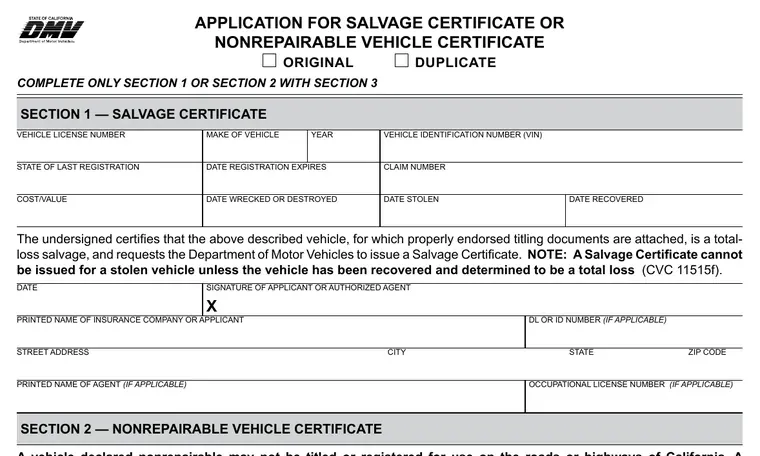
Step 1 · the form itself
Blank REG 488C — Application for Salvage Certificate or Nonrepairable Vehicle Certificate
PDF at dmv.ca.gov · new tab
View the blank REG 488C
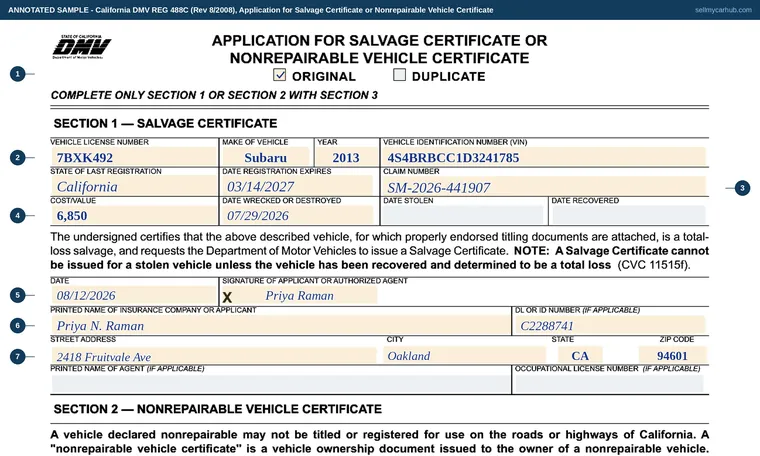
Step 2 · how to fill it in
Our filled-in REG 488C guide
PDF · 3 pages · 570 KB · new tab
See our filled-in example
Two documents, and they are not the same thing. Take the blank REG 488C from the dmv.ca.gov copy so you get the revision that is current today, then print our REG 488C guide and keep it beside you while you fill theirs in.
Written against REG 488C (Rev 8/2008), issued under California Vehicle Code 11515 and 11515.2. Salvage and nonrepairable are not two words for the same thing. A salvage certificate can become a revived title after inspection; a nonrepairable certificate is the end of that vehicle's road life.
Last updated .
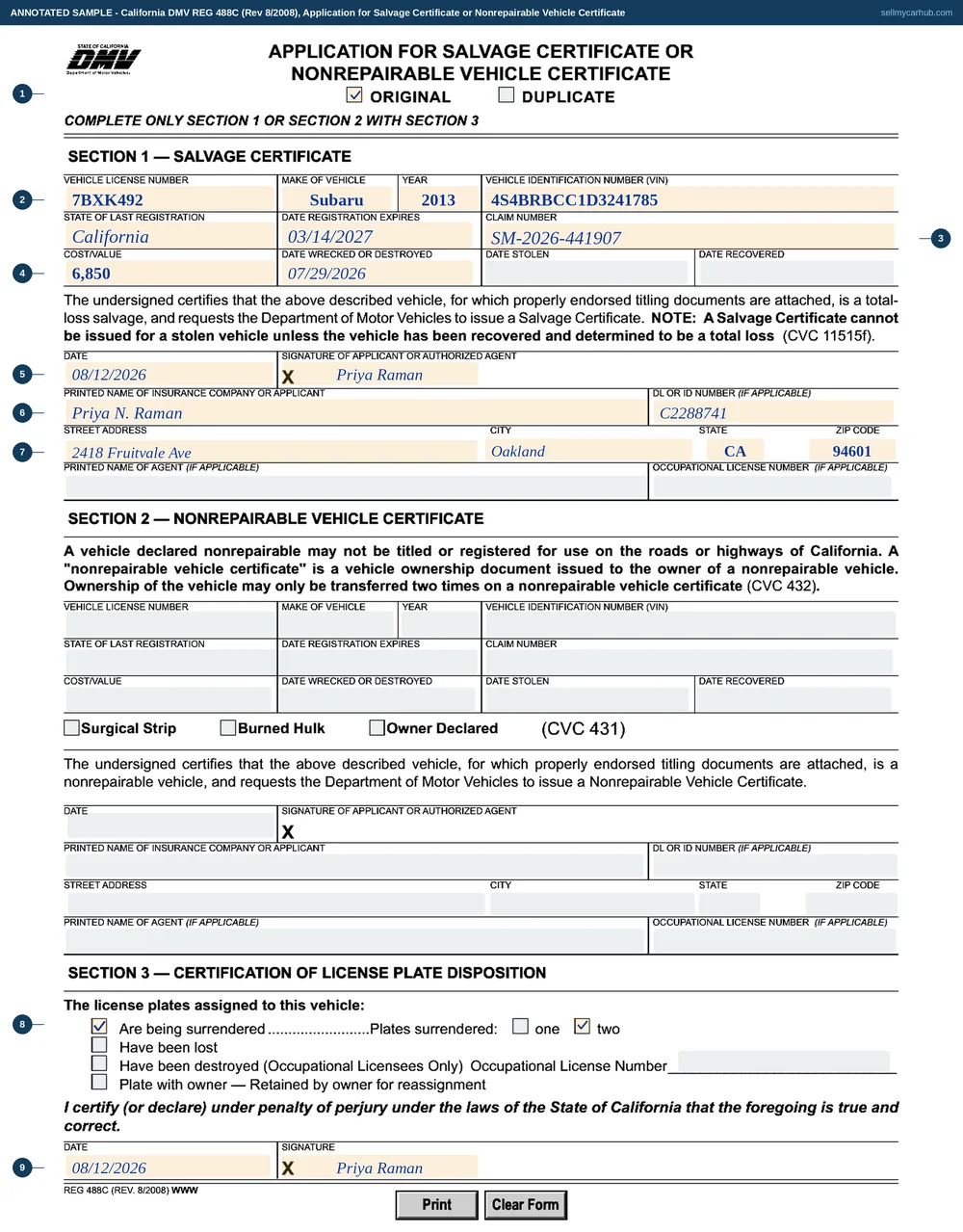
This is the actual REG 488C, rendered from the PDF the California Department of Motor Vehicles publishes and completed end to end: letterhead, every field, and the blocks at the foot.
Click or tap the picture to open it full size.
Download or print this example PDF · 3 pages · 570 KB
Two boxes beside the title. A first application is an original.
Watch out: Duplicate is for replacing a certificate that was already issued. Ticking it on a first application asks the department for a copy of a document that does not exist yet.
Licence plate number, make, year and vehicle identification number, then the state of last registration and the date the registration expires.
Watch out: This is the salvage half of the form. If you are here because the car will never go back on the road, you are on the wrong half - that is section 2, and the two are never completed together.
The insurer's claim reference for the total loss.
Watch out: It is the thread that ties this application to the settlement your insurer already reported. It should match the number on the REG 481 they filed, character for character.
The value of the vehicle, the date it was wrecked or destroyed, and - only where they apply - the dates it was stolen and recovered.
Watch out: The note printed under this row cites CVC 11515(f): a salvage certificate cannot be issued on a stolen vehicle unless it has been recovered and determined to be a total loss.
The undersigned certifies that the vehicle described is a total-loss salvage, that properly endorsed titling documents are attached, and asks the department to issue the certificate.
Watch out: Properly endorsed titling documents means the title, signed. Sending the application without them is the difference between a queue and a rejection.
Your name, where you are the one applying, with a driver licence or ID number beside it.
Watch out: The box is shared with insurers because insurers file this too. When you kept the car, the applicant is you, and the agent and occupational licence boxes beneath stay empty.
Where the salvage certificate is posted to.
Watch out: Nothing about the car can be sold on until that certificate arrives, so this is not a line to give an address you are about to leave.
Four options for what happened to the plates, with a count of one or two where they are being surrendered.
Watch out: Surrendering them is the usual answer, because the notice your insurer filed already told you the plates go back. Lost, destroyed and retained each have their own box and their own consequences.
Section 3 carries its own perjury declaration and its own signature line, below the plate boxes.
Watch out: People sign the first one, see a familiar block at the foot and stop reading. An application with only one of the two signatures on it is incomplete.
| On the form | What to put in it |
|---|---|
| Original or duplicate | Two boxes at the top. Original is the normal case. |
| Section 1 or section 2, never both | The instruction is to complete only section 1 or section 2, with section 3. Section 1 is a salvage certificate; section 2 is a nonrepairable vehicle certificate. |
| Section 1 details | Plate number, make, year, VIN, state of last registration, registration expiry, claim number, cost or value, and the dates wrecked, destroyed, stolen or recovered. |
| The certification | That the vehicle is a total-loss salvage, with properly endorsed titling documents attached, and a request that the DMV issue the certificate. |
| Signature block | Date and signature of applicant or authorised agent, printed name of the insurance company or applicant, licence or ID number, address, and an occupational licence number where one applies. |
Every line here was read off REG 488C (Rev 8/2008) itself — the PDF is here — and off the California Department of Motor Vehicles pages. This is plain-language help with a form, not legal advice, and where our wording and the agency's differ, theirs governs.
Once you've settled with your insurer and kept the car, see getting an offer on a salvage or branded-title car in Oakland.
Back to all California seller paperwork, or what selling a car in California involves.