Your insurer files this when you settle a total loss and keep the car. It is on this list because of what it starts: a ten-day clock that runs against you, not against them.
Step 1 · the form itself
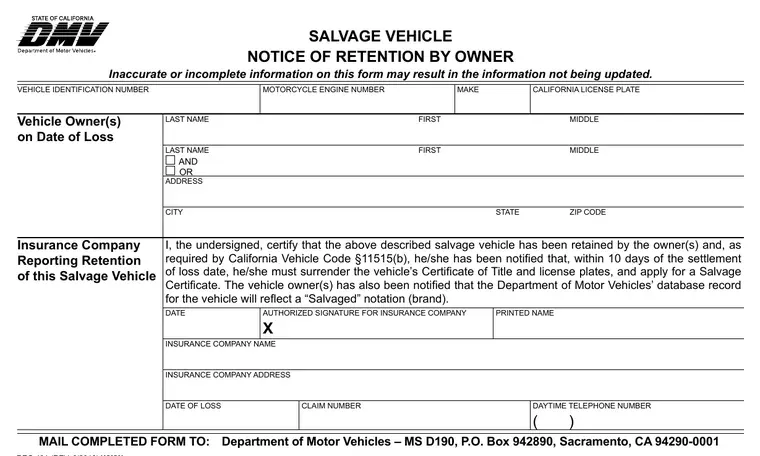
Blank REG 481 — Salvage Vehicle Notice of Retention by Owner
PDF at dmv.ca.gov · new tab
View the blank REG 481
Step 2 · how to fill it in
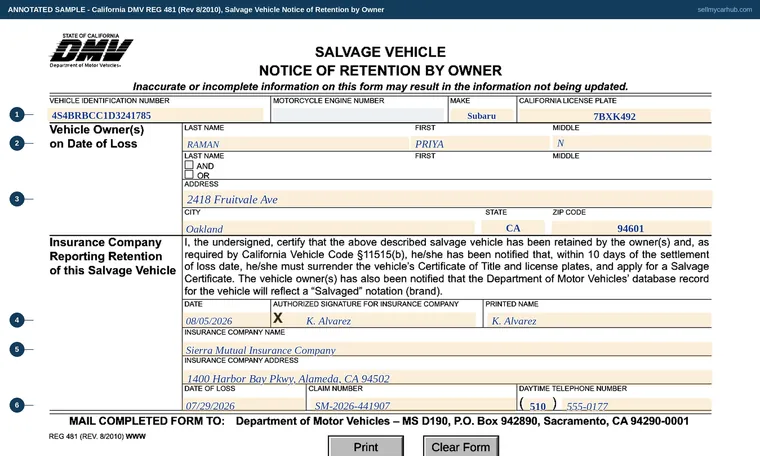
Our filled-in REG 481 guide
PDF · 2 pages · 410 KB · new tab
See our filled-in example
Two documents, and they are not the same thing. Take the blank REG 481 from the dmv.ca.gov copy so you get the revision that is current today, then print our REG 481 guide and keep it beside you when you read theirs.
Written against REG 481 (Rev 8/2010), issued under California Vehicle Code 11515(b). Ten days from the settlement of loss date - not from when the cheque clears, and not from when you get round to it.
Last updated .
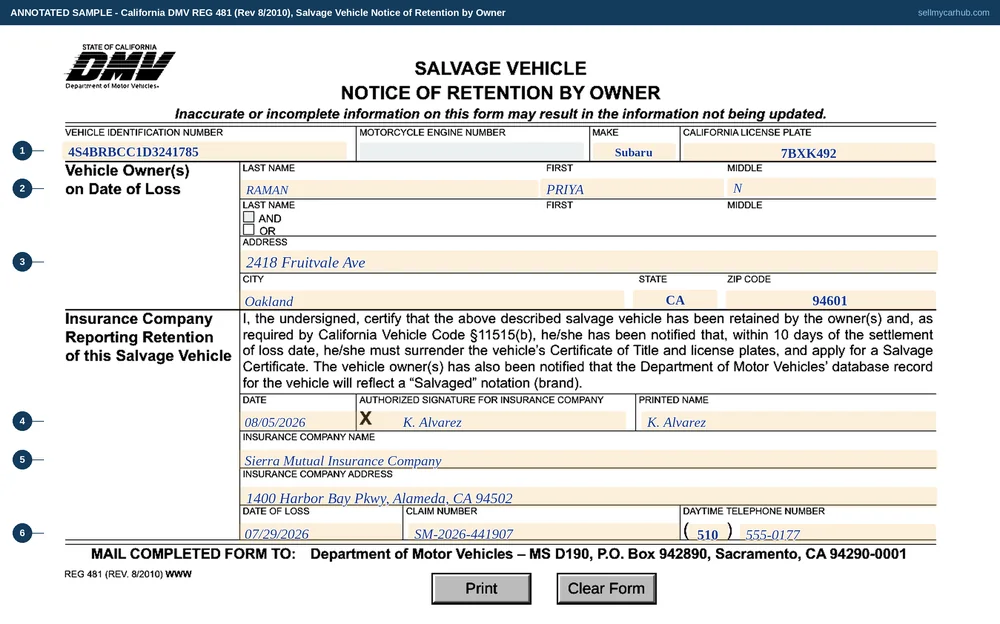
This is the actual REG 481, rendered from the PDF the California Department of Motor Vehicles publishes and completed end to end: letterhead, every field, and the blocks at the foot.
Click or tap the picture to open it full size.
Download or print this example PDF · 2 pages · 410 KB
VIN, make and California licence plate, filled in by the insurer.
Watch out: The line at the top warns that inaccurate or incomplete information may simply result in the record not being updated. Read what your insurer wrote.
Your name - last, first, middle - as the owner when the car was written off.
Watch out: A second owner row with AND / OR tick boxes sits beneath it, for a car titled in two names.
Where you live.
Watch out: This is how the DMV finds you if the salvage certificate does not arrive when it should.
The insurer's authorised signature, not yours.
Watch out: You do not sign this form at all. What it does is certify that you have been notified - which starts the clock in the paragraph above it.
Who is reporting the retention.
Watch out: The certification cites CVC 11515(b): within 10 days of the settlement of loss date you must surrender the certificate of title and the licence plates and apply for a salvage certificate.
The settlement details.
Watch out: The date of loss is the one that matters to you - it is what the ten days run from, not the day the cheque cleared. The DMV record will also carry a Salvaged brand from here on.
| On the form | What to put in it |
|---|---|
| Vehicle strip | VIN, motorcycle engine number, make, California licence plate. |
| Vehicle owner or owners on date of loss | Your name, a co-owner with the AND / OR selection, and the address. |
| The insurance company's certification | This is the part to read. The insurer certifies that the salvage vehicle has been retained by the owner and that, as required by CVC 11515(b), the owner has been notified that within 10 days of the settlement of loss date they must surrender the vehicle's certificate of title and licence plates, and apply for a salvage certificate. |
| The brand notice | The same certification records that you have been told the DMV's database record for the vehicle will carry a Salvaged notation. That brand follows the car for the rest of its life. |
| Date, authorised signature, printed name | The insurer's, not yours. You do not sign this form. |
Every line here was read off REG 481 (Rev 8/2010) itself — the PDF is here — and off the California Department of Motor Vehicles pages. This is plain-language help with a form, not legal advice, and where our wording and the agency's differ, theirs governs.
Keeping a totalled car means it has to sit somewhere, and the Sacramento City Code rules on wrecked or inoperable cars cover both yards and city streets.
Back to all California seller paperwork, or what selling a car in California involves.