The face of a California title carries two numbered signature lines, an odometer disclosure with its own pair of signatures, and the lienholder’s release. A private seller marks it in three places, not one. Every rule below is transcribed from the DMV's Vehicle Industry Registration Procedures Manual, section 11.015, rather than from a summary of it.
Last updated .
Your 8 boxes
As a private seller you complete these and nothing else:
There is no blank California title to download and no sample to look at - yours arrived in the post from Sacramento. What the DMV does publish is the rule for every line, in a manual written for its own counter staff. That is where all of this comes from.
California does not void a title somebody has written on. It asks for an explanation instead.
A Vehicle/Vessel Transfer and Reassignment Form (REG 262) is accepted in place of the registered owner's signature on line 1 - and so is a REG 227. That matters when the certificate is lost, or when somebody has already signed the wrong line.
Start here
The whole certificate, filled in
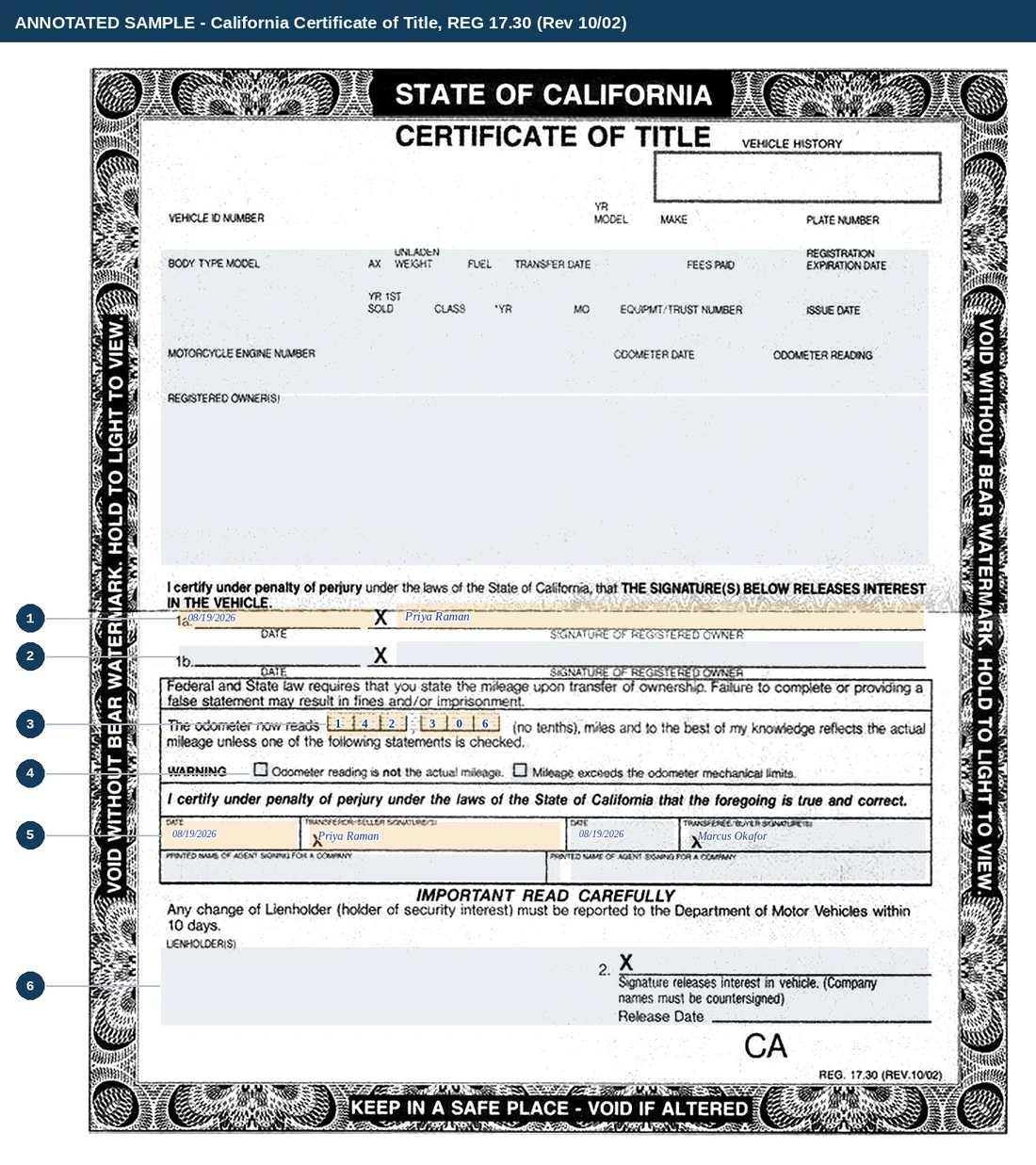
A real California Certificate of Title, blank when it reached us and annotated here for a single private sale. It is the REG 17.30 revision of October 2002 - California has more than one version of the certificate in circulation and this is one of them, so check the code in the lower right of yours against it. The security tint has been lifted toward white so the writing reads; nothing has been removed.
Amber — you write it, in pen
Grey — not yours to fill
Numbered — matches the steps below
Click or tap the picture to open it full size.
Three marks, and only three. Line 1a sells the car. The odometer comb takes the reading, one digit per printed box, with both warning boxes left empty because neither is true. Then the transferor column is signed again - that second signature is federal rather than Californian, and it is the one people miss. Everything greyed is either printed by the DMV or belongs to somebody else: the second owner line, the two warning boxes, the company printed-name lines, and the lienholder release.
A real California document, completed
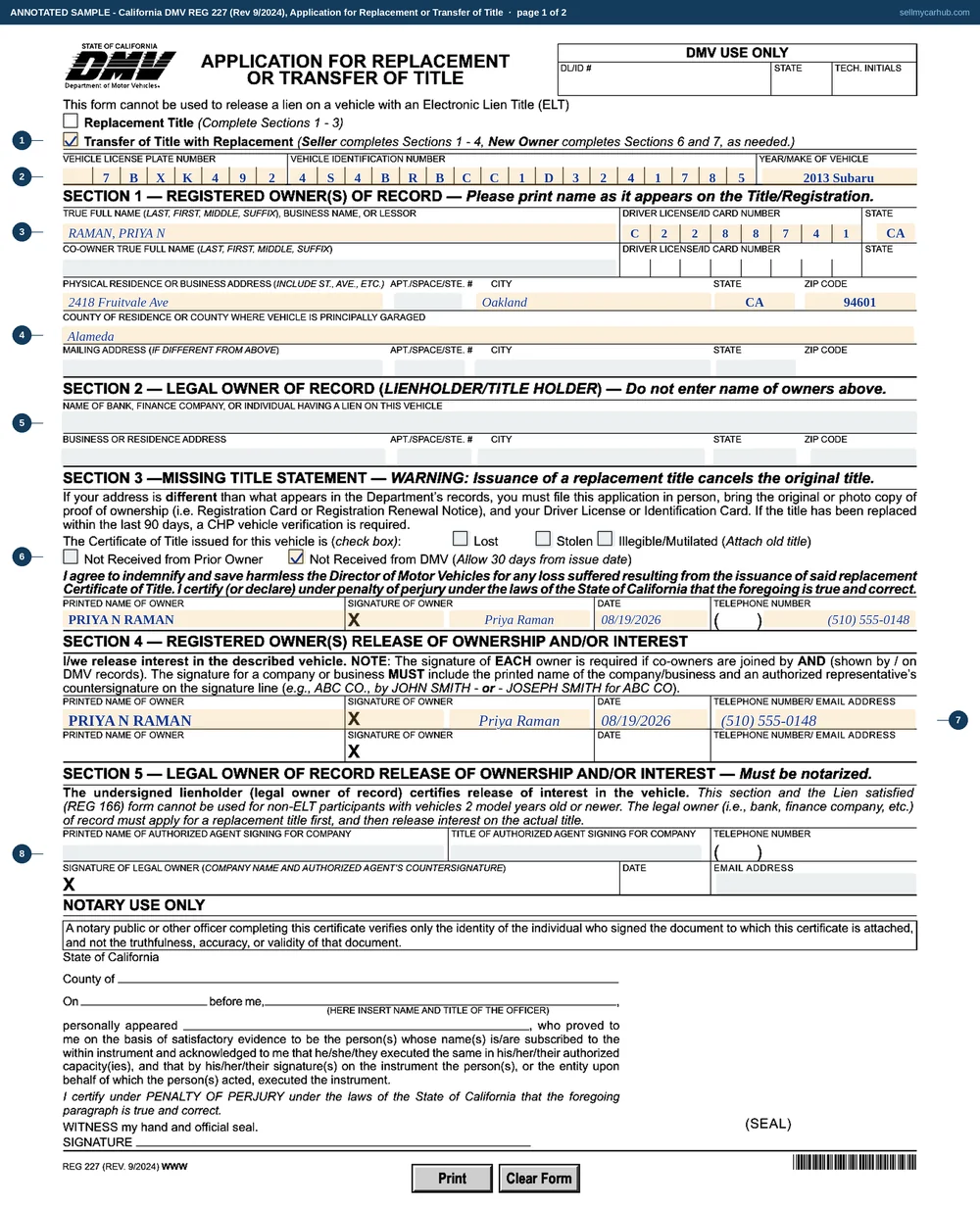
The REG 227 carries the same transfer, and this one you can see filled in
When the certificate is lost - or when somebody has already signed the wrong line on it - California moves the car on a REG 227 instead, and the DMV publishes that form. Sections 1 to 4 below are the seller’s side of exactly the transfer the diagram above describes: the same release of interest, the same signature rules, the same slash meaning AND. It is the closest thing to a filled-in California title that exists in public.
Click or tap the picture to open it full size.
Sections 1 to 4 are the seller’s. Section 5 and the notary block stay empty here because there is no lienholder on this car. Amber is what you write; the greyed blocks are deliberately left alone. The full REG 227 walkthrough takes both sides box by box.
Before you watch. One thing the video does not cover, and the DMV's own private-sale page gets wrong: odometer disclosure. That page still says "if the vehicle is less than 10 years old." Federal law has required disclosure for 20 years on anything built in 2011 or later since the rule changed. Write the mileage in.
Published by the California DMV on its own channel. It walks through the transfer the way the DMV would rather you did it - through its online service - so it is worth watching for the shape of the process, but it does not take you box by box through the paper certificate. The written steps here do that. Nothing loads from YouTube until you press play.
Step by step
Every box, in the order you meet it
1
You fill this in
1a. Signature of registered owner
The line that sells the car, with the date beside it. Sign exactly as your name is printed in the REGISTERED OWNER(S) block above.
Watch out: The certification printed above these lines is worth reading once: you are certifying under penalty of perjury that the signatures below release interest in the vehicle.
2
You fill this in
1b. Signature of registered owner
The second owner's line, directly beneath 1a.
Watch out: Whether it has to be used comes down to one mark. California prints AND as a forward slash, so a title reading SMITH / JONES needs both 1a and 1b. OR and AND/OR need only one.
3
You fill this in
The odometer now reads ___ (no tenths) miles
The mileage at the moment of sale, written into the comb boxes in whole miles.
Watch out: Go by the federal rule, not the DMV's private-sale page, which still says ten years. A 2011-or-newer vehicle needs the mileage until it is twenty years old. The line above it warns that failure to complete it, or a false statement, may result in fines and/or imprisonment.
4
You fill this in
The two warning tick boxes
One reads “Odometer reading is not the actual mileage” and the other “Mileage exceeds the odometer mechanical limits”.
Watch out: Leave both empty unless one is genuinely true. The printed sentence above them says the reading reflects the actual mileage unless one of these is checked - so ticking one is a brand on the car, and not ticking one when it applies is the false statement the warning is about.
5
You fill this in
Transferor / seller signature(s), with the date
A second signature, separate from 1a, under its own certification that the foregoing is true and correct.
Watch out: This is the mark people miss, and it is federal rather than Californian: 49 CFR 580.5(c) says the disclosure “must be signed by the transferor and must contain the transferor's printed name”.
6
The lienholder fills this in
2. Signature releases interest in vehicle
The lienholder's line near the foot of the certificate, with a release date.
Watch out: Company names must be countersigned. And on a vehicle two model years old or newer this is the only place a lien can be released - not a REG 227, not a REG 166.
7
The buyer fills this in
Transferee / buyer signatures
The buyer signs the same odometer disclosure, in the column beside yours.
Watch out: Required by 49 CFR 580.5(f), which also asks for their printed name. An unsigned buyer column is an incomplete disclosure, and it is your disclosure.
8
You fill this in
Printed name of agent signing for a company
One line under each signature column, used only when a company is on either side of the sale.
Watch out: A private individual leaves it alone. A company signature needs the business name and an authorised representative's countersignature - the DMV gives the format as ABC CO., by JOHN SMITH.
9
You fill this in
Smog certification
A valid smog certification, or evidence of exemption, goes with the title.
Watch out: This lands on the seller in California, which catches out anyone who has sold a car in almost any other state. It reaches the DMV electronically and is good for 90 days.
10
The buyer fills this in
The transfer fee, other fees and use tax
Fifteen dollars for the transfer under VC 9255, plus any other fees due and use tax or evidence of exemption.
Watch out: Two clocks. Ownership has to be reported within 10 days, but the manual allows 30 days from the date of transfer to pay the transfer fee without penalty - and 20 days for renewal fees if the registration lapses in the meantime.
11
You fill this in
If somebody has already written on it
A Statement of Error or Erasure (REG 101) is required for any erasure or lined-out information on a California Certificate of Title, completed by whoever made the mark.
Watch out: The bottom band of the certificate reads KEEP IN A SAFE PLACE - VOID IF ALTERED. California will still look at a marked title, which is not true everywhere, but it is a request rather than a right.
Before the pen
What to do before the pen touches the title
Four habits and one piece of punctuation. The slash is the one that costs people a second trip, and none of the rest are expensive to get right first time.
Black or blue ink, capitals on the REG 138
The release of liability asks for CAPITAL LETTERS in black or blue ink in its own instruction line. The rest of the paperwork wants the same ink and no pencil anywhere.
Your true full name as it reads on your licence
Not a nickname, not an initial where the licence spells it out. The DMV matches the two.
Watch the slash
A slash between two owners' names means AND, and AND means everybody signs. It is the most expensive punctuation mark in California vehicle paperwork.
Whole dollars, whole miles
The REG 138 says selling price with no cents and odometer reading with no tenths, in so many words.
Highlight sparingly, if at all
The manual allows highlighters but tells its own staff to mark the X beside a signature line, or the space just above or below it - not the entire field. A block of colour across a box is not a help.
The buyer block is the buyer's
The DMV's first helpful tip on the REG 138 is to write the new owner's information in the new owner section and the seller's in the seller's section. It is listed first because it is the mistake it sees most.
The ink rule is the California DMV's own: “The quality of the certificate issued depends primarily on the legibility and accuracy of the information entered on the application. Information on most documents may be typewritten, computer-generated, or hand-printed. If hand-printed, the DMV prefers that only upper case block letters are used.”
— DMV Vehicle Industry Registration Procedures Manual, 11.015 Basic Transfer Requirements.
Check your source
What Californians get told, and what is actually true
Three things repeated confidently across the first page of search results for this, and every one of them costs a California seller either money or a Saturday. Each correction below links the California source it comes from.
"A California title transfer costs $28."
It costs $15. The DMV's fee chart lists Transfer (VC 9255) at $15, with a $15 late penalty beside it. The $28 figure is real but belongs elsewhere on the same chart - a replacement title under VC 9265, a title-only transaction under VC 9254, and the separate moped and off-highway vehicle tables.
That is the rule in Nevada, Arizona and most of the West, and it is wrong in California. Ordinary California plates stay on the car. Only personalised and special interest plates come off, and those need a REG 17 to be reassigned or held.
That is a different state's title being described. A Californian selling a car they are the registered owner of signs on the face of the certificate - line 1, and again under the odometer disclosure. Federal law is explicit that an owner in whose name the vehicle is titled discloses the mileage on the title itself “and not on a reassignment document”, and the reassignment blocks on the back belong to licensed dealers passing a car along.
It did, for cars built in 2010 or earlier. For a 2011 or newer vehicle the federal exemption is 20 years, and 49 CFR 580.17 gives the worked example: model year 2011 vehicles do not become exempt until calendar year 2031. California's own private-sale page has not been updated to match.
Sign exactly as your name is printed on the face of the title. Who else has to sign is decided by one mark between the names - and in California that mark is a slash:
Co-owners joined by “and”
Shown as a slash between the names. The signature of each owner is required - and that slash is what people misread as OR.
Co-owners joined by “or” or “and/or”
The signature of only one owner.
Co-owners with a JTRS designation
Joint tenants with right of survivorship. The signature of each owner.
A business entity
The name of the business entity and an authorised representative's countersignature. The DMV does not require proof that the person is authorised.
An individual doing business as (dba)
The signature of the individual. John Jones, or John Jones dba Jones Cooler Service, are both accepted.
A sole owner with no lienholder
The signature of the sole owner. The DMV will accept a sole owner's signature on line 2 instead of line 1.
A trust
The signature of the trustee. Where no trustee is listed on the title, a Statement of Facts (REG 256) certifying their appointment goes with it.
Somebody who cannot write
A witnessed signature by mark. The witness prints the applicant's name and signs beside the mark - and for a release of ownership, two witnesses are required.
Once it is signed
Signing the title is the middle of the job. What comes next in California is the opposite of what most sellers expect: the plates stay bolted to the car, and the clock that matters to you is the five-day one on the release of liability, not the buyer’s ten-day one.