Sell My Car Hub

How to fill out California REG 138

Tells the DMV the car is no longer yours. Until it is filed you are still the registered owner of record, which means parking citations, toll notices and civil liability for whatever the buyer does with the car keep arriving at your address.
Written against REG 138 (Rev 3/2024), issued under California Vehicle Code 5602. Five days is short, and the deadline runs from the date of sale, not from the day the buyer gets round to registering. File it the same afternoon.

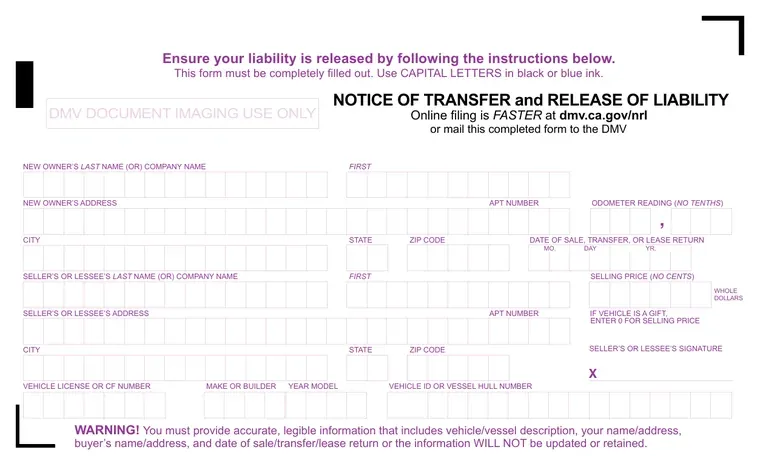
Two documents, and they are not the same thing. Take the blank REG 138 from the dmv.ca.gov copy so you get the revision that is current today, then print our REG 138 guide and keep it beside you while you fill theirs in.

Filled in

What a completed one looks like

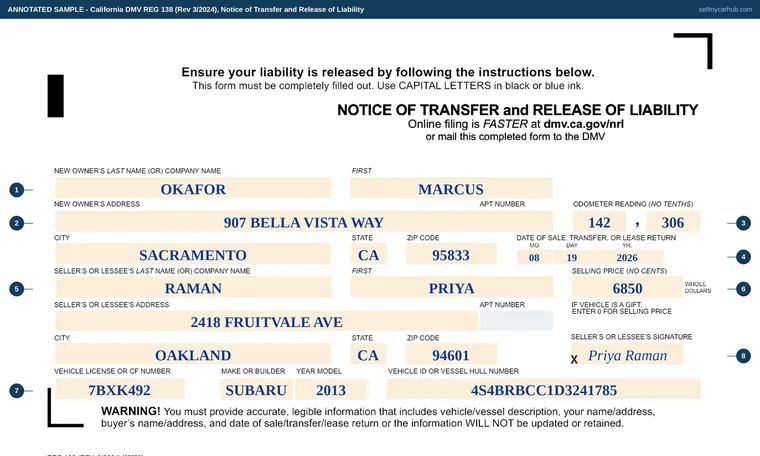
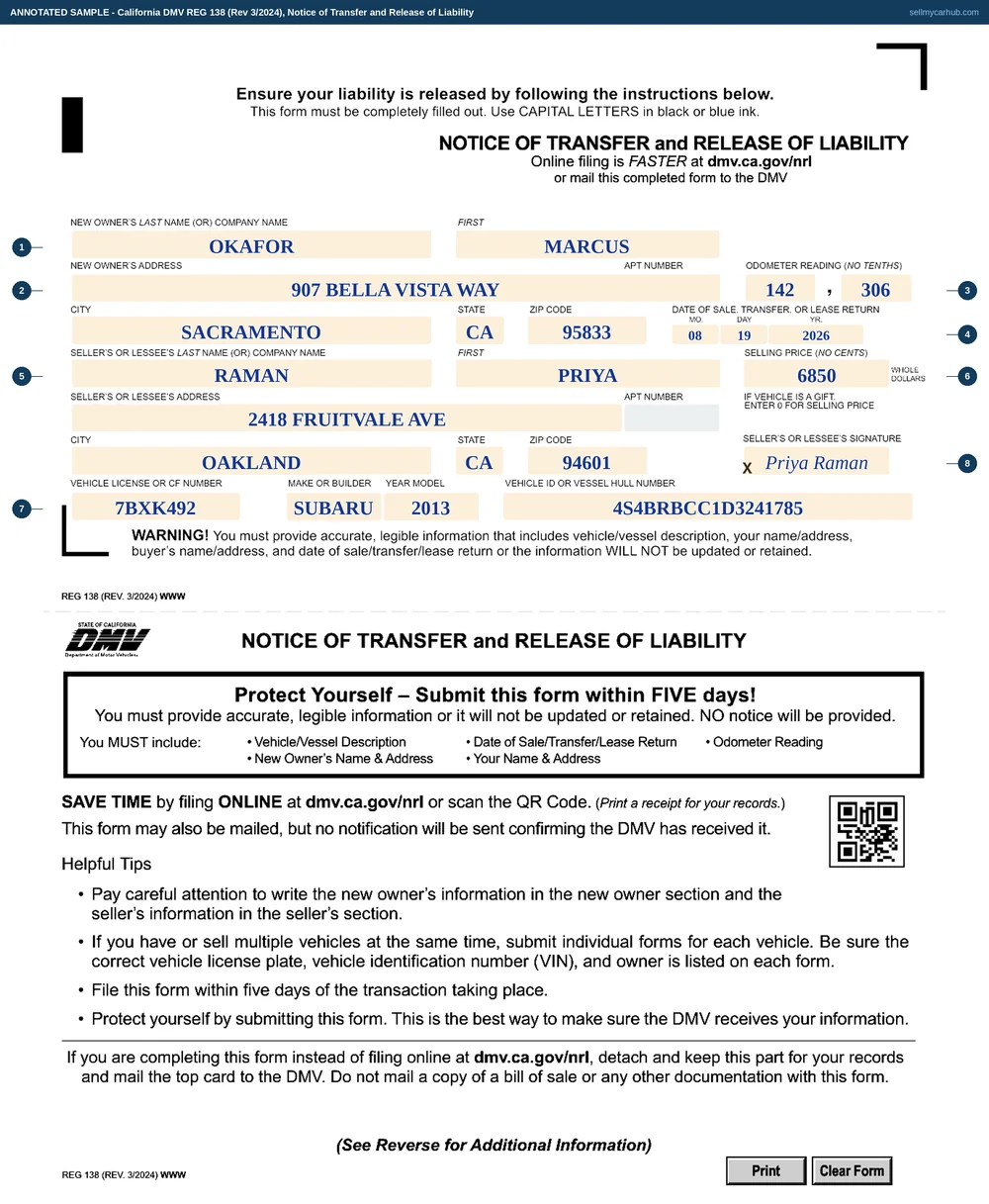
This is the actual REG 138, rendered from the PDF the California Department of Motor Vehicles publishes and completed end to end: letterhead, every field, and the blocks at the foot.

The California REG 138 release of liability filled in in capitals: buyer Marcus Okafor of Sacramento in the new owner block, 142,306 miles split across the two odometer boxes, 19 August 2026, seller Priya Raman of Oakland below, $6,850 in whole dollars, and the vehicle strip along the bottom.
The actual REG 138. Capitals in black or blue, as the instruction line at the top asks. Note the odometer: two boxes with the form's own comma between them, and no tenths. The buyer's details go in the top block and yours in the lower one - the DMV lists getting those two the wrong way round first among its own tips.
Field by field

Every line, in the order you meet it

  1. 1
    You fill this in

    New owner's name

    The buyer's last name or company name, then first name, in capitals.

    Watch out: This is the block people fill with their own details. The DMV lists exactly that mistake first among its own helpful tips - the buyer goes at the top, you go underneath.

  2. 2
    You fill this in

    New owner's address

    Where the buyer actually lives, with an apartment number if there is one.

    Watch out: An address that cannot be read is not corrected, it is discarded. The warning box says the information will not be updated or retained, and no notice is sent to tell you.

  3. 3
    You fill this in

    Odometer reading

    Whole miles, split across the two boxes with the form's printed comma between them - thousands on the left, the last three digits on the right.

    Watch out: No tenths. The box label says so, and a reading with a decimal in it is one of the reasons a notice gets thrown away.

  4. 4
    You fill this in

    Date of sale, transfer, or lease return

    Month, day and year of the handover.

    Watch out: This is the date the five-day clock runs from, and the date that decides whether a citation two weeks from now is yours or theirs. Put the real date.

  5. 5
    You fill this in

    Seller's name and address

    Your details, in the lower block.

    Watch out: Capitals in black or blue ink, as the instruction line at the very top of the form asks.

  6. 6
    You fill this in

    Selling price

    Whole dollars, no cents.

    Watch out: If the car was a gift, the form tells you to enter 0 - not to leave it blank.

  7. 7
    You fill this in

    Vehicle identification strip

    Licence plate or CF number, make or builder, year model, and the full VIN along the bottom.

    Watch out: All four, on every form. If you sold two cars the same day, that is two separate REG 138s with the right plate and VIN on each - the DMV asks for individual forms.

  8. 8
    You fill this in

    Seller's signature

    One signature, yours, on the rule at the right.

    Watch out: A co-owner does not have to sign a release of liability. Then file it - online at dmv.ca.gov/nrl if you want any proof it arrived, because a mailed form generates no confirmation at all.

At a glance

What goes where

On the formWhat to put in it
New owner's last name (or company name) and firstThe buyer. The form carries an explicit tip about this because people fill the buyer's details into the seller block and their own into the new owner block, which files the notice backwards.
New owner's address, apt numberWhere the buyer actually lives. A notice with a made-up or illegible address is discarded rather than corrected.
Odometer reading (no tenths)Whole miles. The box says no tenths and means it.
Date of sale, transfer, or lease returnMonth, day, year. This is the date the five-day clock runs from, and the date that decides whether a citation is yours or theirs.
Seller's or lessee's name and addressYours. Bottom half of the card.
Selling price (no cents)Whole dollars. The form adds: if the vehicle is a gift, enter 0 for selling price.
Seller's or lessee's signatureOne signature, yours. A co-owner does not have to sign a release of liability.
Vehicle licence or CF number, make or builder, year model, VINThe identification strip along the bottom. All four, on every form.

What gets this one rejected

Rules that decide whether it is accepted

Every line here was read off REG 138 (Rev 3/2024) itself — the PDF is here — and off the California Department of Motor Vehicles pages. This is plain-language help with a form, not legal advice, and where our wording and the agency's differ, theirs governs.

Back to all California seller paperwork, or what selling a car in California involves.

Want the paperwork handled instead?

Get My Instant Offer → Online · about 2 minutes · free

Or send the details — we'll come to you

We file the release of liability on every car we buy, and you get the confirmation. That is the part sellers forget and regret.

or call/text (877) 405-1808