Sell My Car Hub

How to fill out California REG 343

The buyer's application. It is here because sellers get asked about it constantly, and because what the buyer has to produce tells you what you have to hand over. It is also the form for a car arriving in California from another state.
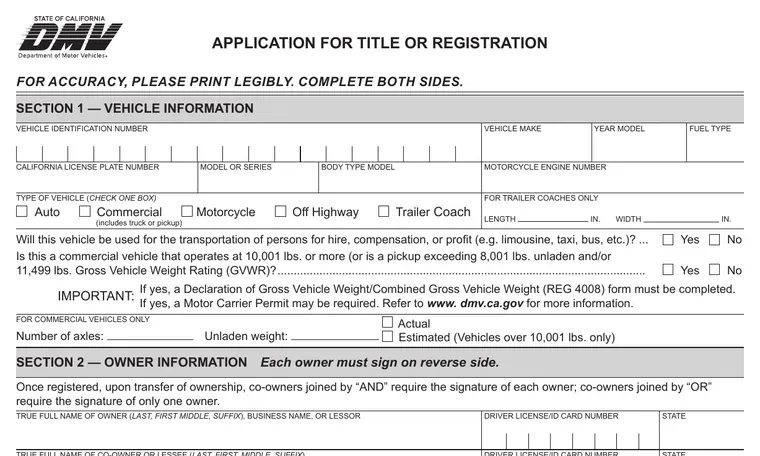
Two documents, and they are not the same thing. Take the blank REG 343 from the dmv.ca.gov copy so you get the revision that is current today, then print our REG 343 guide and keep it beside you while you fill theirs in.

Written against REG 343 (Rev 12/2022), issued under California Vehicle Code 4150 and 9250. This is the buyer's form, not yours. Do not sign it for them and do not fill in their details - a mistake in their block is best made with your signature nowhere near it.

Last updated .
Filled in

What a completed one looks like

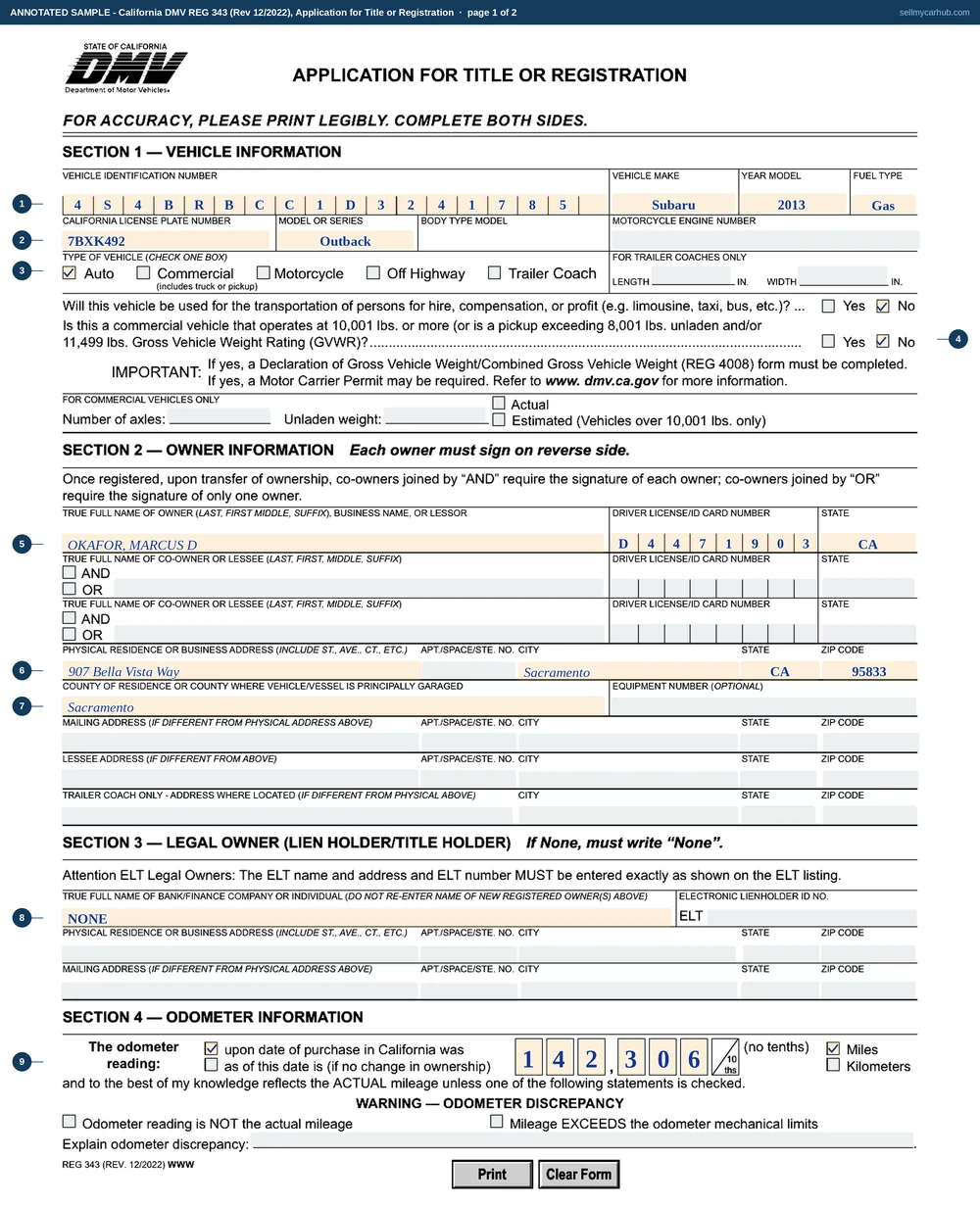
This is all 2 pages of the actual REG 343, rendered from the PDF the California Department of Motor Vehicles publishes and completed end to end: letterhead, every field, and the blocks at the foot.

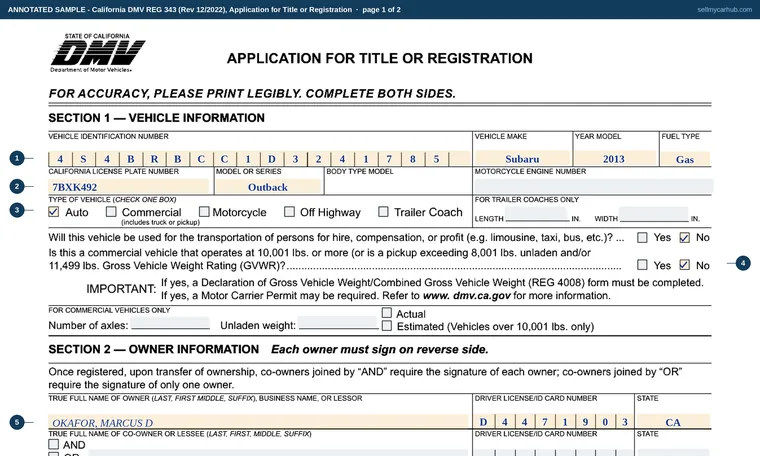
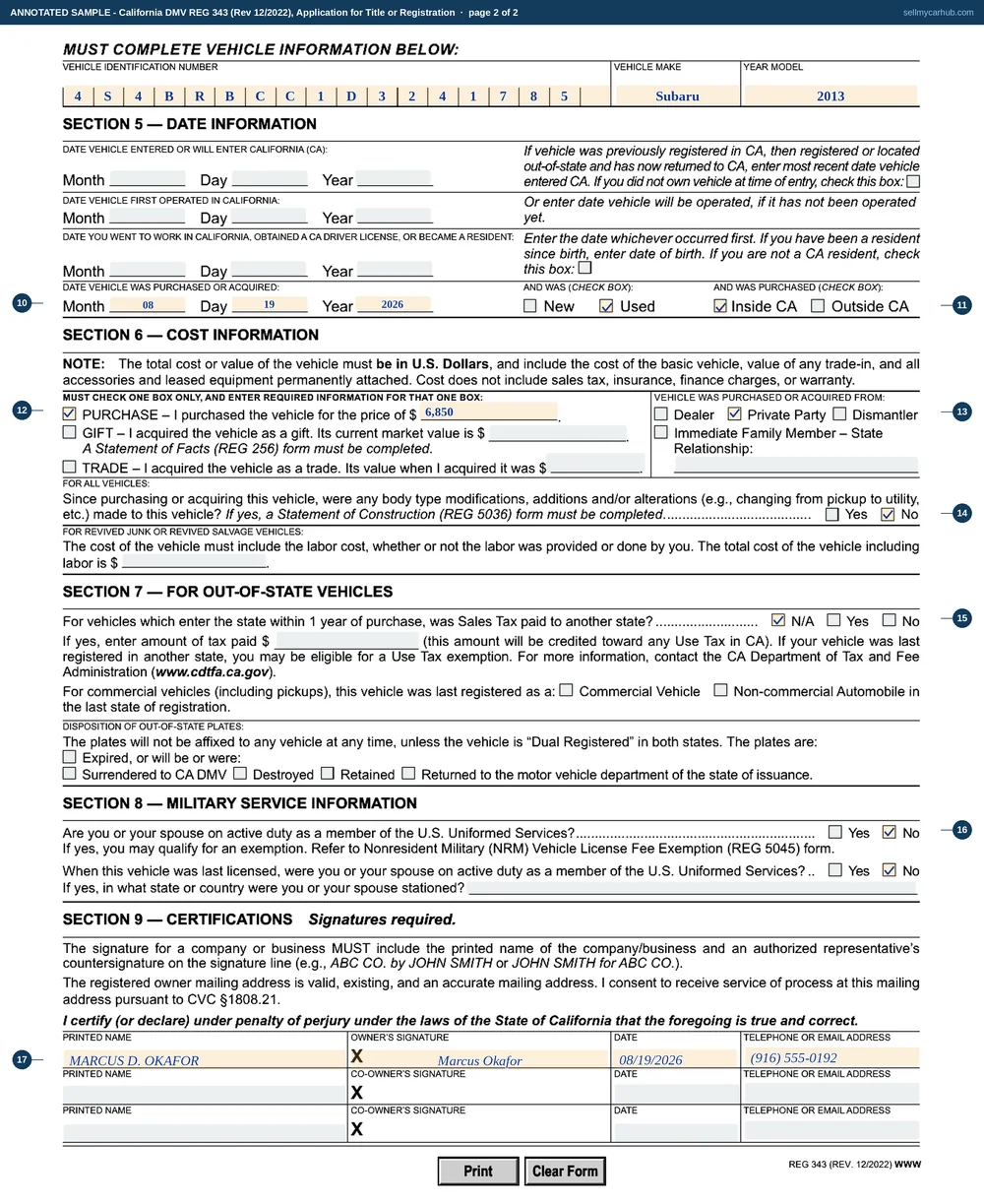
Both sides of the California REG 343 completed by a buyer: the VIN one character per printed box with make, year model and fuel type, Auto ticked, Marcus Okafor's name, licence number, address and county in section 2, NONE written into section 3, an odometer reading of 142,306 miles in section 4, and on the reverse the purchase date, the price, Private Party ticked, and his printed name, signature and date in section 9.

Click or tap a page to open it full size.

Download or print this example PDF · 4 pages · 960 KB

Page 1 of 2. The car, the buyer and the odometer. Section 3 gets the word NONE written into it rather than left empty, which is the one blank on this side the DMV will not accept, and the mileage goes in the six printed boxes with the form's own comma between the third and the fourth.
Page 2 of the filled-in REG 343: The reverse, where the sale itself is described and where the signatures live. Section 5 is left empty on a car that has always been in California - it is there for vehicles arriving from elsewhere - and section 6 carries the purchase box, the price and who it was bought from.
Page 2 of 2. The reverse, where the sale itself is described and where the signatures live. Section 5 is left empty on a car that has always been in California - it is there for vehicles arriving from elsewhere - and section 6 carries the purchase box, the price and who it was bought from.
Field by field

Every line, in the order you meet it

  1. 1
    The buyer fills this in

    The vehicle identification strip

    VIN one character per printed box, then vehicle make, year model and fuel type.

    Watch out: A comb field takes a single character per box. Crowd two into one and the number stops matching the title it is being checked against.

  2. 2
    The buyer fills this in

    Plate number, model or series, body type

    The California licence plate number the car already wears, with the model or series and the body type model beside it.

    Watch out: California plates stay with the car, so this is the number that was on it when you bought it - not a new one you are applying for.

  3. 3
    The buyer fills this in

    Type of vehicle

    One box only: Auto, Commercial, Motorcycle, Off Highway or Trailer Coach.

    Watch out: The form notes in small print under Commercial that it includes a truck or pickup. A trailer coach also has to have its length and width entered in inches.

  4. 4
    The buyer fills this in

    The two questions with consequences

    Will the vehicle carry persons for hire, compensation or profit? And is it a commercial vehicle at 10,001 lbs or more, or a pickup over 8,001 lbs unladen or 11,499 lbs GVWR?

    Watch out: A yes to the second one drags in a Declaration of Gross Vehicle Weight (REG 4008), and the IMPORTANT block beside it warns a Motor Carrier Permit may be required as well.

  5. 5
    The buyer fills this in

    Section 2, owner information

    True full name in last, first, middle, suffix order, with the driver licence or ID card number and the state that issued it.

    Watch out: The rule about co-owners is printed at the top of this section rather than buried elsewhere: joined by AND, every owner signs next time; joined by OR, only one has to.

  6. 6
    The buyer fills this in

    Physical residence or business address

    Street, city, state and zip - the address the vehicle actually lives at.

    Watch out: A mailing address goes on the line below it only where the two differ. Filling both with the same thing is a way of introducing a discrepancy that was not there.

  7. 7
    The buyer fills this in

    County of residence

    The county you live in, or the county where the vehicle is principally garaged.

    Watch out: It gets a line of its own because what you pay is not the same in every county. Skipping it is not a small omission.

  8. 8
    The buyer fills this in

    Section 3, legal owner

    The bank or finance company lending against the car. Where there is not one, the heading says it in quotation marks: if None, must write None.

    Watch out: An electronic lienholder needs its ELT number as well, and the attention line insists the name, address and number all match the ELT listing exactly.

  9. 9
    The buyer fills this in

    Section 4, odometer information

    The reading on the day of purchase, digit by digit into the printed boxes, with miles or kilometers ticked beside it.

    Watch out: The last box is shaded and marked no tenths - it is not part of the reading. Under it sit the two discrepancy boxes, and neither should be ticked unless it is true.

  10. 10
    The buyer fills this in

    Date the vehicle was purchased or acquired

    Month, day and year, in section 5 on the reverse.

    Watch out: The three date rows above it are about a vehicle arriving in California from somewhere else. On a car that has never left the state they stay empty.

  11. 11
    The buyer fills this in

    New or used, inside or outside California

    Two tick boxes on the same row as the purchase date.

    Watch out: Inside CA and Outside CA is about where the transaction happened, not where the car is now. It is the pair people answer from habit and get wrong.

  12. 12
    The buyer fills this in

    Section 6, cost information

    Tick PURCHASE and enter the price paid. The note above it says the figure must be in U.S. dollars and must include the value of any trade-in and anything permanently attached.

    Watch out: It also says what to leave out - sales tax, insurance, finance charges and warranty. The three boxes are exclusive: purchase, gift or trade, one only.

  13. 13
    The buyer fills this in

    Who the vehicle came from

    Dealer, Private Party, Dismantler, or Immediate Family Member with the relationship written in.

    Watch out: Ticking Immediate Family Member is what makes a Statement of Facts (REG 256) necessary, and the family list that qualifies is shorter than most people assume.

  14. 14
    The buyer fills this in

    Body type modifications

    A yes or no about alterations since the vehicle was acquired - the form's own example is changing from pickup to utility.

    Watch out: A yes here means a Statement of Construction (REG 5036) as well, which is a different form and a slower application.

  15. 15
    The buyer fills this in

    Section 7, for out-of-state vehicles

    Whether sales tax was paid to another state, and what happened to that state's plates.

    Watch out: N/A is a real answer here and the form prints it as the first of the three boxes. A California car bought from a California seller has nothing else to say in this section.

  16. 16
    The buyer fills this in

    Section 8, military service information

    Two questions about active duty in the U.S. Uniformed Services, for you or a spouse.

    Watch out: A yes may qualify for the exemption on the Nonresident Military (NRM) Vehicle License Fee Exemption (REG 5045) form, which the section names in full.

  17. 17
    The buyer fills this in

    Section 9, certifications

    Printed name, signature, date and a telephone number or email address, under the perjury declaration.

    Watch out: The paragraph above the signature is consent to receive service of process at the mailing address given, so an address entered carelessly on the front has a consequence here.

At a glance

What goes where

On the formWhat to put in it
The instruction at the topFor accuracy, please print legibly. Complete both sides. Section 2 adds that each owner must sign on the reverse - people fill in the front, sign nothing, and post it.
Section 1, vehicle informationVIN, make, year model, fuel type, California plate number, model or series, body type model, and a motorcycle engine number where that is what is being registered.
Type of vehicleOne box: Auto, Commercial - which the form notes includes a truck or pickup - Motorcycle, Off Highway, or Trailer Coach. A trailer coach also needs its length and width in inches.
The two questions that change everythingWill the vehicle carry persons for hire, compensation or profit? And is it a commercial vehicle operating at 10,001 lbs or more, or a pickup over 8,001 lbs unladen or 11,499 lbs GVWR? A yes to the second needs a Declaration of Gross Vehicle Weight (REG 4008), and may need a Motor Carrier Permit.
For commercial vehicles onlyNumber of axles, and unladen weight marked as either actual or - for vehicles over 10,001 lbs - estimated.
Section 2, owner informationTrue full name of each owner. The rule that matters is printed right here rather than buried: once registered, co-owners joined by AND require the signature of each owner, and co-owners joined by OR require the signature of only one.
Odometer disclosureGo by the federal rule rather than the DMV's older ten-year wording - a 2011-or-newer car needs the mileage whatever a summary elsewhere says.

What gets this one rejected

Every line here was read off REG 343 (Rev 12/2022) itself — the PDF is here — and off the California Department of Motor Vehicles pages. This is plain-language help with a form, not legal advice, and where our wording and the agency's differ, theirs governs.

Forms that go with this one

When your buyer asks where to file this, point them to the three Sacramento-area DMV offices that list title transfers, on Broadway, La Mancha Way and North Avenue.

Back to all California seller paperwork, or what selling a car in California involves.

Want the paperwork handled instead?

Get My Instant Offer → Online · about 2 minutes · free

Or send the details — we'll come to you

You do not fill this one in when you sell to us. The title side is ours.

or call/text (877) 405-1808