Sell My Car Hub

How to fill out California REG 227

Replaces a California title that is lost, stolen or ruined - and, on the same sheet, transfers the car to a buyer without waiting for the replacement to arrive. Tick the second box at the top and the seller, the buyer and any lienholder all sign this one form instead of a certificate that no longer exists.
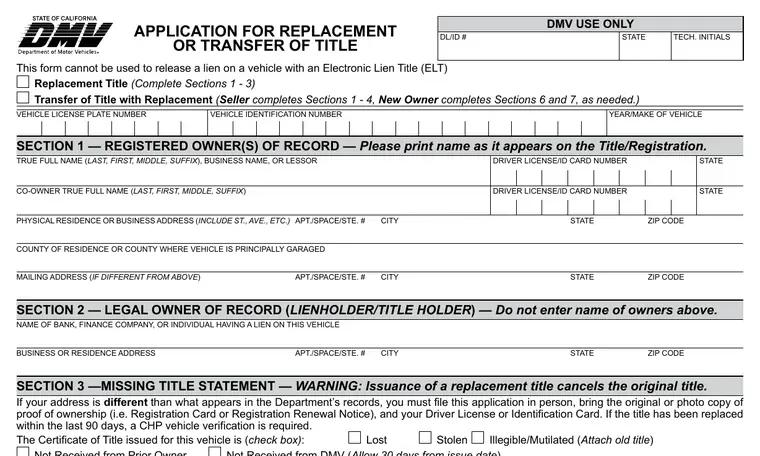
Written against REG 227 (Rev 9/2024), issued under California Vehicle Code 4150, 5752 and 9265. Issuing a replacement title cancels the original outright. If the old certificate turns up in a drawer afterwards it is waste paper - do not sign it and hand it to a buyer.

Two documents, and they are not the same thing. Take the blank REG 227 from the dmv.ca.gov copy so you get the revision that is current today, then print our REG 227 guide and keep it beside you while you fill theirs in.

Filled in

What a completed one looks like

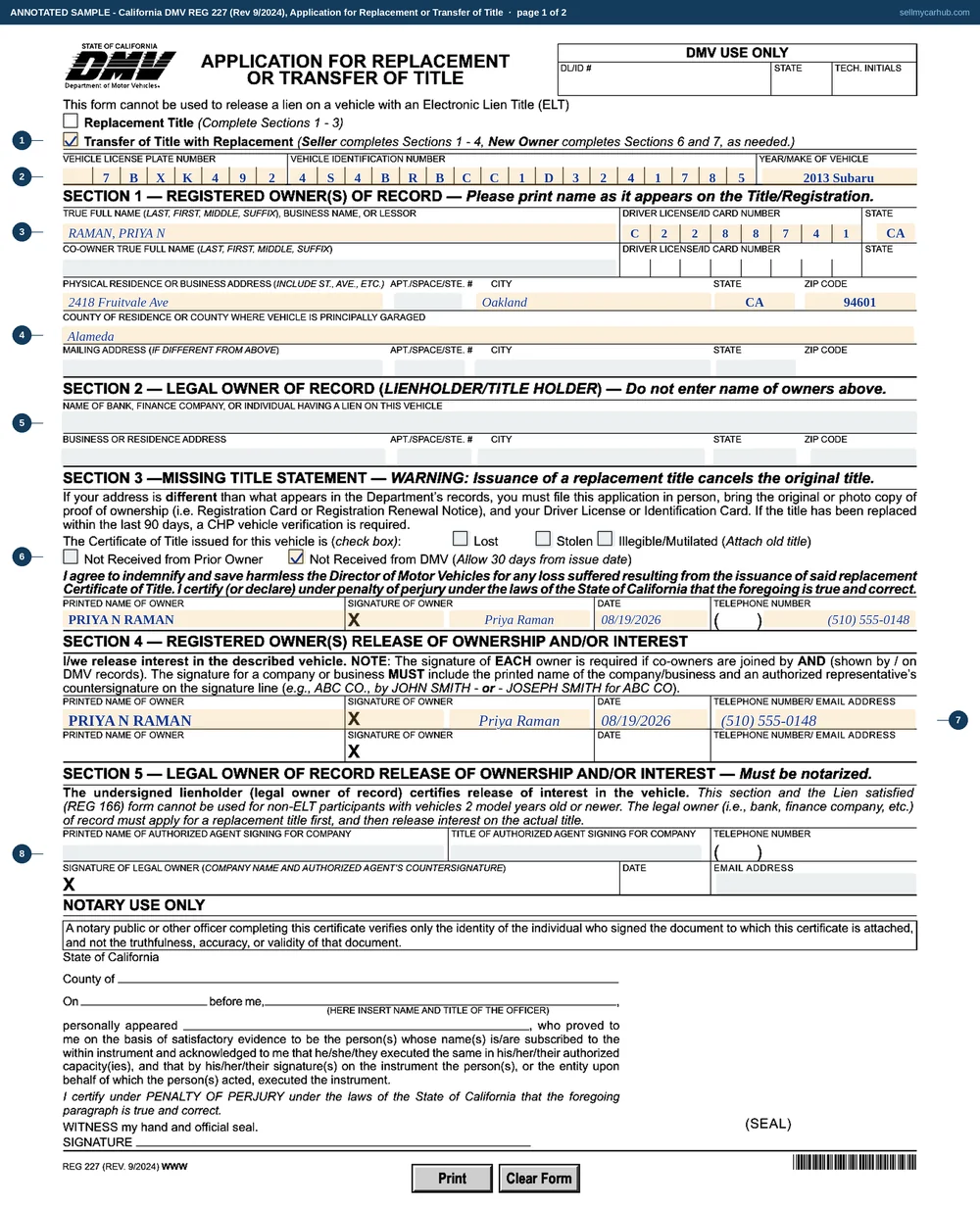
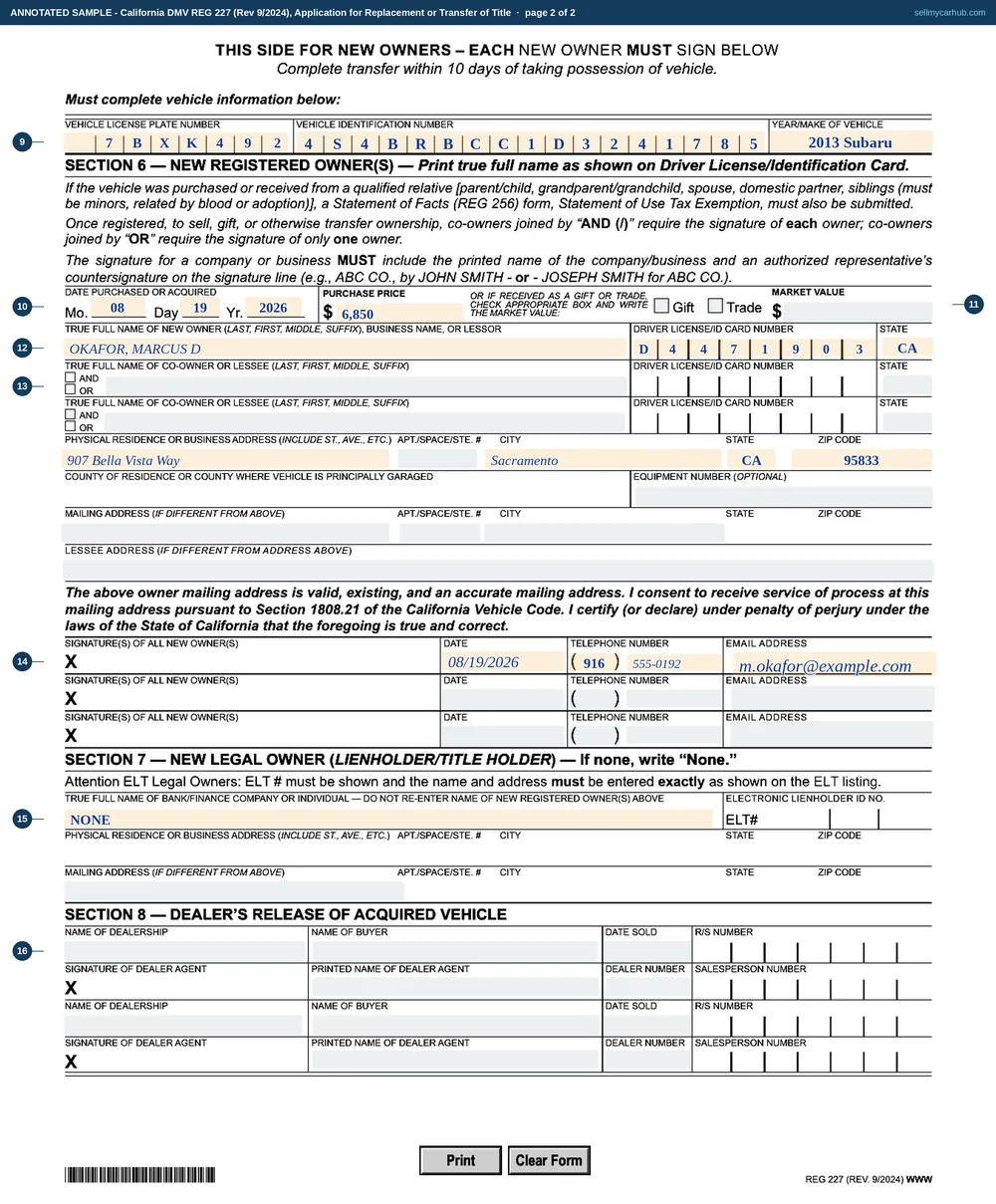
This is all 2 pages of the actual REG 227, rendered from the PDF the California Department of Motor Vehicles publishes and completed end to end: letterhead, every field, and the blocks at the foot.

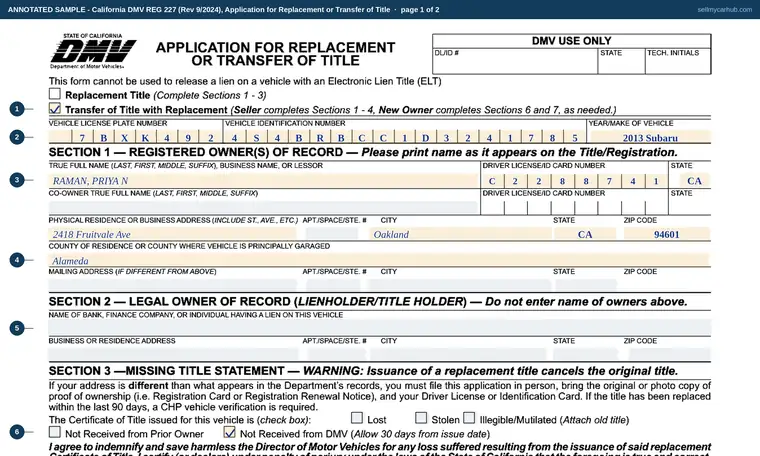
Both sides of the California REG 227 filled in: the Transfer of Title with Replacement box ticked at the top, plate and VIN one character per printed box, seller Priya Raman's details and signature in sections 1, 3 and 4, and buyer Marcus Okafor's in section 6 with NONE written on the new legal owner line.
Page 1 of 2.
Both sides of the California REG 227 filled in: the Transfer of Title with Replacement box ticked at the top, plate and VIN one character per printed box, seller Priya Raman's details and signature in sections 1, 3 and 4, and buyer Marcus Okafor's in section 6 with NONE written on the new legal owner line.
Page 2 of 2.
Field by field

Every line, in the order you meet it

  1. 1
    You fill this in

    The two boxes at the top

    Replacement Title means sections 1 to 3 and you keep the car. Transfer of Title with Replacement means the seller completes 1 to 4 and the new owner completes 6 and 7.

    Watch out: Ticking the wrong one is the difference between a title posted to you and a car registered to somebody else. Read both lines before you mark either.

  2. 2
    You fill this in

    Plate, VIN and year/make

    The identification strip above section 1, written one character per printed box.

    Watch out: These are comb fields. Crowding two characters into one box is how a VIN becomes unreadable at the counter.

  3. 3
    You fill this in

    Section 1, registered owner of record

    Print your name as it appears on the title or registration, with your driver licence number and state, then the physical address and county.

    Watch out: Not as it appears on your licence if the two differ - the form says as it appears on the Title/Registration and means it.

  4. 4
    You fill this in

    County of residence

    The county you live in, or where the vehicle is principally garaged.

    Watch out: It has a line of its own because California registration fees vary by county. It is not optional detail.

  5. 5
    The lienholder fills this in

    Section 2, legal owner of record

    The bank or finance company holding a lien. Left empty when there genuinely is not one.

    Watch out: The form warns in bold not to enter the name of the owners above. Unlike section 7, a true blank is correct here.

  6. 6
    You fill this in

    Section 3, missing title statement

    Tick one: Lost, Stolen, Illegible/Mutilated, Not Received from Prior Owner, or Not Received from DMV. Then print your name, sign, date, and give a phone number.

    Watch out: Illegible or mutilated means attaching the old title. Not Received from DMV means allowing 30 days from the issue date first. And if your address differs from the DMV's records, this has to be filed in person.

  7. 7
    You fill this in

    Section 4, release of ownership

    Print, sign and date again - this is the part that actually releases the car.

    Watch out: The signature of each owner is required where co-owners are joined by AND, and California shows AND as a forward slash. A title reading SMITH / JONES needs both signatures.

  8. 8
    The lienholder fills this in

    Section 5, legal owner release

    The lienholder signing off, with a notary acknowledgement beneath it.

    Watch out: This is the only notarised part of the form, and it is not yours. It also cannot be used at all on a vehicle with an Electronic Lien Title.

  9. 9
    The buyer fills this in

    The vehicle strip again, on side two

    Plate, VIN and year/make repeated at the top of the new owner's side.

    Watch out: The two sides are processed as one document but each carries its own identification. Filling one and not the other stalls it.

  10. 10
    The buyer fills this in

    Date purchased and purchase price

    The date of sale in month, day and year, then the price.

    Watch out: The price is what the use tax is calculated on, so it wants to match the bill of sale and the release of liability.

  11. 11
    The buyer fills this in

    Gift or trade

    Only where no money changed hands: tick gift or trade and write the market value instead.

    Watch out: A gift from a qualified relative also needs a REG 256 statement of use tax exemption attached, and the relative list is short.

  12. 12
    The buyer fills this in

    Section 6, new registered owners

    True full name as shown on the buyer's licence, with the licence number, address and county.

    Watch out: The transfer has to be completed within 10 days of taking possession. That line is printed at the top of this side of the form.

  13. 13
    The buyer fills this in

    AND / OR between co-owners

    If the car is going into two names, the buyers pick AND or OR on the tick boxes between the name lines.

    Watch out: That single choice decides who has to sign the next time the car is sold. AND means everybody; OR means either one.

  14. 14
    The buyer fills this in

    Signatures, dates and contact details

    Each new owner signs for themselves, with a date, phone number and email.

    Watch out: A company or business signature must include the printed company name and an authorised representative's countersignature - the form gives the format: ABC CO., by JOHN SMITH.

  15. 15
    The buyer fills this in

    Section 7, new legal owner

    The buyer's lender. If there is none, write None.

    Watch out: Here the blank is not acceptable - the form asks for the word. An electronic lienholder also needs its ELT number and its details exactly as they appear on the ELT listing.

  16. 16
    Dealers only

    Section 8, dealer's release

    For a dealership releasing a car it acquired.

    Watch out: It stays empty on a private sale. Nothing about it applies to either of you.

At a glance

What goes where

On the formWhat to put in it
The two boxes at the very topReplacement Title means sections 1 to 3 only, and you keep the car. Transfer of Title with Replacement means the seller completes 1 to 4 and the new owner completes 6 and 7. Ticking the wrong one is the difference between a title posted to you and a car registered to somebody else.
Section 1, registered owner of recordPrint the name exactly as it appears on the title or registration, not as it appears on your driver's licence if the two differ. Plate number, VIN and year/make go in the strip above it.
County of residenceOr the county where the vehicle is principally garaged. It has its own line because California registration fees vary by county.
Section 2, legal owner of recordThe bank or finance company holding a lien. The form warns in bold: do not enter the name of the owners above. Leaving it blank when there genuinely is no lienholder is correct here - unlike section 7, which wants the word None written in.
Section 3, missing title statementTick one of Lost, Stolen, Illegible/Mutilated, Not Received from Prior Owner, or Not Received from DMV. Illegible or mutilated means attaching the old title. Not Received from DMV means allowing 30 days from the issue date first.
Section 4, release of ownershipThe seller's signature block. The form spells out the rule: the signature of EACH owner is required if co-owners are joined by AND - and California prints AND as a forward slash on its records, so a title reading SMITH / JONES needs both signatures.
Section 5, legal owner releaseThis is the only part of the form that must be notarised. It is the lienholder signing off, not you.
Section 6, new registered ownersThe buyer's side. Purchase price or, for a gift or trade, the market value with the matching box ticked. Each new owner prints a true full name as shown on their licence and signs; the AND/OR boxes between the co-owner lines decide who has to sign next time the car is sold.
Section 7, new legal ownerThe buyer's lender. If there is none, the form says to write None - here the blank is not acceptable. An electronic lienholder also needs its ELT number and its name and address exactly as they appear on the ELT listing.
Section 8, dealer's releaseNot yours. It is for a dealership releasing a car it acquired, and stays empty on a private sale.

What gets this one rejected

Every line here was read off REG 227 (Rev 9/2024) itself — the PDF is here — and off the California Department of Motor Vehicles pages. This is plain-language help with a form, not legal advice, and where our wording and the agency's differ, theirs governs.

Back to all California seller paperwork, or what selling a car in California involves.

Want the paperwork handled instead?

Get My Instant Offer → Online · about 2 minutes · free

Or send the details — we'll come to you

A lost California title is the most common reason a private sale stalls. It does not stall a pickup - we buy cars on a REG 227 every week.

or call/text (877) 405-1808