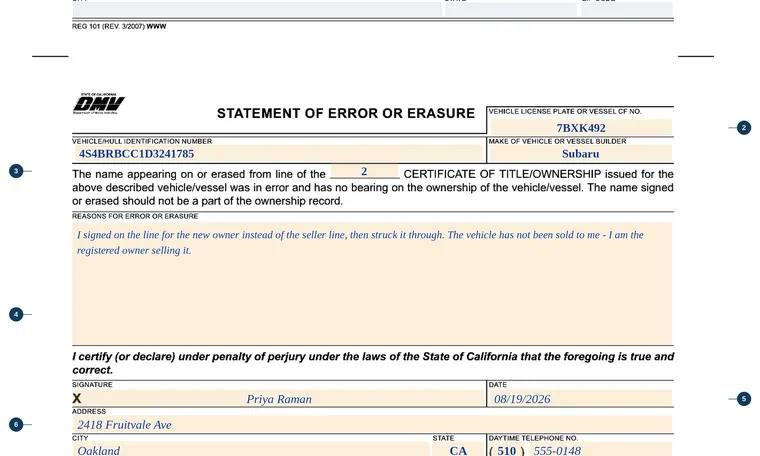
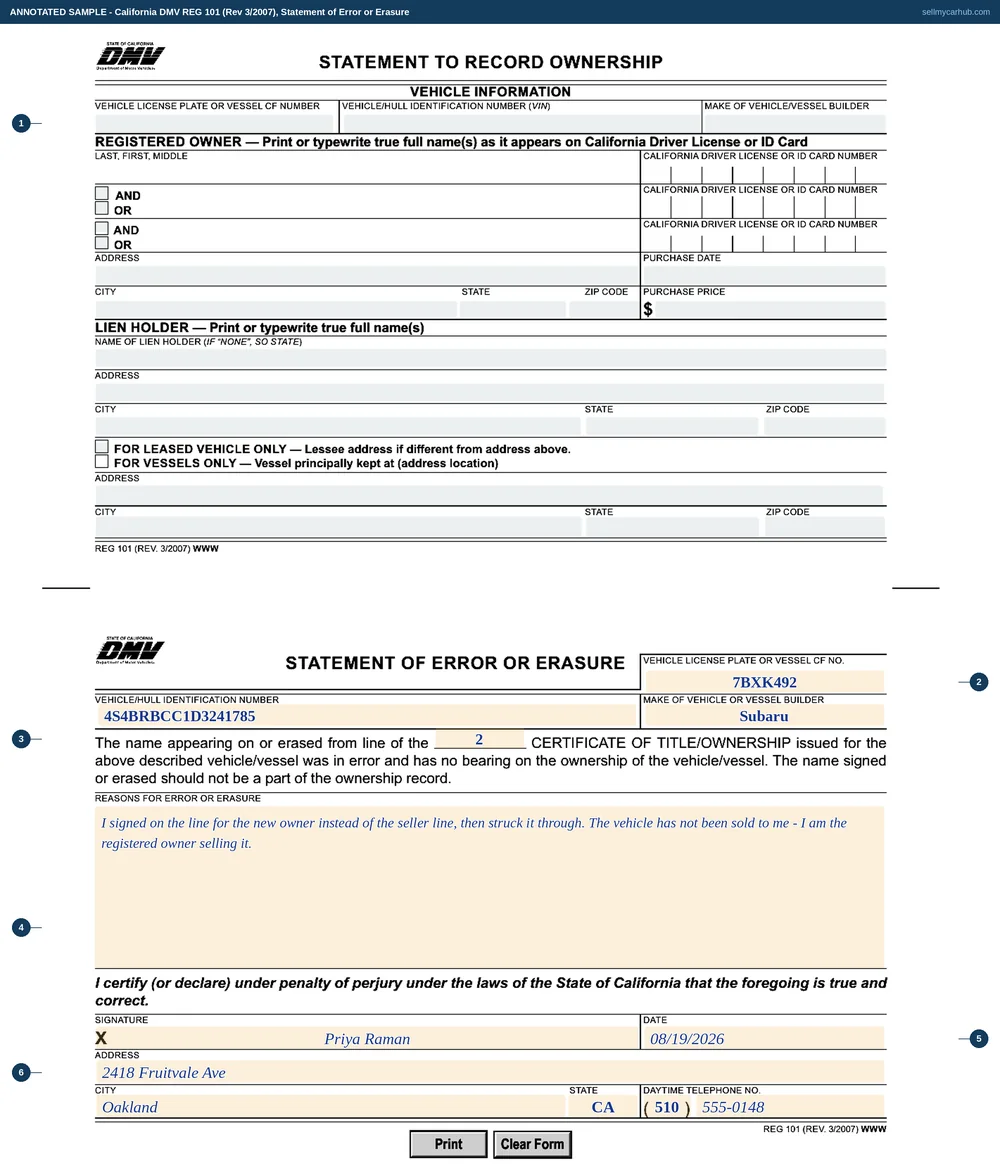
Two different rescue forms on one sheet. The top half records ownership details the DMV is missing. The bottom half - the Statement of Error or Erasure - is the one sellers need: it explains a name written or scratched out on the title in error, so a certificate somebody has already spoiled does not have to be replaced.
Written against REG 101 (Rev 3/2007), issued under California Vehicle Code 4150 and 4453. California will look at a title with a name crossed out. That is genuinely different from states where any alteration voids the certificate outright - but it is a request, not a right, and a second erasure on the same title is unlikely to be forgiven.
Two documents, and they are not the same thing. Take the blank REG 101 from the dmv.ca.gov copy so you get the revision that is current today, then print our REG 101 guide and keep it beside you while you fill theirs in.
This is the actual REG 101, rendered from the PDF the California Department of Motor Vehicles publishes and completed end to end: letterhead, every field, and the blocks at the foot.
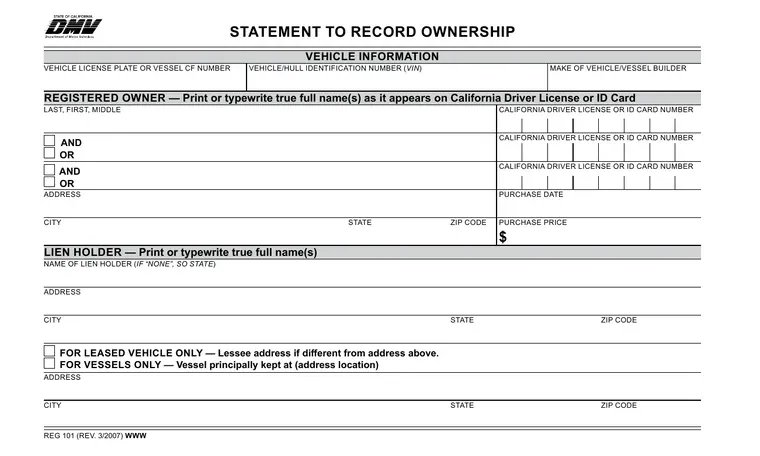
Statement to Record Ownership. A different form that happens to share this sheet.
Watch out: If you are here because you wrote on a title, this half is not yours. Leave it alone rather than filling it in for completeness.
Plate or CF number, VIN and make, repeated at the head of the lower half.
Watch out: The two halves are processed separately, so the vehicle has to be identified on whichever one you are using.
Which line of the certificate of title carries the name written or erased in error.
Watch out: Count the lines on the certificate in front of you rather than guessing. The clerk will be counting the same lines.
One plain sentence saying what happened.
Watch out: This is the part that decides it. Signed on the buyer's line by mistake reads very differently from the word mistake on its own - a clerk is reading this and choosing whether to accept a marked certificate.
Sign under penalty of perjury and date it.
Watch out: You are certifying the name has no bearing on ownership. This is not a route out of a sale you have changed your mind about.
Where you can be reached about it.
Watch out: California will look at a title somebody has written on, which is genuinely different from states where any alteration voids the certificate. It is still a request rather than a right.
| On the form | What to put in it |
|---|---|
| Vehicle information | Plate or CF number, VIN and make, at the head of each half. Fill it in on both halves if you are using both. |
| Registered owner, with AND / OR boxes | True full names as they appear on the California licence or ID card, each with its licence number, and a tick box between the lines choosing AND or OR. That tick decides who has to sign the next time the car changes hands. |
| Purchase date and purchase price | Small boxes on the right of the owner block, and the pair the DMV uses to check use tax. |
| Lien holder | The form is explicit: if none, so state. Write the word NONE rather than leaving it empty. |
| For leased vehicle only / for vessels only | Skip both on an ordinary private car. |
| Statement of error or erasure - line number | The bottom half asks which line of the certificate of title carries the name written or erased in error. Count the lines on the certificate and put the number in. |
| Reasons for error or erasure | Free text, and the part worth writing carefully. Say what happened in one plain sentence - signed on the buyer's line by mistake, name entered before the sale fell through - because a clerk reads this and decides. |
| Signature, date, address, daytime telephone | Under penalty of perjury, on the error half. |
Every line here was read off REG 101 (Rev 3/2007) itself — the PDF is here — and off the California Department of Motor Vehicles pages. This is plain-language help with a form, not legal advice, and where our wording and the agency's differ, theirs governs.
Back to all California seller paperwork, or what selling a car in California involves.