Sell My Car Hub

How to fill out New Jersey OS/SS-61

One page that turns a New Jersey certificate of ownership into a salvage certificate of title. A private owner meets it when an insurer has written the car off and it is staying with them, or when a car has been damaged badly enough that it cannot honestly go on being titled as an ordinary vehicle - and the box that matters most on it is the one asking, in plain words, how you came by the car and what happened to it.
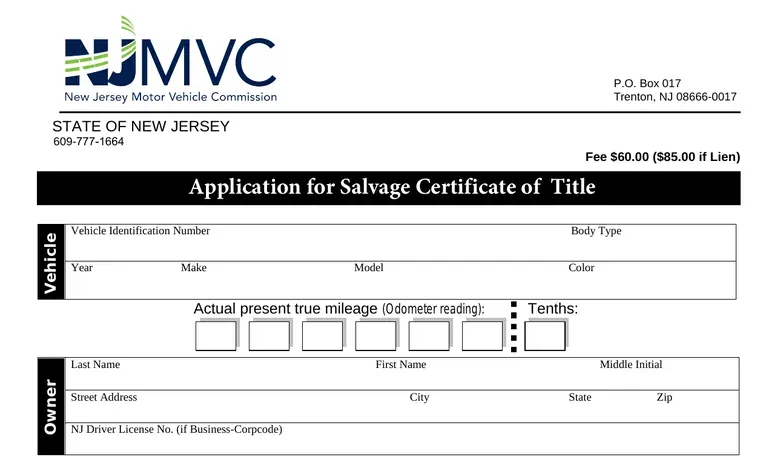
Written against OS/SS-61 (R7/25), issued under the Commission's Salvage Title Unit procedure. A salvage certificate changes what the vehicle is on New Jersey's record permanently. It is the right document for a written-off car and the wrong one for a car that merely looks bad.

Two documents, and they are not the same thing. Take the blank OS/SS-61 from the nj.gov copy so you get the revision that is current today.

Filled in

What a completed one looks like

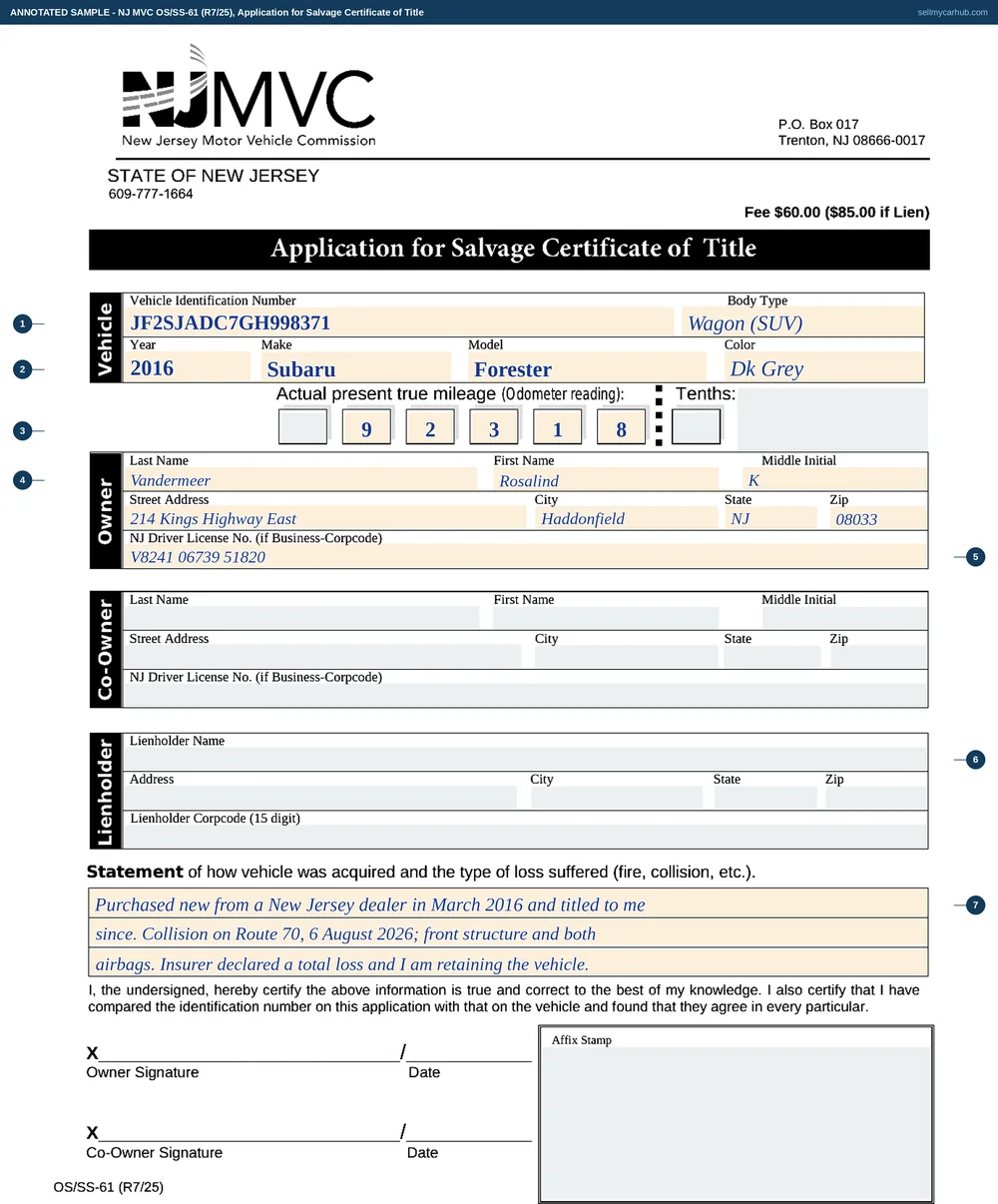
This is the actual OS/SS-61, rendered from the PDF the New Jersey Motor Vehicle Commission publishes and completed end to end: letterhead, every field, and the blocks at the foot.

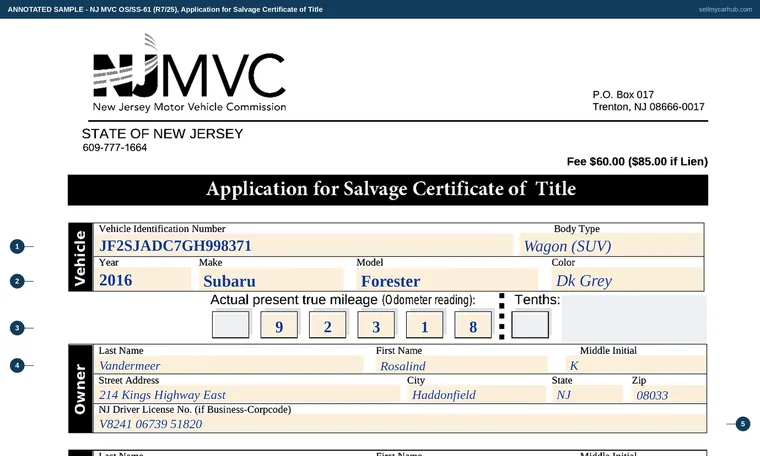
The New Jersey OS/SS-61 salvage title application filled in: a 2016 Subaru Forester, VIN JF2SJADC7GH998371, an odometer reading of 92,318 written one digit to a box, owner Rosalind K. Vandermeer of Haddonfield with her driver licence number, and a three-line statement describing a collision on Route 70 and a total loss.
The actual OS/SS-61. The co-owner and lienholder blocks are grey because this is a sole owner with no loan, and so is the large sales tax stamp box at the foot - that is applied at the counter, not by you. The two signature rules underneath are printed lines with no fillable field behind them, so they are shown the way the Commission prints them: empty.
Field by field

Every line, in the order you meet it

  1. 1
    You fill this in

    Vehicle identification number and body type

    Off the certificate. The body type box sits beside it on the same row.

    Watch out: You are about to certify that this number matches the one on the vehicle. On a crashed car, find the plate before you write the number down.

  2. 2
    You fill this in

    Year, make, model, colour

    Four boxes across the second row of the vehicle block.

    Watch out: Colour as the certificate has it, even if the panel that carried it is no longer attached to the car.

  3. 3
    You fill this in

    The odometer row

    Actual present true mileage, one digit per printed box, with tenths in the separate box at the end.

    Watch out: Six boxes and a tenths box. Bunching the digits into the first three is the classic way to make a clerk ask for the form again.

  4. 4
    You fill this in

    Owner name and address

    Last name, first name, middle initial on one row; street, city, state and zip on the next.

    Watch out: Surname first on this form. It is laid out for the Commission's index rather than the way you would write your own name.

  5. 5
    You fill this in

    Driver licence number, or corpcode

    One wide line under the address. A business puts its corpcode here instead.

    Watch out: The co-owner block below repeats all of this, and it stays empty on a single-owner car.

  6. 6
    The lienholder fills this in

    The lienholder block

    Name, address and the fifteen-digit lienholder corpcode, where a lien is recorded against the vehicle.

    Watch out: Nobody expects you to know a lender's corpcode from memory. It is on the certificate, printed beside their name.

  7. 7
    You fill this in

    How it was acquired, and the loss

    Three ruled lines. The form's own examples of the type of loss are fire and collision.

    Watch out: Two sentences beats one word. How the vehicle came to you, and what happened to it - a clerk reading fire on its own has to write back and ask.

  8. 8
    You fill this in

    Sign, date, and check the VIN once more

    Owner signature and date, co-owner beneath where there is one, under a certification about comparing the identification number with the vehicle.

    Watch out: The sales tax stamp box is the large empty rectangle to the right of your signature. It is not yours - leave it alone.

At a glance

What goes where

On the formWhat to put in it
Vehicle blockVehicle identification number, body type, then year, make, model and colour.
OdometerA row of separate boxes headed actual present true mileage, with a tenths box off to the side. One digit per box.
Owner blockLast name, first name, middle initial; street address, city, state, zip; and the New Jersey driver licence number, or the corpcode where the owner is a business.
Co-owner blockThe same six lines again, for a second name on the certificate.
Lienholder blockLienholder name, address, city, state, zip, and a fifteen-digit lienholder corpcode.
Statement of how the vehicle was acquired and the type of loss sufferedThree ruled lines, and the form's own parenthesis tells you what it is after - fire, collision, etc. This is the substance of the application.
The certificationThat the information is true and correct to the best of your knowledge, and that you have compared the identification number on the application with the one on the vehicle and found that they agree in every particular.
Affix StampA large box at the foot of the page for the sales tax stamp.
SignaturesOwner signature and date, co-owner signature and date, each marked with an X.

What gets this one rejected

Rules that decide whether it is accepted

Every line here was read off OS/SS-61 (R7/25) itself — the PDF is here — and off the New Jersey Motor Vehicle Commission pages. This is plain-language help with a form, not legal advice, and where our wording and the agency's differ, theirs governs.

Back to all New Jersey seller paperwork, or what selling a car in New Jersey involves.

Want the paperwork handled instead?

Get My Instant Offer → Online · about 2 minutes · free

Or send the details — we'll come to you

Written off, stripped or sitting on a driveway with a branch through it? Tell us what happened and we will tell you which certificate the Commission expects.

or call/text (877) 405-1808