The single page that carries the mileage when the certificate itself cannot. It is not a substitute for signing the title - the form says so in its own words, that it is only a supplement to a fully assigned certificate of title or manufacturer certificate of origin - but it is what a New Jersey counter asks for when the mileage block on the certificate is full, spoiled or missing.
Written against OS/SS-2 (R4/23), issued under the federal Truth in Mileage Act, and N.J.S.A. 39:10-11 as cited on the form itself. This page has no power to move ownership. It records mileage, and it does that job well - but a buyer holding only this is holding nothing.
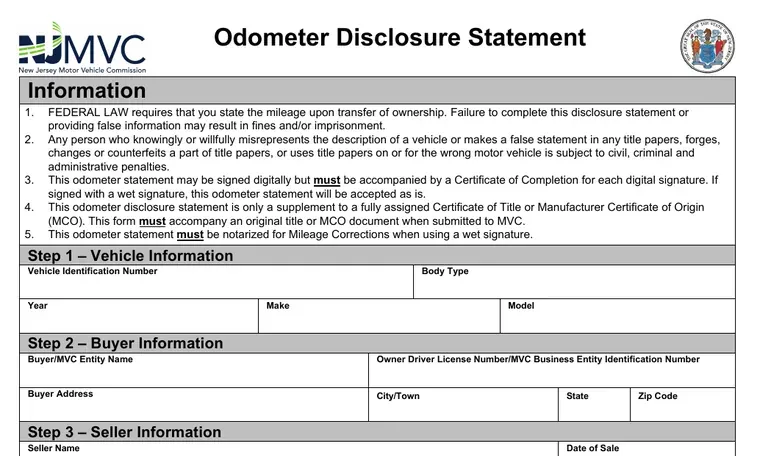
Two documents, and they are not the same thing. Take the blank OS/SS-2 from the nj.gov copy so you get the revision that is current today.
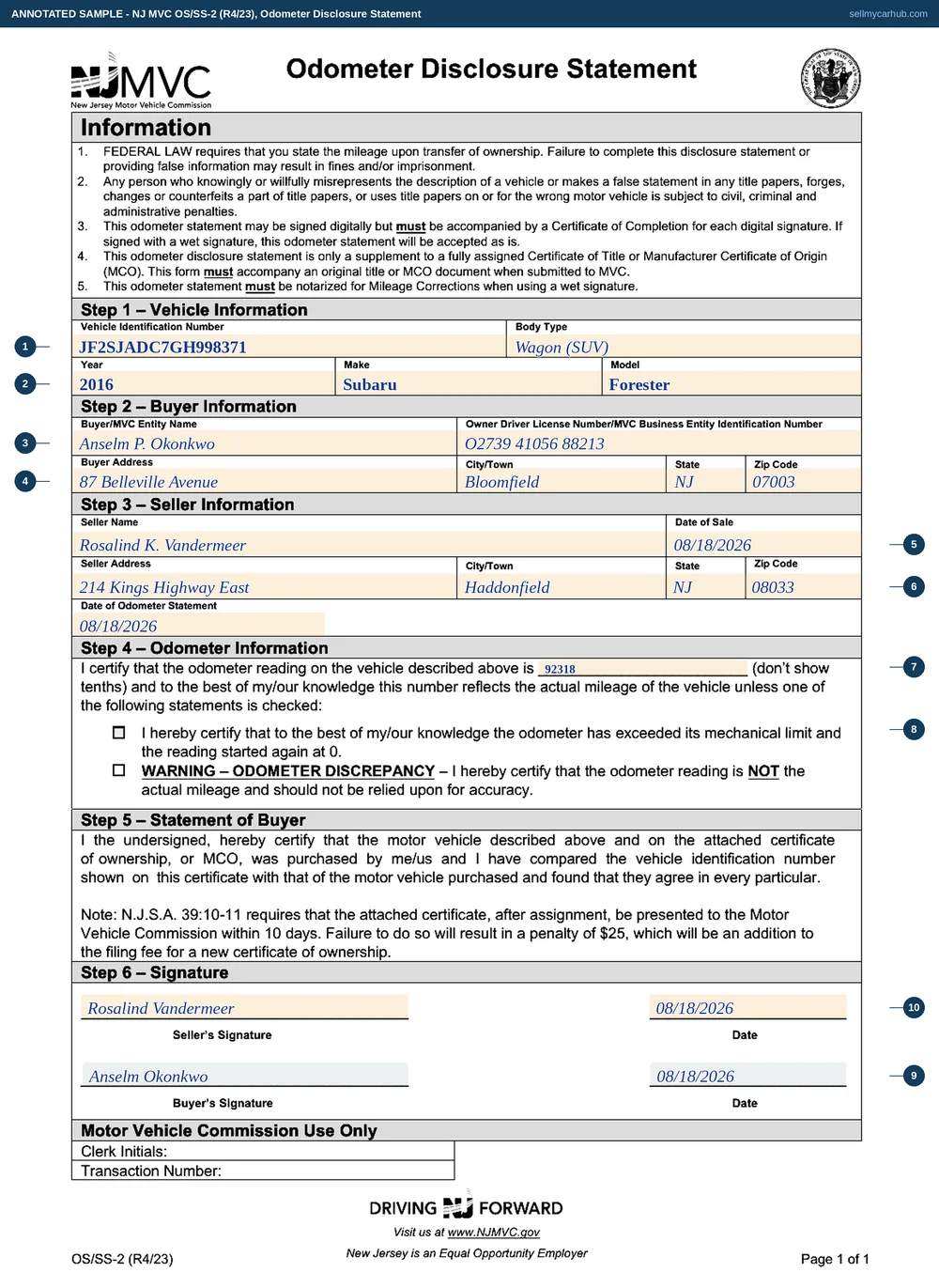
This is the actual OS/SS-2, rendered from the PDF the New Jersey Motor Vehicle Commission publishes and completed end to end: letterhead, every field, and the blocks at the foot.
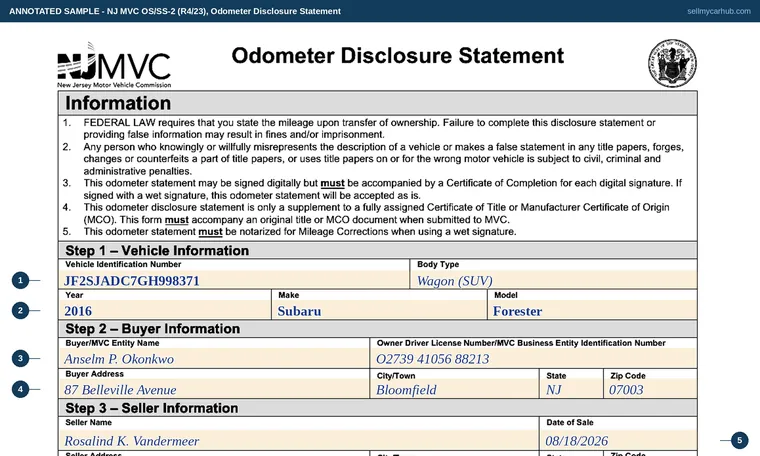
Copied off the certificate. The body type is the same short description the Commission uses elsewhere.
Watch out: The buyer's own certification further down is that they compared this number with the one on the car and found they agree in every particular. Get it right here and that comparison is a formality.
Three boxes across, matching the certificate rather than the badge on the boot lid.
Watch out: Trim levels do not belong here. Model means what the title says the model is.
The buyer's full name or entity name, and their driver licence number - or an MVC Business Entity Identification Number if the car is going into a company.
Watch out: Ask to see the licence and copy from it. This is the second document in the transaction that carries their number, and the two have to agree.
Street, city, state and zip. Where they live, not where they are collecting the car.
Watch out: If the address on the licence is out of date, use the one they are registering from and expect the counter to ask about the difference.
Your name as it appears on the certificate, and the day the car actually changed hands.
Watch out: This is the date the buyer's ten-day clock runs from. It should match the date on the certificate and on your bill of sale, all three.
Your address, then the separate line for the date you are signing this particular page.
Watch out: Two different dates here is normal and not a mistake. A blank one is.
Whole miles, no tenths, in the gap in the sentence. Writing it there certifies that to the best of your knowledge it reflects the actual mileage of the vehicle.
Watch out: Read it off the dash the morning you hand the car over, not off the last service invoice. A number that has drifted by a few hundred miles is the kind of discrepancy a buyer notices later.
Tick the first if the odometer has exceeded its mechanical limit and the reading started again at 0. Tick the second, headed WARNING - ODOMETER DISCREPANCY, if the reading is not the actual mileage.
Watch out: Neither box is an accusation and neither stops a sale. Ticking nothing on a car you know has a replaced cluster is the thing that causes trouble.
The buyer certifies that they bought the vehicle described and have compared the VIN on the certificate with the one on the car.
Watch out: Let them actually check it. The number is on the dash, visible through the windscreen from outside, on anything built since 1968.
Seller signs and dates; buyer signs and dates. A wet signature is accepted as is; a digital one needs a Certificate of Completion attached for each signature.
Watch out: No notary here - unless the reason you are filling this in is to correct a mileage already on the record and you are signing in ink, in which case it must be notarised.
| On the form | What to put in it |
|---|---|
| The five numbered notes at the top | Federal law requires the mileage on transfer; a false statement in title papers carries civil, criminal and administrative penalties; a digital signature needs a Certificate of Completion attached for each one; the form is a supplement and must accompany an original title or MCO; and it must be notarised for mileage corrections when a wet signature is used. |
| Step 1, vehicle information | Vehicle identification number, body type, year, make and model. |
| Step 2, buyer information | Buyer or entity name, their driver licence or business entity identification number, and their full address. |
| Step 3, seller information | Seller name, date of sale, seller address, and separately the date of the odometer statement itself - which is not always the same day. |
| Step 4, odometer information | One line for the reading, marked don't show tenths, above a certification that the number reflects the actual mileage. Two boxes underneath are the only exceptions: the odometer has exceeded its mechanical limit and started again at 0, or - under the word WARNING - the reading is not the actual mileage and should not be relied upon for accuracy. |
| Step 5, statement of buyer | The buyer's certification that they bought the vehicle and have compared the VIN on this certificate with the one on the vehicle and found that they agree in every particular. |
| The note under step 5 | The Commission's own reminder that N.J.S.A. 39:10-11 requires the assigned certificate to be presented within 10 days, and that failing to do so adds a $25 penalty to the filing fee. |
| Step 6, signatures | Seller's signature and date, buyer's signature and date. Both, on the same sheet. |
Every line here was read off OS/SS-2 (R4/23) itself — the PDF is here — and off the New Jersey Motor Vehicle Commission pages. This is plain-language help with a form, not legal advice, and where our wording and the agency's differ, theirs governs.
Back to all New Jersey seller paperwork, or what selling a car in New Jersey involves.