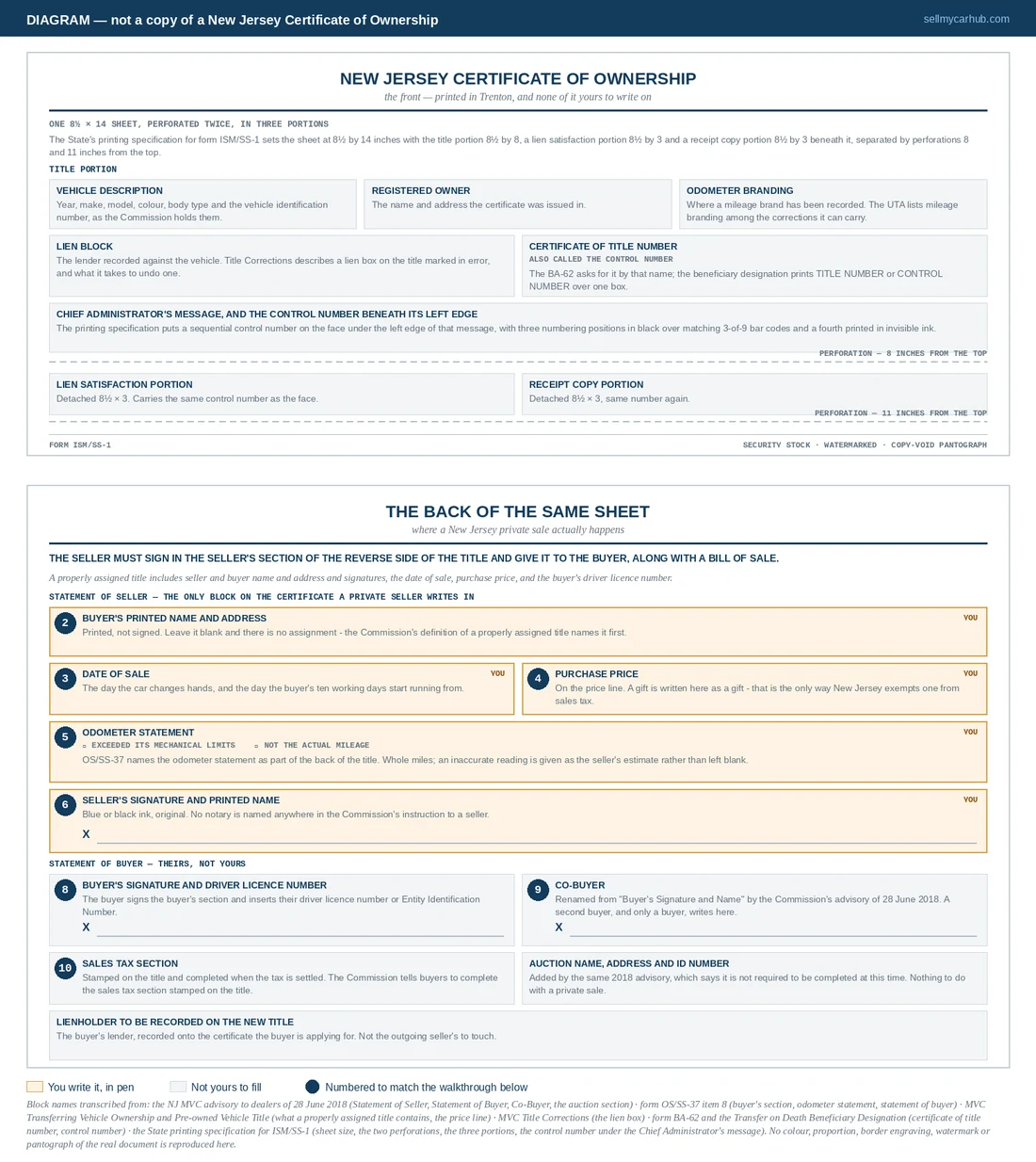
A New Jersey sale happens on the back of the certificate of ownership, in a block headed Statement of Seller, and it takes four pieces of information and one signature. Below is a diagram of that document with every block named from the Commission's own writing about it, because the Commission publishes no picture of one - and the reason it does not turns out to be the most useful thing on this page.
Last updated .
Your 8 boxes
As a private seller you complete these and nothing else:
There is no blank New Jersey certificate to download and anyone offering you one is selling something else. The Commission has it printed on security stock in a guarded plant; yours arrives in the post and there is one of it. What you can print is the checklist above, which is ours.
Two blanks turn a signed New Jersey certificate into a problem: the buyer's name and the purchase price.
Blue or black ink, an original signature, and no photocopies: that is the standard the Commission applies to every document in this set, and the certificate is the one where it matters most because there is exactly one of them.
Start here
A diagram, because New Jersey publishes no picture of its own certificate
Every block, sentence and section name on this drawing is transcribed from something the Commission or the State has published about the certificate - the transfer instructions, the 2018 dealer advisory that renamed three of its sections, the insurer's application that describes what sits on the back, and the State's printing specification for the document itself. What it deliberately does not reproduce is the engraving, the colour or the proportions, because those are the security features.
Amber — you write it, in pen
Grey — not yours to fill
Numbered - matches the steps below
Click or tap the picture to open it full size.
Drawn, not copied. Block names come from the MVC's transfer instructions, its June 2018 advisory to dealers, the OS/SS-37 and the State's own printing specification for form ISM/SS-1; the proportions and every security feature are left out.
The one real one there is
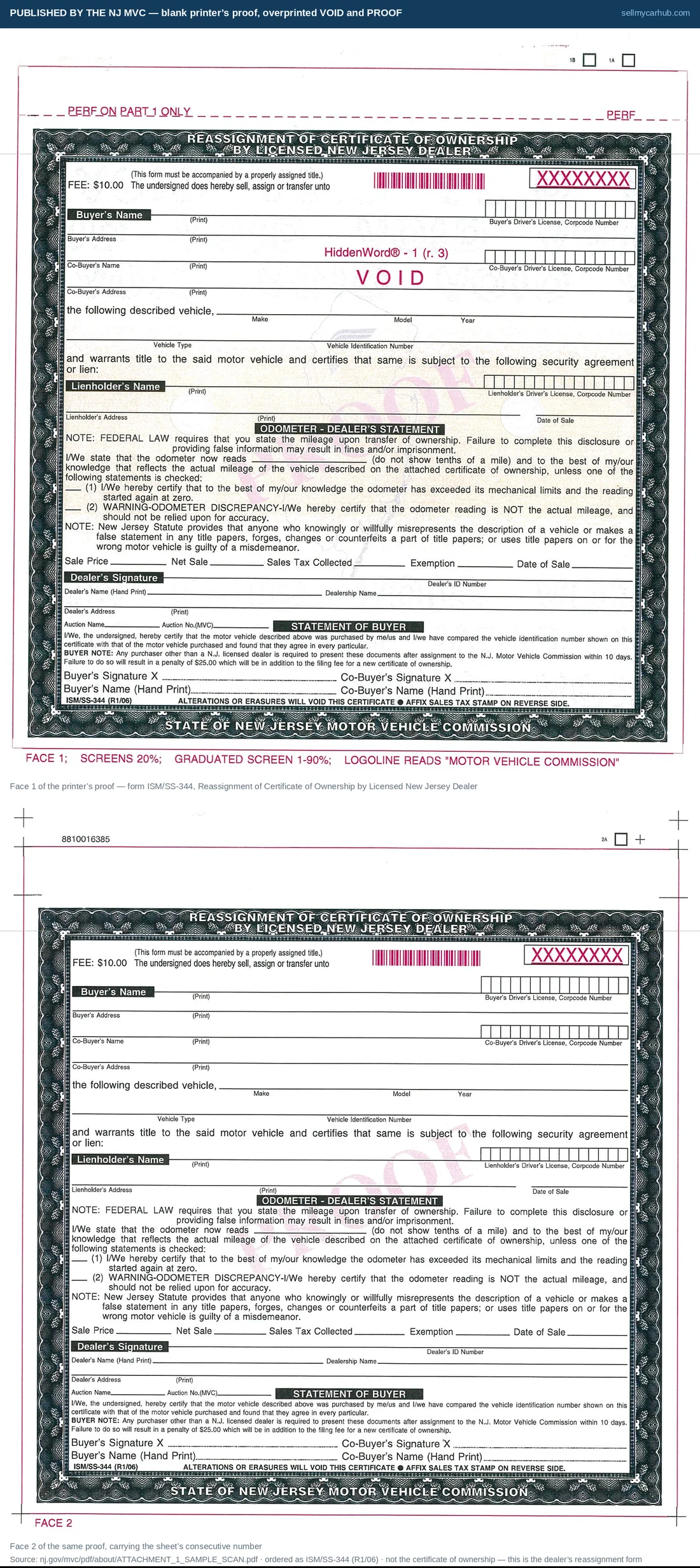
What the Commission does publish: the dealer's reassignment, VOID and blank
One New Jersey ownership document exists as a picture on nj.gov, and it is not the certificate. It is form ISM/SS-344, the Reassignment of Certificate of Ownership by Licensed New Jersey Dealer - a printer's proof, blank, overprinted VOID and PROOF with XXXXXXXX where the control number goes, attached to the Commission's own 2019 tender to have 450,000 of them made. A private seller never touches one. It is here because the Commission revised the two documents together: its June 2018 advisory to dealers announces the changes to the certificate's Statement of Seller and Statement of Buyer and the renaming of a line to Co-Buyer on both. Everything printed below is this form's own wording, not the certificate's - but it is the closest published thing to it, and it shows you what a New Jersey assignment block is shaped like.
Click or tap the picture to open it full size.
Two faces of the same proof, exactly as the MVC published them. Nothing has been added and nothing removed. Read the small print at the foot of it - alterations or erasures will void this certificate - and then read it again before you pick up a pen anywhere near the real thing.
Step by step
Every box, in the order you meet it
1
You fill this in
Turn the certificate over
Everything a private seller does happens on the reverse. The front is what the Commission printed when it issued the document - the vehicle, you, and any lien recorded against it - and none of it is yours to change.
Watch out: If a mistake on the front is what is stopping the sale, that is a title correction rather than a transfer: $60 at an agency, free only where the Commission clearly caused the error.
2
You fill this in
The buyer's name, in the seller's section
Their full legal name and address, printed legibly, in the block the Commission calls the Statement of Seller. This is the block its June 2018 advisory to dealers named when it revised the certificate.
Watch out: Copy it off the licence they are holding, not off the message they sent you. The certificate goes to a counter where a clerk compares the two.
3
You fill this in
The date of sale
The day the car actually changes hands. It is what the buyer's ten-working-day clock is measured from and what your plate receipt should sit alongside.
Watch out: Do not post-date it as a favour. The date on the certificate is the date the Commission works from if anything is ever disputed.
4
You fill this in
The purchase price
What they paid, in figures, on the price line. If the car is a genuine gift, that is what goes on this line instead - the MVC says a vehicle is only exempt from sales tax if the customer indicates on the price line that it is one.
Watch out: This is the line the Division of Taxation reads. Leave it blank and Trenton values the car itself from trade data, then writes to both of you.
5
You fill this in
The odometer reading
Whole miles as the instrument shows them, no tenths, on the same reverse side. If the reading is wrong, New Jersey wants your estimate of what it should be rather than an empty box.
Watch out: There are exactly two exceptions and they are printed as boxes: the reading has rolled past its mechanical limit, or it is not the actual mileage. Ticking neither is a statement that the number is true.
6
You fill this in
Your signature
Blue or black ink, in the seller's section, an original. No notary, no witness, nobody watching. If two names are on the face, work on the basis that both sign.
Watch out: Sign nothing until the money is real and the buyer is standing there. The certificate is the car; a signed one lying around is a car anybody can claim.
7
You fill this in
Write the bill of sale
Not optional in New Jersey. The Commission lists it as part of what the seller hands over and names its four contents: buyer's name and address, date of sale, odometer reading, sale price.
Watch out: Make two and keep one. It is the only document in the transaction that stays in your hands, and it is what you will reach for if Taxation writes to you.
8
The buyer fills this in
The buyer's section
They sign the buyer's section on the same reverse side and write in their driver licence number, or an Entity Identification Number if the car is going into a business name.
Watch out: A missing licence number in that block is one of the things that sends them home again, and they will assume you did it.
9
The buyer fills this in
The Co-Buyer line, if there are two of them
The second name and signature go on the line the 2018 advisory renamed Co-Buyer. Two buyers means two entries there.
Watch out: Only the buyers fill this in. A seller writing a second name into the buyer's half is an alteration on a document where alterations are the whole problem.
10
The buyer fills this in
The sales tax stamp
The reverse of a New Jersey certificate carries a sales tax section, and it is completed when the tax is settled at the agency counter.
Watch out: Nothing here is the seller's, but if a buyer asks you to write a lower price to shrink it, the answer is no - Taxation checks the figure afterwards by post.
11
You fill this in
Take the plates off
Before the car leaves. Surrender them at any agency or in the drop box outside it, or move them to another vehicle of yours - never to the buyer.
Watch out: The receipt gets posted to you. Ask at the greeter desk if you need it in your hand the same day, and keep it until the buyer's registration is done.
12
The buyer fills this in
The buyer goes to an agency, in person
Within ten working days, with the assigned certificate, a BA-49, their licence, proof of New Jersey insurance, the fee and the tax. It cannot be posted.
Watch out: The $25 penalty for missing that window is theirs, not yours - but until they go, the Commission's record still has your name on the car.
Before the pen
Before you meet the buyer at the agency
Six habits worth having before you write on a document that is engineered to make a correction visible for the rest of its life.
Blue or black, original
The Universal Title Application spells the standard out - original signatures in blue or black ink only - and the LOA-1 puts it in capitals: photocopies of this form are not acceptable. Treat the certificate the same way.
No correction fluid
The document is printed on chemically sensitised stock precisely so that an alteration shows. A spoiled certificate is a $60 replacement, not a repair.
Nothing signed in advance
There is no New Jersey mechanism that undoes a signature given to the wrong person. Sign when the buyer is in front of you and the money has cleared.
Both halves stay in their lane
Seller's section, buyer's section. Filling in the buyer's licence number to be helpful is an alteration by somebody who was not entitled to write there.
The price line gets a number
Even where it is a gift, which is written on that line rather than left off it. That line is read by two different agencies.
Photograph it before it goes
Both sides, completed, on your phone. It costs nothing and it is the only copy you will ever have of a document you are handing away.
The ink rule is NJ MVC's own: “Sign in the seller's section of the reverse side of the title and give it to the buyer, along with a bill of sale”
— NJ MVC, Transferring Vehicle Ownership.
Check your source
What people assume about New Jersey, and what the MVC says
Three things that get repeated about selling a car in New Jersey. One of them will send you looking for a notary you do not need; one of them will cost you a plate you were supposed to keep.
"A New Jersey title has to be signed in front of a notary."
Not for an ordinary private sale. The Commission's instruction to a seller is to sign the seller's section on the reverse and hand the certificate over with a bill of sale, and no notary appears in it. The notary requirements New Jersey does have attach to a power of attorney, a company's letter of authority, a surviving spouse's affidavit, a beneficiary designation and a car bought where no title is issued.
"Leave the plates on so the buyer can drive it home."
They are registered to you, not to the car. The Commission's first instruction to a seller is to remove the plates and surrender them unless they are going onto another vehicle of yours, and it says in the same breath that plates can be transferred to another vehicle but not to another owner.
Trenton checks, afterwards, by post. The Division of Taxation runs a Motor Vehicle Casual Sales review on private transfers, requires a Purchaser's Affidavit on the questionnaire, can require the Seller's Affidavit too, and values the car from trade data if nobody replies.
Who has to hold the pen depends on who is named on the face of the certificate, and on whether that person can get to the room:
The owner named on the face
Signs the seller's section on the reverse. That signature, with the buyer's details beside it, is the sale.
Both owners, where two names are on the certificate
New Jersey publishes no and/or rule for a private sale, so treat two names as two signatures and ask the agency if only one of you can attend. Under-claiming here costs nothing; guessing costs a rejected transfer.
Somebody holding a power of attorney
Only with a General, Durable or Limited POA that is notarised and names the attorney-in-fact and the principal. A Limited one has to quote the year, make, VIN and the transaction it authorises.
Somebody carrying your paperwork but not signing it
That is the LOA-1, and it is a different animal: it lets a person hand documents across the counter and expressly does not let them sign anything for you.
A surviving spouse or domestic partner
Signs the certificate themselves, with the BA-62 affidavit notarised and a copy of the death certificate, when both names were on the title.
The buyer
Signs the buyer's section and adds their driver licence number or Entity Identification Number. You cannot do this half for them and should not try.
Once it is signed
Signing the certificate is the middle of a New Jersey sale, not the end. The plates are still on the car and they are still registered to you, and that is the piece nobody gets round to.