Turns a wrecked vehicle's ordinary title into a salvage title, or into a nonrepairable title for one that will never legally return to the road. If you settled a total loss and kept the car, this is what has to be filed before it can be sold on.
Step 1 · the form itself
Blank VTR-441 — Application for Salvage or Nonrepairable Vehicle Title
PDF at txdmv.gov · new tab
View the blank VTR-441
Step 2 · how to fill it in
Our filled-in VTR-441 guide
PDF · 3 pages · 960 KB · new tab
See our filled-in example
Two documents, and they are not the same thing. Take the blank VTR-441 from the txdmv.gov copy so you get the revision that is current today, then print our VTR-441 guide and keep it beside you while you fill theirs in.
Written against VTR-441 (Rev 01/25), issued under Texas Transportation Code 501.091 and 501.100. Texas brands wrecks two ways, and only one of them has a road back. Repair a salvage vehicle, pass the inspection, and it retitles as rebuilt salvage. A nonrepairable vehicle never does - the brand is terminal, and applying under the wrong one is not a clerical slip you fix later.
Last updated .
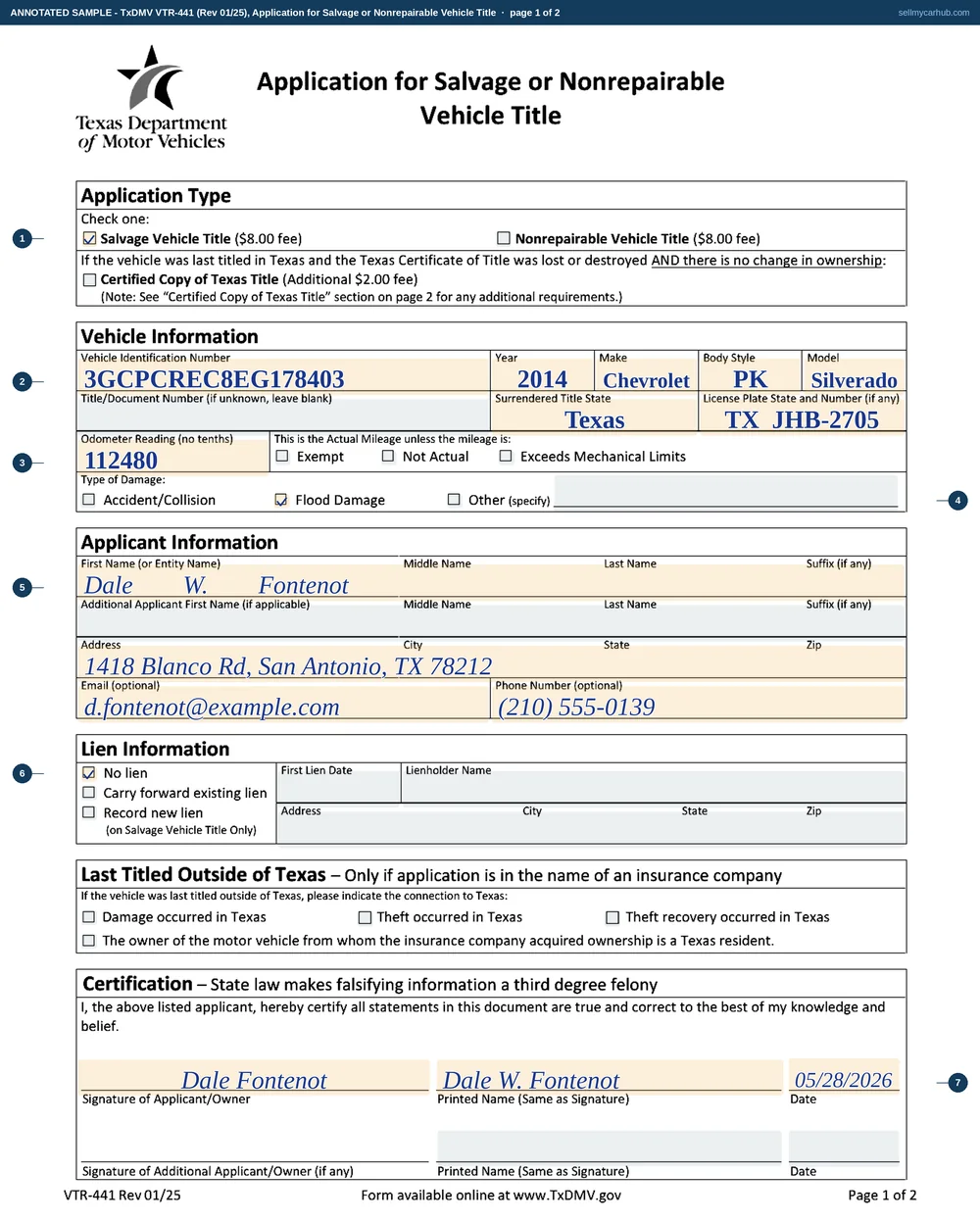
This is all 2 pages of the actual VTR-441, rendered from the PDF the Texas Department of Motor Vehicles publishes and completed end to end: letterhead, every field, and the blocks at the foot.
Click or tap a page to open it full size.
Download or print this example PDF · 3 pages · 960 KB
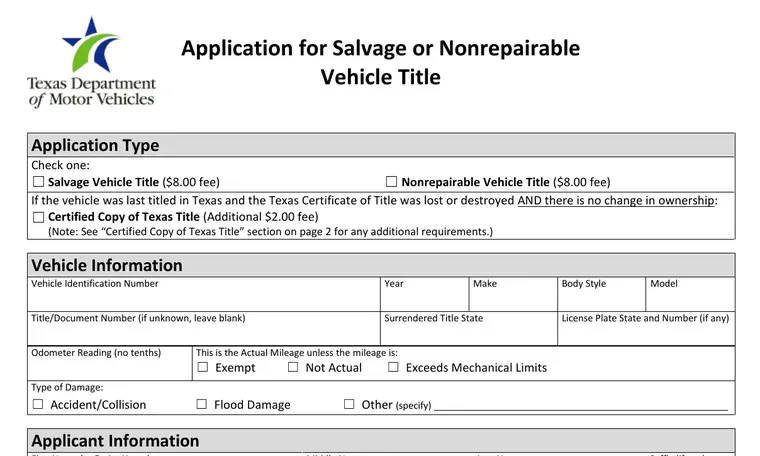
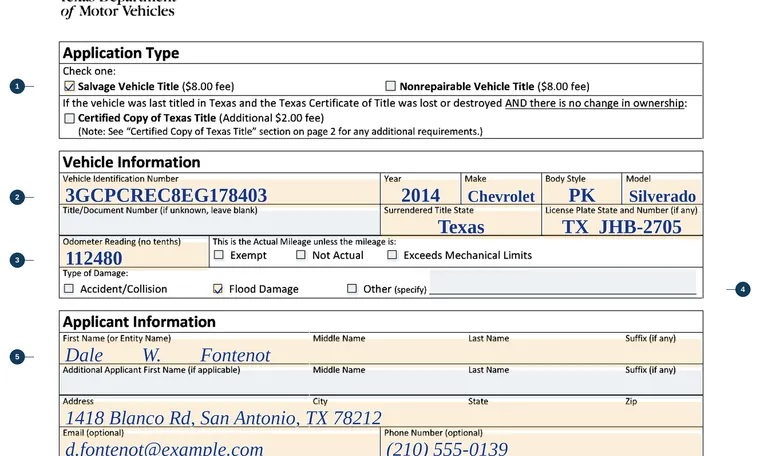
Salvage Vehicle Title or Nonrepairable Vehicle Title, each an $8.00 fee, with a third box adding a Certified Copy of Texas Title for another $2.00.
Watch out: The certified copy box has a condition attached: the vehicle must have been last titled in Texas, the title lost or destroyed, and there must be no change in ownership - including adding or removing an owner.
VIN, year, make, body style, model, the title or document number, the state that issued the surrendered title, and the plate state and number.
Watch out: Surrendered Title State catches people out on a vehicle that has only ever been in Texas. It is Texas, and it is not the same question as the plate state beside it.
The reading with no tenths, and three boxes: Exempt, Not Actual, Exceeds Mechanical Limits.
Watch out: The printed line reads this is the Actual Mileage unless the mileage is - so an unticked row is an affirmative statement, not a gap. The checklist on page two asks for a reading for vehicles subject to federal odometer disclosure.
Accident/Collision, Flood Damage, or Other with a written specification.
Watch out: Flood has its own box because Texas tracks flood history separately, and a flood brand follows the vehicle into every subsequent record. Do not put a flood car under Other.
Your name, an additional applicant if the vehicle is in two names, the address, and an optional email and phone number.
Watch out: Page two puts it plainly on the checklist: legal name of applicant and mailing address is provided. The name has to match the ownership evidence being surrendered.
No lien, Carry forward existing lien, or Record new lien - and that last one is marked on Salvage Vehicle Title Only.
Watch out: The default is against you: a release of lien is required if an existing lien is recorded and should not be carried forward; otherwise, the lien will be carried forward. Silence carries the lender onto the new title.
The applicant and any additional applicant sign, print and date under the third-degree-felony certification.
Watch out: The original title properly assigned goes in with this - and where you are already the owner on record, the form says no signatures are required on that original title at all.
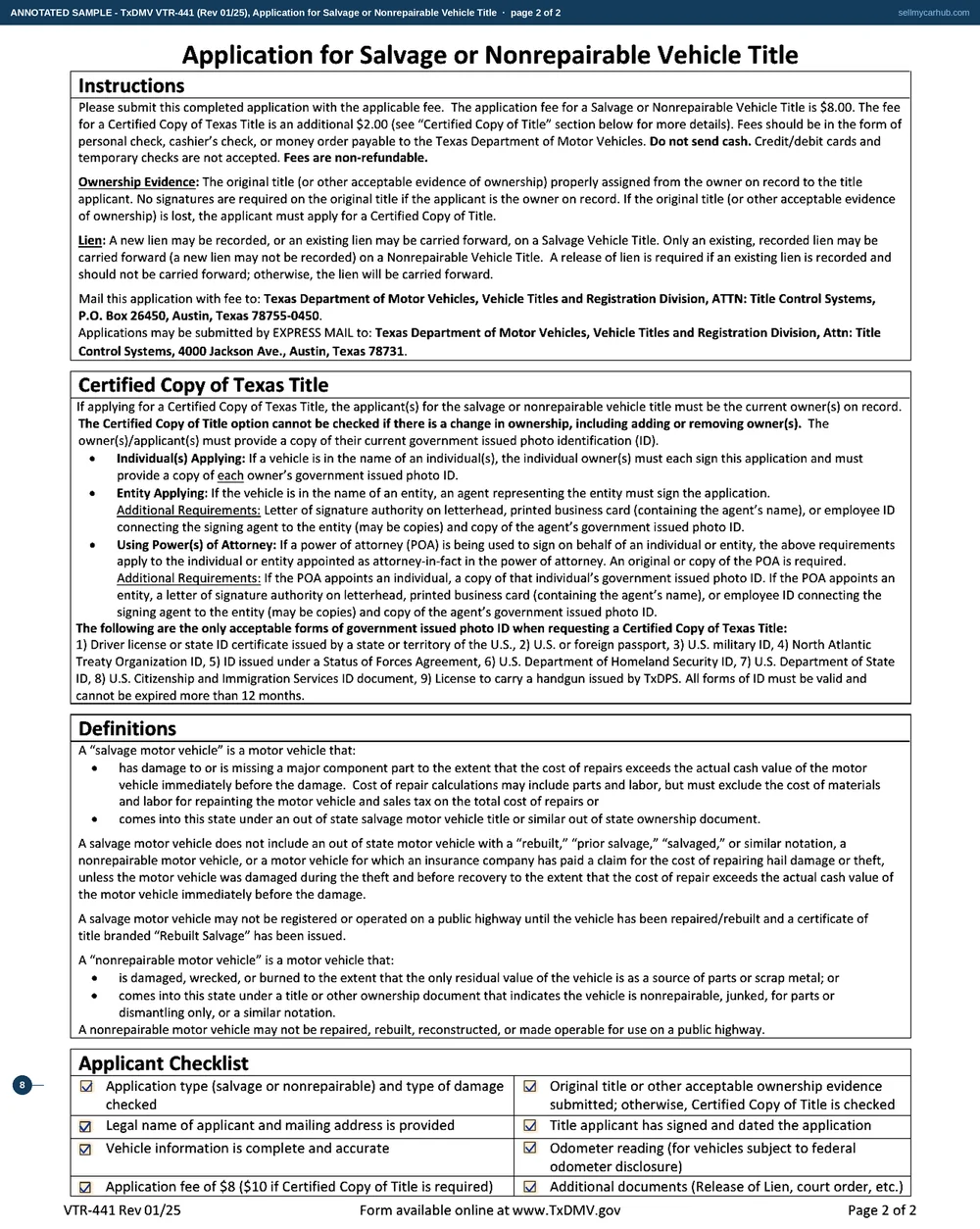
Eight boxes covering the application type and damage, the ownership evidence, your legal name and address, your signature and date, the vehicle information, the odometer reading, the fee, and any additional documents.
Watch out: Page two is otherwise all instructions and definitions, which is exactly why the checklist at the bottom of it gets skipped. It is the only part of that page you write on.
| On the form | What to put in it |
|---|---|
| Application type | Salvage Vehicle Title or Nonrepairable Vehicle Title, $8.00 either way. A third box adds a certified copy of Texas title for another $2.00, but only where the vehicle was last titled in Texas, the title is lost or destroyed, and there is no change of ownership. |
| Vehicle information | VIN, year, make, body style, model, title or document number, the state that issued the surrendered title, and the plate state and number. |
| Odometer reading | No tenths, with the same three tick boxes the 130-U uses: Exempt, Not Actual, Exceeds Mechanical Limits. |
| Type of damage | Accident or collision, flood damage, or other with a written specification. Flood is a separate box because Texas treats flood history differently. |
| Applicant information | Name, address, and an optional email and phone. Room for a second applicant. |
| Lien information | Three tick boxes, and they are not interchangeable: No lien, Carry forward existing lien, or Record new lien - and that last one is marked on Salvage Vehicle Title Only. A new lien cannot be recorded against a nonrepairable certificate. |
| Last titled outside of Texas | Only where an insurance company is applying. It asks what connects the vehicle to Texas: the damage happened here, the theft happened here, the recovery happened here, or the owner it was acquired from is a Texas resident. |
| Certification and signatures | Applicant and any additional applicant sign and print, under the third-degree-felony line. |
Every line here was read off VTR-441 (Rev 01/25) itself — the PDF is here — and off the Texas Department of Motor Vehicles pages. This is plain-language help with a form, not legal advice, and where our wording and the agency's differ, theirs governs.
Kept a car your insurer totaled after hail? Our page explains why a hail-totaled car can't be driven to the sale in Dallas, and when its registration stops counting.
Back to all Texas seller paperwork, or what selling a car in Texas involves.