Sell My Car Hub

How to fill out Michigan TR-12

One application, two very different outcomes, decided by a single percentage. A vehicle whose estimated cost of repair is 75% or greater but less than 91% of its pre-damaged value gets a salvage title and can be rebuilt; at 91% or greater it gets a scrap title and can never be registered again. You, your insurer or a dealer can apply.
Written against TR-12 (Rev 07/26), issued under Public Act 300 of 1949, as amended. The tax warning on the reverse is heavier than most: penalties can include criminal prosecution or an assessment of up to 175% of the tax due, and it then quotes Public Act 162 of 1980 - a person who violates the section with intent to defraud or evade the payment of tax is guilty of a felony punishable by a fine of not more than $5,000, or imprisonment for not more than five years, or both.

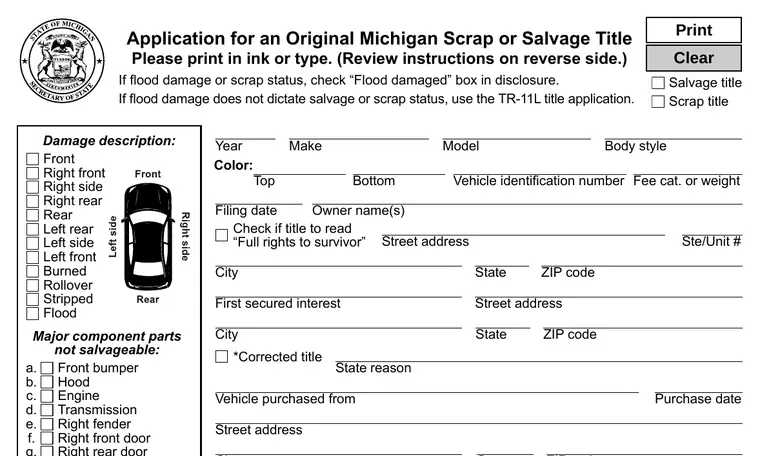
Two documents, and they are not the same thing. Take the blank TR-12 from the michigan.gov copy so you get the revision that is current today.

Filled in

What a completed one looks like

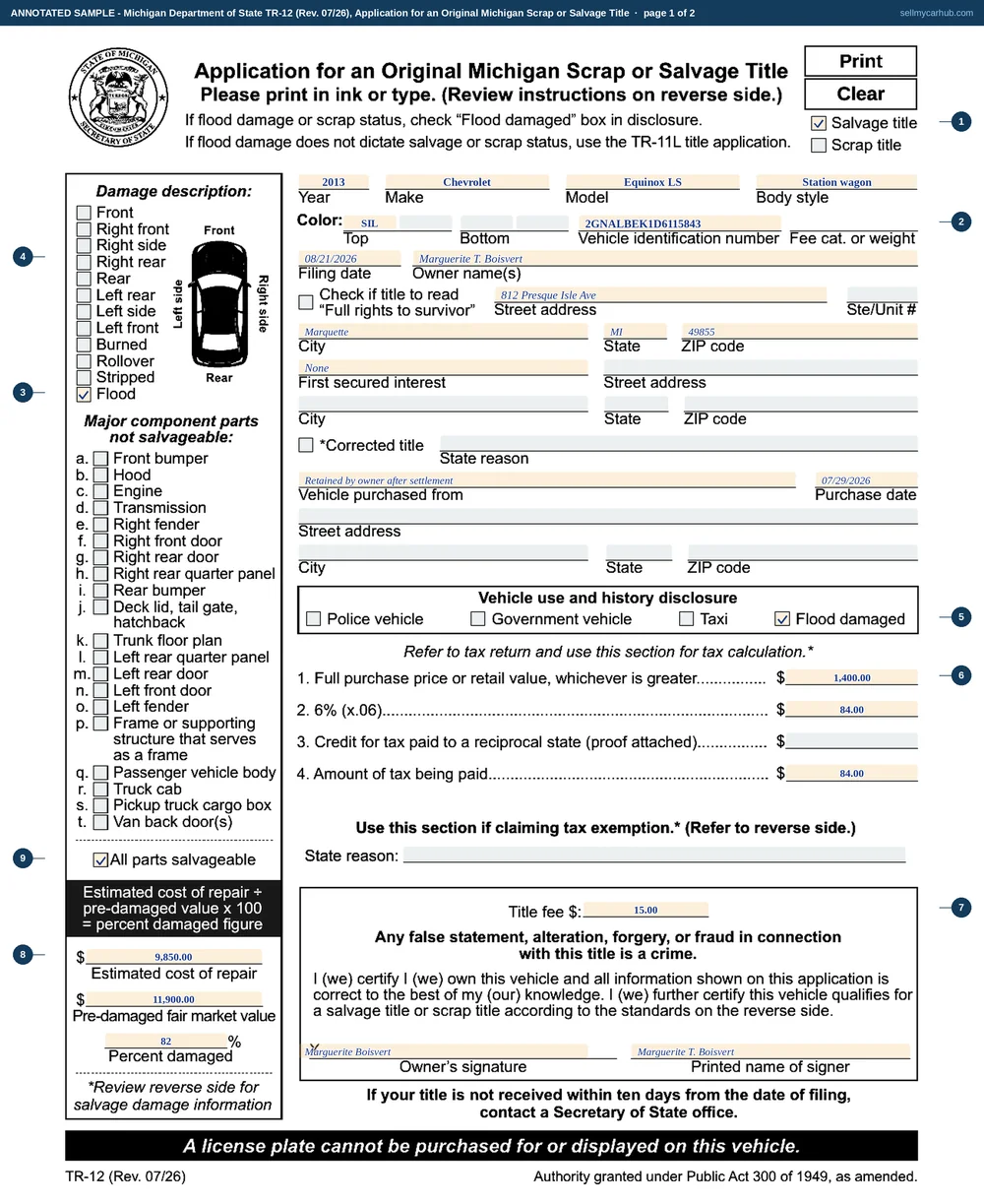
This is all 2 pages of the actual TR-12, rendered from the PDF the Michigan Department of State publishes and completed end to end: letterhead, every field, and the blocks at the foot.

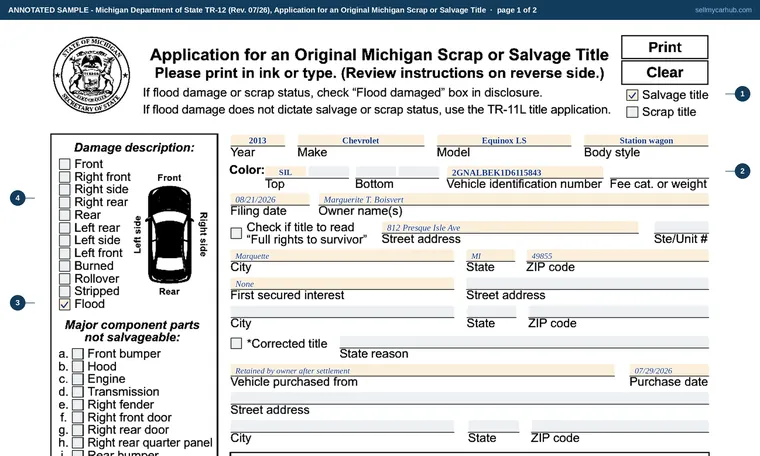
A Michigan TR-12 filled in for a flood-damaged 2013 Chevrolet Equinox LS with VIN 2GNALBEK1D6115843: the Salvage title box ticked, Flood ticked in the damage description, all parts salvageable ticked, owner Marguerite T. Boisvert of Marquette, the vehicle purchased from line reading retained by owner after settlement, a purchase price of 1,400 dollars with 84 dollars of tax, an estimated cost of repair of 9,850 dollars against a pre-damaged value of 11,900 dollars, and 82 percent damaged.
Page 1 of 2. The application. Only one damage tick and one disclosure tick are used - the other eleven damage boxes and all twenty component-part boxes are greyed because a flood-damaged vehicle with every part salvageable needs none of them.
A Michigan TR-12 filled in for a flood-damaged 2013 Chevrolet Equinox LS with VIN 2GNALBEK1D6115843: the Salvage title box ticked, Flood ticked in the damage description, all parts salvageable ticked, owner Marguerite T. Boisvert of Marquette, the vehicle purchased from line reading retained by owner after settlement, a purchase price of 1,400 dollars with 84 dollars of tax, an estimated cost of repair of 9,850 dollars against a pre-damaged value of 11,900 dollars, and 82 percent damaged.
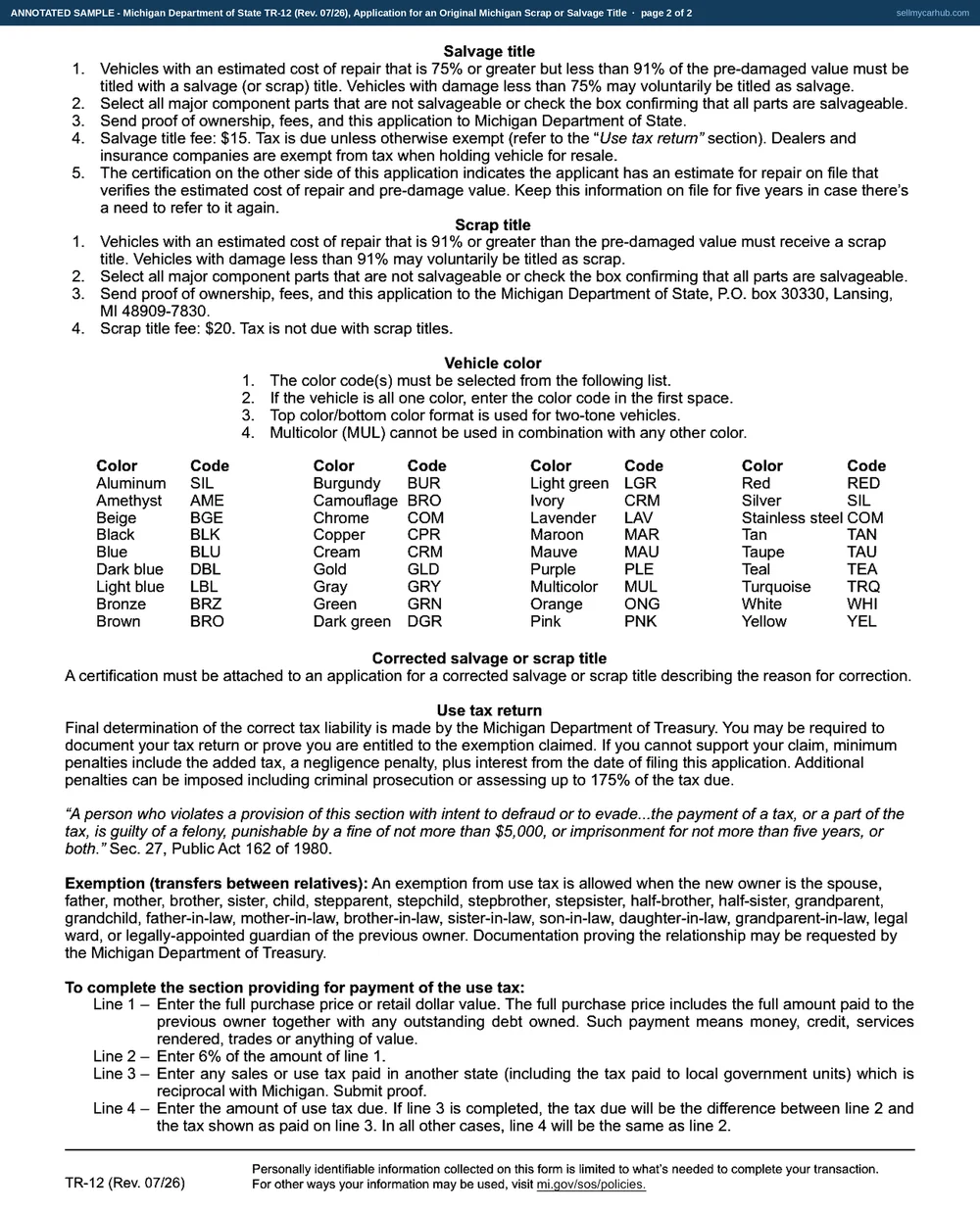
Page 2 of 2. The reverse, untouched. It carries the salvage and scrap definitions, the two different fees, the two different addresses, the colour code table and the use tax return instructions.
Field by field

Every line, in the order you meet it

  1. 1
    You fill this in

    Salvage title or Scrap title

    Two ticks at the top right of the form.

    Watch out: The percentage at the foot decides which. Below 75% you may title it salvage voluntarily; from 75% to under 91% you must; at 91% or greater it is scrap and the vehicle is finished as a road vehicle.

  2. 2
    You fill this in

    Vehicle identification number

    The VIN, on the second row beside the colour codes and the fee category.

    Watch out: The colour codes come from a printed table on the reverse. One colour goes in the first space only, and multicolor cannot be combined with anything else.

  3. 3
    You fill this in

    Damage description

    Twelve ticks down the left margin, beside a diagram of a car.

    Watch out: Tick what is true, not what is convenient. This list and the percentage at the foot are read together, and a flood tick with no water damage in the estimate is a contradiction on a form signed under a criminal certification.

  4. 4
    You fill this in

    Owner name(s) and address

    Your name, street address, city, state and ZIP, with a filing date above them.

    Watch out: There is a survivorship tick beside it if the title is to read Full rights to survivor. It is easy to miss because it sits in the margin rather than on a line of its own.

  5. 5
    You fill this in

    Flood damaged, in the disclosure row

    One of four ticks in the vehicle use and history disclosure - police vehicle, government vehicle, taxi, flood damaged.

    Watch out: The instruction at the head of the form is explicit: if flood damage or scrap status, check the flood damaged box in disclosure. It is a separate tick from the flood box in the damage description.

  6. 6
    You fill this in

    Full purchase price or retail value, whichever is greater

    Line 1 of the tax calculation, with 6% of it on line 2.

    Watch out: On a settlement where you bought the wreck back from your insurer, this is the buy-back figure. Dealers and insurance companies holding a vehicle for resale are exempt from the tax; an owner is not.

  7. 7
    You fill this in

    Title fee

    One box beside the certification block.

    Watch out: $15 for a salvage title, $20 for a scrap title. The reverse prints them as two separate figures because the two applications go to two different addresses.

  8. 8
    You fill this in

    Estimated cost of repair and pre-damaged fair market value

    Two dollar boxes at the foot left, with the percentage between them.

    Watch out: Keep the estimate. The reverse says the certification indicates you have one on file verifying both numbers, and that it must be kept for five years in case anyone needs to look at it again.

  9. 9
    You fill this in

    All parts salvageable

    A single tick beneath the twenty lettered component boxes.

    Watch out: Use it instead of the twenty when nothing structural is gone. Ticking it on a vehicle with a missing engine is the sort of contradiction the certification above the signature is about.

At a glance

What goes where

On the formWhat to put in it
Salvage title or Scrap titleTwo tick boxes at the top right, and the instruction beside them: if flood damage does not dictate salvage or scrap status, use the TR-11L title application instead.
Damage descriptionTwelve ticks down the left margin - front, right front, right side, right rear, rear, left rear, left side, left front, burned, rollover, stripped, flood - beside a diagram of a car.
Major component parts not salvageableTwenty lettered ticks, a to t, from front bumper and hood through frame, passenger vehicle body, truck cab and pickup truck cargo box - or a single box confirming that all parts are salvageable.
Vehicle and ownerYear, make, model, body style, colour codes, VIN, fee category or weight, filing date, owner name, street address, city, state and ZIP, and a survivorship tick.
First secured interestName and address of a lender, if one is still recorded.
Corrected titleA tick and a state reason line. The reverse says a certification has to be attached to an application for a corrected salvage or scrap title describing the reason for correction.
Vehicle purchased from, and purchase dateTwo boxes and an address block. On an insurance settlement this is where the vehicle came back from.
Vehicle use and history disclosureFour ticks: police vehicle, government vehicle, taxi, flood damaged.
Tax calculationFour numbered lines: full purchase price or retail value whichever is greater, 6% of it, credit for tax paid to a reciprocal state, and the amount of tax being paid.
Percent damagedThree boxes at the foot left - estimated cost of repair, pre-damaged fair market value, and the percentage the first is of the second. That number is what decides salvage or scrap.
Owner's certificationA signature and printed name, under a printed line: any false statement, alteration, forgery, or fraud in connection with this title is a crime.

What gets this one rejected

Rules that decide whether it is accepted

Every line here was read off TR-12 (Rev 07/26) itself — the PDF is here — and off the Michigan Department of State pages. This is plain-language help with a form, not legal advice, and where our wording and the agency's differ, theirs governs.

Back to all Michigan seller paperwork, or what selling a car in Michigan involves.

Want the paperwork handled instead?

Get My Instant Offer → Online · about 2 minutes · free

Or send the details — we'll come to you

Salvage, scrap or somewhere in between - we buy vehicles in all three states and the title status does not change whether we are interested.

or call/text (877) 405-1808