The way back from a salvage title. Once a salvage vehicle has been repaired it cannot be plated again until a specially trained police officer - a salvage vehicle inspector - has verified where the parts came from and that the vehicle meets Michigan's equipment and safety requirements. This is the application for that inspection, and it is four parts filled in by four different people.
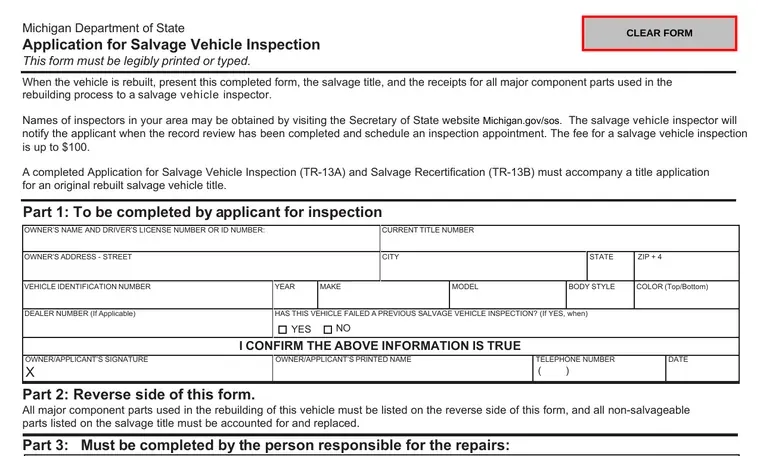
Written against TR-13A (07/2023), issued under MCL 257.217c, under Public Act 300 of 1949. The title you end up with is branded. Passing the inspection gets you a certificate carrying the legend REBUILT SALVAGE, which stays on that vehicle's record for every future owner - the department's own explanation is that it alerts them the vehicle was once classified as totaled by an insurance company.
Two documents, and they are not the same thing. Take the blank TR-13A from the michigan.gov copy so you get the revision that is current today.
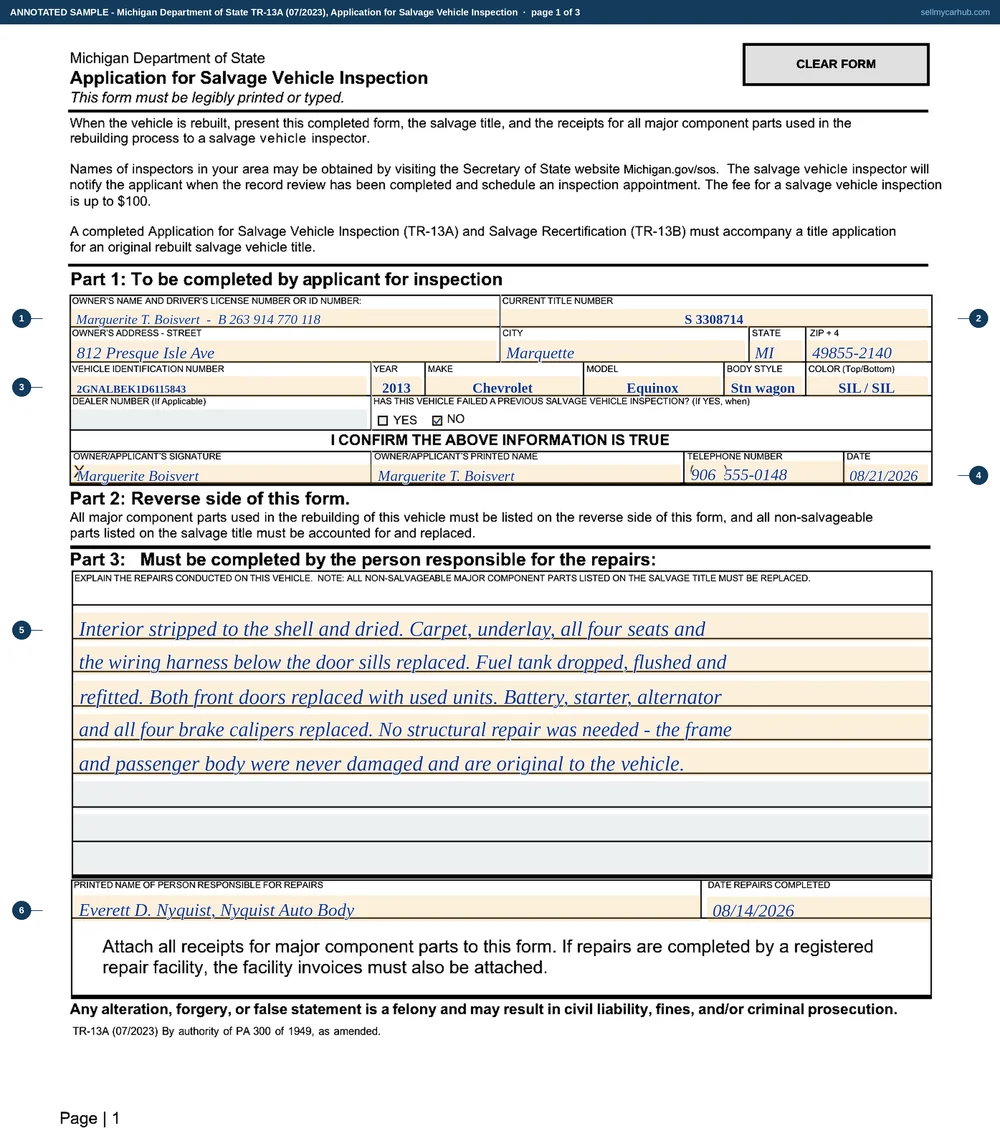
This is all 3 pages of the actual TR-13A, rendered from the PDF the Michigan Department of State publishes and completed end to end: letterhead, every field, and the blocks at the foot.
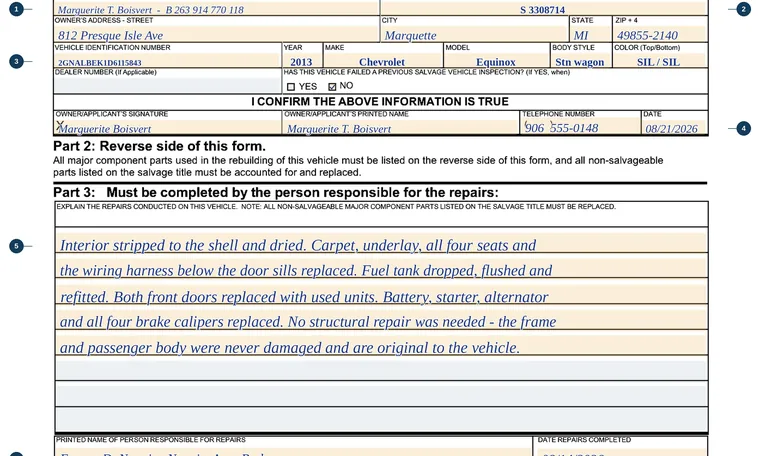
The first box of Part 1, which takes both in one line.
Watch out: Part 1 is the only part of this form the vehicle's owner completes. Parts 3 and 4 belong to the repairer and to a certified mechanic.
The number from the salvage title, top right.
Watch out: The salvage title itself has to be presented at the inspection, so the number here should match the document in your hand.
The VIN, with year, make, model, body style and colour across the same row.
Watch out: Colour is asked for as top and bottom, the same convention the salvage application uses. A single-colour vehicle repeats the code.
The confirmation row at the foot of Part 1, with the signature rule to its left.
Watch out: The line above it says I confirm the above information is true, and the foot of the page adds that any alteration, forgery, or false statement is a felony.
Eight ruled lines in Part 3, completed by the person responsible for the repairs.
Watch out: If a major component part was repaired rather than replaced, the printed instruction is to explain that specifically. Vague descriptions send an inspector looking for the parts themselves.
Their name and the date repairs were completed, closing Part 3.
Watch out: This may be you if you did the work yourself, but it is a separate declaration from the applicant's above it and it is signed separately.
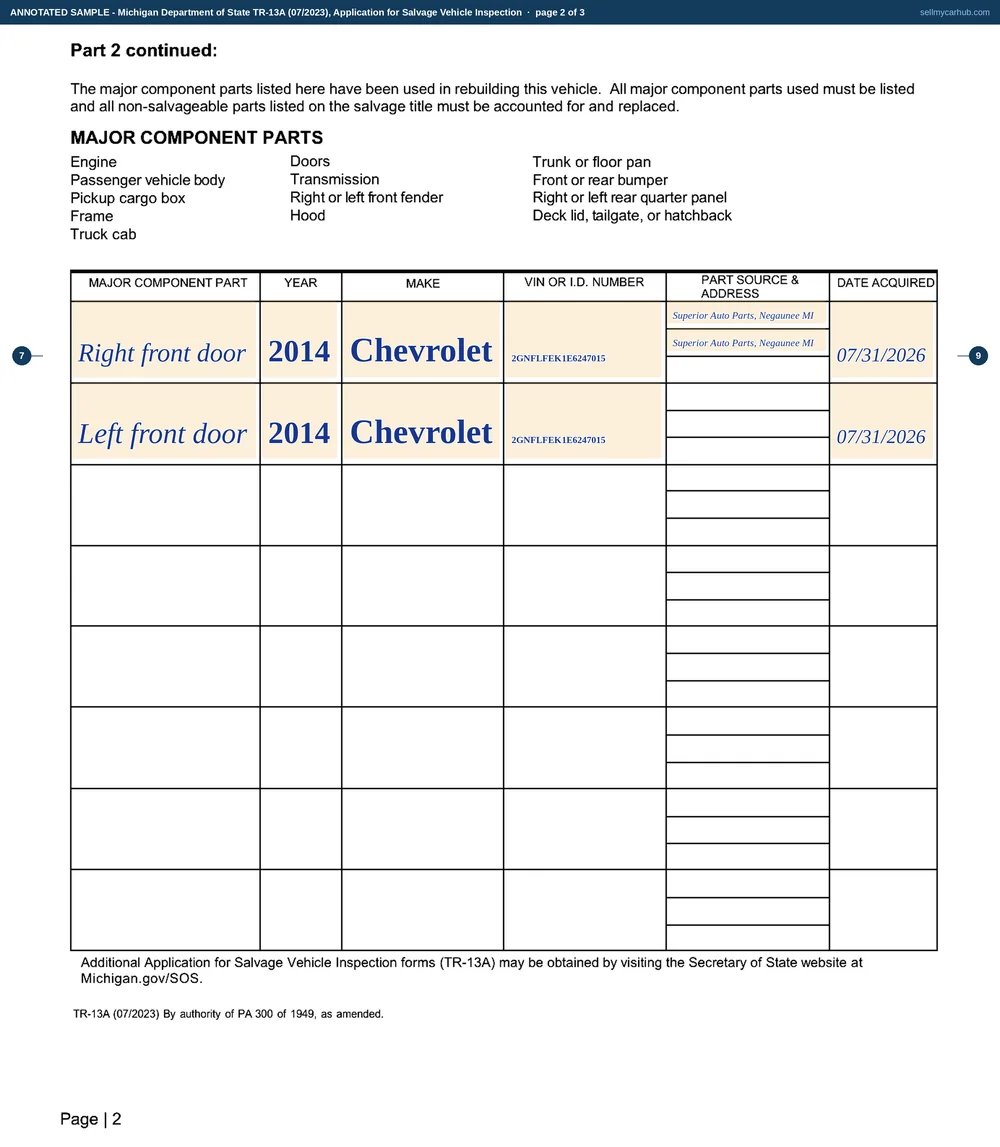
The first column of the parts table in Part 2.
Watch out: The list of what counts is printed above the table - engine, transmission, doors, frame, truck cab, quarter panels and the rest. Anything on that list has to appear in this table.
The identification number of the donor vehicle or component.
Watch out: This is what an inspector cross-checks against theft records. A part with no traceable number and no receipt is the commonest reason a rebuild fails at this stage.
The last column of the parts table, beside the part source and address.
Watch out: It has to be consistent with the receipts you attach. A part dated before the vehicle was damaged invites a question you would rather not be asked.
| On the form | What to put in it |
|---|---|
| Part 1: the applicant | Owner's name and driver's licence or ID number, current title number, address, city, state and ZIP + 4, then the VIN, year, make, model, body style and colour top and bottom. |
| Part 1: previous failures | A yes or no tick asking whether this vehicle has failed a previous salvage vehicle inspection, and if yes, when. |
| Part 1: the confirmation | Owner or applicant's signature and printed name, telephone number and date, under the line I CONFIRM THE ABOVE INFORMATION IS TRUE. |
| Part 2: major component parts | A table on the reverse - major component part, year, make, VIN or ID number, part source and address, date acquired - repeated over twenty-four rows. |
| Part 3: the repairs | Eight ruled lines for whoever did the work to explain the repairs conducted on the vehicle, then their printed name and the date repairs were completed. |
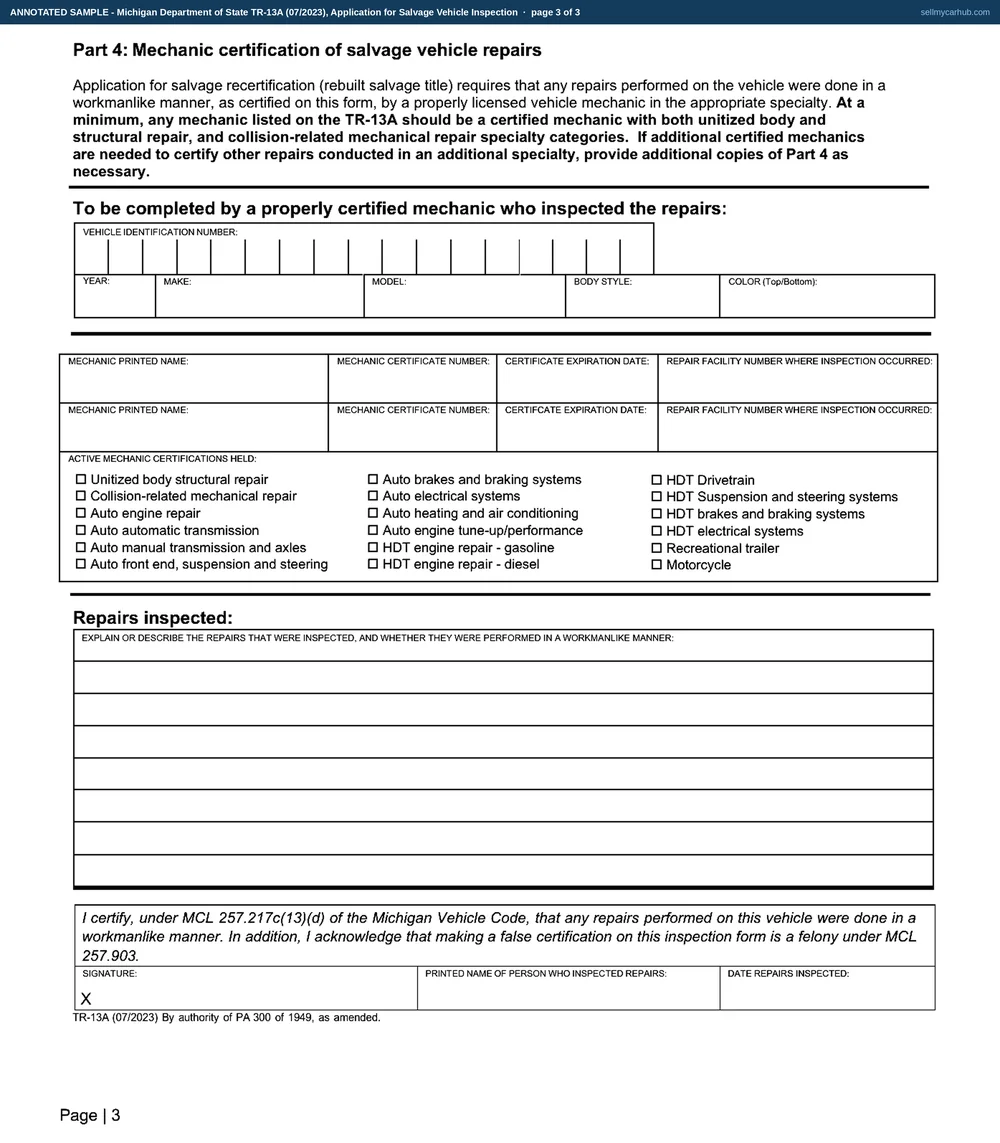
| Part 4: mechanic certification | A separate page for a certified mechanic: the vehicle again, mechanic printed name, certificate number and expiration, repair facility number, a checklist of twenty active mechanic certifications, and a description of the repairs inspected. |
Every line here was read off TR-13A (07/2023) itself — the PDF is here — and off the Michigan Department of State pages. This is plain-language help with a form, not legal advice, and where our wording and the agency's differ, theirs governs.
Back to all Michigan seller paperwork, or what selling a car in Michigan involves.