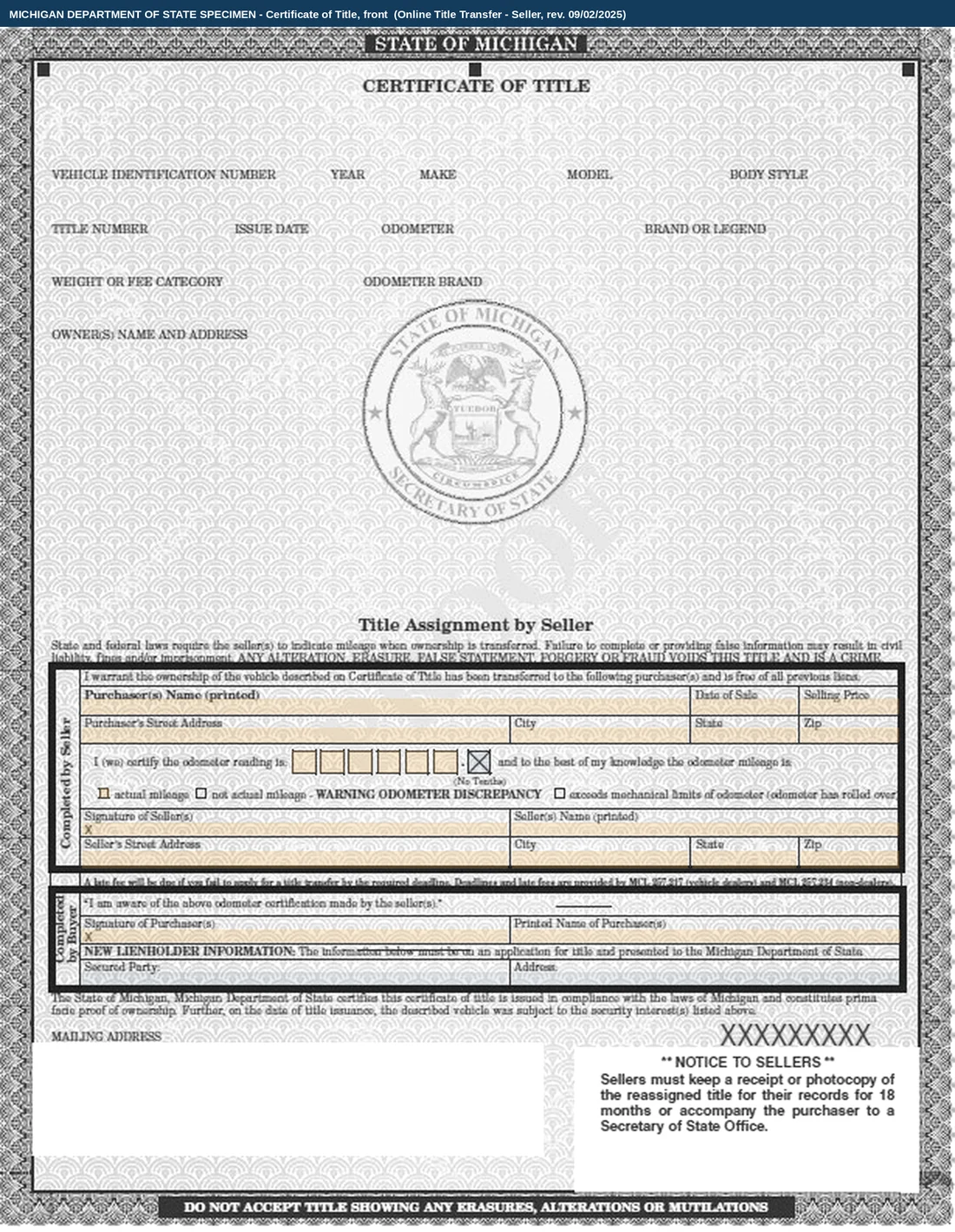
Michigan puts the whole private-party transfer on the front of the certificate, in a block headed Title Assignment by Seller, and a second, smaller block underneath for the buyer. There is no separate application for a private buyer to fill in and nothing to post afterwards - this block is the transaction. Every field below is numbered on the department's own specimen certificate, reproduced further down this page.
Last updated .
Your 7 boxes
As a private seller you complete these and nothing else:
You cannot download a blank Michigan title and there is nothing to print instead - the assignment is on the certificate that came in the post from Lansing. What the department does publish is the specimen below, inside a guide almost nobody opens because its subject is the online transfer. This walkthrough is that specimen, filled in.
ANY ALTERATION, ERASURE, FALSE STATEMENT, FORGERY OR FRAUD VOIDS THIS TITLE AND IS A CRIME.
That line is printed directly above the assignment block, in capitals, on every Michigan certificate. It is why there is no tidy way to fix a slip on a Michigan title: you attach a TR-34 explaining it, or the buyer needs a new certificate.
The department's own specimen
A real Michigan certificate, and the third of it that is yours
This is the Michigan Department of State's own picture of a Michigan Certificate of Title, published inside its seller guide to the online title transfer and watermarked VOID PROOF across the middle. Every field on it is blank and the control number is a row of X's, so no person appears on it anywhere. Amber marks the two blocks a private sale is made in; everything above them was printed in Lansing the day the certificate was issued.
Amber — you write it, in pen
Grey — not yours to fill
Numbered — matches the steps below
Click or tap the picture to open it full size.
Published by the department on page 2 of its Online Title Transfer - Seller guide, rev. 09/02/2025, and again on page 7 of the buyer's guide. Note the notice printed at the foot: sellers must keep a receipt or photocopy of the reassigned title for their records for 18 months or accompany the purchaser to a Secretary of State office. That sentence is the whole of Michigan's release-of-liability regime, and it is printed on the document rather than filed anywhere.
Filled in
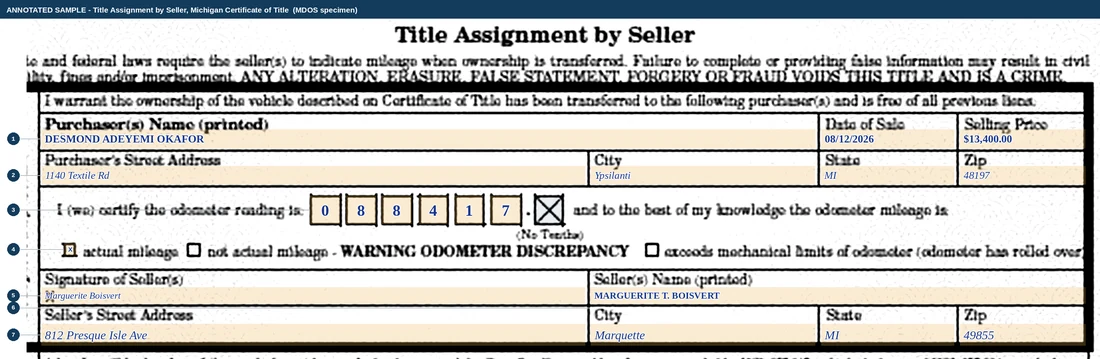
Title Assignment by Seller, completed for one private sale
The same block, enlarged and filled in for a 2017 Jeep Cherokee sold in Marquette to a buyer in Ypsilanti for $13,400 with 88,417 miles on it. Amber is what you write; the greyed cell is the tenths box, which the department has crossed through on the certificate itself.
Click or tap the picture to open it full size.
Two things worth copying. The reading goes in as six digits, one per printed cell, with nothing after the decimal point - the seventh cell is the department's, already crossed. And the actual mileage box is ticked rather than left blank: the printed row offers three, and the certificate does not treat an empty row as a certification.
Click or tap the picture to open it full size.
Directly underneath the seller's block, and much smaller. The buyer signs and prints their name against the odometer acknowledgement; the New Lienholder Information line below is for their lender, not yours, and it is greyed here because this sale was paid for in cash. If a lender does go on that line the department will hold the new title electronically and no paper certificate is printed at all.
Step by step
Every box, in the order you meet it
1
You fill this in
Purchaser(s) Name (printed), Date of Sale, Selling Price
The top row of the assignment carries three boxes, and the two narrow ones on the right are the ones people skip: the date of sale and the selling price.
Watch out: The date of sale starts the buyer's fifteen days to transfer the title - after that a $15 late fee is added - and the selling price is what the buyer's 6% use tax is worked out from. Leave the price blank and the counter values the vehicle instead, which almost never goes the buyer's way.
2
You fill this in
Purchaser's Street Address, City, State, Zip
The buyer's address in four boxes on the second row, printed rather than signed.
Watch out: This is not a formality. The odometer disclosure Michigan requires under MCL 257.233a has to carry the transferee's name and current address, and this row is where the certificate collects it.
3
You fill this in
The odometer reading, six cells and a decimal point
Six printed cells for whole miles, one digit each, then a decimal point and a seventh cell for tenths that the department has already crossed through.
Watch out: Write nothing after the decimal point and nothing in the crossed cell. The department's own warning about this box is that mileage cannot be corrected at a later date - once the buyer's application is in, the reading you wrote is the reading on the record.
4
You fill this in
actual mileage, or one of the other two
Three tick boxes on the line below: actual mileage, not actual mileage with the WARNING ODOMETER DISCREPANCY legend, or exceeds mechanical limits of odometer.
Watch out: Tick one. An untouched row is not a certification, and the middle box is the one to use if the cluster has ever been swapped - a discrepancy disclosed is a nuisance, a discrepancy hidden is a federal offence.
5
You fill this in
Signature of Seller(s)
Your signature, in the left half of the row. Every owner named on the front of the certificate signs here.
Watch out: In ink, and once. There is no crossing out on this document - the line above the block says any alteration or erasure voids the title, and the way back from a slip is a TR-34 attached to the transaction, not a correction.
6
You fill this in
Seller(s) Name (printed)
The same name again, printed, in the right half of the same row.
Watch out: Print it as it appears on the face of the certificate above. A married name on the signature line and a maiden name on the title is a mismatch a clerk has to resolve before anything moves.
7
You fill this in
Seller's Street Address, City, State, Zip
Your own address, on the bottom row of the seller's block.
Watch out: Your current address, not the one printed on the title. If you have moved since the certificate was issued the two will differ, and the current one is what the odometer disclosure asks for.
8
The buyer fills this in
Signature of Purchaser(s)
In the smaller block underneath, against the printed line 'I am aware of the above odometer certification made by the seller(s).'
Watch out: Watch them do it before they drive off. A Michigan title with the seller's half completed and the buyer's half empty is not a finished assignment, and getting a signature afterwards means finding the buyer again.
9
The buyer fills this in
Printed Name of Purchaser(s)
The buyer's name printed beside their signature, in the right half of the same row.
Watch out: Compare it with the licence they showed you and with what you wrote in box 1. Three spellings of the same person is the commonest reason a private Michigan transfer is handed back at the counter.
10
The lienholder fills this in
NEW LIENHOLDER INFORMATION - Secured Party and Address
The last row of the buyer's block, for the buyer's lender if they are financing the car.
Watch out: Nothing here is yours, and a private cash sale leaves it empty. If the buyer does fill it in, the title they get will be electronic - the department holds it until that loan is paid off, and no paper certificate is printed.
Before the pen
Before you sign the front of the sheet
Six habits, and the first one is the one that voids Michigan certificates: there is no second attempt at a box on this document.
Ink, and no alterations
The TR-128 puts it plainly for the whole Michigan set: all information must be completed in ink, and any alterations void this form.
No correction fluid, no correction tape, no erasing
The Vehicle Dealer Manual's rule for fixing an assignment is a single line through the wrong entry, the right entry beside it, and a TR-34 attached explaining it. Everything else is an alteration.
Whole miles, no tenths
Six printed cells and a crossed seventh. The reading cannot be corrected once the application has been submitted.
Both halves of your own name
Signature in one box and printed name in the next. Michigan asks for both on the title, on the odometer statement and on the salvage application.
The original, never a copy
The department's instruction to buyers is that the seller must give them the original vehicle title. A photocopy is not an ownership document in Michigan and a colour copy is one only for a licensed dealer with a registered inventory lender.
Photograph it before you hand it over
MCL 257.240 accepts a photocopy of the reassigned title as your record of the sale. The cheapest eighteen months of protection available anywhere in this state costs one photograph.
Three things said confidently about selling a car in Michigan that are wrong, and each of them costs the seller either the plate, the protection or a wasted trip to a branch office. Every correction below links the Michigan source it comes from.
"Leave the plate on the car for the buyer."
That is California's rule and it is the reverse of Michigan's. The Secretary of State's instruction to a seller is that you must remove the license plate before the buyer takes possession of the vehicle, and its answer to the buyer is blunter still: do not use the seller's license plate on the vehicle while driving it home, the seller keeps their license plate. The single exception is a transfer to an immediate family member.
"File a release of liability so the car is off your name."
There is nothing to file. Michigan publishes no notice of transfer and no release of liability for a motor vehicle - checked against all 316 documents in the department's own forms index. MCL 257.240 replaces it with two alternatives: accompany the purchaser to a branch office, or maintain a record of the sale for not less than 18 months. Do neither and the statute presumes you are still the last titled owner, and liable for towing and daily storage on an abandoned vehicle.
"Get a Michigan bill of sale from the Secretary of State."
The only bill of sale the department publishes is the TR-207, and it says what it is for on its own face: a non-titled trailer, a non-titled watercraft or a snowmobile, chosen from three tick boxes. There is no state bill of sale for a car, because the assignment on the front of the title is the bill of sale - and MCL 257.240 tells you what a private record of the sale has to contain instead.
The assignment on a Michigan title asks for two signatures and two printed names, in four separate boxes, and a counter clerk notices which of the four is empty before you do:
Every owner shown on the face
All owners whose names appear on the front of the title have to sign the assignment. Two names on the certificate means two signatures before it transfers.
Signature of Seller(s), then the printed name beside it
Michigan asks for both, in adjacent boxes on the same row, and a signature with no printed name beside it is an incomplete assignment.
The seller's street address, city, state and zip
A row of its own underneath the signatures. It is not decoration - the odometer disclosure required by MCL 257.233a has to carry the transferor's name and current address.
Signature of Purchaser(s) and the printed name
In the buyer's block, under the line 'I am aware of the above odometer certification made by the seller(s).' Theirs, not yours.
An agent, if an owner genuinely cannot sign
The TR-128 appoints one, and it will not appoint the same person to sign as both seller and buyer where the vehicle needs an odometer disclosure.
The lienholder, if one is still recorded
Either by completing the termination statement on the title, or by a separate signed statement or letterhead letter carrying the VIN. The seller does not sign that on their behalf.
Once it is signed
Signing is not the end of it in Michigan, but what is left is short. The plate comes off before the buyer drives away, and the only thing standing between you and a car you no longer own is a record of the sale you keep yourself for eighteen months.