The separate odometer disclosure, for when the certificate has no room for one. Michigan's own instruction is that the reading goes on the title; this is what you use when the title has no space provided, when the title is missing and a self-certification is going in instead, or when a lease is being bought out.
Written against BDVR-108 (Rev 08/26), issued under Section 233a of the Michigan Vehicle Code and 49 CFR part 580. Anything built in the 2011 model year or later is not exempt from disclosure until twenty years after 1 January of that model year, so a 2017 has to be disclosed until 2037. The ten-year rule people remember applies only to vehicles from the 2010 model year and earlier.
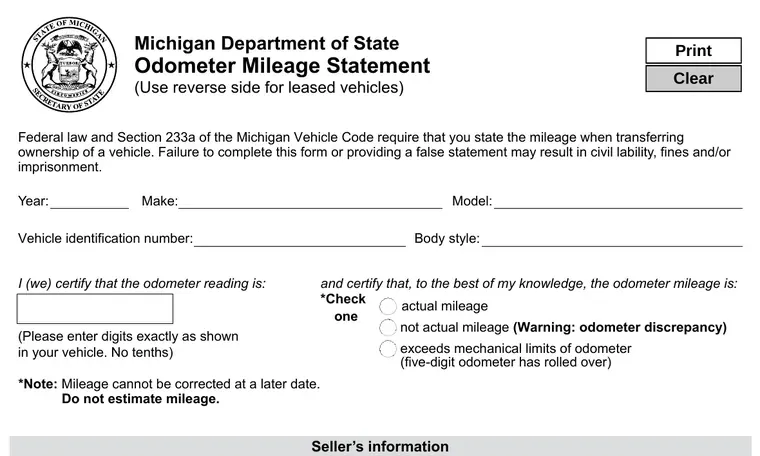
Two documents, and they are not the same thing. Take the blank BDVR-108 from the michigan.gov copy so you get the revision that is current today.
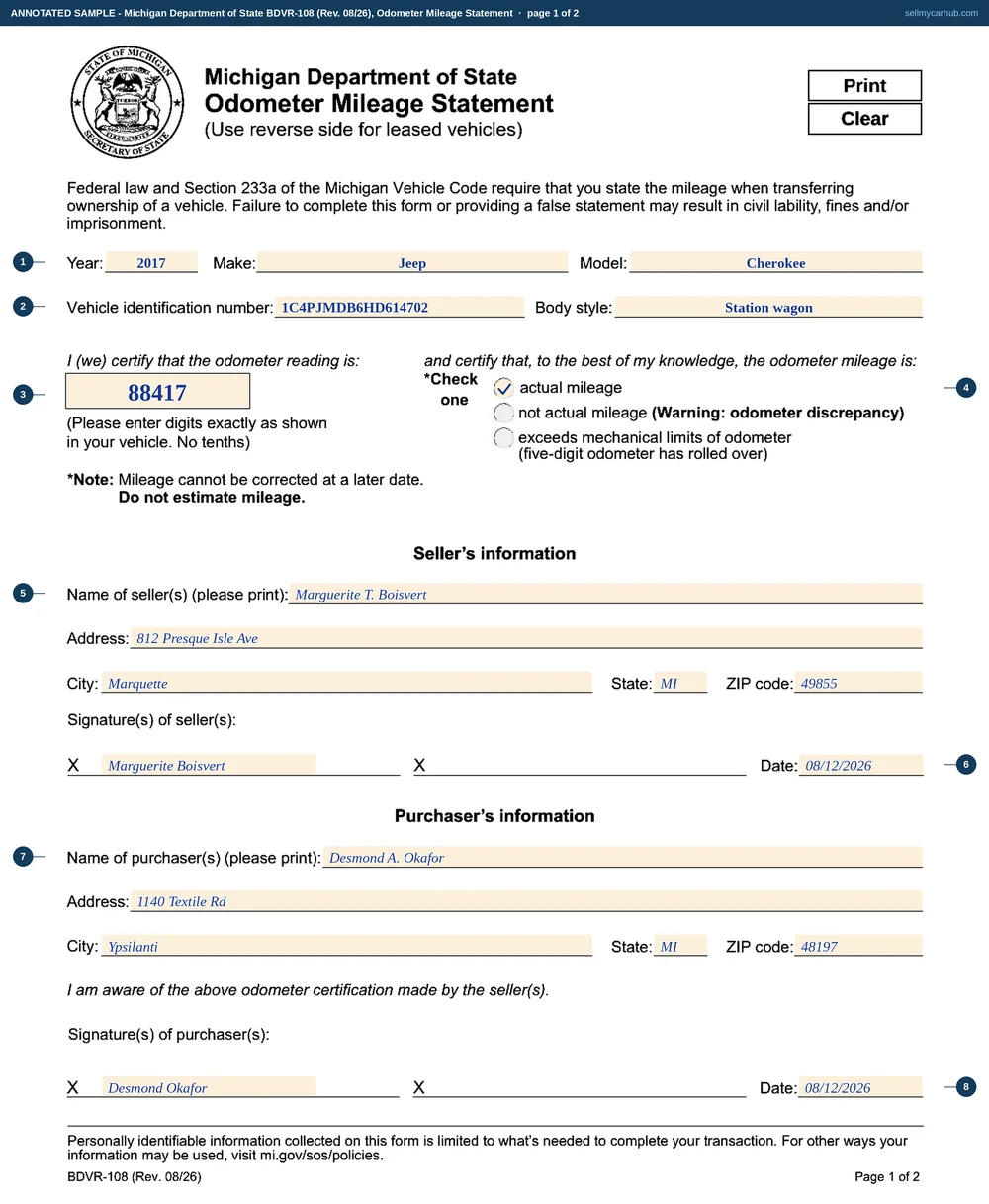
This is all 2 pages of the actual BDVR-108, rendered from the PDF the Michigan Department of State publishes and completed end to end: letterhead, every field, and the blocks at the foot.
The vehicle, across the top row.
Watch out: Copy it from the title. This statement gets stapled to a transaction and read alongside a certificate, and the two have to describe the same car.
The VIN, with body style in the box beside it.
Watch out: Seventeen characters and no spaces. Federal law requires the disclosure to identify the vehicle, and the VIN is what does that.
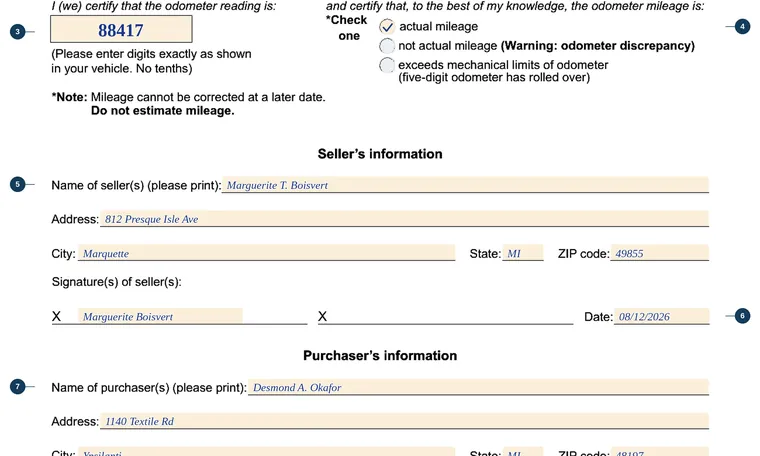
The reading, in whole miles, in the tall box on the left.
Watch out: Digits exactly as shown in the vehicle, and no tenths. If your cluster shows a decimal, it does not come across to this form.
One of three: actual mileage, not actual mileage, or exceeds mechanical limits of odometer.
Watch out: The second is not an admission of guilt, it is a disclosure - use it if the cluster was ever replaced. The third is for a five-digit odometer that has rolled over, which is rarer than people think.
Your printed name, then the address, city, state and ZIP rows underneath it.
Watch out: Every owner on the title signs. The form gives two signature rules on the same line because a vehicle in two names needs both of them.
Your signature on the first rule, with the date of transfer in the box at the end of the row.
Watch out: The date here is the date of sale, and it should match the one on the title assignment to the day.
The buyer's printed name and address, under the heading Purchaser's information.
Watch out: The disclosure has to carry the buyer's current address as well as yours. A post-office box that the seller wrote in for speed is not it.
The buyer signs under the printed line acknowledging your certification, and dates it.
Watch out: Get it before they leave. Chasing an acknowledgement afterwards means chasing the person who has already got the car.
| On the form | What to put in it |
|---|---|
| Year, make, model | Three boxes across the top, describing the vehicle the reading belongs to. |
| Vehicle identification number and body style | The second row. Both are required - the statement is worthless if it cannot be attached to a particular vehicle. |
| I (we) certify that the odometer reading is | One box, with the instruction printed beneath it: please enter digits exactly as shown in your vehicle, no tenths. |
| The three certifications | A radio group, one of which must be chosen: actual mileage; not actual mileage, carrying the printed warning of an odometer discrepancy; or exceeds mechanical limits of odometer, which the form glosses as a five-digit odometer having rolled over. |
| Seller's information | Name of seller or sellers printed, address, city, state and ZIP, then two signature rules side by side and a date - two rules because a vehicle in two names needs two signatures. |
| Purchaser's information | The same block for the buyer, under the printed acknowledgement: I am aware of the above odometer certification made by the seller(s). |
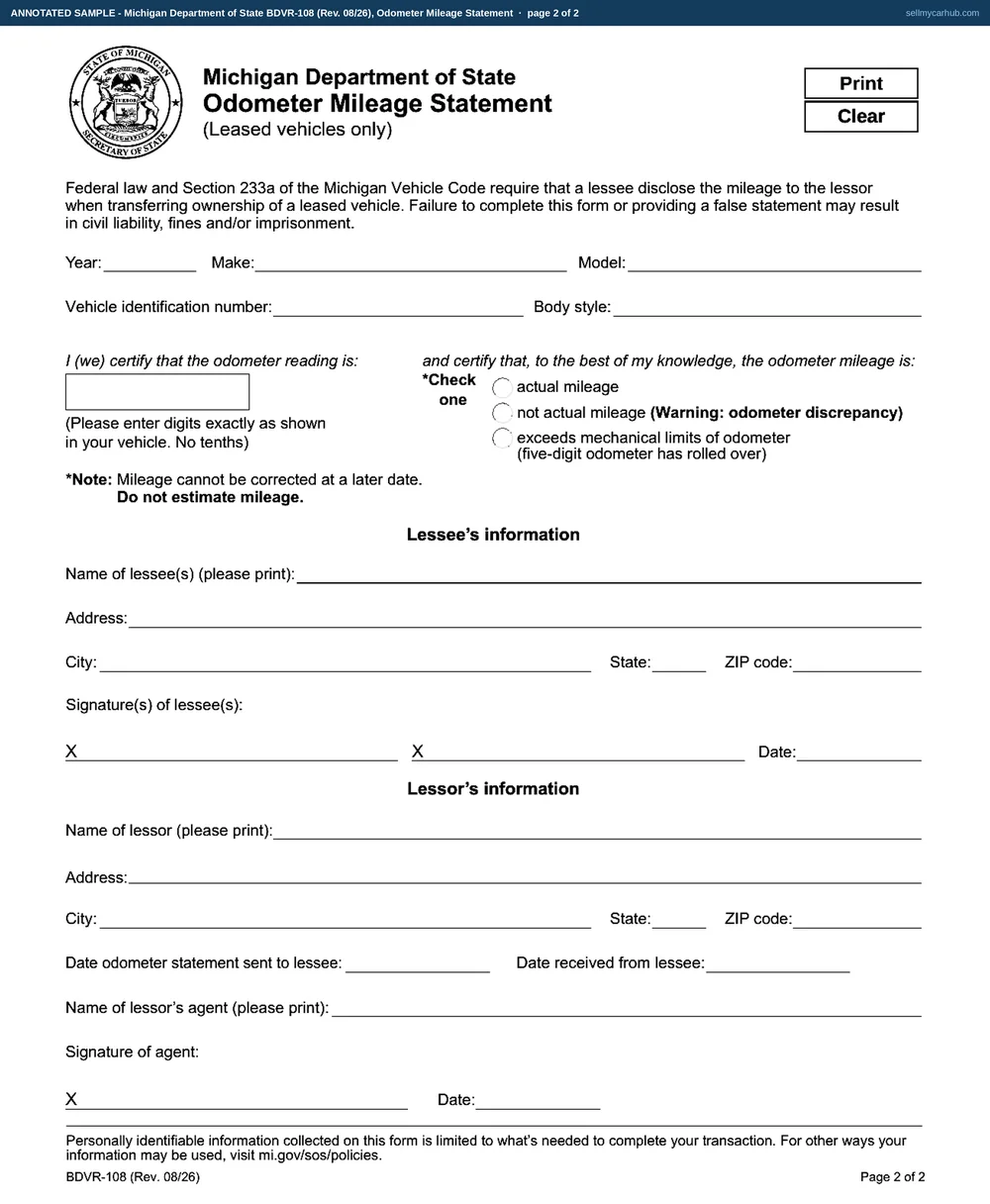
| The reverse side | A second, near-identical page headed leased vehicles only, where the lessee certifies to the lessor and the lessor's agent countersigns. A private seller who fills that page in has filled in the wrong side. |
Every line here was read off BDVR-108 (Rev 08/26) itself — the PDF is here — and off the Michigan Department of State pages. This is plain-language help with a form, not legal advice, and where our wording and the agency's differ, theirs governs.
Back to all Michigan seller paperwork, or what selling a car in Michigan involves.