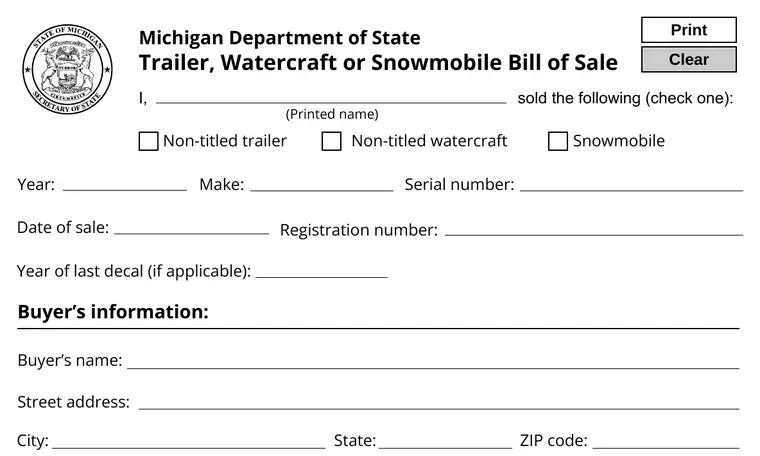
The only bill of sale the Michigan Department of State publishes, and it is not for a car. Three tick boxes across the top of it decide what it can be used for - a non-titled trailer, a non-titled watercraft, or a snowmobile - and a motor vehicle is none of them. It has a page here because half the people searching for a Michigan bill of sale end up on it.
Written against TR-207 (Rev 06/26), issued under Public Act 300 of 1949, as amended. If you found this page searching for a Michigan bill of sale for a vehicle, this is not it and there is not one. Read the certificate-of-title walkthrough instead: on a Michigan title the seller's block does the job a bill of sale does elsewhere.
Two documents, and they are not the same thing. Take the blank TR-207 from the michigan.gov copy so you get the revision that is current today.
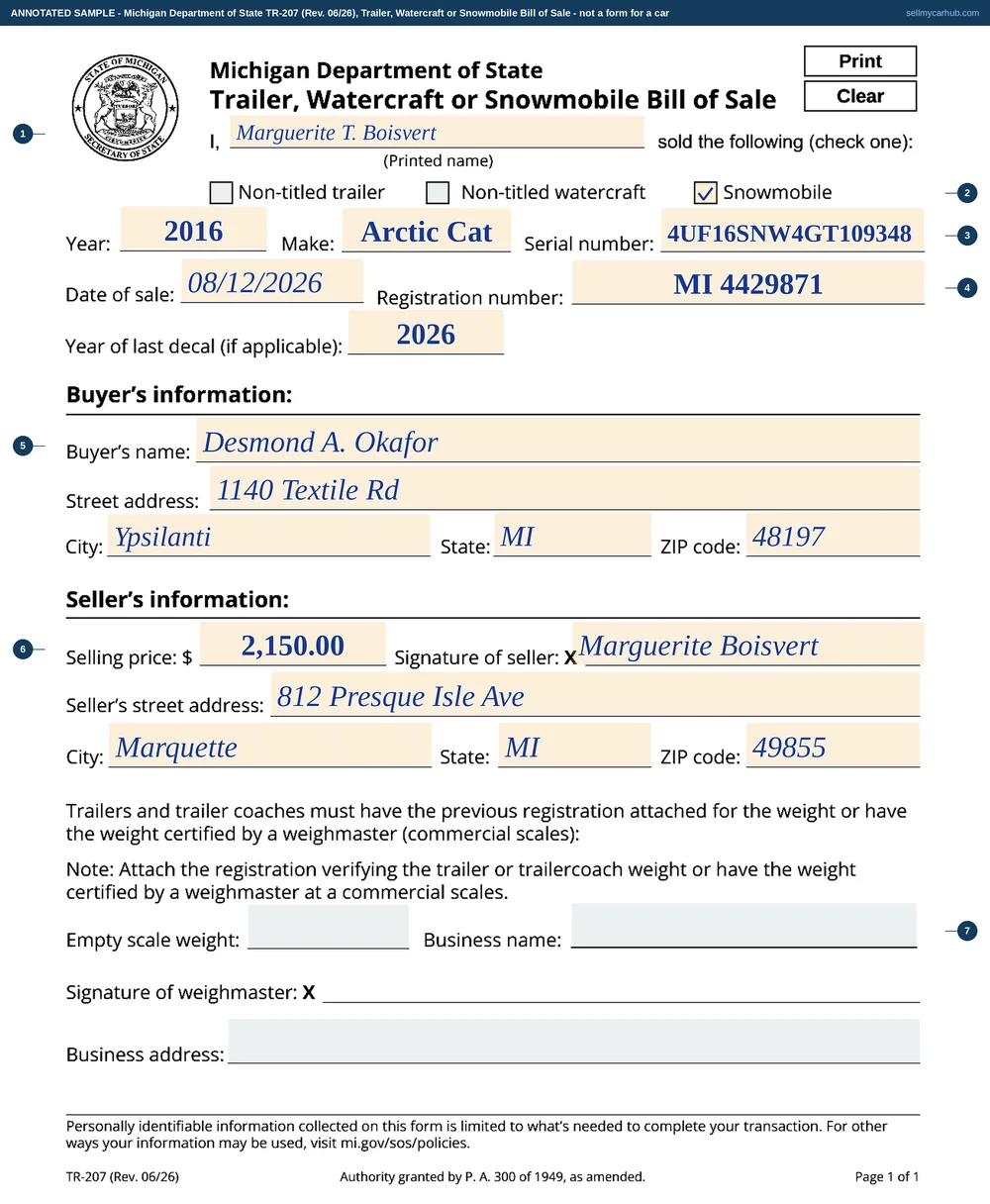
This is the actual TR-207, rendered from the PDF the Michigan Department of State publishes and completed end to end: letterhead, every field, and the blocks at the foot.
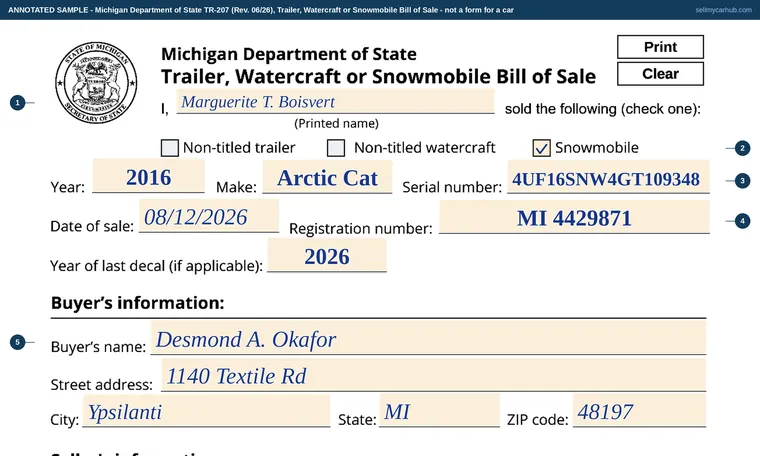
Your name across the head of the form, before anything else.
Watch out: Printed, not signed. Your signature belongs further down, on the selling price row.
Non-titled trailer, non-titled watercraft, or snowmobile.
Watch out: If none of the three describes what you are selling, this is not your form. There is no fourth box and no other bill of sale in the Michigan set.
The serial number of the item, beside its year and make.
Watch out: Not a VIN. These are things Michigan registers without titling, and the serial number stamped on the frame or hull is what identifies them.
The current registration number, with the date of sale in the box to its left.
Watch out: Year of last decal, in the box below, is a snowmobile question - Michigan snowmobile registrations run on a dated decal rather than a plate.
The buyer's name, street address, city, state and ZIP code.
Watch out: Take it off their licence rather than from memory. This document is the buyer's proof of ownership until the department reissues the registration.
The price in one box, your signature on the rule beside it, then your own address underneath.
Watch out: Both halves of the row. A price with no signature beside it is a note, not a bill of sale.
Empty scale weight, business name, signature of weighmaster and business address, at the foot of the form.
Watch out: Only a trailer or trailer coach needs it, and only if the previous registration showing the weight is not attached. Left empty on everything else.
| On the form | What to put in it |
|---|---|
| I, [printed name], sold the following | Your name in one long box across the head of the form, with the three tick boxes immediately underneath. |
| Check one | Non-titled trailer, non-titled watercraft, or snowmobile. The word non-titled is the whole point: these are the things Michigan registers without issuing a certificate of title. |
| Year, make, serial number | The item, on the row beneath. A serial number rather than a VIN, because none of these three carry one. |
| Date of sale and registration number | The two boxes that make the document useful, followed by year of last decal if applicable - a snowmobile question, since Michigan snowmobiles carry a dated decal. |
| Buyer's information | Name, street address, city, state and ZIP code. |
| Seller's information | Selling price and your signature on one row, then your street address, city, state and ZIP underneath. |
| The weighmaster block | The foot of the form, and only for a trailer or trailer coach: empty scale weight, business name, signature of weighmaster and business address. Michigan registers trailers by weight, so it either wants the previous registration attached or a commercial scale to certify it. |
Every line here was read off TR-207 (Rev 06/26) itself — the PDF is here — and off the Michigan Department of State pages. This is plain-language help with a form, not legal advice, and where our wording and the agency's differ, theirs governs.
Back to all Michigan seller paperwork, or what selling a car in Michigan involves.